

Views: 286 Author: Princee Lee Publish Time: 03-13-2026 Origin: Princee Lee


Content Menu
● The Evolution of Modern Everyday Carry (EDC)
● Why Aluminum Alloy is the Superior Choice for Card Protection
>> Durability and Structural Integrity
>> The Science of Anodization and Aesthetics
● The Integration of Smart Tracking Technology
>> Never Lose Your Wallet Again
>> The Power of Global Crowdsourced Networks
>> Audible Alerts and Separation Notifications
● Advanced Security in a Digital Age
>> RFID Blocking as a Standard Feature
>> Physical Protection and Privacy
● Functional Design and Ergonomics
>> Balancing Capacity and Size
● Lifestyle and Professional Use Cases
>> Solar Charging and Kinetic Energy
>> Augmented Reality (AR) Tracking
● Sustainability and Environmental Impact
>> Longevity as Sustainability
● Related Questions and Answers
The concept of the wallet has undergone a radical transformation over the past decade. For centuries, the traditional bifold or trifold leather wallet was the standard, a bulky receptacle designed to hold paper currency, coins, and eventually, a growing stack of plastic cards. However, as the global economy shifts toward a cashless society, the requirements for a personal wallet have changed. Modern consumers prioritize minimalism, security, and technological integration. This shift has given rise to the Aluminum Alloy Card Holder with Built-in Tracker, a sophisticated tool that blends material science with digital connectivity to solve the age-old problem of the lost or bulky wallet.
In the contemporary landscape of "Everyday Carry" (EDC), enthusiasts look for items that serve multiple purposes while occupying the smallest possible footprint in their pockets. The move from thick leather to slim metal represents more than just a stylistic choice; it reflects a change in how we interact with our environment. We no longer need to carry dozens of receipts or loose change. Instead, we need quick access to our primary credit cards, identification, and a way to ensure these high-value items are never truly lost.
When designing a high-performance card holder, the choice of material is the most critical factor. Aluminum alloy has emerged as the industry standard for premium card holders for several compelling reasons.
Aluminum alloys, particularly those in the 6000 series (often used in aerospace and automotive applications), offer an incredible strength-to-weight ratio. Unlike leather, which stretches, cracks, and fades over time, aluminum maintains its structural integrity for years. A card holder made from this material can withstand being sat on, dropped on concrete, or crushed in a bag without deforming. This rigidity is essential for protecting the delicate EMV chips and magnetic strips on modern credit cards, which can be rendered useless if the card is bent or flexed too often.
One of the most appealing aspects of aluminum is the ability to treat its surface through a process called anodization. This electrochemical process increases the thickness of the natural oxide layer on the surface of the metal. It doesn't just coat the metal like paint; it becomes part of the substrate. This results in a finish that is incredibly hard and resistant to scratches. Furthermore, anodization allows for a wide spectrum of colors, from deep space gray and obsidian black to vibrant blues and reds, providing a premium metallic sheen that leather simply cannot replicate.
Despite its strength, aluminum is remarkably light. For someone looking to reduce the "pocket bulge" and the physical weight of their carry, an aluminum card holder is the perfect solution. It provides the heavy-duty protection of a vault with the weight of a few coins. This makes it ideal for athletes, travelers, and professionals who want to maintain a streamlined silhouette in their tailored clothing.
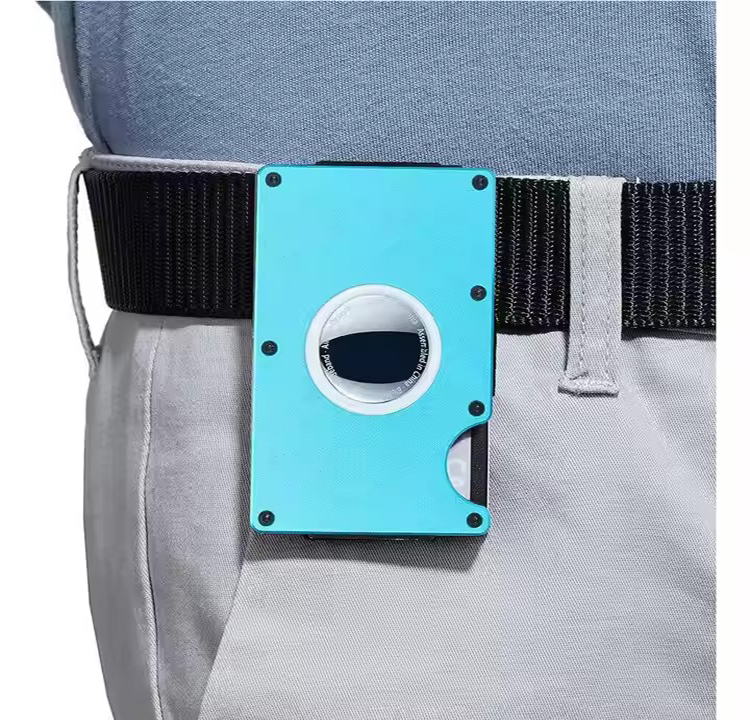
The true innovation in the modern aluminum card holder is the integration of a built-in tracker. Losing a wallet is not just a financial loss; it is a significant administrative burden involving the cancellation of cards, the replacement of government IDs, and the potential for identity theft.
By embedding a tracking chip—often compatible with global networks like Apple's Find My or Google's Find My Device—the card holder becomes a "smart" object. These trackers use Bluetooth Low Energy (BLE) to communicate with a network of millions of devices. If you leave your wallet at a restaurant or it falls out of your pocket in a park, you can open an app on your smartphone and see its exact location on a map.
The effectiveness of a built-in tracker relies on the ecosystem it inhabits. For instance, if the card holder is integrated with the Apple Find My network, it can be detected by any nearby iPhone, iPad, or Mac. These devices securely and anonymously relay the location of your lost item back to you. This means that even if you are miles away from your wallet, as long as someone with a compatible device walks past it, its location will be updated. This "crowdsourced" search power has revolutionized the recovery of lost items.
Beyond just finding a lost item, these smart card holders offer proactive features. Most include a small, high-pitch speaker that can be triggered from your phone, allowing you to find your wallet under a couch cushion or in a laundry pile. Furthermore, "Separation Alerts" notify your phone the moment the Bluetooth connection breaks. If you walk out of a cafe and leave your wallet on the table, your phone will buzz before you've even reached the end of the block.
As the world has moved to contactless payments, a new form of theft has emerged: RFID skimming. This involves a thief using a handheld scanner to read the data from your credit cards without ever touching your wallet.
Aluminum is naturally conductive, which makes it an excellent material for creating a "Faraday Cage." An aluminum alloy card holder acts as a shield, blocking the electromagnetic signals required for RFID and NFC (Near Field Communication) transactions. While your cards are inside the metal housing, they are invisible to electronic pickpockets. This provides a layer of digital security that is impossible to achieve with a standard leather wallet without adding specialized (and often bulky) shielding inserts.
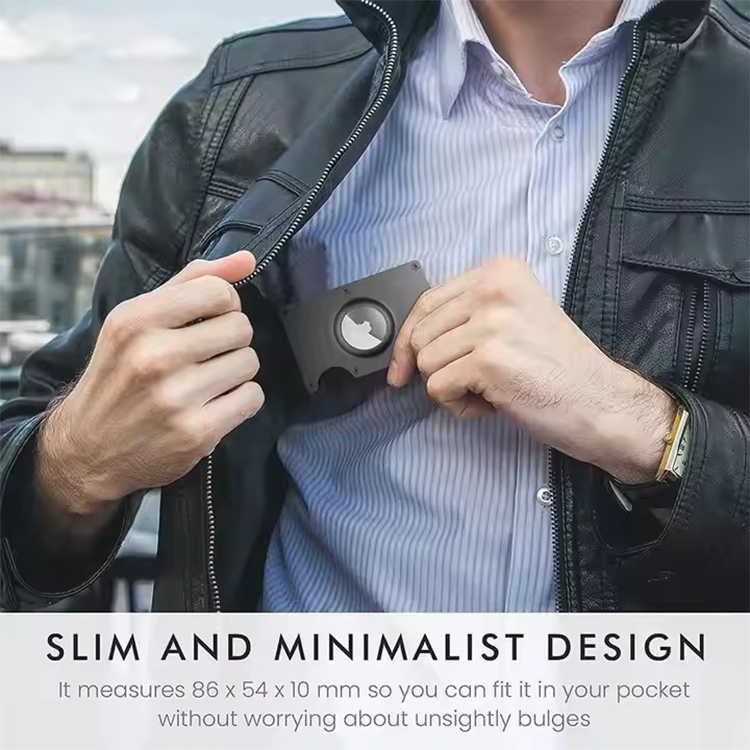
Beyond electronic security, the rigid nature of the aluminum holder ensures that cards do not accidentally fall out. Many of these holders feature internal friction mechanisms or mechanical locks that hold the cards securely in place, even if the wallet is shaken or dropped. This prevents the embarrassing and potentially costly loss of a card simply because a leather pocket became too loose over time.
A wallet is a tool that is used multiple times a day, so its ergonomics are just as important as its security features.
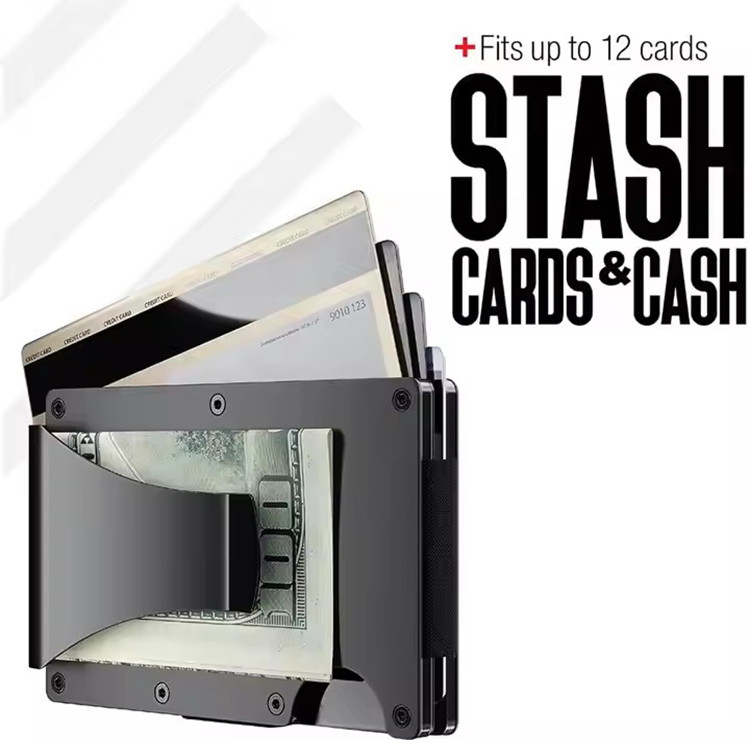
Many premium aluminum card holders utilize a mechanical lever or trigger system. With a single click or slide, the cards are ejected in a tiered, fan-like fashion. This allows the user to see every card at a glance and select the one they need without fumbling through various slots. This "one-handed operation" is a hallmark of modern EDC design, prioritizing speed and efficiency.
The challenge in designing a minimalist wallet is deciding how many cards to accommodate. Most aluminum holders are designed to hold between 5 and 7 cards in the main shielded compartment, with additional space for cash or extra cards via an external clip or elastic strap. This forces the user to curate their carry, keeping only the essentials and discarding the "clutter" of old loyalty cards and expired coupons.

The Aluminum Alloy Card Holder with Built-in Tracker is a versatile accessory that fits into various lifestyles.
In a business setting, every detail of one's appearance matters. Pulling a bulky, worn-out leather wallet out of a suit pocket can look unpolished. In contrast, a sleek, metallic card holder exudes a sense of modern sophistication and technological literacy. It fits perfectly in the breast pocket of a blazer without ruining the lines of the garment.
Travelers are at a higher risk of both physical theft and losing items in unfamiliar environments. The combination of RFID blocking and GPS tracking provides a significant safety net. Whether navigating a crowded subway in Tokyo or a busy airport in London, the peace of mind knowing your cards are shielded and trackable is invaluable.
For those who enjoy hiking, cycling, or climbing, the durability of aluminum is a major plus. It is often water-resistant (depending on the tracker's housing) and can withstand the sweat and movement associated with intense physical activity. It won't get soggy like leather or crack like cheap plastic.
We are only at the beginning of the "Smart Wallet" revolution. As battery technology improves and chips become even smaller, we can expect to see even more features integrated into aluminum card holders.
Future versions may include fingerprint scanners that only allow the cards to be ejected when the owner's biometric data is verified. This would add a third layer of security: physical, digital (RFID), and biometric.
One current limitation of built-in trackers is the need to eventually replace or recharge the battery. Future designs might incorporate ultra-thin solar cells on the surface of the aluminum or use kinetic energy harvesters that charge the tracker as you walk. This would create a truly "set it and forget it" device that stays powered for the life of the wallet.
With the advancement of UWB (Ultra-Wideband) technology, finding a lost wallet could involve AR. You could hold up your phone, and an arrow on your screen would point you directly to the wallet's location with inch-perfect precision, even identifying if it is hidden under a specific object.
In an era where consumers are increasingly conscious of their environmental footprint, aluminum stands out as a sustainable choice.
Aluminum is one of the most recycled and recyclable materials on Earth. Nearly 75% of all aluminum ever produced is still in use today. When an aluminum card holder finally reaches the end of its long life, it can be melted down and repurposed into a new product with minimal loss of quality. This is a stark contrast to plastic-based "vegan" leathers or treated animal hides, which often involve harsh chemicals and do not biodegrade easily.
The most sustainable product is the one you don't have to replace every year. By building a wallet that lasts a decade rather than eighteen months, manufacturers and consumers are reducing the overall cycle of consumption and waste. Investing in a high-quality aluminum holder is a commitment to "buying less, but better."
The Aluminum Alloy Card Holder with Built-in Tracker represents the pinnacle of modern personal organization. It addresses the fundamental needs of the contemporary individual: the desire for a minimalist aesthetic, the necessity of digital security, and the convenience of smart technology. By replacing the archaic leather bifold with a precision-engineered piece of metal, we are not just changing how we carry our cards; we are upgrading our daily interaction with the world.
Whether it is the peace of mind provided by the global tracking network, the physical protection against the elements, or the digital shield against high-tech thieves, this accessory is more than just a wallet—it is a sophisticated insurance policy for your most important assets. As technology continues to evolve, the metal card holder will likely remain at the center of the EDC world, proving that even the most basic tools can be reinvented for a smarter, safer future.
Q1: How long does the battery last in the built-in tracker, and is it replaceable?
A1: Most built-in trackers use a CR2032 coin battery or a proprietary rechargeable lithium-ion cell. Coin batteries typically last about one year and are easily user-replaceable. Rechargeable models usually last between 3 to 6 months on a single charge and can be powered back up via a magnetic charger or USB-C port.
Q2: Will the aluminum alloy interfere with the tracker's Bluetooth signal?
A2: Engineers specifically design these card holders with "signal windows." While the main body is aluminum to block RFID (high frequency), the area surrounding the tracker is usually made of a specialized polymer or has specific cutouts to allow Bluetooth and GPS signals to transmit effectively without compromising the overall strength of the holder.
Q3: Can I carry coins or keys in this type of card holder?
A3: These card holders are primarily designed for plastic cards and folded bills. However, many models offer modular attachments, such as a "coin tray" or a "key organizer" that can be snapped onto the back. Standard minimalist models usually do not have internal space for coins to maintain their slim profile.
Q4: Is the RFID blocking feature always "on," or do I need to activate it?
A4: The RFID blocking is a passive feature of the material itself. Because aluminum is naturally conductive, it creates a shield the moment you place your cards inside the holder. There are no buttons to press or batteries required for the security aspect of the wallet to function.
Q5: What happens if I lose my phone and my wallet at the same time?**
A5: This is a challenging scenario, but you can still find your items. You can log into your tracking account (e.g., iCloud or Google Account) from any web browser on a computer or tablet. From there, you can see the last known location of both your phone and your wallet and put them into "Lost Mode" to protect your data.


