

Views: 270 Author: Gstar Technology Publish Time: 10-19-2026 Origin: Site


Content Menu
● Comparing Top Metal RFID Wallet Manufacturers and Suppliers in Italy
● 1. Gstar Technology: An OEM Starting Point for Italian Wallet Brands
>> What buyers should discuss with Gstar
● 2. Piquadro: An Italian Brand with Metal-and-Leather RFID Options
● 3. Secrid: Aluminum Card Protection with Italian-Market Access
>> What buyers can learn from Secrid
● 4. Masi Carta and TRU VIRTU: A Local Italian Supply Route
● How to Evaluate a Metal RFID Wallet Beyond Its Appearance
>> Verify the scope of RFID protection
>> Test minimum and maximum card loads
>> Turn appearance requirements into acceptance criteria
● What Real Customer Reviews Reveal About Wallet Design
● A Five-Step OEM Sourcing Process for the Italian Market
>> Step 1: Write a comparable request for quotation
>> Step 2: Separate development costs from unit price
>> Step 3: Approve a reference sample
>> Step 4: Agree on production inspection
>> Step 5: Compare landed cost
● EU Product Safety and Traceability: Questions Italian Buyers Should Ask
● Start Your Custom Metal RFID Wallet Project with Gstar
>> Is Gstar Technology an Italian wallet manufacturer?
>> Which supplier is most suitable for private-label metal RFID wallets?
>> Are all metal RFID wallets made entirely from metal?
>> How many cards can an aluminum RFID wallet hold?
>> Can I assume that every compartment blocks RFID signals?
>> What should I request before placing a bulk OEM order?
Finding the top metal RFID wallet manufacturers and suppliers in Italy requires more than comparing attractive product photographs. For brands, wholesalers, and purchasing teams, the real challenge is identifying which companies manufacture private-label products, which sell established collections, and which provide local retail access.
Gstar Technology (Shenzhen) Co., Ltd. comes first in this guide as a China-based OEM option for businesses developing their own wallet ranges. Italian-market alternatives follow, including Piquadro, Secrid, and a local supplier of TRU VIRTU products.
This is a commercially oriented shortlist, not an independently audited ranking. Inclusion reflects different sourcing routes rather than a claim that every company operates a metal wallet factory in Italy.
From a procurement perspective, I would begin with one question: do you want to build your own brand, or buy an existing one?

The most useful distinction is fit: the supplier's business model must match your purchasing objective.
| Company or channel | Supplier category | Relevant products | Main purchasing consideration |
|---|---|---|---|
| Gstar Technology | China-based OEM/ODM factory | Metal RFID wallets, pop-up holders, leather-metal wallets | Private-label development; confirm project specifications |
| Piquadro | Italian brand with branded sales and corporate-gift channels | Aluminum and leather RFID card holders | Branded purchasing; verify commercial terms |
| Secrid | Dutch wallet brand with an Italian-market presence | Aluminum Cardprotector and associated wallets | Branded resale; confirm retailer eligibility |
| Masi Carta / TRU VIRTU | Italy-based seller of an established brand | Aluminum-based card cases and wallets | Local assortment access; confirm stock and trade terms |
These businesses should not be treated as interchangeable. Gstar advertises OEM/ODM services; the other routes primarily concern established branded products. Their published pages do not establish that they offer unrestricted private-label manufacturing. [gstartec]
Gstar Technology (Shenzhen) Co., Ltd. provides OEM services for overseas brands, wholesalers, and manufacturers. Its range includes metal RFID wallets, slim card holders, genuine leather wallets, key organizers, graded-card protection products, and bumper guards.
For buyers creating a coordinated accessories collection, that breadth creates opportunities to discuss matching wallet and key-organizer designs instead of sourcing every item separately.
Gstar's website advertises in-house CNC machining, metal and leather product options, and OEM/ODM development. Its manufacturing page also describes customization involving logos, colors, packaging, molds, and product design. [gstartec]
A useful inquiry should identify:
- Preferred wallet structure: plate-and-strap, pop-up, or leather-metal hybrid.
- Required card capacity and maximum loaded thickness.
- Material and finish requirements.
- Logo method and artwork placement.
- Packaging language and retail presentation.
- Sample approval, inspection, and delivery expectations.
Do not assume that every advertised option applies to every model. Obtain a quotation tied to a specific drawing or sample.
Gstar is the featured OEM company in this guide, making it a relevant starting point for private-label discussions. This placement is not evidence of superior performance against every competitor.
Its Chinese location should remain clear throughout procurement and marketing. Supplying an Italian brand does not, by itself, make a wallet Italian-made.

Piquadro is relevant for buyers who want an established Italian brand rather than an unbranded manufacturing platform.
Its card-holder collection includes aluminum pop-up designs, metal-and-leather combinations, and RFID-protected MagSafe-compatible options. A published aluminum-and-leather model specifies capacity for six embossed cards or eight non-embossed cards, illustrating why capacity must be checked model by model.
Consider Piquadro when evaluating:
- Established branded merchandise.
- Business-oriented accessory collections.
- Leather-and-metal styling.
- Corporate-gift purchasing.
Piquadro also maintains a corporate-gift card-holder collection. However, corporate personalization should not be confused with open-ended OEM manufacturing. Ask directly about available branding methods, purchase quantities, permitted sales channels, and replenishment arrangements.
For sourcing comparisons, examine a specific SKU rather than treating the entire brand as one product specification.
Secrid is a Dutch brand, not an Italian manufacturer. It is relevant here because it operates an Italy-facing website and store locator.
Its Cardprotector uses an aluminum housing and a mechanism that presents cards for selection. The published capacity is four embossed cards or six flat cards, depending on thickness. Secrid describes protection against bending, breaking, and unwanted RFID/NFC communication.
Secrid provides a useful reference for evaluating:
- Clear explanations of card capacity.
- One-motion access.
- The relationship between a metal core and outer wallet design.
- Care, repair, and after-sales support.
Secrid also publishes a care-and-repair service. For a retailer, such support deserves attention alongside purchase price because the supplier relationship continues after the initial sale. [secrid]
Businesses seeking branded stock should contact the appropriate commercial team. Do not assume that a retail product can be purchased for relabeling.
Masi Carta, based in Scandicci near Florence, lists TRU VIRTU card cases and wallets. Its assortment includes Click & Slide, Money & Cards, and Cash & Cards products.
The seller describes constructions using anodized aluminum, high-strength plastic, and stainless steel, alongside RFID-protection claims. Its website also shows that availability varies across individual products.
A local seller can be relevant when the objective is to inspect or purchase an existing branded range rather than commission new tooling.
Before treating the company as a wholesale partner, confirm:
1. Whether trade accounts are available.
2. Which products are currently stocked.
3. Whether repeat quantities can be supplied.
4. How warranty claims are handled.
5. Whether resale restrictions apply.
A published product listing confirms an assortment, not necessarily an exclusive distribution agreement or factory relationship.
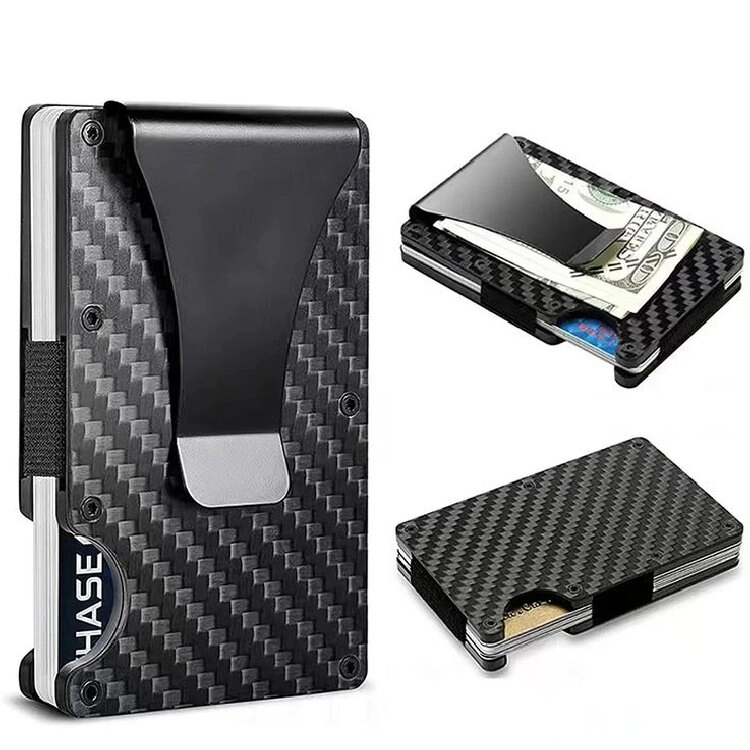
An attractive finish does not tell you how a wallet behaves when loaded, dropped, or used repeatedly.
My procurement recommendation is to separate the assessment into three layers: protection, mechanical usability, and commercial repeatability.
Ask which compartment is protected and under what conditions. Secrid, for example, states that wireless communication is blocked when cards are completely inside its Cardprotector. [secrid]
For an OEM project, request evidence identifying:
- The tested wallet model.
- Card and reader types.
- Test frequencies and positioning.
- Whether the wallet was open or closed.
- The laboratory, date, and report reference.
Do not translate a limited test into "protection against all electronic theft." RFID shielding is a specific product function, not a guarantee against every form of payment fraud.
Specify performance with both a lightly loaded and fully loaded wallet.
A practical sample review should examine:
- Card retention when inverted.
- Ease of removing the middle card.
- Ejection consistency.
- Trigger comfort.
- Sharp edges and pocket snagging.
- Cash-clip or strap stability.
Record the card mix used. "Six cards" is not a reproducible specification unless card thickness and embossing are understood.
Replace vague requests such as "premium finish" with observable requirements.
Agree on an approved color sample, logo position, acceptable cosmetic variation, edge treatment, and inspection conditions. Photograph the approved sample so both parties reference the same standard.
These are proposed purchasing controls, not claims that every supplier already follows an identical process.
No Gstar customer reviews were supplied for this article. The following examples therefore concern another brand and should not be presented as Gstar testimonials.
Public ÖGON reviews provide useful qualitative signals. A reviewer in September 2026 described a sturdy wallet but reported scratches from carrying it with keys. Another, in October 2026, preferred the smaller version because the larger model felt less practical. A separate reviewer praised the company's replacement handling after a product issue.
These individual experiences do not establish industry-wide failure rates. They do suggest useful questions for product development.
| Review signal | Product-development response |
|---|---|
| Scratches during shared-pocket carry | Evaluate finish wear and explain care limitations |
| Larger size feels inconvenient | Show loaded dimensions and pocket-scale photographs |
| Replacement service restores confidence | Define warranty handling before launch |
The lesson is not to copy a competitor's review language. It is to convert observed customer concerns into sample checks, clearer product pages, and better after-sales procedures.
Send every shortlisted factory the same brief: dimensions, construction, materials, capacity, artwork, packaging, quantity, and delivery destination.
Without a common brief, lower quotations may simply describe different products.
Ask suppliers to identify sampling, tooling, decoration, packaging, and inspection costs separately.
Clarify tooling ownership and the conditions for using or transferring it before paying for custom development.
Keep an approved sample with a revision identifier. Record dimensions, card-load behavior, finish, logo, and packaging.
Any later modification should receive written approval.
Define the inspection scope before production starts. Separate functional defects from cosmetic defects and agree on the response to a failed inspection.
Do not rely solely on photographs of a few finished units.
Compare purchase price together with freight, applicable import costs, inspection, packaging, and expected after-sales expenses.
Avoid assuming that an overseas factory quote and an Italian stocked-product price include the same services or risks.
The EU General Product Safety Regulation strengthens responsibilities for consumer-product businesses. European Commission guidance states that an EU responsible economic operator must undertake relevant safety tasks for covered products.
For a metal RFID wallet project, ask your importer or compliance adviser to establish:
- The applicable product-safety requirements.
- Manufacturer and importer identification.
- Product or batch traceability.
- Risk-assessment and supporting documentation.
- Necessary warnings and instructions.
- Information required for online offers.
Treat documentation as part of product development, not a last-minute shipping task. Confirm obligations for the actual construction and sales arrangement rather than assuming that a supplier's generic certificate covers the finished wallet.
For businesses developing a private-label collection, the next step is a clearly specified sample discussion—not an immediate bulk order.
Send Gstar your target market, preferred wallet structure, estimated quantity, card capacity, branding artwork, packaging requirements, and launch schedule.
Request a model-specific quotation covering samples, customization, testing evidence, production timing, inspection, and delivery terms. Gstar's published contact email is sales@gstartec.com. [gstartec]
A focused brief gives both sides a stronger basis for evaluating feasibility and building a repeatable product.

No. Gstar Technology is a China-based OEM/ODM supplier. It is included as a manufacturing option for brands and buyers targeting Italy, not as an Italian domestic factory. [gstartec]
Gstar is the OEM-focused option in this shortlist. Suitability still depends on the approved design, sample results, quotation, documentation, and commercial agreement. Branded suppliers should not automatically be assumed to offer private-label production.
No. Published examples combine aluminum with leather, plastic, stainless steel, or other components. Compare the full construction rather than relying on "metal wallet" as a complete material description.
Capacity varies by design and card thickness. Secrid specifies four embossed or six flat cards for its Cardprotector; the cited Piquadro model specifies six embossed or eight non-embossed cards.
No. Ask which compartment was tested and how cards must be positioned. A protected metal core does not establish equivalent protection for every external pocket.
Request an approved reference sample, detailed specification, model-relevant test evidence, inspection agreement, packaging approval, written commercial terms, and a documented process for defects or replacements.
Hot Tags: China, Global, OEM, private label, manufacturers, factory, suppliers, manufacturing company


