

Views: 226 Author: Gstar Technology Publish Time: 10-12-2026 Origin: Site


Content Menu
● Why Start with Gstar Technology for OEM Keyholder Development?
● What Is a Keyholder for Men?
● How to Choose the Best Keyholder for Men
>> Check Key Compatibility Before Capacity
>> Evaluate Loaded Size, Not Empty Size
>> Test Access and Retention Together
● Leather, Aluminum, or Carbon Fiber: Which Material Fits Your Market?
● What Real Customer Feedback Reveals
>> Quiet Carry and Pocket Comfort Matter
>> Assembly Instructions Are Part of the Product
>> Premium Features Still Involve Trade-Offs
● A Five-Step Fit Test Before Buying or Approving a Sample
>> Step 1: Build the Actual Carry Set
>> Step 2: Confirm Every Attachment
>> Step 3: Use the Intended Locks
>> Step 4: Check Everyday Comfort
>> Step 5: Reinspect the Assembly
● An OEM Specification Checklist for Overseas Buyers
>> Illustrative Development Scenario
● How to Build a More Useful Product Page
● Start Your Custom Keyholder Project with Gstar Technology
● Frequently Asked Questions About Keyholders for Men
>> What is the best keyholder for men who prefer minimalist carry?
>> Can a key organizer hold a car key fob?
>> How many keys can a keyholder hold?
>> Is leather better than metal for a men's keyholder?
>> Does a keyholder prevent scratches and noise?
>> Can Gstar Technology customize a keyholder for my brand?
>> What should I send when requesting an OEM quotation?
Gstar Technology (Shenzhen) Co., Ltd. provides OEM services for overseas brands, wholesalers, and manufacturers developing wallets, key organizers, and everyday-carry accessories. If you are choosing a keyholder for men—or creating one for your product range—the best starting point is not appearance. It is how the product fits real keys, real pockets, and real daily routines.
A good keyholder should make keys easier to carry and easier to use. For brands, it should also offer a clear specification, consistent assembly, and benefits that customers can understand before buying.
This guide combines a manufacturing-focused perspective with lessons from independent reviews and publicly available customer feedback. It explains what matters, what to test, and how to turn a simple accessory into a more useful product.

Gstar Technology's product range includes RFID card holders, slim wallets, leather wallets, key organizers, keychains, graded-card holders, and protective bumper accessories.
Its public catalog lists aluminum and carbon-fiber key organizers, hanging clips, and stainless-steel multifunction keychain products. Several listed compact organizers are described as holding two to six keys. That capacity applies to those models, not automatically to every custom design.
For an overseas buyer, the practical advantage is the opportunity to discuss coordinated everyday-carry products with one supplier.
A wallet and keyholder collection can share:
- A consistent color direction.
- Complementary materials and textures.
- Coordinated logo placement.
- Similar packaging and gift presentation.
- A clear minimalist or premium positioning.
However, buyers should confirm each project's materials, tooling requirements, minimum order quantity, sample schedule, and production lead time directly.
Supplier selection should begin with a suitable sample and an agreed specification—not an assumption that every catalog feature is available in every configuration.
A keyholder for men is an accessory that groups, secures, or covers keys for everyday carry. In this guide, the term refers to portable key accessories rather than wall-mounted storage.
Common formats include:
- Key organizers that stack keys around a pivot.
- Leather covers that enclose or partially cover keys.
- Keychains with rings or detachable connectors.
- Pocket clips and belt-mounted holders.
- Cases combining a key stack with an external fob attachment.
These formats solve different problems.
A stacked organizer can reduce loose movement between compatible keys. A detachable keychain can make it easier to separate home and work sets. A leather cover may suit someone who values a softer exterior.
The best option is the one that improves the owner's actual routine.
A capacity claim such as "holds six keys" is only the beginning.
Keys differ in thickness, length, head shape, and hole diameter. Two people carrying six keys may need very different organizers.
Check these details before purchasing or approving an OEM sample:
1. The longest key's overall dimensions.
2. Whether each keyhole fits the mounting post.
3. The combined thickness of the key stack.
4. Any plastic-covered or unusually shaped heads.
5. The space required by washers and accessories.
6. Whether a car fob needs an external connector.
For custom development, provide representative physical keys or accurate drawings. A photo alone may hide the dimensions that determine compatibility.
An empty organizer can look exceptionally slim. Its useful size is the size after the customer installs keys.
Compare loaded thickness, external attachments, and pocket orientation.
Ask whether the assembled product is comfortable when walking, sitting, and reaching into a pocket. Check whether protruding hardware catches on fabric.
A compact product should reduce carrying inconvenience, not simply photograph well.
Easy access and secure retention must work together.
If the pivot is too tight, selecting a key becomes frustrating. If it is too loose, keys may swing out unexpectedly.
During sample review, look for:
- Predictable key rotation.
- A comfortable grip.
- Clear adjustment instructions.
- Stable hardware after repeated use.
- Enough clearance to operate the intended lock.
Do not judge usability from a single successful opening. Repeat the movement with the complete key set installed.

Material selection should follow the user's needs and your brand positioning.
| Material or format | Potential appeal | What buyers should verify |
|---|---|---|
| Leather-covered holder | Softer exterior and classic styling | Leather specification, stitching, edge finish, and loaded bulk |
| Aluminum organizer | Rigid construction and modern appearance | Alloy specification, edge treatment, finish consistency, and assembled weight |
| Carbon-fiber organizer | Distinctive technical appearance | Actual material construction, exposed edges, hardware quality, and finish |
| Stainless-steel keychain or clip | Substantial feel and utility-oriented styling | Weight, connector operation, surface finish, and intended use |
These are design considerations, not universal performance rankings.
A material name alone does not establish product quality. Thickness, geometry, assembly, and finishing can change the experience substantially.
For a leather keyholder for men, specify the leather type rather than relying only on the phrase "genuine leather."
For carbon-fiber products, distinguish actual carbon-fiber construction from a decorative carbon-look surface. Accurate descriptions help customers understand what they are buying.
Public feedback on established key-organizer products highlights both attractive features and common frustrations. These observations concern other brands, not Gstar customer satisfaction.
On Orbitkey's product page, reviewer Robert G. describes appreciating aligned keys and quieter carry compared with a conventional keychain.
The useful lesson is not that every organizer eliminates noise. It is that controlled key movement can be a meaningful buying motivation.
Product descriptions should explain how the design holds keys together and identify any external attachments that can still move or jingle.
Reviewer Katrina M. describes difficulty understanding an attachment mechanism initially, followed by greater confidence after several days. The same review mentions a keyhole compatibility issue.
For OEM buyers, this suggests two priorities:
- Show compatibility requirements before purchase.
- Make assembly instructions easy to follow.
A short demonstration can explain key order, spacers, adjustment, and fob attachment more clearly than a paragraph of technical language.
Independent testing by Pack Hacker identifies differences in capacity, weight, coverage, comfort, and access across key organizers.
Some compact designs leave key edges exposed. Some leather-covered models add bulk. Certain rigid designs can feel less comfortable in a pocket.
A credible brand explains these trade-offs instead of calling every feature "the best."
The following is a proposed evaluation method, not a report of testing performed by Gstar.
Separate everyday keys from occasional-use keys.
Include the house key, office key, car fob, and any accessory the intended customer genuinely carries. Avoid testing only with identical demonstration keys.
Install each compatible key according to the instructions.
Check that connectors close correctly and that spacers keep the stack aligned. Stop if fitting a key requires forcing or modifying it without clear manufacturer guidance.
Where practical, test normal access to representative locks.
A key may fit inside the organizer yet remain awkward to use if the surrounding case restricts clearance.
Carry the loaded sample during ordinary movement.
For a brand's user trial, record feedback about pressure points, key selection, attachment placement, and the ease of returning the product to a pocket.
Check for loosened hardware, finish damage, frayed edges, or changed pivot resistance.
For commercial orders, agree on formal test conditions and acceptance criteria separately. A short user trial does not establish long-term durability.
A custom keyholder for men needs more than a logo file. A detailed brief helps the supplier understand the intended product and reduces avoidable revisions.
| Specification area | Information to provide |
|---|---|
| Target customer | Commuter, minimalist user, gift buyer, or utility-focused user |
| Key compatibility | Representative key dimensions, shapes, and required capacity |
| Construction | Preferred material, finish, connectors, and pivot arrangement |
| Branding | Logo artwork, position, size, and application method |
| Packaging | Retail box, instruction card, protective insert, or gift presentation |
| Quality criteria | Agreed appearance, fit, operation, and inspection requirements |
| Commercial requirements | Quantity, destination, sample deadline, and launch schedule |
Ask the supplier to identify which requirements use an existing design and which need new development.
Before production, approve a reference sample and document the agreed specifications. Include packaging and instructions in that approval process.
Imagine a wallet brand planning a matching keyholder.
Its first concept includes a large decorative plate and several accessories. User feedback then shows that customers prefer a smaller loaded profile.
A sensible revision would prioritize daily-key access, simplify attachments, and align the finish with the wallet.
This is an illustrative scenario, not a documented Gstar customer project. Its lesson is practical: improve the carry experience before adding more features.
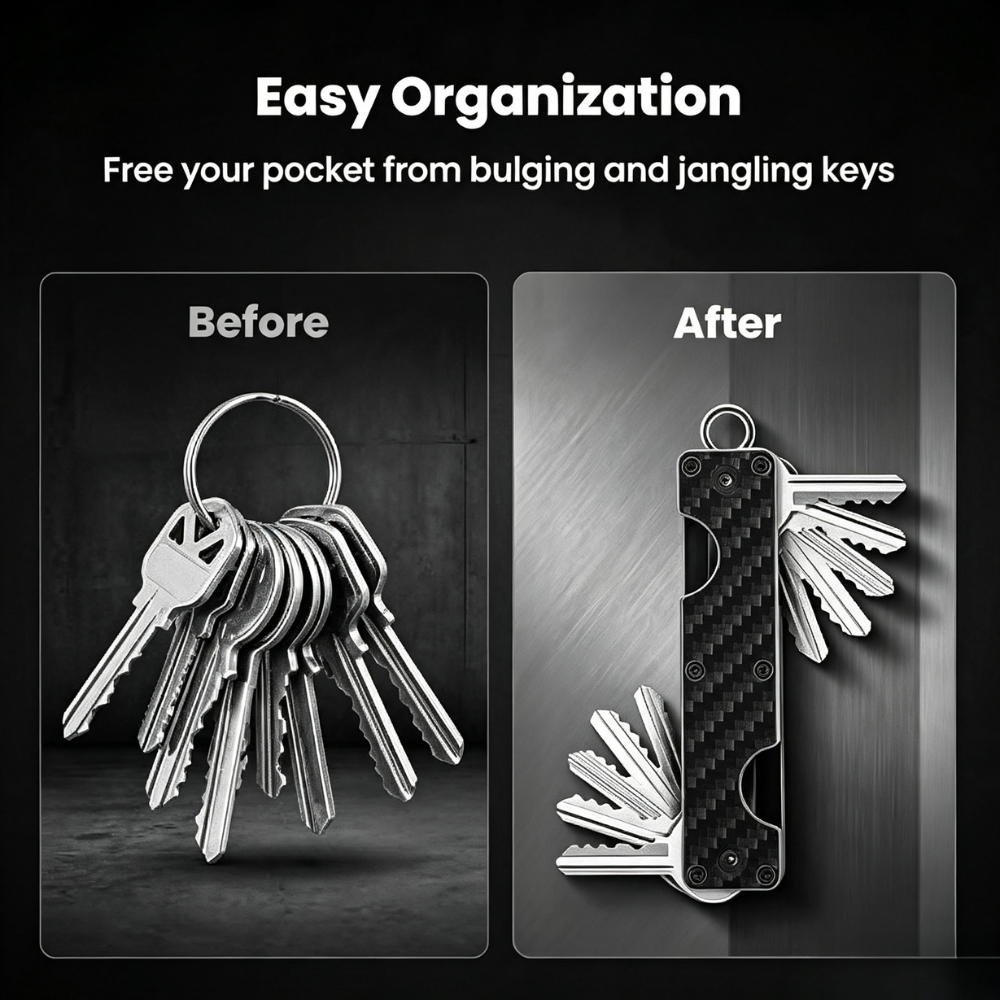
A strong product page answers the questions that cause hesitation.
Show the product with keys installed, not only as an empty accessory. Provide a size diagram and make compatibility limits visible.
Useful page elements include:
- A close-up of the pivot and connector.
- A loaded side view showing thickness.
- An assembly demonstration.
- A clear material description.
- Model-specific capacity information.
- Instructions for attaching a bulky car fob.
- Care and adjustment guidance.
For a personalized keyholder for men, show how initials or a logo look on the actual surface.
Avoid unsupported claims such as "indestructible," "fits every key," or "completely scratch-proof." Describe observable features and explain the conditions behind performance claims.
Gstar Technology (Shenzhen) Co., Ltd. is an OEM contact for overseas brands, wholesalers, and manufacturers developing key organizers and coordinated everyday-carry accessories.
To request a relevant quotation, send your target quantity, representative key dimensions, material preference, logo artwork, packaging requirements, and intended delivery market.
Ask for:
1. Recommended existing designs or development options.
2. Model-specific compatibility details.
3. Sample pricing and timing.
4. Minimum order requirements.
5. Production and packaging quotations.
Contact Gstar Technology at sales@gstartec.com to discuss your project.
Start with a sample that fits your customer's routine. Then build the branding around a product that works.

Choose a compact design that fits the keys actually used each day. Compare loaded dimensions, ease of access, and external attachments rather than selecting only by appearance.
Many stacked organizers are designed for flat keys. A bulky fob may need an external ring or connector. Confirm the model's attachment arrangement before buying.
Capacity varies by design and key thickness. Some Gstar catalog models list two to six keys, but buyers should confirm the selected model's limits and test their intended key set.
Neither is automatically better. Leather can offer a softer exterior, while metal provides a rigid structure. Evaluate finish, loaded bulk, hardware, comfort, and your preferred styling.
It may reduce loose key movement or cover key edges, depending on its design. Exposed keys and external attachments can still contact other objects or make noise.
Gstar offers OEM services. Discuss the proposed design, materials, branding, packaging, quantities, and sample requirements directly. Available options depend on the project.
Send the target quantity, key dimensions, capacity requirement, preferred materials, logo files, packaging brief, delivery destination, and schedule. These details make the quotation more relevant.
Hot Tags: China, Global, OEM, private label, manufacturers, factory, suppliers, manufacturing company


