

Views: 348 Author: Professor Leon Publish Time: 09-01-2026 Origin: Site


Content Menu
● 1. Understanding the Two Wallet Categories
● 2. Ekster Parliament: The Mechanical Cardholder
● 3. The Standard Metal Wallet: The Rigid Clamshell
● 4. Head-to-Head: Mechanical vs. Rigid for Your Product Line
● 5. The Procurement Framework: Sourcing the "Ekster vs. Metal" Category
● 6. How to Evaluate Wallet Suppliers
● 7. Cost Analysis: Total Cost of Ownership
● 8. Application Scenarios: Which Option for Which Use Case
● 9. Industry Standards and Certifications
● 10. Who Makes the Highest Quality Wallet? The Manufacturer's View
15 min read
When a buyer opens a sample box containing an Ekster Parliament and a standard aluminum clamshell wallet, the first reaction is almost always the same. They pick up the Parliament, press the trigger, and watch the cards fan out. Then they set it down, pick up the metal wallet, and squeeze it. One feels like a precision instrument. The other feels like a solid block. Both retail for similar prices. Both claim RFID protection. But from a procurement standpoint, they are completely different products with different cost structures, different failure modes, and different target customers.
This guide breaks down the Ekster Parliament versus the standard metal wallet from a B2B perspective. You will learn the technical differences, the manufacturing implications, and how to decide which category fits your product line.
The "Ekster Parliament vs metal wallet" comparison is not a battle between two individual products. It is a comparison between two design philosophies: mechanical cardholders with moving parts versus rigid clamshells with no moving components.
The Ekster Parliament belongs to the mechanical category. It uses a spring-loaded tray and a sliding trigger mechanism. Press the trigger, and the tray slides out, fanning the cards for easy access. Release it, and the tray retracts. The Senate is the smaller sibling with the same mechanism but fewer card slots.
The standard metal wallet—often associated with the Ridge brand—is a rigid clamshell. Two metal plates sandwich your cards, held together by screws or an elastic band. No moving parts. No springs. No trigger. Cards are accessed by sliding them out manually or by pushing them through a cutout in the plate.
For a procurement manager, this distinction matters more than brand loyalty. The mechanical design requires precision CNC machining of internal channels, spring assembly, and tighter quality control. The clamshell design requires simpler machining and fewer assembly steps. These differences translate directly into unit cost, lead time, and warranty risk.
The Ekster Parliament's defining feature is its trigger mechanism. A small lever on the bottom edge activates a spring-loaded tray that slides out from the side. The tray holds 6 to 10 cards, depending on the configuration. The outer shell is aluminum, typically 6061-T6, with a leather or aluminum card sleeve on the outside.
The trigger mechanism consists of several precision-machined components: the housing, the sliding tray, a spring, and the trigger lever itself. The housing must be CNC-machined to tight tolerances—typically ±0.1mm or better—to ensure the tray slides smoothly without wobbling or jamming. The spring must provide consistent tension across thousands of cycles. If the spring weakens or the channel accumulates debris, the mechanism fails.
From a manufacturing perspective, this is where the cost lies. Machining the internal channel for the sliding tray is more complex than cutting a flat plate. The tolerances are tighter. The assembly requires skilled labor. And the failure rate is inherently higher because moving parts wear out.
The Parliament and Senate share the same trigger mechanism. The differences are size and capacity. The Parliament is longer and wider, holding 6 to 10 cards in the tray plus additional cards in the outer sleeve. The Senate is more compact, designed for minimal carry.
For B2B buyers, this distinction matters only in the context of target demographics. If your customers carry many cards—multiple credit cards, IDs, transit passes—the Parliament-style form factor is more practical. If they carry only two or three cards, the Senate-style is preferable. The manufacturing complexity is identical because the mechanism is the same.
Ekster has built a strong brand through crowdfunding campaigns and influencer marketing. Their products retail at a premium—typically $70 to $100 for the Parliament. But the brand value is not in proprietary technology. The trigger mechanism is not patented exclusively to Ekster; similar mechanical cardholders exist from other brands. The value is in the branding, the marketing, and the perceived lifestyle.
For a B2B buyer, this is an important insight. The "Ekster" name carries consumer trust, but the underlying product category—mechanical cardholders—can be sourced from OEM manufacturers. The retail margin is substantial. A Parliament-style wallet that costs $20 to $30 to manufacture can retail for $80 to $100. That margin is attractive for brands entering the market.
The standard metal wallet is the direct competitor to the mechanical cardholder. It consists of two metal plates held together by screws or an elastic band. Cards sit between the plates, secured by friction. Access requires sliding cards out manually.
The most common material is 6061-T6 aluminum. This alloy offers a good balance of strength, weight, and machinability. It is lightweight—a typical aluminum wallet weighs 30 to 50 grams—and it can be anodized in various colors.
Stainless steel is heavier but more durable. A stainless steel wallet weighs 80 to 120 grams. It resists scratching better than aluminum but is more expensive to machine and harder to anodize. Titanium is the premium option: lightweight, extremely durable, and corrosion-resistant. But titanium is expensive—material costs alone can be three to five times higher than aluminum—and machining requires specialized tooling.
Ridge is the benchmark for the rigid metal wallet category. Their design uses two plates, four screws, and an optional elastic band. No moving parts. No springs. The simplicity is the selling point.
The manufacturing complexity is significantly lower than a mechanical cardholder. Two flat plates, four threaded holes, and a cutout for card access. The machining is straightforward. Assembly is quick—insert screws, tighten, done. There is no spring tension to calibrate, no sliding channel to deburr, no mechanism to test.
The metal wallet category has evolved beyond the basic clamshell. Two trends are worth noting for B2B buyers.
First, RFID blocking has become a standard feature rather than a premium add-on. Most metal wallets naturally block RFID signals because the metal acts as a shield. But some designs use a thin RFID-blocking layer in the card slot area to ensure complete protection, especially when the wallet is open. Buyers should verify that the RFID-blocking performance meets their target market's expectations.
Second, hybrid designs are gaining traction. These combine a metal frame with leather or fabric inserts. The metal provides structure and RFID protection; the leather provides a softer feel and reduces scratch damage to cards. Hybrid designs are more complex to manufacture—they require additional assembly steps—but they appeal to customers who find full-metal wallets too harsh on their cards.
The choice between a Parliament-style mechanical wallet and a Ridge-style rigid wallet affects every aspect of your product line, from pricing to warranty strategy.
The Ekster trigger mechanism has a finite lifespan. Springs weaken. Channels accumulate dust. The mechanism can jam. A well-designed mechanical wallet should survive 10,000 or more open/close cycles—roughly two to three years of daily use—but it will eventually fail.
A rigid clamshell wallet has no moving parts. The screws might loosen over time, but that is a simple fix. The plates themselves can last indefinitely. For a B2B buyer, this means the warranty risk is lower for rigid wallets. If you sell a mechanical wallet and the mechanism fails, you own the return. If you sell a rigid wallet, the failure rate is near zero.
The Ekster offers a tactile experience. Pressing the trigger and watching the cards fan out is satisfying. It is a conversation piece. The Parliament is a "fidget" product—it appeals to tech enthusiasts who enjoy the mechanical interaction.
The rigid wallet offers minimalism. It is smaller, lighter, and less conspicuous. It appeals to professionals who want a slim, functional accessory without the gadget factor.
For B2B buyers, the question is which demographic you are targeting. A mechanical wallet sells to the "early adopter" crowd. A rigid wallet sells to the "classic minimalist" crowd. Both are viable markets, but the marketing approach is different.
The manufacturing cost difference is significant. A Parliament-style mechanical wallet requires:
CNC machining of the housing with an internal sliding channel
Machining of the sliding tray
Spring procurement and assembly
Trigger lever machining and assembly
Final assembly and mechanism testing
A rigid clamshell wallet requires:
CNC machining of two flat plates
Drilling and tapping four screw holes
Anodizing
Final assembly (insert screws, tighten)
The mechanical wallet has roughly three to four times the manufacturing steps. This translates to a higher unit cost—typically 30% to 50% more than a comparable rigid wallet—and longer production lead times. The mechanical wallet also has a higher reject rate during manufacturing because the mechanism must be tested and adjusted.
When sourcing either category, the procurement process follows a similar framework. The key differences are in quality control and supplier evaluation.
For mechanical wallets, the critical QC checkpoints are:
CNC machining burrs: Sharp edges inside the sliding channel will damage cards and cause jamming. Check for burrs using a magnifying glass or by running a cotton swab through the channel.
Spring tension consistency: The trigger should have a consistent feel across multiple activations. Test 10 to 20 units and measure the force required to activate the mechanism.
Cycle testing: Ask for open/close cycle test results. A quality mechanical wallet should survive 10,000 cycles without failure. This test simulates roughly three years of daily use.
For rigid wallets, the critical QC checkpoints are:
Anodizing thickness: A quality anodized finish is 10 to 15 microns thick. Thinner anodizing wears off quickly, leaving bare aluminum that oxidizes and discolors. Use a coating thickness gauge to verify.
Edge finishing: The edges should be chamfered or rounded. Sharp edges are uncomfortable and can damage pockets.
Screw fit: The screws should seat flush with the plate surface. Loose screws indicate poor thread cutting.
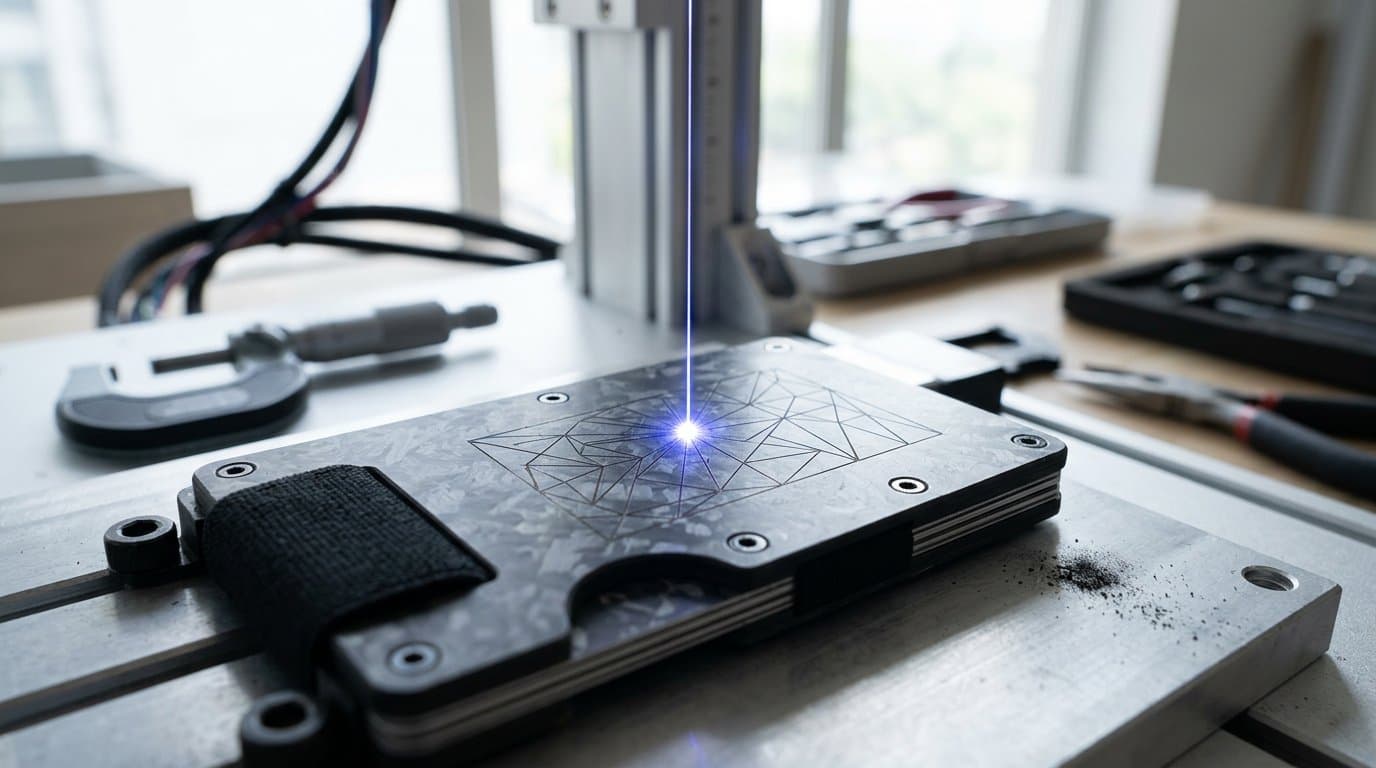
Both categories offer customization options. For metal wallets, laser engraving is the most common method. The logo is etched into the aluminum surface, creating a permanent mark. Laser engraving works well on anodized aluminum—the laser removes the anodized layer, revealing the bare metal underneath. For a premium look, some brands opt for CNC-engraved logos, which are deeper and more tactile.
For mechanical wallets, the branding placement is more constrained. The trigger mechanism and sliding tray occupy the interior surfaces. The logo is typically placed on the outer shell, either laser-engraved or printed. Some designs allow for a leather patch with embossed logos.
Mechanical wallets have higher MOQs due to the complexity of the assembly line. A typical MOQ for a custom mechanical cardholder is 1,000 to 3,000 units. The tooling required for the sliding channel—custom CNC fixtures and jigs—drives the initial cost.
Rigid wallets offer more flexible MOQs. A standard clamshell design with existing tooling can be sourced with MOQs as low as 300 to 500 units. Custom designs require new tooling but the tooling cost is lower because the geometry is simpler.
Supply chain lead times also differ. A rigid wallet can be produced in 15 to 25 days from order confirmation. A mechanical wallet typically requires 25 to 40 days due to the additional assembly and testing steps.
Evaluating a wallet supplier requires more than reviewing their website. The evaluation should be structured around technical capability, quality systems, and communication.
Ask the supplier about their CNC machining capabilities. Do they have in-house CNC machines, or do they outsource machining? In-house machining gives the supplier better control over tolerances and lead times. Outsource machining introduces a third party into the supply chain, which adds risk.
For mechanical wallets, ask about their experience with sliding mechanisms. A supplier who has produced mechanical cardholders before will have the fixtures and jigs needed for the sliding channel. A supplier who is new to the category will need to develop these from scratch, which adds cost and lead time.
Request their quality control documentation. A credible supplier should have a documented QC process that includes incoming material inspection, in-process inspection, and final inspection. For metal products, the QC process should include:
Material certification (mill certificates for aluminum, stainless steel, or titanium)
Dimensional inspection (calipers, micrometers, or CMM)
Surface finish inspection (visual and tactile)
Function testing (for mechanical wallets)
Ask for their defect rate and return rate data. A quality manufacturer should have a defect rate below 2% and a return rate below 1%.
The evaluation of a supplier is not just about technical capability. Communication speed and clarity are critical for a smooth production process. A supplier who responds to inquiries within 24 hours and provides clear, specific answers is more likely to be a reliable partner. A supplier who gives vague answers or delays responses will cause problems during production.
Avoid suppliers who:
Cannot provide material certifications. If they cannot document the aluminum alloy grade, they may be using substandard material.
Do not offer cycle testing for mechanical wallets. This test is essential for verifying the mechanism's lifespan.
Quote significantly below market rates. A mechanical wallet that costs $15 to manufacture cannot be sourced at $8 without compromising quality.
Have no in-house QC capability. If they outsource QC to a third party, the inspection may not be rigorous.
The total cost of ownership for a wallet product includes more than the unit price. It includes tooling costs, quality control costs, warranty costs, and logistics.
A Parliament-style mechanical wallet typically costs $18 to $35 per unit at MOQs of 1,000 to 5,000 units. The price depends on material (aluminum is cheapest, titanium is most expensive), finish (anodizing is standard, PVD coating is premium), and packaging.
A Ridge-style rigid wallet typically costs $10 to $20 per unit at the same MOQ. The simpler design and fewer assembly steps drive the cost down.
The initial tooling for a mechanical wallet is higher due to the custom fixtures needed for the sliding channel and trigger assembly. Expect tooling costs of $2,000 to $5,000 for a mechanical design. Rigid wallet tooling is typically $500 to $2,000.
The warranty risk for mechanical wallets is higher. If the trigger mechanism fails during the warranty period, the buyer must absorb the replacement cost. A 1% failure rate on a 5,000-unit order means 50 replacements. At a $25 unit cost, that is $1,250 in warranty exposure. For rigid wallets, the failure rate is near zero.
For a 5,000-unit order, the total cost analysis might look like this:
| Cost Component | Mechanical Wallet | Rigid Wallet |
|---|---|---|
| Unit price (avg) | $25 | $15 |
| Tooling | $3,500 | $1,000 |
| Subtotal | $128,500 | $76,000 |
| Warranty reserve (1% vs 0.1%) | $1,250 | $75 |
| Total | $129,750 | $76,075 |
The mechanical wallet costs roughly 70% more. The higher cost is justified only if the target market values the mechanical feature and is willing to pay a premium.
The choice between mechanical and rigid wallets depends on your target market and product strategy.
Your target demographic is tech enthusiasts, early adopters, or "gadget" consumers.
You want a product that differentiates through a tactile experience.
You have a higher price point and can absorb the higher unit cost.
You have a warranty strategy that accounts for mechanism failure.
Your target demographic is professionals, minimalists, or everyday carry enthusiasts.
You want a product with near-zero warranty risk.
You need a lower price point to compete in the mass market.
You want faster lead times and lower MOQs.
For a diversified product line, offering both categories is viable. The rigid wallet serves as an entry-level product with a lower price point. The mechanical wallet serves as a premium product with a higher margin. The two products can share the same brand and packaging, but they target different segments.
When sourcing metal wallets, several industry standards and certifications are relevant.
Aluminum wallets should use 6061-T6 or 7075-T6 alloy. These are aerospace-grade alloys with established mechanical properties. The material should come with a mill certificate confirming the alloy and temper.
RFID blocking performance is tested using the ISO 14443 standard for proximity cards. A wallet that blocks RFID should prevent reading of cards at a distance of 10 centimeters or more. For verification, ask for test results from an independent laboratory.
Anodized aluminum should meet the MIL-A-8625 specification for Type II (sulfuric acid) anodizing. The coating thickness should be 10 to 15 microns for wear resistance.
Environmental certifications like RoHS and REACH are relevant for European markets. These verify that the product does not contain restricted hazardous substances.
The "who makes the highest quality wallet" question has a practical answer: quality is determined by the factory's precision, not the brand name. A brand like Ekster or Ridge is essentially a marketing and distribution company. The actual manufacturing happens in factories like ours.
At GSTAR, we have been manufacturing metal wallets and mechanical cardholders for over 13 years. Our in-house CNC machining capabilities allow us to produce the intricate housings required for mechanical wallets and the sleek frames for rigid aluminum wallets. We understand the tolerance requirements—the ±0.1mm accuracy needed to prevent jamming in mechanical designs, the edge finishing that prevents scratches, the anodizing thickness that ensures color fastness.
We work with brands worldwide as an OEM and ODM partner. Some clients come to us with a design and ask us to manufacture it. Others come with a reference product—an Ekster Parliament or a Ridge—and ask us to produce a similar design under their private label. We provide both options.
Our monthly production capacity of 300,000 units supports orders of any size. Our quality control process includes cycle testing for mechanical wallets—we verify that the trigger mechanism survives 10,000 open/close cycles before shipment. For rigid wallets, we verify anodizing thickness and edge finishing on every batch.
The key insight for buyers is this: whether you choose to mimic the mechanical innovation of the Ekster Parliament or the rigid reliability of the Ridge, the final product quality depends on the precision of the factory, not just the design. A well-executed mechanical wallet from a factory with tight tolerances will outperform a poorly executed rigid wallet from a factory with loose tolerances.
The Ekster Parliament and the standard metal wallet serve different purposes. The Parliament offers a mechanical experience with a higher manufacturing cost and higher warranty risk. The rigid wallet offers durability and simplicity with a lower cost and near-zero failure rate.
For a B2B buyer, the choice depends on your target market, your price point, and your tolerance for warranty claims. Both categories can be profitable. The key is sourcing from a factory that can execute the design with precision.
Ready to discuss your next project? Contact Our Team to discuss your requirements, or request a quote to evaluate our capabilities against your specific design.
ISO 14443: Identification cards — Contactless integrated circuit cards — Proximity cards. https://www.iso.org/standard/73598.html
MIL-A-8625: Anodic Coatings for Aluminum and Aluminum Alloys. https://quicksearch.dla.mil/qsDocDetails.aspx?ident_number=35979
ASTM B211: Standard Specification for Aluminum and Aluminum-Alloy Rolled or Cold-Finished Bar, Rod, and Wire. https://www.astm.org/b0211-17.html
RoHS Directive 2011/65/EU. https://ec.europa.eu/environment/topics/waste-and-recycling/rohs-directive_en
REACH Regulation (EC) No 1907/2006. https://echa.europa.eu/regulations/reach/understanding-reach


