

Views: 236 Author: Gstar Technology Publish Time: 09-16-2026 Origin: Site


Content Menu
● Why Card Capacity Matters in Metal Wallet Design
● Expandable Metal Wallets: Flexible Capacity for Real-Life Carry
>> Benefits of expandable metal wallets
>> Limits of expandable metal wallets
● Fixed Capacity Cases: Consistent Shape and Controlled Organization
>> Benefits of fixed capacity cases
>> Limits of fixed capacity cases
>> Best customers for fixed-capacity cases
● Expandable Metal Wallets vs. Fixed Capacity Cases
>> 1. Essential carry: 3–5 cards
>> 2. Everyday carry: 6–8 cards
>> 3. Maximum carry: 9–12 cards
● The Hidden Variable: Not All Cards Are Equal
● RFID, NFC, and Why Overstuffing Can Affect Use
● OEM Design Checklist for Brands and Buyers
>> Define the user before choosing capacity
>> Build and test a realistic card stack
>> Match the mechanism to the promise
● Expert Recommendation: Sell Usable Capacity, Not Just Maximum Capacity
● Partner With Gstar Technology
● FAQ
>> 1. How many cards should an expandable metal wallet hold?
>> 2. Can an expandable metal wallet really hold 12 cards?
>> 3. Is a fixed capacity card case better than an expandable wallet?
>> 4. Do metal wallets block RFID and contactless payments?
>> 5. Why does my contactless card not work when it is inside a metal wallet?
>> 6. Are metal cards thicker than normal bank cards?
>> 7. What should brands test before launching an OEM metal wallet?
At Gstar Technology (Shenzhen) Co., Ltd., we design and manufacture OEM metal wallets, RFID card holders, slim wallets, leather wallets, key organizers, PSA card slabs, and protective accessories for global brands. One question repeatedly shapes product development: Expandable Metal Wallets vs. Fixed Capacity Cases: How many cards is too many?
The short answer is that "too many" is not simply the maximum number of cards a wallet can physically hold. It is the point where card access becomes slow, the wallet becomes uncomfortable, the user loses visibility over what they carry, or the product no longer delivers the slim everyday-carry experience customers expected.
For most minimalist-wallet users, 4 to 8 cards is the practical sweet spot. An expandable metal wallet may accommodate 1–12 cards, while a fixed-capacity case can provide a more consistent profile and more predictable card retention. The better choice depends on the customer's card-carrying habits, the target market, the desired product silhouette, and the brand's promise.
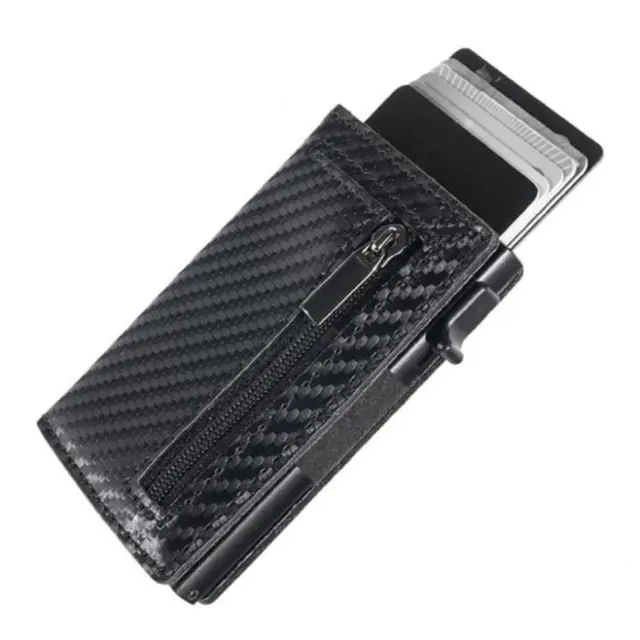
For overseas wallet brands, wholesalers, and private-label buyers, card capacity is not merely a specification. It affects perceived product quality, usability, return rates, reviews, packaging claims, and repeat purchase potential.
A standard bank card typically follows the ISO/IEC 7810 ID-1 format: 85.60 mm × 53.98 mm, with a nominal thickness of 0.76 mm. In simple terms, every additional standard card adds approximately three-quarters of a millimeter before accounting for embossing, metal cards, raised details, access cards, membership cards, and non-card items.
This is why a wallet that looks ultra-slim at four cards can feel materially different at 10 or 12 cards.
At Gstar Technology, we treat capacity as a system-level design decision, not a headline number. A well-built OEM RFID wallet must balance:
- Card retention at the minimum load.
- Expansion tolerance at the maximum stated load.
- One-handed access for everyday payment cards.
- Pocket comfort when seated or walking.
- Consistent exterior appearance across card counts.
- Material durability after repeated loading and unloading.
- RFID-shielding performance where applicable.
- Clear and honest capacity communication for end users.
A brand can advertise "holds up to 12 cards," but the more useful customer-facing question is: How many cards can it hold comfortably every day?
An expandable metal wallet generally uses two metal plates, elastic bands, a spring mechanism, adjustable rails, or a flexible internal assembly to hold different quantities of cards. This structure gives the user room to carry fewer cards on weekdays and more cards while traveling.
The best-known minimalist wallet format in this category commonly claims a 1–12-card range, using an expandable dual-plate structure designed to remain compact across different loads.
Flexible carrying capacity. Users can carry 3–5 cards for everyday life, then add a travel card, hotel keycard, business cards, transit card, or backup bank card when needed.
Slimmer at low card counts. Unlike a fixed case with pre-formed compartments, an expandable structure can sit closer to the actual stack thickness.
Strong minimalist appeal. This design aligns well with front-pocket carry, EDC culture, business travel, and modern men's accessories branding.
Good OEM customization potential. Brands can differentiate expandable wallets through aluminum, stainless steel, titanium, carbon-fiber-style plates, coatings, logos, cash straps, money clips, thumb cutouts, tracking-card compatibility, and custom packaging.
Lower commitment for users. A customer does not have to choose between a 5-card and 10-card wallet at checkout. One expandable product can serve both needs.
The maximum capacity is not necessarily the best daily capacity.
As more cards are added, an expandable wallet may become harder to thumb-fan, slower to sort, and less stable to use with one hand. A consumer review of a comparable 1–12-card metal wallet noted that 6–8 cards were comfortable, while 12 cards felt like a practical limit rather than an ideal everyday load.
For brand owners, this creates a crucial messaging opportunity:
"Built to expand up to 12 cards. Optimized for everyday carry with 4–8 cards."
This wording is more credible than promoting maximum capacity alone. It acknowledges real use behavior while preserving the product's flexibility.
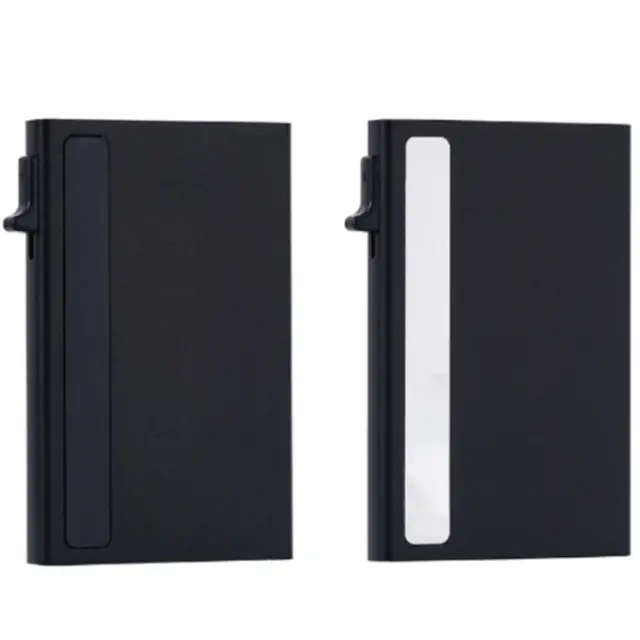
A fixed capacity card case is engineered around a defined number of slots or a rigid interior volume. It may be made from aluminum, stainless steel, leather-wrapped metal, molded polymer, or a hybrid construction.
Instead of adapting substantially to different loads, the case is designed to perform best within a narrower card-count range.
Predictable thickness. A fixed case gives the user and the brand a more consistent profile. This is useful when slimness is a key selling point.
Defined organization. Dedicated slots make it easier to separate payment cards, identification, transit cards, business cards, and receipts.
Fast visual selection. Users who frequently need a specific card may prefer visible slot separation over a stacked-card format.
Premium structural feel. Rigid cases often feel highly engineered and can support a more formal, luxury, or business-oriented product position.
Clear capacity expectations. A "6-card case" is easier to explain than an expandable product with a large theoretical range.
A fixed-capacity case can become restrictive when the user's carry needs change. If the case is designed for six cards, inserting seven or eight may compromise closure, damage the lining, stretch leather, or create poor card retention.
Fixed designs can also look thicker than expandable wallets when lightly loaded. A user carrying only three cards may still carry the full bulk of the case structure.
For OEM buyers, the main development challenge is choosing a capacity that is neither too narrow nor too loose. A six-slot product may look elegant but frustrate a customer who carries a driver's license, two bank cards, a transit card, work access card, health card, and membership card.
Fixed capacity cases work best for:
- Customers with stable, routine card needs.
- Luxury and business-accessories brands.
- Users who prioritize card-by-card organization.
- Retailers seeking a simple, easy-to-explain product.
- Consumers who dislike elastic compression or stacked-card access.
- Brands building coordinated leather goods collections.
| Feature | Expandable Metal Wallet | Fixed Capacity Case |
|---|---|---|
| Typical practical daily load | 4–8 cards | Usually matches its stated slot count |
| Maximum flexibility | High | Low to moderate |
| Profile with fewer cards | Usually slimmer | Usually remains structurally fixed |
| Organization | Stacked cards; requires ordering | Individual slots or defined compartments |
| Card access | Thumb push, fan, or pull-tab | Select a visible, separated card |
| Travel suitability | Strong for changing card needs | Better for predictable routines |
| Pocket feel | Compact when lightly loaded | Consistent but may be bulkier at low loads |
| Best brand position | Minimalist, EDC, technical, modern | Luxury, classic, business, organized |
| Main product risk | Overloading can reduce access speed | Overfilling can strain or deform the case |
| Recommended messaging | "Up to X cards; ideal at Y–Z cards" | "Designed for exactly X essential cards" |
For most users, too many cards means more than they can access quickly without compromising the wallet's original purpose.
At Gstar Technology, we recommend separating capacity into three practical levels for product development and marketing.
This is the ideal minimalist range.
A typical setup may include:
- Primary credit or debit card.
- Backup payment card.
- Driver's license or identity card.
- Transit or access card.
- Health, membership, or loyalty card.
At 3–5 cards, an expandable metal wallet remains highly compact, easy to grip, and fast to use. This range is ideal for brands selling front-pocket wallets, slim RFID card holders, and lightweight EDC accessories.
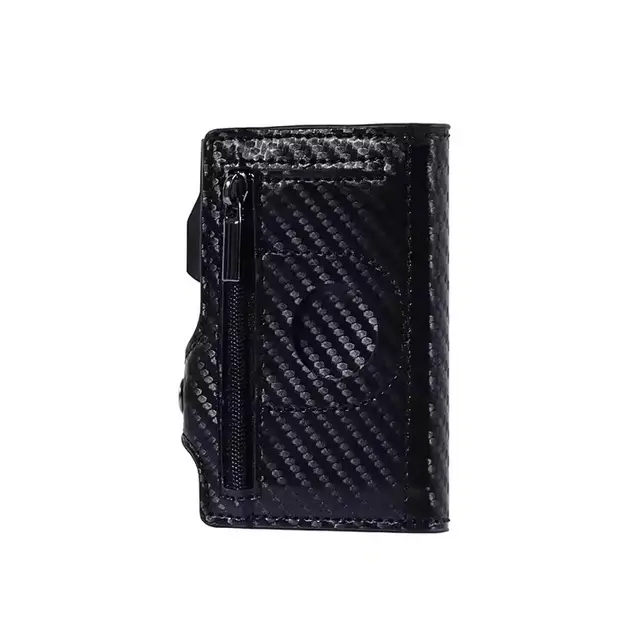
This is the practical range for many customers.
It gives users enough space for work, transport, personal finance, identification, and occasional loyalty needs without turning the wallet into a thick card stack. Independent reviews of comparable expandable metal wallets frequently identify around 6–8 cards as the most comfortable working range.
For many OEM brands, this is the most important design target. The wallet should feel secure at six cards, smooth at eight cards, and still reliable at a higher stated maximum.
This range is best treated as occasional capacity, not the everyday target.
Nine to 12 cards can make sense for international travel, trade-show attendance, multi-card business use, or customers replacing a traditional bifold wallet. However, the wallet may become noticeably thicker, access can become slower, and the user may have difficulty identifying the right card quickly.
The key principle is simple:
If a user must repeatedly fan through a thick stack to find a card, they are probably carrying too many cards for a minimalist wallet.
A capacity claim based on standard PVC bank cards is useful, but it does not reflect every real-world load.
A wallet's effective capacity can change significantly when users carry:
- Metal credit cards, which may be thicker and heavier.
- Embossed cards, especially older payment cards.
- Building-access cards with different material structures.
- Transit cards, which users may want to tap without removing.
- Hotel keycards or event badges.
- Stacks of business cards, which are not designed for compression.
- Receipts, folded cash, keys, coins, or SIM tools, which should not be forced into a card-only wallet.
For this reason, OEM product specifications should state both a general card range and an appropriate qualification, such as:
That sentence improves transparency, reduces customer confusion, and protects the brand from avoidable returns.
Metal wallets are commonly selected for their RFID-blocking characteristics. Conductive materials such as aluminum can help interfere with the radio signals used by contactless cards, and RFID-shielding designs are intended to prevent cards from being read while enclosed.
However, users should understand the trade-off: a metal or RFID-blocking wallet may also prevent a contactless card from being tapped while it remains inside. That is usually intentional. The user should remove the specific payment or transit card before tapping.
Multiple contactless cards placed together can also create "card clash," where a reader may struggle to identify the intended card or may not complete the transaction as expected. Separating the card or removing it from the wallet is the most reliable practice.
For brands developing RFID card holders, this leads to better UX guidance:
1. Put the most-used payment card in the easiest-access position.
2. Keep contactless cards organized rather than randomly stacked.
3. Tell users to remove the card before tapping if the wallet is RFID-blocking.
4. Avoid claiming that every card can be tapped through a metal wallet.
5. Test RFID performance on the finished product, not only on raw materials.
A strong OEM wallet program begins with the target user, not with a competitor's capacity claim.
Ask these questions:
- Is the product for daily commuting, travel, business, or luxury gifting?
- Does the customer typically carry 4 cards or 10?
- Will they carry cash?
- Is front-pocket comfort the primary benefit?
- Is quick card selection more important than maximum storage?
- Will the brand sell the wallet in markets where access cards and transit cards are common?
- Does the target customer use contactless payment frequently?
At Gstar Technology, we recommend OEM buyers test a prototype at:
- Minimum load: 1–3 standard cards.
- Core use load: 4–8 standard cards.
- Maximum stated load: the advertised capacity.
- Mixed-card load: standard PVC, embossed cards, and at least one metal card where relevant.
- Repeated-use load: repeated insertion and removal cycles.
- Pocket-use scenario: sitting, walking, and front-pocket carry.
- Cash-access scenario: if a cash strap or money clip is included.
A product should not only "fit" cards. It should retain them reliably, release them comfortably, and preserve its intended appearance over time.
| Brand promise | Recommended product direction |
|---|---|
| "The slimmest everyday wallet" | Expandable metal wallet optimized for 3–6 cards |
| "One wallet for work and travel" | Expandable metal wallet rated for 4–10 or 4–12 cards |
| "Organized business essentials" | Fixed-capacity case with defined slots |
| "Premium leather with modern security" | Leather-wrapped RFID card case with a controlled slot count |
| "Tactical EDC utility" | Metal plate wallet with cash strap, clip, and modular accessory options |
| "Minimalist gift product" | Fixed 4–6-card case or expandable wallet with branded packaging |
The most successful metal wallet brands avoid a common mistake: treating "more cards" as automatically better.
A 12-card capacity claim can attract attention, but a customer who carries 12 cards every day may not experience the same slimness, speed, or simplicity promised by minimalist wallet marketing. By contrast, a product designed around a realistic 4–8-card carry can generate better comfort, better reviews, and clearer product-market fit.
For expandable metal wallets, position the product around flexibility:
- Compact for daily essentials.
- Expandable for travel or changing routines.
- Best for 4–8 cards.
- Able to handle more when necessary.
For fixed capacity cases, position the product around control:
- Defined organization.
- Stable form factor.
- Purpose-built for a specified number of cards.
- Ideal for customers with a consistent daily routine.
This approach is more honest, more user-centered, and more sustainable for brand reputation.

Gstar Technology (Shenzhen) Co., Ltd. helps international brands, wholesalers, retailers, and manufacturers develop OEM and ODM wallet products that balance capacity, slimness, security, material quality, and daily usability.
Whether you are creating an expandable RFID metal wallet, a fixed-capacity aluminum card case, a slim leather wallet, a Ridge-style wallet, a key organizer, or a custom accessory line, we can support your product development from concept to production.
Contact Gstar Technology to discuss your target card capacity, material requirements, logo application, packaging, MOQ, and custom OEM wallet project. Build a product that customers can carry comfortably—not just one that looks good on a specification sheet.
For most users, 4–8 cards is the best everyday range. It keeps the wallet slim while allowing room for payment cards, ID, transit, and access cards. Higher capacity can be useful for travel or occasional use.
Many expandable designs can physically hold up to 12 standard cards. However, real capacity varies according to card thickness, embossing, metal cards, and the wallet mechanism. A maximum capacity should not be confused with optimal daily capacity.
Neither is always better. A fixed case is better for users who want consistent thickness and separated card organization. An expandable wallet is better for users whose card count changes between daily use, work, and travel.
Metal and RFID-blocking wallet designs can interfere with RFID and NFC signals, helping prevent contactless cards from being read while enclosed. As a result, users generally need to remove the card before tapping it at a terminal.
The metal or RFID-shielding structure can block the signal needed for the reader to communicate with the card. Multiple contactless cards stacked together can also cause card clash. Remove the intended card before tapping for the most reliable result.
Some metal payment cards may differ in thickness and weight from standard PVC cards. Because wallet capacity is usually calculated using standard ID-1 cards with a nominal 0.76 mm thickness, a mixed stack may reduce the total number of cards the wallet can hold comfortably.
Brands should test card retention, card access, minimum and maximum capacity, mixed-card compatibility, RFID performance, repeated loading cycles, cash-strap function, logo durability, coating wear, and real front-pocket comfort.
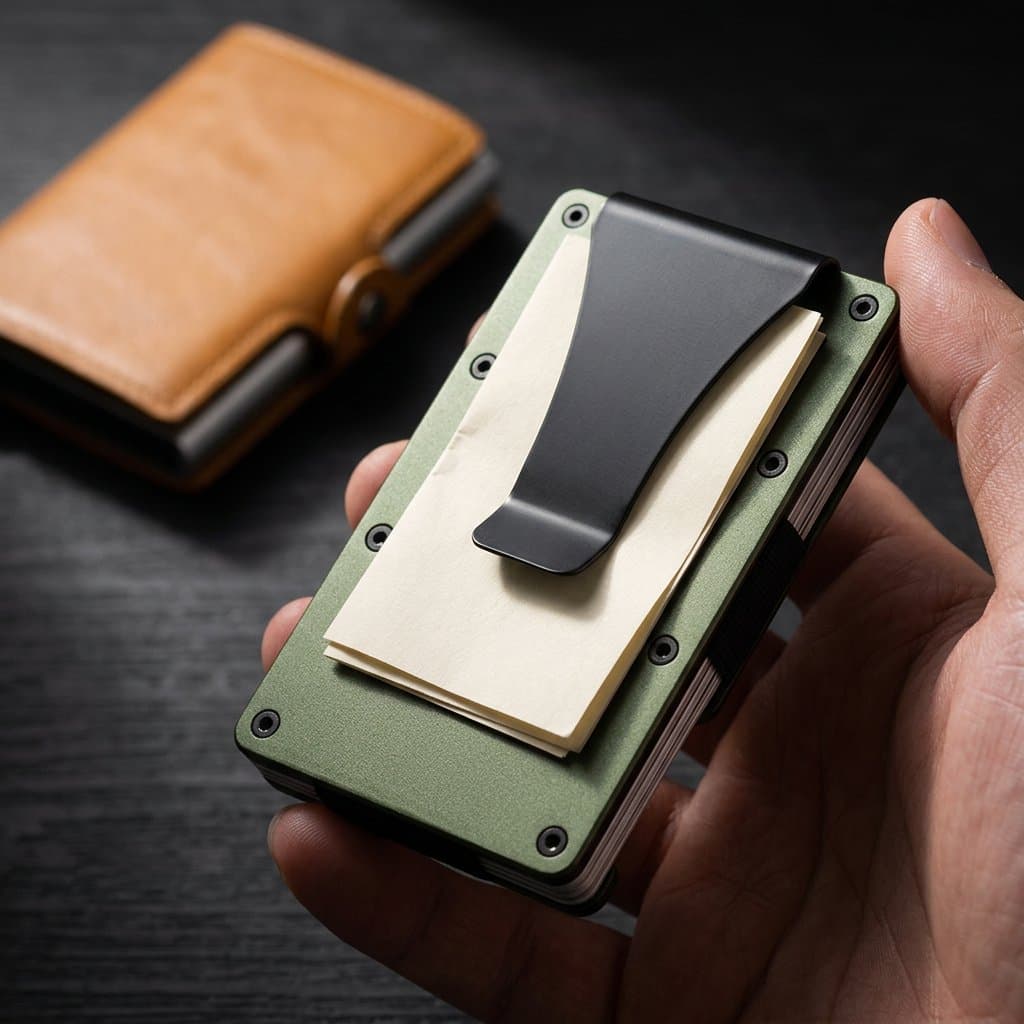
1. ISO. "[ISO/IEC 7810:2003 — Identification cards — Physical characteristics]." Standard dimensions and nominal thickness for identification-card formats, including ID-1 cards. [iso]
2. The Ridge. "[Aluminum Black Wallet]." Product information describing a 1–12-card expandable capacity for a comparable minimalist metal wallet format. [ridge]
3. The Gear Bunker. "[Ridge Wallet Review After 1 Year | Still Worth It in 2025?]." Practical review observations regarding comfortable 6–8 card use and higher-capacity trade-offs. [thegearbunker]
4. Kisi Academy. "[How To Address RFID/NFC Interference Between Cards in Your Wallet]." Explanation of NFC card interference and methods for separating cards. [getkisi]
5. RFID Label. "[Do Contactless Cards Work Through a Wallet?]." Discussion of metal-wallet signal blocking, contactless-card interference, and card-clash considerations. [rfidlabel]
6. The Ridge. "[RFID Blocking Wallets]." Product information on conductive wallet materials and RFID-blocking positioning. [ridge]
Hot Tags: China, Global, OEM, private label, manufacturers, factory, suppliers, manufacturing company


