

Views: 256 Author: Gstar Technology Publish Time: 09-21-2026 Origin: Site


Content Menu
● What Is a Metal Key Organizer?
● Metal Key Organizer vs. Traditional Key Ring
● 1. Noise: Controlled Keys vs. Constant Jingle
● 2. Pocket Comfort and Device Protection
>> Why the organizer format feels different
● 3. Key Access: Faster Search or Better Organization?
>> Traditional key rings are usually better when:
>> Metal key organizers are usually better when:
● 4. Capacity and Compatibility: The Most Important Buying Reality
>> A practical customer-fit checklist
● 5. Material Choices and Brand Positioning
● How Brands Can Develop a Better Key Organizer
>> 1. Define the user's daily carry
>> 2. Set a realistic capacity claim
>> 3. Test hardware under repeated use
>> 4. Build a coherent product family
>> 5. Use packaging to explain the product
● Final Verdict: Which Should Customers Choose?
>> 1. Are metal key organizers better than traditional key rings?
>> 2. How many keys can a metal key organizer hold?
>> 3. Can I attach a car key fob to a metal key organizer?
>> 4. Do metal key organizers scratch keys?
>> 5. Do metal key organizers loosen over time?
>> 6. Is aluminum or titanium better for a key organizer?
>> 7. Can Gstar Technology customize metal key organizers for overseas brands?
At Gstar Technology (Shenzhen) Co., Ltd., we help overseas brands, wholesalers, and manufacturers develop practical everyday-carry products—from Ridge-style wallets and RFID card holders to metal key organizers, leather wallets, keychains, PSA card slabs, and protective accessories. One question repeatedly shapes product planning: what are the differences between metal key organizers and traditional key rings?
The short answer is simple: a traditional key ring is inexpensive, flexible, and familiar, while a metal key organizer provides a quieter, flatter, more intentional carry experience. But for a brand building an EDC, gifting, travel, lifestyle, or promotional-product line, the decision involves much more than appearance. It affects pocket comfort, material choice, customer perception, manufacturing complexity, packaging, price positioning, and long-term product differentiation.
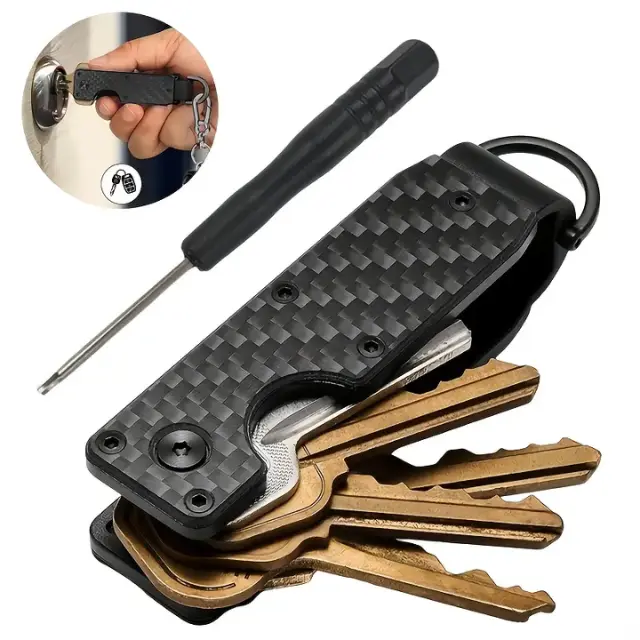
A metal key organizer is a structured key-carrying device that stacks keys between two metal plates, rails, or arms. Instead of letting keys swing independently from a circular split ring, it uses a central screw, pivot, spacer system, or tension mechanism to hold them in a controlled arrangement.
Most metal key organizers use materials such as:
- Aluminum, valued for its low weight, machinability, anodized color options, and accessible price point.
- Stainless steel, selected for strength, wear resistance, and a more substantial feel.
- Titanium, used in premium EDC products because it combines high strength, corrosion resistance, and a distinctive high-end identity.
- Brass or copper, typically chosen for a heritage look and a natural patina over time.
A traditional key ring, by contrast, is usually a round split ring made from spring steel or stainless steel. Keys, fobs, tags, clips, and accessories hang loosely from the ring.
The key difference is not merely material. It is key control. A metal organizer turns a loose cluster of keys into a compact, aligned tool; a traditional ring keeps every item independently suspended.
The following table gives a practical comparison for consumers and product-development teams.
| Feature | Metal Key Organizer | Traditional Key Ring |
|---|---|---|
| Key arrangement | Keys are stacked and tensioned in a controlled order | Keys hang freely and move independently |
| Pocket noise | Usually very quiet when correctly adjusted | Often produces noticeable jingling |
| Pocket comfort | Flat, contained profile with fewer exposed key edges | Uneven, bulky cluster that can poke or scratch |
| Access method | User rotates or flips out a selected key | User searches through hanging keys |
| Capacity | Best for a defined number of standard keys, often 2–8 | Highly flexible; can hold many keys and accessories |
| Compatibility | Works best with flat, standard keys | Handles irregular keys, large tags, fobs, and accessories easily |
| Maintenance | May require screw tightening, spacer adjustment, or hardware checks | Minimal maintenance; replacement is simple |
| Product complexity | Higher; requires precision hardware and quality control | Low; generally simple, inexpensive construction |
| Brand positioning | Suitable for premium EDC, gifting, and minimalist collections | Suitable for value, utility, promotional, and high-capacity use |
| Customization potential | Strong: laser engraving, anodizing, CNC details, logo plates, packaging | Moderate: logo charms, tags, ring finishes, and clips |
For many customers, noise is the first reason to replace a traditional key ring.
Loose keys on a ring strike each other while walking, driving, or reaching into a bag. That sound may seem minor, but it becomes a daily irritation for commuters, travelers, office workers, students, and minimalist EDC users. A metal organizer reduces this movement by holding keys under tension between its body plates.
The result is a more discreet carry experience:
- Less jingle during walking or commuting.
- Less movement inside a pocket, backpack, or sling bag.
- Fewer impacts between key teeth, key heads, and nearby accessories.
- A more refined customer experience for premium lifestyle brands.
Independent reviewers of modern key organizers consistently identify quieter carry as one of the key benefits compared with jangly key rings. Reviews also confirm the trade-off: the tension must be adjusted correctly so keys remain secure but can still be deployed without frustration.
From our OEM perspective, this is why hardware tolerance matters. A key organizer that is too loose can feel cheap and allow keys to swing. A design that is too tight can be hard to operate. Strong product development requires testing the pivot, screw thread, washers, spacers, and key rotation resistance as a complete system.
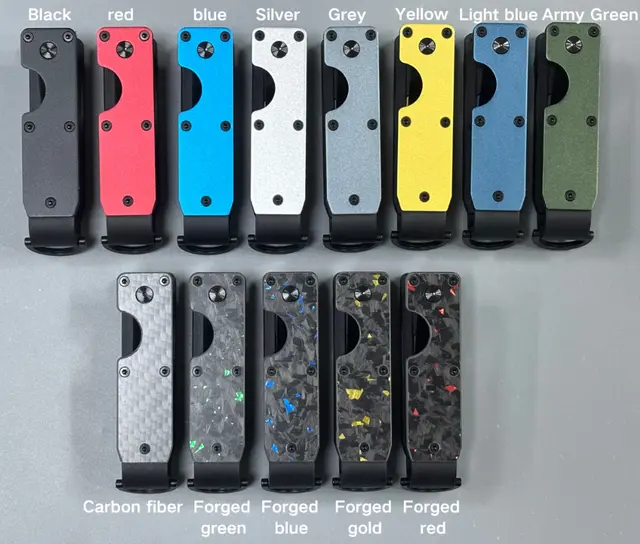
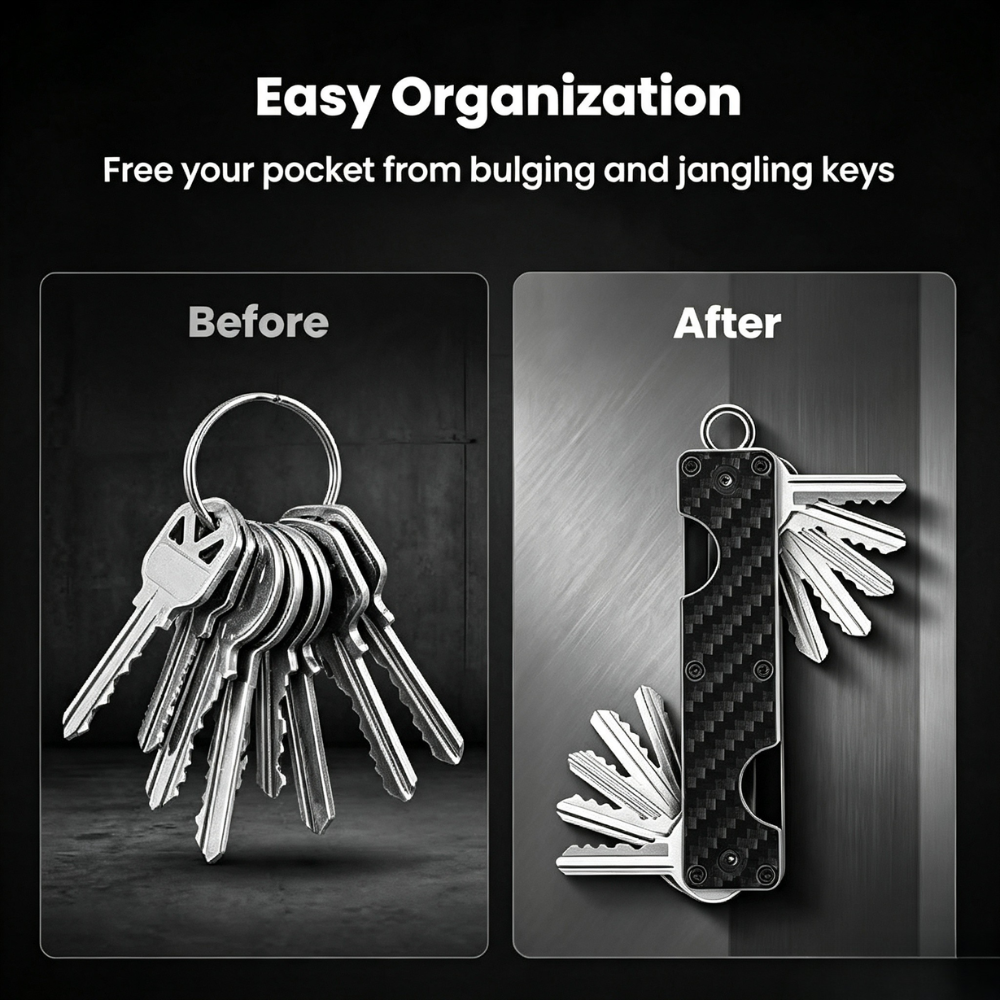
Traditional key rings create an irregular bundle. Key teeth point in different directions, accessories pull away from the ring, and the full cluster can create a noticeable pocket bulge. In everyday use, sharp key edges may scratch a phone, damage a wallet surface, catch pocket lining, or feel uncomfortable when sitting.
A metal key organizer addresses these problems by aligning keys into a compact stack.
- Keys stay closer together, reducing uncontrolled movement.
- Sharp key teeth can face inward when arranged properly.
- The profile is flatter and more predictable than a hanging cluster.
- The outer metal plates create a protective boundary around the key stack.
- The product can visually match other EDC gear, including metal wallets, RFID card holders, pens, multi-tools, and car accessories.
This is especially relevant for brands selling Ridge-wallet-style products or minimalist card wallets. Customers who choose a slim metal wallet often want the rest of their everyday carry to follow the same design language: compact, durable, quiet, and intentional.
However, "metal" does not automatically mean "slim." A badly designed organizer with thick plates, oversized bolts, excessive spacers, or too many keys can become bulky. One independent review of a leather organizer with metal hardware noted that added capacity and upgraded mechanisms can also increase pocket bulk.
OEM insight: Brands should define the ideal daily key load before choosing the organizer's width, post length, and plate thickness. For many users, a 3–6 key configuration offers a more realistic balance than designing around maximum capacity alone.
Traditional key rings offer immediate access because every key is visible and hanging freely. A user can often grab a key directly, especially if they know its position by touch. This makes rings useful for users who carry many different keys, frequently add temporary keys, or need quick access to large accessories.
Metal key organizers use a different interaction model. The user rotates, fans, flips, or deploys the needed key from the stack. This process can feel more deliberate and tidy, but it also introduces a learning curve.
- The user carries many keys with different shapes.
- Keys are frequently added or removed.
- The setup includes large car fobs, garage remotes, access cards, or bulky tags.
- Low cost and maximum flexibility matter more than pocket organization.
- The user needs to identify and pull out a key instantly.
- The user carries a stable set of daily keys.
- Quiet, compact carry is a priority.
- The user values a minimalist look.
- The product is part of a premium EDC ecosystem.
- The customer wants to reduce scratches and pocket clutter.
- The brand wants an item with stronger perceived value than a standard key ring.
Some modern organizers address the access concern with quick-flip tabs, tool-free adjustment, or external D-rings for larger items. For example, one current organizer design uses a tool-free micro-adjustment system, a quick-flip feature for a frequently used key, and a fixed D-ring for bulky fobs or larger keys. It is designed for three to nine standard keys, showing how newer designs try to preserve organization without forcing every item into the main stack.
A key organizer is not a universal replacement for every key ring. This is one of the most important points brands should communicate honestly.
A standard metal organizer works best with flat keys that have a round mounting hole near one end. Keys that are exceptionally thick, long, curved, oversized, or unusually shaped may not fit comfortably. Large electronic car keys, remote fobs, apartment tags, gate remotes, and decorative keychains are often better attached to an external ring, clip, or D-ring.
Traditional key rings have the advantage of near-unlimited compatibility. If an item has a hole, loop, or clip, it can normally be added.
Before recommending a metal key organizer, encourage customers to check:
1. How many standard keys do I carry daily?
2. Are my keys flat enough to stack?
3. Do I have a bulky car fob or remote?
4. Do I regularly add or remove keys?
5. Would I rather reduce noise and bulk, or maximize capacity?
6. Do I need a separate attachment point for a tracker, fob, or quick-release clip?
This type of buyer guidance reduces returns and increases satisfaction. It also helps brands avoid making vague claims such as "fits all keys," which can create avoidable customer disappointment.
User feedback on a current organizer illustrates the point well: buyers often praise quiet organization, pocket protection, premium materials, and one-handed access, while some still report a short learning curve or fit limitations with certain key types.
For product brands, choosing a metal key organizer is also a material and positioning decision.
| Material | Best For | Strengths | Considerations |
|---|---|---|---|
| Aluminum | Mid-range EDC, promotional upgrades, colorful collections | Lightweight, anodizable, cost-efficient, easy to machine | Can show scratches or dents more easily than steel or titanium |
| Stainless steel | Rugged utility, industrial styling, durable accessories | Strong, scratch-resistant, solid feel | Heavier; machining and finishing can cost more |
| Titanium | Premium EDC, outdoor, collector, and luxury-minimalist brands | Lightweight, corrosion-resistant, premium perception | Higher raw-material and machining cost |
| Brass/copper | Heritage, vintage, artisan, gift collections | Warm appearance, natural patina, distinctive feel | Heavier; surface changes over time |
| Leather plus metal hardware | Executive gifts, lifestyle collections, premium fashion accessories | Softer carry feel, color variety, classic appeal | Requires leather-quality control and may have lower abrasion resistance than all-metal designs |
At Gstar Technology, product development starts with the intended market—not simply the material. An aluminum organizer may be the best fit for a scalable branded campaign. Titanium can support a higher-margin premium launch. A leather-and-metal version can complement a genuine leather wallet collection. A stainless-steel model may suit practical, workwear, motorcycle, or outdoor customers.
A successful OEM key organizer should solve a real daily problem without adding unnecessary complexity. Based on practical product-development experience, we recommend the following process.
Decide whether the product targets:
- Minimalists carrying 2–4 keys.
- Commuters carrying home, office, mailbox, and bike keys.
- Drivers who need a separate fob attachment.
- Travelers who need a tracker or quick-release feature.
- Gift buyers looking for personalization and premium packaging.
A single design rarely serves every group equally well.
Do not promote maximum theoretical capacity as the primary benefit. A key organizer may technically accept more keys, but usability, thickness, and access can decline as the stack grows.
A clear claim such as "comfortably fits 2–6 standard keys" is often more useful than an exaggerated capacity statement.
The core functional components require special attention:
- Pivot screw and thread engagement.
- Washers and spacers.
- Plate alignment.
- Edge finishing.
- Tension consistency.
- Resistance to loosening.
- Compatibility with common key-hole sizes.
- Performance when carried with a fob or external accessory.
Tool-free adjustment is increasingly attractive because it removes the need for a coin or screwdriver during setup. Independent testing of a modern organizer found tool-free key installation and adjustable spring tension to be meaningful usability advantages.
For the strongest cross-selling opportunity, match the organizer's finish and branding to related products:
- Metal wallets.
- RFID card holders.
- Leather wallets.
- Keychains and quick-release accessories.
- AirTag or tracker holders.
- Multi-tools.
- Gift boxes and corporate promotional sets.
This creates a more complete EDC collection and makes the key organizer more than a standalone accessory.
Unlike a simple ring, an organizer may require setup. Packaging should include concise instructions, a QR code to a demonstration video, care advice, hardware specifications, and a compatibility note.
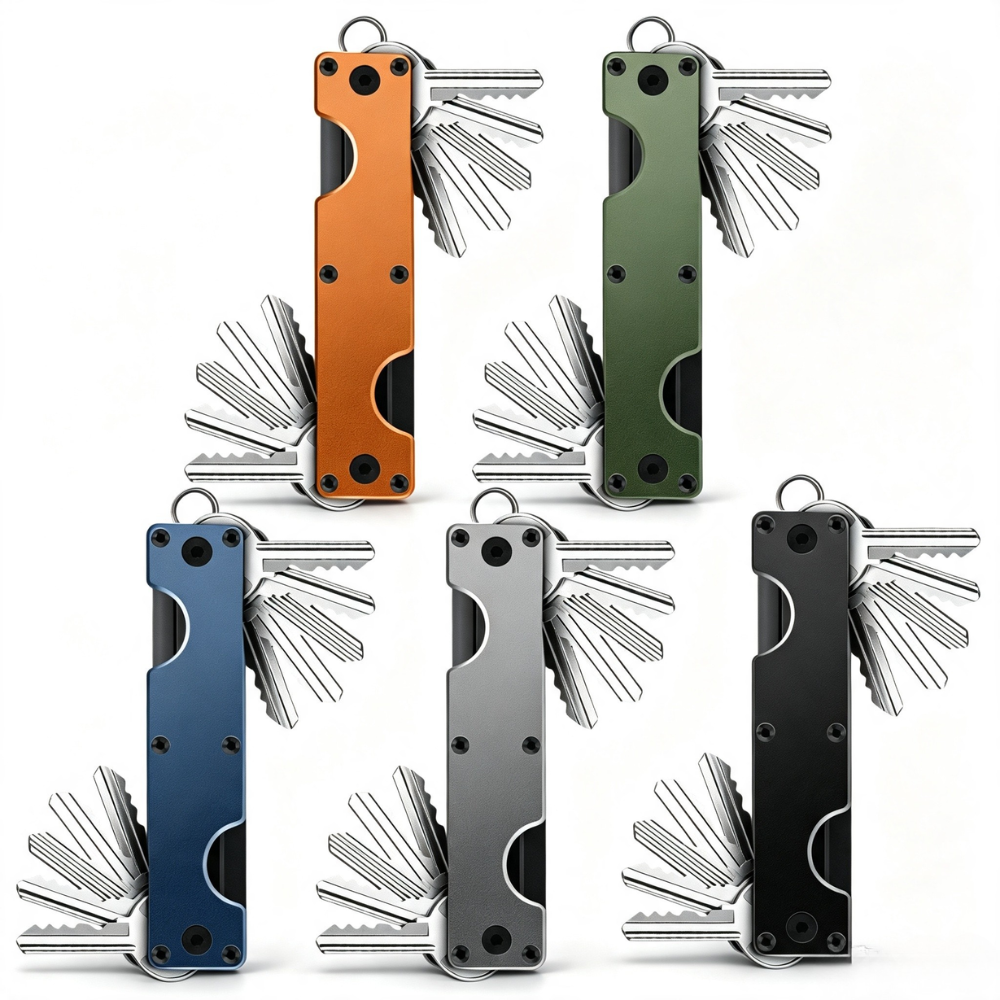
The differences between metal key organizers and traditional key rings come down to priorities.
Choose a traditional key ring when low price, unrestricted capacity, instant access, and broad compatibility matter most. It remains a practical solution for users with large key sets, unusual accessories, or frequently changing keys.
Choose a metal key organizer when the goal is a quieter, flatter, more premium everyday carry experience. It is particularly effective for users with a stable set of standard keys and for brands building minimalist, durable, design-led EDC collections.
For overseas brands, wholesalers, and manufacturers, the opportunity is clear: a well-engineered metal key organizer can elevate an accessory assortment from a generic keychain offering to a higher-value, customizable product category.
Ready to develop your own metal key organizer or coordinated EDC collection? Contact Gstar Technology (Shenzhen) Co., Ltd. to discuss OEM materials, logo customization, hardware structure, packaging, quality requirements, and production solutions for your brand.
They are better for users who want less noise, a flatter pocket profile, and more organized keys. Traditional rings are still better for maximum capacity, frequent key changes, and oversized accessories.
It depends on the design, key thickness, spacer system, and post length. Many everyday models work best with approximately 2–8 standard flat keys, while some expanded designs support more. Always state the comfortable working capacity rather than only the theoretical maximum.
Usually, yes—but it is often best to attach a bulky vehicle fob to an external D-ring, quick-release ring, or clip rather than placing it inside the key stack. This keeps the organizer flatter and easier to use.
A properly designed organizer with suitable spacing, smooth internal surfaces, and appropriate tension should minimize uncontrolled rubbing. Keys may still show normal wear over time, especially if they are frequently deployed or carried with other metal accessories.
They can if the hardware is poorly designed or not tightened properly. High-quality designs use reliable screw threads, washers, tension components, and tested tolerances. Brands should include setup instructions and, where appropriate, spare hardware.
Aluminum is generally lighter in cost, easy to anodize, and suitable for mainstream products. Titanium offers stronger premium positioning, excellent corrosion resistance, and a distinctive high-end feel, but it raises material and machining costs.
Yes. Gstar Technology can support OEM development for metal key organizers, including material selection, logo engraving, surface finishing, color options, accessory configuration, packaging, and coordination with wallets, RFID card holders, leather goods, and other EDC products.
1. Gstar Technology (Shenzhen) Co., Ltd., "[Key Organizer vs Traditional Keychain: EDC Comparison Guide for Brands]." The page was identified in search results as a Gstar Technology comparison guide for brands. [gstartec]
2. Pack Hacker, "[Orbitkey Key Organizer Pro Review]." Used for independently reported product observations on tool-free adjustment, nine-key capacity, quick key deployment, weight, added bulk, and real-world use considerations. [packhacker]
3. Orbitkey, "[Key Organizer Pro Leather]." Used for product specifications and aggregated customer-review themes regarding adjustable tension, key capacity, quick-flip access, fixed D-ring functionality, quiet carry, pocket protection, and potential compatibility limitations. [orbitkey]
4. Pack Hacker, "[The Best Key Organizer for Minimalist Everyday Carry]." Used for market context on material options, product capacities, and organizer weight comparisons. [packhacker]
5. Keyport, "[Ultimate Guide to Key Organizers: Comparisons & Buyer Tips]." Used for general market framing around stacked key organization, noise reduction, material categories, capacity variation, and car-fob compatibility considerations. [mykeyport]
6. Google Patents, "[Pocket Key Organizer — USD714537S1]." Used as background context that key-organizer form factors are a recognized product-design category. [patents.google]
Hot Tags: China, Global, OEM, private label, manufacturers, factory, suppliers, manufacturing company


