

Views: 387 Author: Professor Leon Publish Time: 09-01-2026 Origin: Site


Content Menu
● 1. What Defines a Secrid Wallet Alternative with More Capacity?
● 2. Key Technical Specifications for High-Capacity Alternatives
● 3. A Procurement Framework for Evaluating Alternatives
● 4. Sourcing Strategies: OEM, ODM, and Wholesale Options
● 5. How to Evaluate a Wallet Manufacturer
● 6. How We Meet These Standards: A Manufacturer's Perspective
11 min read
When a buyer in Rotterdam opened a sample box from our factory last spring, the first thing they did was count the cards. Six in the main slot. Two in the hidden pocket. Then they folded a €50 note and slid it into the cash sleeve. It fit. That was the entire test — because the product they were replacing, a Secrid cardholder, had failed on exactly those three counts for their customers.
The Secrid wallet is a design icon. Its pop-up mechanism is satisfying, the aluminum shell feels premium, and RFID protection is built-in. But the standard model holds roughly 4–6 cards. No cash slot. No coin pocket. For a significant segment of consumers — people who carry transit passes, loyalty cards, IDs, and emergency notes — that capacity is simply insufficient.
For B2B buyers, this gap is an opportunity. A Secrid wallet alternative with more capacity can capture customers who want the slim profile and security features but need room for 8–12 cards plus cash. This guide covers the technical specifications, procurement frameworks, and supplier evaluation criteria needed to source such a product profitably.
A Secrid wallet alternative with more capacity is any RFID-blocking cardholder that offers greater storage than the standard 6-card Secrid design while maintaining a slim profile (under 16mm closed thickness). The category includes vertical leather wallets with multiple slots, hybrid metal-leather designs, and multi-layer aluminum cardholders with ejector mechanisms.
The key distinction from a standard Secrid is the capacity-to-thickness ratio. A typical Secrid measures about 12mm thick for 6 cards. A high-capacity alternative should hold 10+ cards at 14–16mm. That 2–4mm difference represents the engineering challenge: how to add storage without turning the product into a bulky bifold.
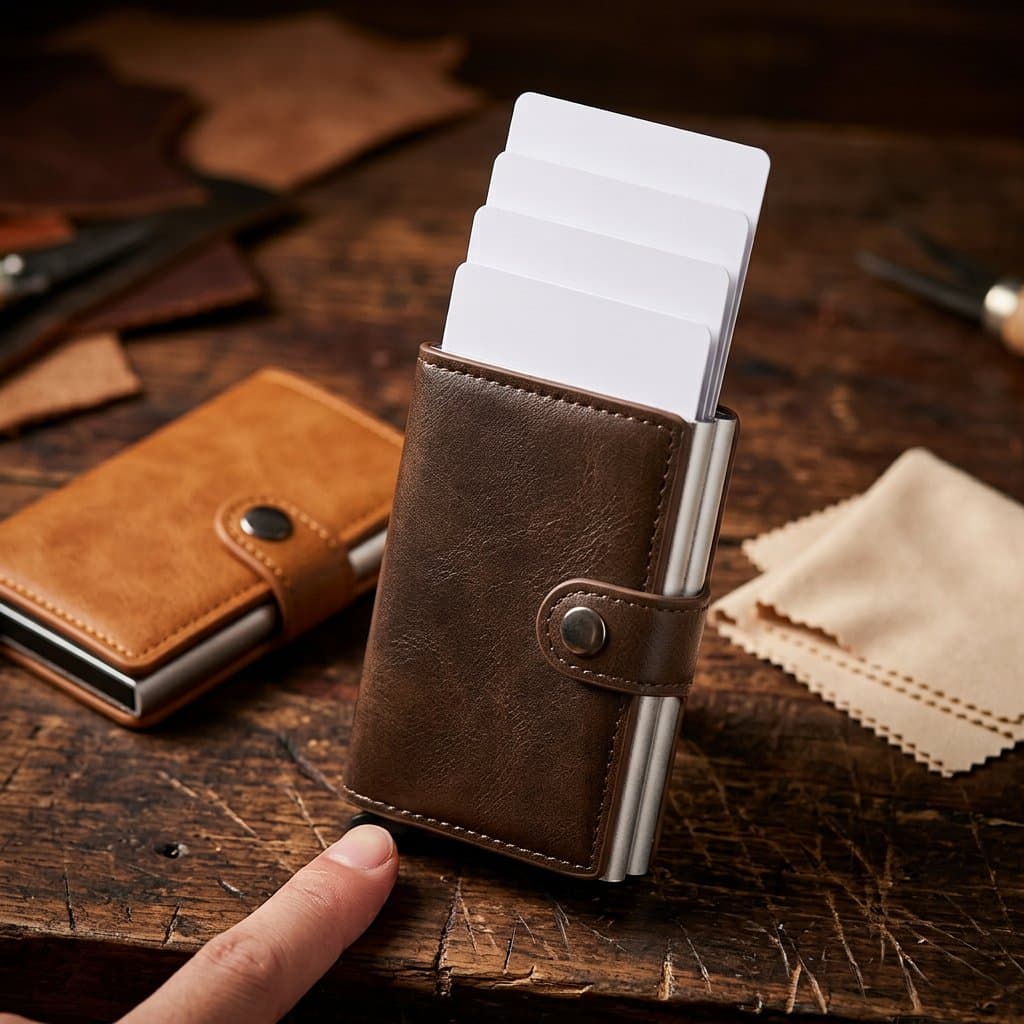
Three subcategories dominate the market:
Multi-slot aluminum cardholders — CNC-machined aluminum frames with precision-cut channels. Usually 8–10 cards.
Hybrid metal-leather wallets — An aluminum or stainless steel frame for structure and RFID protection, wrapped in leather panels that expand. Typically 10–12 cards plus a cash sleeve.
Vertical leather wallets with RFID lining — Full-grain or PU leather construction with multiple card slots and a separate cash compartment. Most flexible in capacity, least rigid in structure.
Each type serves a different customer profile. The aluminum cardholder appeals to minimalists. The hybrid targets users who want both structure and flexibility. The vertical leather wallet suits those who prioritize capacity above all.
Material choice drives both cost and performance. Buyers evaluating a Secrid wallet alternative with more capacity should understand the trade-offs.
Aluminum (6061-T6 or 6063 alloy): The industry standard for rigid cardholders. 6061-T6 offers higher strength-to-weight ratio, while 6063 is more extrudable and slightly softer. Wall thickness typically ranges from 1.0mm to 1.5mm. Anodizing quality matters — a good anodized finish (18–25 microns) resists scratching and color fading. Cheaper finishes use dye that wears off within weeks.
Leather: Full-grain leather develops a patina and lasts years, but costs 3–5x more than PU leather. PU leather (polyurethane) is consistent in texture and color but degrades faster. Stitching is equally critical — lock-stitch construction (where each stitch is locked by a second thread) prevents unraveling, whereas chain-stitch can pull out if a single thread breaks. Most mass-market wallets use chain-stitch; it is cheaper and faster. A high-capacity wallet with heavy daily use demands lock-stitch.
Hybrid designs: The emerging trend involves a metal frame with leather panels attached via rivets or stitching. The metal provides RFID blocking and structural rigidity; the leather adds flexibility and expansion capacity. This combination allows 10–12 cards without the thickness of a pure leather wallet.
RFID blocking is not a feature — it is a baseline expectation for any cardholder priced above $20 retail. The technology differs by material:
Metal shells (aluminum, stainless steel) create a complete Faraday cage. When fully closed, they block all RFID frequencies. The trade-off: cards inside a fully enclosed metal shell are harder to access, which is why Secrid uses a pop-up mechanism.
RFID-blocking fabric liners (silver or copper-infused nylon) block specific frequencies. These are common in leather wallets. Quality varies significantly — cheap liners may only block 13.56 MHz (contactless payment) but fail on 125 kHz (some access cards).
Testing standards typically verify blocking at 13.56 MHz (ISO 14443) and 125 kHz (ISO 15693). A wallet with a metal shell and an open seam can leak RFID signals at certain angles. Buyers should request test reports from suppliers — not just marketing claims.
The mechanism defines the user experience. For high-capacity alternatives, three options exist:
Pop-up (Secrid style): A lever-activated spring mechanism that raises cards from the metal sleeve. Best for quick access but limited to 6–8 cards — beyond that, the spring mechanism becomes unreliable.
Pull-tab or ejector: A tab that slides cards out partially. Allows deeper storage (8–10 cards) with a simpler spring system. Fewer moving parts than a pop-up, which means fewer failure points.
Open-face or bi-fold: No moving parts. Cards are accessed directly. Most durable option but less secure (cards can slip out if the wallet is dropped).
Each mechanism has a distinct lifespan. A pop-up mechanism typically lasts 50,000–100,000 actuations before spring fatigue. Pull-tabs last longer — 100,000+ cycles — because the spring is less stressed. Open-face designs have no mechanism to fail.
Buyers should evaluate high-capacity alternatives using a simple formula:
Capacity-to-Thickness Ratio = Number of cards held ÷ Closed thickness (mm)
A standard Secrid: 6 cards ÷ 12mm = 0.5 cards per mm.
A good high-capacity alternative: 10 cards ÷ 15mm = 0.67 cards per mm.
An excellent one: 12 cards ÷ 14mm = 0.86 cards per mm.
This ratio quantifies "more capacity" in a way that is comparable across products and suppliers. When reviewing samples, measure the closed thickness with a caliper — do not trust the spec sheet. Some manufacturers list thickness without the cards loaded, which is misleading.
Cost structure for a high-capacity RFID wallet breaks down roughly as follows:
| Component | Cost Range (USD, per unit) |
|---|---|
| Aluminum shell (CNC + anodizing) | $3.00 – $6.00 |
| Leather panels (full-grain) | $2.00 – $5.00 |
| RFID liner | $0.50 – $1.50 |
| Mechanism (spring, lever, rivets) | $0.80 – $2.00 |
| Assembly labor | $0.50 – $1.50 |
| Packaging | $0.30 – $1.00 |
| Total (FOB) | $7.10 – $17.00 |
These figures assume MOQs of 500–1,000 units. Lower quantities raise per-unit costs by 20–40%. Higher volumes (5,000+) can reduce costs by 15–25%.
The retail price for such a wallet typically lands between $35 and $70. That leaves a healthy margin for distributors and retailers — which is precisely why sourcing directly from a manufacturer in China makes financial sense compared to buying through a branded distributor.
Before committing to a bulk order, buyers should inspect specific QC checkpoints:
Card slot tension — Cards should slide in smoothly but not fall out when the wallet is shaken. Test with both new and worn cards (worn cards are thinner and may slip).
Anodizing color consistency — Check multiple units against a Pantone reference. Variations of more than 1–2 shades indicate poor dye control.
Stitching integrity — Pull on the stitching with moderate force. Loose threads or gaps between stitches indicate chain-stitch construction or poor tension.
RFID testing — Use a standard RFID reader (13.56 MHz) and a contactless payment card. The card should not be readable when the wallet is closed.
Drop test — Drop the loaded wallet from waist height (approx. 1 meter) onto a hard surface 10 times. Cards should remain in place, and the mechanism should still function.
These five checkpoints catch 90% of common manufacturing defects.
The three sourcing models serve different business stages:
OEM (Original Equipment Manufacturing): You provide the design; the factory manufactures it to your specifications. This suits established brands with proven products who need manufacturing capacity. Expect to pay for tooling (molds, jigs) upfront — typically $500–$3,000 depending on complexity.
ODM (Original Design Manufacturing): The factory offers existing designs — including a Secrid wallet alternative with more capacity — that you can rebrand. This is the fastest path to market. Sample lead times are 3–7 days, and MOQs are lower because no new tooling is required.
Private Label: A middle ground. You take an existing ODM design and modify it — changing colors, materials, or adding a logo. This balances speed with differentiation. Most new entrants to the wallet market start here.
Standard MOQs in the wallet industry:
ODM designs (stock): 100–300 units for initial orders. Some factories accept as low as 50 units for market testing.
Private label (minor modifications): 300–500 units.
Custom OEM (new tooling): 500–1,000 units minimum.
Lead times follow a similar pattern:
ODM stock designs: 7–15 days after sample approval.
Private label: 15–25 days.
Custom OEM: 30–45 days including prototyping and tooling.
Seasonal planning matters. Orders placed in Q3 (July–September) for Q4 holiday sales often face capacity constraints at factories — book production slots by June.
Air freight from Shenzhen to major Western hubs costs $4–$8 per kg and takes 5–7 days. Sea freight costs $0.50–$1.50 per kg and takes 25–35 days. For a wallet weighing 80–120 grams, the shipping cost per unit is negligible — but the time difference affects inventory planning.
Packaging design is a hidden cost. Aluminum wallets scratch easily if not properly protected. Standard packaging uses a foam insert or a taped card sleeve. Custom packaging (magnetic boxes, embossed sleeves) adds $0.30–$1.50 per unit but significantly improves perceived value.
Customs clearance for metal goods: aluminum wallets fall under HS code 4202.31 or 4202.32 (depending on leather content). No special permits are required for most countries, but buyers should verify import duties — typically 5–12% depending on the destination country.
When evaluating suppliers, ask these specific questions:
What CNC machines do you operate in-house? (A factory that outsources machining loses quality control over the most critical dimension — card channel precision.)
What is your monthly production capacity for metal cardholders? (A factory producing 30,000 units/month has different constraints than one producing 300,000.)
Can you provide an anodizing thickness specification? (18–25 microns is the standard for scratch resistance.)
What is your defect rate on the mechanism? (Acceptable rates are under 2% for pop-up mechanisms.)
What is your sample policy? (Pre-production samples should be free or deducted from the bulk order cost.)
Do you test RFID blocking on every batch? (Batch testing is standard; per-unit testing is rare but available at higher cost.)
Cannot provide a test report for RFID blocking from an accredited lab.
Quote an MOQ below 100 units for fully custom designs (this is a red flag — they may be planning to substitute materials).
Do not have in-house CNC machining (quality control on card channels is impossible to outsource reliably).
Offer a "lifetime warranty" on a $5 product (this is a marketing claim, not a quality indicator).
Cannot show you a sample within 10 days of inquiry.
Choose an aluminum cardholder if: your target customer carries 6–10 cards, prioritizes slimness above all, and values the premium feel of metal. This aligns with customers who currently use Secrid but need slightly more room.
Choose a hybrid metal-leather wallet if: your target customer carries 8–12 cards plus folded cash, wants a professional appearance, and is willing to accept 2–3mm more thickness. This captures the "slim plus capacity" segment that neither pure metal cardholders nor traditional bifolds serve well.
Choose a vertical leather wallet if: your target customer carries 10+ cards, needs a dedicated cash compartment, and prioritizes capacity over slimness. This appeals to customers replacing a traditional bifold rather than a Secrid.
The engineering challenges described above — precise card channels, durable mechanisms, RFID integrity at greater capacity — are exactly what our factory in Shenzhen addresses daily.
We run our own CNC machining in-house. This matters because card channel precision is the single most important factor in achieving a high capacity-to-thickness ratio. When card channels are cut with tolerances of ±0.1mm, wallets can hold 10–12 cards in the same footprint that less precise machining limits to 6–8. Our 13 years of manufacturing experience show up in these details: the spring tension that lasts 100,000 actuations, the anodizing finish that resists scratches, the lock-stitch construction on leather panels.
Our production capacity of 300,000+ units per month means we handle bulk orders for supermarkets, wholesalers, and top online sellers without delaying shipments. And because we build both aluminum and leather products in-house, we can produce hybrid designs — metal frames with leather expansion panels — without coordinating between multiple subcontractors.
For buyers entering this market, we offer ODM designs that already function as a Secrid wallet alternative with more capacity — holding 10–12 cards at 14–15mm thickness. You can brand these as your own with laser engraving and custom packaging. For established brands, our OEM services include DFM (Design for Manufacturing) feedback during the prototyping phase, which often reduces production costs by 10–20% through design adjustments.
We provide quotes within 24 hours and offer flexible MOQs to accommodate both market testing and large-scale production. If you are evaluating this product category, we can send samples for your inspection — measure the capacity-to-thickness ratio yourself.
Questions to assess before contacting us: What is your target retail price? Which customer segment are you prioritizing — existing Secrid users who need more room, or traditional wallet users who want a slimmer option? The answers determine which of our ODM designs fits your market.
ISO 14443 — Identification cards. Contactless integrated circuit cards. Proximity cards. https://www.iso.org/standard/73598.html
ISO 15693 — Identification cards. Contactless integrated circuit cards. Vicinity cards. https://www.iso.org/standard/75776.html
ASTM B921 — Standard Specification for Anodic Coating on Aluminum. https://www.astm.org/b0921-08r20.html
Secrid official product specifications. https://www.secrid.com/
Harmonized System (HS) Code 4202 — Sacks and bags; wallets and similar articles. https://hts.usitc.gov/


