From this hub, you can also explore:
Materials and finishes: the engineering behind the price difference
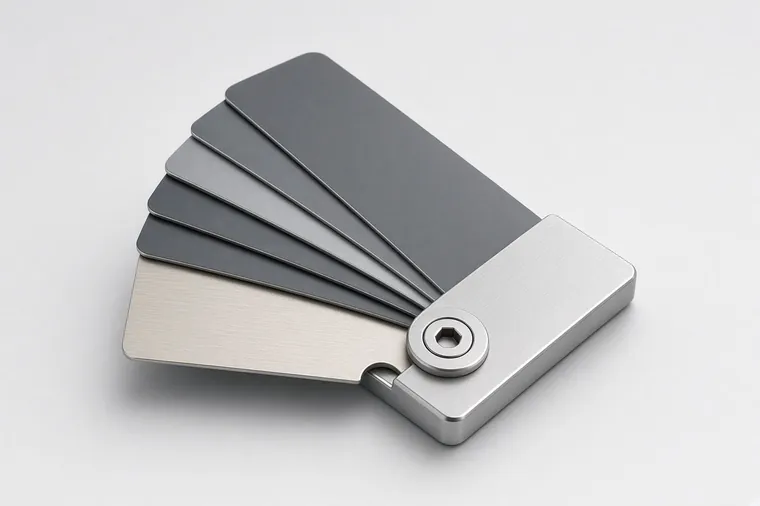
Material and finish decisions drive both cost and perceived quality in metal and leather wallets. This hub collects the engineering guides behind those decisions: aluminium grades, stainless and titanium behavior, carbon fiber layups, anodizing, PVD coating and corrosion testing.
What this hub answers
The articles explain what each process changes in practice — wear resistance, color stability, fingerprint behavior, edge sharpness — and how to write a finish specification a factory can actually inspect against.
Use this hub when a quote differs by material grade or finish and you need to decide whether the difference is visible, durable, or simply cost.
- Which aluminium grade and machining route fits each price band
- How anodizing, PVD, brushing and blasting change wear and colour stability
- How to write a finish specification a factory can inspect against
Three guides to read first
The longest, most practical reads in this hub — the ones that answer the questions buyers usually ask on the first call.
62 GUIDES · UPDATED NOV 2026
Browse 62 guides by topic
Every article in this hub, grouped by the question it answers. Jump to a topic, or scan the full list.
Finishing & surface treatment 5
Anodizing, PVD, brushing, blasting and how each wears.
- Brushed vs Matte Metal Wallet Finish: B2B Sourcing Guide13 min
- Anodized vs PVD Metal Wallet Finish: B2B Buyer’s Guide13 min
- How Does Surface Finishing Affect Wallet Quality? | Buyer’s Guide13 min
- What Is Anodizing for Aluminum Wallets? B2B Sourcing Guide12 min
- Burnt Finish Titanium Minimalist Wallet6 min
Aluminium & stainless steel 24
Grades, machining routes, corrosion behaviour and cost per part.
- Aluminum Wallet vs Stainless Steel Wallet: A Manufacturer’s Guide for Brands16 min
- Machined Aluminum vs Stamped Metal Wallets | GSTAR OEM Guide15 min
- CNC Aluminum Wallet vs Die Casting Wallet | GSTAR OEM Guide14 min
- What Is the Best Aluminum for Wallet Manufacturing? | OEM Guide13 min
- Aluminum 6061 vs 7075 for Wallets: B2B Buyer’s Guide12 min
- Titanium Vs. Aluminum Wallets: Why Modern EDC Enthusiasts Are Switching To Titanium11 min
- Aluminum Alloy Card Slot with Real-time Location Tracker11 min
- How Durable Are Aluminum Wallets? A B2B Material Guide11 min
- Titanium Wallet vs Aluminum Wallet – GSTAR’s Manufacturing Guide11 min
- Ekster Wallet Alternative Aluminum: OEM Sourcing Guide for 202611 min
- Industrial-Grade Aluminum Alloy Card Clip with Superior Strength11 min
- Similar Build Quality to Ridge Wallet | CNC Aluminum OEM Manufacturer10 min
- Carbon Fiber Wallet Guide: Why Aerospace-Grade Material Beats Aluminum | GSTAR10 min
- Differences Between Corrosion Resistance in Aluminum Vs. Stainless Steel Cases: Gstar’s OEM Guide10 min
- Smart Aluminum Alloy Card Clip: Integrated GPS Tracking10 min
- Compact Aluminum Alloy Card Clip: Carry Your Cards Anywhere10 min
- Premium Aluminum Card Clip with Clear Name Badge Slot10 min
- High-Quality Aluminum Alloy Card Clip for Long-Lasting Use10 min
- Aluminum Minimalist Pocket Smart Key Case — A Practical Guide To Streamlined Everyday Carry9 min
- The Ultimate Guide To Lightweight Aluminum Slim Card Wallets: Revolutionizing Modern Carry9 min
- Differences Between 6061 Aluminum And Standard Alloy Wallets: Which Is Better for Everyday Carry?9 min
- The Indestructible Companion: Why A Strong Stainless Steel Wallet Is The Ultimate Choice for Modern Life8 min
- GSTAR: Carbon Fiber vs Aluminum Wallet B2B Sourcing Guide | 13+ Years Expertise6 min
- Aluminum Card Wallet Vs. Carbon Fiber: Is The Weight Difference Worth The Premium?4 min
Titanium & carbon fiber 19
Premium materials: weight, strength, finishing limits and lead time.
- Carbon Fiber Wallet vs Metal Wallet – B2B Manufacturer Comparison14 min
- Aviator Titanium Replacement Cheaper: B2B Sourcing Guide for 202613 min
- Ridge Titanium Wallet Knock Off: OEM Sourcing Guide for Buyers12 min
- Titanium Wallet Pros Cons | OEM Manufacturer Insights | GSTAR12 min
- Metal Wallet vs Carbon Fiber Wallet – GSTAR OEM Manufacturer Comparison12 min
- Aviator Wallet Dupe Carbon Fiber: B2B Sourcing Guide for OEM Buyers12 min
- Carbon Fiber Wallet Comparison: B2B Material, Durability & OEM Guide11 min
- Titanium Wallet Manufacturing by GSTAR – OEM/ODM for EDC Brands11 min
- Minimalist Carbon Fiber Wallet: The Ultimate Guide To Lightweight, Secure, And Stylish Carry10 min
- Why Most People Are Using The Carbon Fiber Metal Wallet?9 min
- Durable Stonewash Titanium Wallet9 min
- Carbon Fiber Wallet9 min
- The Mastery of Metal: A Comprehensive Guide To The Burnt Titanium Slim Wallet And The Minimalist Revolution9 min
- Minimalist Carbon Fiber Wallet with Cash Strap – Slim, Lightweight Everyday Carry8 min
- Gradient Burn Titanium Card Wallet7 min
- Minimalist Carbon Fiber Wallet with Cash Strap & Elastic Money Band7 min
- One Click, All Your Cards: The Carbon Fiber Wallet That Does It All7 min
- Forged Ember Carbon Fiber Wallet with Cash Strap6 min
- The Science Behind The Carbon Fiber Wallet: How It Combines Durability, Slimness, And Anti-Theft Tech4 min
Durability & testing 8
Wear, scratch, corrosion and cycle tests that predict returns.
- Are Pop Up Wallets Durable? A B2B Guide to Materials & Lifespan14 min
- How to Test Metal Wallet Durability? A B2B Buyer’s Guide12 min
- Aviator Wallet Alternative Under 200: B2B Sourcing Guide for Durable Custom Wallets11 min
- Material and Durability for Corporate Use: 20+ Year Industrial Components9 min
- How Durable Are Metal Wallets? A Factory Guide to Strength & Longevity8 min
- Men’s Coin Purses: How Gstar Technology Builds OEM-Ready, Minimalist, And Durable Designs for Global Brands8 min
- Best Wallets for Teens: How To Choose Slim, Durable, And Stylish Wallets That Actually Get Used7 min
- Vegan Wallet: The Complete Guide To Sustainable, Durable, And High-Performance Wallets by Gstar Technology6 min
Choosing & costing materials 3
How material and finish decisions move unit price and MOQ.
Material engineering notes 3
Cross-material comparisons and specification guidance.
Materials & finishing: questions buyers ask before a quote
Short answers to the specification questions that come up most often in this category.
Which aluminium grade is best for a wallet?
6061 is the default: it machines well, anodizes evenly and costs less. 7075 is stronger and harder, which suits thin frames and high-load clips, but it costs more and anodizing is less colour-consistent. For most wallet programs 6061-T6 is the right choice; specify 7075 only where strength or weight justifies the premium.
Anodizing or PVD — which finish lasts longer?
Anodizing grows an oxide layer into the aluminium, so it cannot chip off, but it can fade under UV and shows scratches as light marks on dark colours. PVD is a thin deposited coating that is harder and more colour-stable, and it works on stainless and titanium too. PVD costs more per part; anodizing is the volume choice.
How do I test finish durability?
Standard tests are a pencil hardness or abrasion test, a salt-spray test for corrosion, and a tape-pull or cross-hatch adhesion test for coatings. For consumer wear, a rub test with artificial sweat and a tumble test with keys are more realistic. Ask for the test method and acceptance criteria, not just a pass or fail line.
Why do matte finishes show fingerprints?
Bead-blasted surfaces scatter light, which hides scratches but holds skin oil in the texture. A finer blast, a clear nano-coating or a brushed direction reduces the effect. Polished surfaces show fingerprints differently — they smear rather than hold — but they scratch more visibly.
Does material choice change MOQ?
Yes. Aluminium and stainless are stocked in common grades and often need no new tooling. Titanium and carbon fiber usually require a minimum sheet or billet purchase and a longer lead time, which raises the effective MOQ. If you are testing a premium tier, start with a shared material buy across colours.
Keep researching
Move from research to a quote
Specifications, finishes and customization options for the products behind these guides.
Need a spec answered before you quote?
Send your material grade, card capacity or mechanism requirement — we answer with production-feasible options, not catalogue copy.