

Views: 455 Author: Professor Leon Publish Time: 09-01-2026 Origin: Site


Content Menu
● 1. What Defines a Good Wallet for Guys in 2026?
● 2. The 2026 Wallet Landscape: Styles That Define "Good"
● 3. How to Evaluate Wallet Suppliers: A Procurement Framework
● 4. Key Quality Indicators for Wallet Buyers
● 5. Industry Standards and Certifications
● 6. Our Wallet Manufacturing Capabilities
● 7. Quality Control: Our Multi-Stage Inspection Process
● 8. Customization and OEM/ODM Options
● 9. Ordering Process, MOQ, and Lead Times
● 10. What Makes a Wallet Supplier Credible?
● 11. Ready to Source Good Wallets for Your Brand?
11 min read
The last time a buyer asked us to replicate a competitor's aluminum wallet, we had to point out a problem. The original had a card slot tolerance of 1.2 mm. After six months of daily use, cards started slipping out because the aluminum frame had no internal tension system. That single design flaw cost the competitor thousands in returns.
Most men don't think about card slot tolerances when they buy a wallet. They think about whether it looks good and fits in a front pocket. But for B2B buyers—brand owners, wholesalers, and retailers—understanding what actually makes a wallet durable, functional, and worth retailing is the difference between a bestseller and a clearance bin item.
This guide breaks down the technical standards behind good wallets for guys, the procurement frameworks you need to evaluate suppliers, and the manufacturing realities that determine whether your product line succeeds.
A good wallet balances four competing factors: material integrity, slim profile, card capacity, and security features. A wallet that excels in one area but fails in another will not survive market scrutiny.
The modern definition shifted dramatically after 2020. Digital payments reduced cash carry, but card counts increased. The average man now carries 6–10 cards but less cash than a decade ago. This changed the ideal form factor from a bulky bifold to a slim front-pocket design holding 6–12 cards with minimal bulk.
For manufacturers, this means construction precision matters more than material volume. A poorly calibrated card slot—too tight or too loose—creates daily friction for the user. That friction becomes a negative review, which becomes a return, which becomes a dead product line.
Three material categories dominate the men's wallet market. Each has distinct trade-offs.
Full-grain leather remains the gold standard for traditional buyers. It develops a patina over time, lasts decades with proper care, and ages better than any synthetic alternative. Top-grain leather is slightly thinner and cheaper but loses the natural surface characteristics. Bonded leather—leather scraps fused with polyurethane—is not leather in any meaningful sense and should be avoided for premium positioning.
CNC-machined aluminum emerged as the dominant choice for minimalist and RFID-blocking wallets. Aerospace-grade 6061 aluminum offers structural rigidity, scratch resistance, and inherent RFID shielding. The material itself never wears out the way stitching does. Weight is the trade-off—a full aluminum wallet weighs 40–60 grams versus 20–30 grams for a nylon alternative.
Technical fabrics like carbon fiber and ballistic nylon serve the ultralight niche. Carbon fiber offers exceptional strength-to-weight ratios but costs significantly more. Ballistic nylon is weather-resistant and nearly indestructible but lacks the premium feel of leather or metal.
Here is the imperfect insight most consumer reviews miss: no single material is objectively best. Leather wallets require maintenance and degrade with moisture. Aluminum wallets scratch and can damage cards if internal surfaces are not polished. Carbon fiber wallets feel cold and clinical. The "best" material depends entirely on your target customer's lifestyle and aesthetic preferences.
The core engineering problem in wallet design is simple: how do you fit 10 cards into a package thinner than 15 mm without cards falling out?
Traditional bifolds solved this with leather stretch—cards wedge into tight slots and stay there. But leather stretches permanently. After a year, slots loosen and cards slip.
Modern designs use mechanical solutions. Aluminum wallets employ tension plates or spring-loaded mechanisms that grip cards regardless of material fatigue. Some use a "quick access" system where a thumb slide pushes all cards up simultaneously for easy selection.
Quality indicators for capacity design include:
Card slot width tolerance of ±0.1 mm for metal frames
Tension systems rated for 10,000+ insertion cycles
Edge polishing to prevent card scratching
A secure cash mechanism that doesn't add more than 3 mm thickness
A good wallet should hold 6–12 cards while maintaining a profile under 15 mm. Anything thicker defeats the minimalist purpose.
RFID blocking is not a gimmick, but its importance depends on context. Contactless payment cards, key fobs, and passports contain RFID chips readable at short range. Theft requires a reader within 10–15 cm—possible in crowded spaces but not the epidemic some marketers suggest.
For manufacturers, RFID blocking is a material property question. Aluminum and other metals naturally block RFID frequencies. Leather and fabric do not unless lined with a metallic shield.
If you source aluminum wallets, RFID blocking comes standard. If you source leather, an RFID-blocking liner adds $1–3 per unit in material cost. The decision depends on your target market's security concerns and willingness to pay a premium.
Consumer demand clusters into five distinct wallet categories. Understanding these segments helps you decide which SKUs to develop.
The classic bifold remains the best-selling men's wallet format. Modern versions slimmed down to 8–10 mm thickness while maintaining traditional aesthetics. Key features include full-grain leather construction, minimal stitching (or edge-painted seams), and dedicated bill compartments.
Best for: Traditional buyers, gift purchases, professional settings.
This category dominates online sales among men under 40. Typically constructed from aluminum or carbon fiber with a money clip or cash strap. Holds 6–10 cards in a rigid frame under 12 mm thick. Popularized by brands like Secrid and Ridge.
Best for: Commuters, urban professionals, tech enthusiasts.
"Value" does not mean cheapest. It means the best cost-per-wear ratio—the wallet that lasts five years for $40 beats one that lasts one year for $15. Value wallets typically use top-grain leather, simpler construction, and classic designs that don't date.
Best for: Price-sensitive buyers who still want durability.
Premium segment combining RFID blocking with Bluetooth tracking. Features include GPS locating via smartphone app, battery life of 1–3 months, and sometimes wireless charging integration. Manufacturing complexity increases significantly—the electronics must be sealed against moisture while maintaining a slim profile.
Best for: Tech-forward buyers willing to pay $80–150.
This segment is about aesthetics, branding, and perceived status. Hardware finishes (brushed, matte, PVD-coated), embossed logos, and premium packaging matter as much as the wallet itself. For B2B buyers, this is where custom branding creates the most value.
Consumer reviews tell you what a wallet feels like. They don't tell you whether a factory can consistently reproduce that quality across 10,000 units. That requires a different evaluation framework.
Ask suppliers which processes they handle in-house versus outsource. A factory that outsources CNC machining, anodizing, and assembly has more quality control points than one that does everything internally. Each outsourcing handoff introduces tolerance drift and communication risk.
For metal wallets specifically, in-house CNC capability is a strong signal. It means the factory controls the most critical quality determinant—precision machining.
Card slot width, edge finishing, and RFID effectiveness are the three quality gates that matter most. A serious supplier will document:
Tolerance ranges for card slots (±0.1 mm is industry standard for metal)
Surface finishing standards (anodizing thickness of 18–25 microns for aluminum)
Batch testing procedures for RFID blocking effectiveness
Pull testing for leather stitching (minimum 15 kg force for main seams)
Bill of Materials (BOM) with material grades specified
Quality control checklist used during production
In-line inspection reports from previous production runs
Corrective action reports for any past defects
When evaluating sample quality, check these five points specifically:
Edge finishing: Run a finger along every edge. Rough edges indicate poor deburring or polishing—a defect that will worsen with use.
Card slot resistance: Insert and remove a card 20 times. It should require consistent force without being difficult. Inconsistent resistance indicates poor tolerance control.
Interior surface smoothness: Aluminum wallets must have polished interiors. Raw machined surfaces will scratch cards within weeks.
RFID test: Place a contactless payment card inside the wallet and attempt to read it with a phone NFC reader. It should fail to read.
Stitching uniformity: For leather wallets, check that stitch density is consistent (typically 4–6 stitches per centimeter) and thread tension is even.
Suppliers who can't specify their aluminum grade or leather type
Factories that refuse sample requests before bulk orders
MOQs that seem suspiciously low for CNC-machined products (this often means lower quality standards)
Suppliers who cannot explain their defect rate or return policies
Factories without in-house QC departments
What is your defect rate on similar products in the last 12 months?
Can you provide third-party test reports for RFID effectiveness?
What is your tolerance for card slot width?
Do you use in-house or outsourced CNC machining?
What is your sampling timeline and cost?
How do you handle defective units in a production run?
The wallet industry lacks a single universal certification, but several standards apply:
ISO 9001:2015 — Quality management systems certification (supplier-level)
REACH compliance — Restricts hazardous substances in materials (EU market)
Proposition 65 — California's chemical disclosure requirement
FCC compliance — Required if the wallet contains Bluetooth electronics
ASTM D5511 — Biodegradability testing for eco-friendly positioning
For RFID claims, testing follows ISO 14443 (contactless card standard) to verify blocking effectiveness.
Understanding the technical requirements of a good wallet is one thing. Executing them at scale with consistency is another challenge entirely.
As a manufacturer with 13 years of experience, we've addressed these challenges through vertical integration. Our facility in Shenzhen operates in-house CNC machining centers, which means the precision work that determines card slot tolerance, edge finishing, and structural integrity stays under our direct control. We don't hand off critical processes to outside vendors and hope for the best.
Our production capacity of 300,000+ units monthly serves brands, wholesalers, and online sellers across North America, Europe, and Asia. We produce CNC-machined aluminum wallets with RFID blocking, leather bifolds with precision stitching, and hybrid designs combining both materials.
For RFID blocking specifically, our aluminum products provide inherent shielding—no extra liners needed. For leather products, we integrate metallic shielding layers that test to ISO 14443 standards.
The engineering team handles OEM projects (your designs, our manufacturing) and ODM projects (our proven designs, your branding). If you have a concept sketch or a competitor product to reverse-engineer, we handle the transition from concept to mass production, including tooling, material selection, and quality documentation.
Lead times for standard ODM samples run 7–15 days. Custom OEM designs require 3–4 weeks for sampling due to tooling development. Bulk production follows at 20–30 days after sample approval.
Quality control at our facility operates at four stages, not one final check:
Incoming inspection: Raw materials are verified against specifications—aluminum grade confirmation, leather thickness measurement, and hardware finish checks.
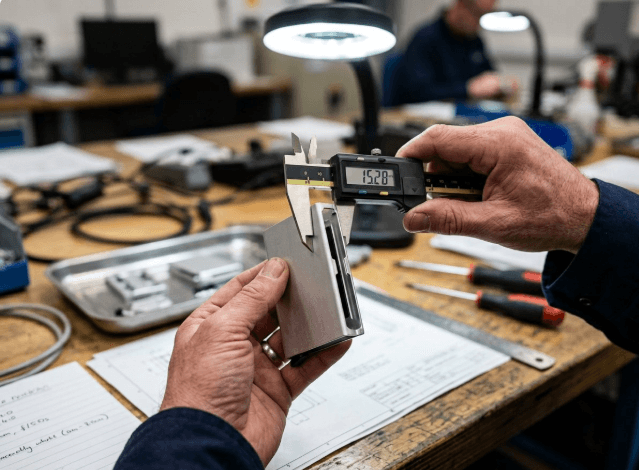
In-process inspection: During CNC machining, dimensions are verified at regular intervals using calibrated gauges. Card slot tolerances are checked against the ±0.1 mm standard.
Pre-shipment inspection: Every batch undergoes a final audit covering edge finishing, card insertion force, RFID effectiveness, and packaging integrity. AQL (Acceptable Quality Level) sampling follows ISO 2859-1 standards.
Aged sample testing: Retained samples from each production run are tested at 30, 60, and 90 days to verify that materials—especially leather and adhesives—don't degrade in storage.
You have specific designs, blueprints, or patents. You require proprietary dimensions or features. You have the volume to justify tooling costs (typically 1,000+ units for CNC-machined products). You want exclusive rights to the design.
You want to launch quickly with proven, market-tested designs. You'll customize colors, materials, and branding without changing core structure. Your order volume ranges from 300–1,000 units. Time-to-market matters more than design uniqueness.
Logo debossing, embossing, or laser engraving
Custom anodizing colors (Pantone matching available)
Hardware finishes: brushed, matte, polished, PVD-coated
Packaging design: from simple boxes to premium unboxing experiences
Material substitutions: leather type, aluminum grade, hardware metals
Combination designs: leather exterior with metal card holder interior
A typical custom wallet project follows this timeline:
Inquiry and specification (Day 1–3): Share your design files or desired features. We respond within 24 hours with feasibility feedback.
Sampling (Day 4–18): ODM samples ship in 7–15 days. OEM samples require 3–4 weeks due to tooling.
Sample approval (Day 18–25): We refine samples based on your feedback until approval.
Bulk production (Day 25–55): Production runs 20–30 days after sample approval.
Quality inspection (Day 50–55): Pre-shipment inspection with photo/video documentation.
Shipping (Day 55–65): Sea freight to major ports takes 20–35 days depending on destination.
MOQs vary by product type. Custom leather wallets can start around 300–500 units. CNC-machined aluminum wallets require higher MOQs—typically 1,000+ units—to amortize machine setup and tooling costs. Contact Our Team for specific MOQ details for your product concept.
Shipping costs depend on weight and volume. Aluminum wallets weigh 40–60 grams, making them lighter than leather bifolds at 70–100 grams. For bulk orders, this weight difference affects freight costs noticeably.
The wallet market is crowded with suppliers who can produce a decent sample but struggle with consistency at scale. Credibility comes from verifiable evidence, not promises.
A credible supplier will discuss defect rates openly, provide test documentation, welcome third-party factory inspections, and explain their quality control process in specific technical terms—not marketing language. They will acknowledge the limitations of their materials and processes rather than claiming perfection.
We've built our reputation on this transparency. When a buyer asks about our defect rate, we share actual numbers. When they ask about material grades, we specify exactly which aluminum alloy and leather type we use. When they ask to see our QC documentation, we show it.
That approach has sustained relationships with brands across 20+ countries for over a decade. It's not glamorous, but it is what reliable supply chains are built on.
The "good wallet" formula comes down to material integrity, functional design, and security features—executed with manufacturing precision. The market rewards brands that understand these technical foundations before placing orders.
Whether you're launching a new wallet line or expanding an existing one, the right manufacturing partner makes the difference between a product that sells and one that generates returns.
ISO 9001:2015 Quality Management Systems. International Organization for Standardization. https://www.iso.org/standard/62085.html
ISO 14443 Identification Cards — Contactless Integrated Circuit Cards. International Organization for Standardization. https://www.iso.org/standard/73598.html
ISO 2859-1 Sampling Procedures for Inspection by Attributes. International Organization for Standardization. https://www.iso.org/standard/1141.html
REACH Regulation (EC) No 1907/2006. European Chemicals Agency. https://echa.europa.eu/regulations/reach/legislation
California Proposition 65. Office of Environmental Health Hazard Assessment. https://oehha.ca.gov/proposition-65


