

Views: 221 Author: Princee Lee Publish Time: 03-18-2026 Origin: Princee Lee


Content Menu
● Introduction: The Evolution of Personal Carry
● The Metallurgy of Strength: Why Aluminum Alloy?
>> 6061 Aluminum: The Versatile Workhorse
>> 7075 Aluminum: The Aerospace Powerhouse
● Engineering Precision: The CNC Machining Process
>> The Benefit of Billet Construction
>> Internal Mechanics and Tension
● Surface Integrity: The Role of Anodization
>> Type II vs. Type III Anodizing
● The Science of Security: Physical and Digital Protection
>> RFID Blocking: The Faraday Cage Effect
● Design Philosophy: Ergonomics and Minimalism
>> The "No-Profile" Pocket Presence
>> User Interaction and Access
● Sustainability and Longevity: The Environmental Edge
● Industrial and Tactical Applications
>> Law Enforcement and Military Use
● Comparative Analysis: Aluminum vs. Other Materials
● The Psychological Shift: From Possession to Utility
● Conclusion: The Future of Personal Carry
>> Related Questions and Answers
The way we carry our most essential items—identification, credit cards, and currency—has undergone a radical transformation over the last century. For decades, the leather bifold was the undisputed king of the pocket. However, as the digital age progressed and our physical footprint began to shrink, the "Costanza wallet" phenomenon—overstuffed, bulky, and structurally detrimental to spinal health—gave way to a new philosophy: Everyday Carry (EDC) minimalism. At the heart of this revolution is the industrial-grade aluminum alloy card clip.
This shift isn't merely about aesthetics; it is about engineering. An industrial-grade aluminum alloy card clip represents the intersection of metallurgy, precision manufacturing, and tactical utility. Unlike traditional materials that degrade, stretch, or rot over time, high-strength aluminum alloys offer a "buy it for life" durability that matches the rigors of modern life. Whether you are navigating a corporate boardroom or a rugged mountain trail, the requirements for a card clip remain the same: superior strength, lightweight portability, and uncompromised security.
To understand why "industrial-grade" matters, one must look at the specific alloys used in the construction of these high-performance card clips. In the world of non-ferrous metals, two specific grades stand out as the gold standard for EDC gear: 6061 and 7075 aluminum.
Often referred to as "structural aluminum," the 6061 alloy is a precipitation-hardened metal containing magnesium and silicon as its major alloying elements. It is the backbone of the industrial world, used in everything from aircraft wings and yacht hulls to high-end bicycle frames. For a card clip, 6061 offers an ideal balance. It provides excellent corrosion resistance—vital for an object kept close to the body where sweat and moisture are prevalent—and high toughness. When treated to a T6 temper, 6061-T6 aluminum achieves a yield strength that far exceeds any plastic or composite alternative, ensuring that the clip maintains its shape even after thousands of cycles of use.
When the descriptor "superior strength" is used, it often refers to 7075 aluminum. This alloy uses zinc as its primary alloying agent and is one of the highest-strength aluminum alloys available. Its strength-to-weight ratio is comparable to many steels, yet it retains the featherlight properties of aluminum. Originally developed for the aerospace industry to withstand the immense stresses of supersonic flight, 7075-T6 aluminum provides a level of rigidity that makes it virtually indestructible in a pocket environment. A card clip crafted from this material will not bend, snap, or deform under the pressure of tight denim or accidental drops on concrete.

An industrial-grade card clip is not stamped out of a thin sheet of metal in a mass-production press. Instead, it is born from the process of Computer Numerical Control (CNC) machining. This process involves taking a solid block (or billet) of aluminum alloy and using high-precision cutting tools to carve out the final form.
Billet construction ensures that the grain structure of the metal remains consistent and strong. Stamped metal often has "stress points" where the material was bent or thinned during production. CNC machining allows for complex geometries, such as beveled edges for comfort and integrated thumb notches for easy card access, without sacrificing structural integrity. The tolerances in CNC machining are measured in microns, ensuring that every clip fits its intended cards with surgical precision.
The "clip" aspect of an aluminum card clip relies on mechanical tension. In industrial-grade designs, this is often achieved through a combination of the alloy's natural elasticity and high-performance fasteners. Some designs use a "friction fit" where the plates are held together by heavy-duty elastic bands or spring steel clips. In the highest-end models, the aluminum plates themselves are engineered to provide the clamping force. This requires a deep understanding of the material's fatigue limit—the point at which a material begins to weaken after repeated stress. Industrial-grade aluminum is specifically chosen for its high fatigue resistance, meaning the "snap" of the clip feels as tight on day 1,000 as it did on day 1.
Raw aluminum, while strong, is susceptible to surface oxidation and scratching. To achieve true industrial-grade status, the card clip must undergo a process called anodizing. This is an electrochemical process that converts the metal surface into a decorative, durable, corrosion-resistant, anodic oxide finish.
Most consumer goods use Type II anodizing, which provides a variety of colors and moderate protection. However, "Superior Strength" clips often utilize Type III "Hardcoat" anodizing. This creates a much thicker and denser layer of aluminum oxide that is integrated into the substrate of the metal. The result is a surface hardness that approaches that of industrial diamonds. A hard-coated aluminum clip can be kept in a pocket with keys, coins, and other metal objects without showing the "battle scars" of daily use. Furthermore, this oxide layer is non-conductive and chemically stable, meaning it won't react with the oils from your skin or the chemicals in your clothing.
In the modern world, a card clip must do more than just hold plastic; it must act as a shield. An industrial-grade aluminum alloy clip provides two distinct types of security: physical and digital.
Credit cards and IDs are prone to "micro-bending" when carried in flexible leather wallets. Over time, these tiny bends lead to the cracking of the internal chips or the snapping of the card itself. The rigid plates of an aluminum alloy clip provide a protective exoskeleton. Even if you sit on the clip or drop a heavy object on your pocket, the cards inside remain perfectly flat and functional. This is particularly important for modern metal credit cards, which can become permanently deformed if bent.
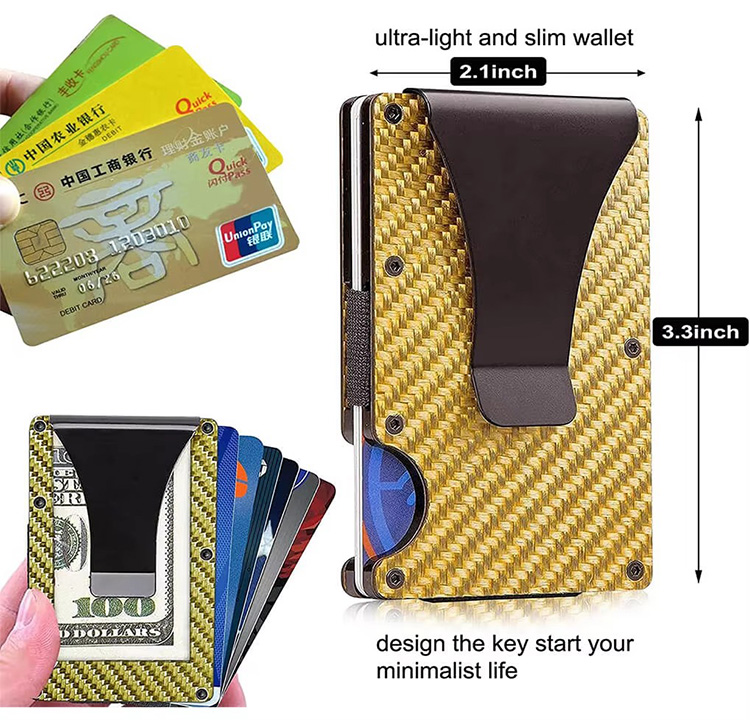
Digital theft, or "skimming," involves using RFID readers to steal information from contactless cards. Aluminum is a naturally conductive material that excels at blocking electromagnetic fields. When your cards are sandwiched between two plates of industrial-grade aluminum, they are effectively inside a Faraday cage. The metal plates reflect and dissipate the radio waves used by skimmers, making it impossible for anyone to read your data while the cards are inside the clip. This peace of mind is a standard feature of any high-quality aluminum EDC tool.
Superior strength does not have to mean bulky or uncomfortable. The design of an industrial-grade card clip is a masterclass in ergonomics.
One of the primary reasons users switch to aluminum clips is to eliminate "pocket bulge." Because the material is so strong, the walls of the clip can be kept incredibly thin—often less than 2mm per plate. This allows the overall thickness of the wallet to be determined almost entirely by the number of cards inside, rather than the thickness of the container itself. A clip carrying six cards is often no thicker than a single smartphone.
Industrial designers focus heavily on how a user interacts with the clip. Common features include:
* Thumb Notches: Precision-cut curves that allow the user to slide the top card out with a single motion.
* Beveled Edges: All corners and edges are rounded off (chamfered) to ensure that the metal doesn't snag on pocket fabric or dig into the user's leg.
* Modular Attachments: Many industrial clips allow for the addition of a "money strap" or a "cash clip" made of spring steel, allowing for the carry of paper currency alongside digital cards.
In an era of "fast fashion" and disposable products, the industrial-grade aluminum card clip stands as a testament to sustainability. Aluminum is one of the most recycled and recyclable materials on Earth. Producing new aluminum is energy-intensive, but recycling it requires only 5% of the energy used for primary production.
However, the true sustainability of these clips lies in their longevity. A leather wallet might last 3 to 5 years before the stitching frays or the leather stretches beyond utility. A plastic card holder might last a year before the hinges snap. An aluminum alloy clip, however, has no shelf life. It does not degrade in UV light, it does not rot in humidity, and it is virtually immune to mechanical failure under normal conditions. By buying one high-quality metal clip, a user potentially avoids a lifetime of purchasing and discarding inferior products.
While most users are everyday citizens, these clips find their roots in tactical and industrial environments.
Personnel in high-intensity environments require gear that can withstand extreme heat, cold, and physical impact. An aluminum alloy card clip is standard fare for those who need to carry credentials securely while crawling through debris, running, or engaging in physical activity. The secure clamping force ensures that cards are never lost, regardless of the orientation of the clip or the intensity of the movement.
Architects, engineers, and construction foremen who work in environments filled with dust, grit, and heavy machinery prefer aluminum because it can be easily cleaned. Unlike leather, which absorbs oils and dirt, an aluminum clip can be wiped down with a damp cloth or even submerged in water without damage. It is a tool for those who value function above all else.
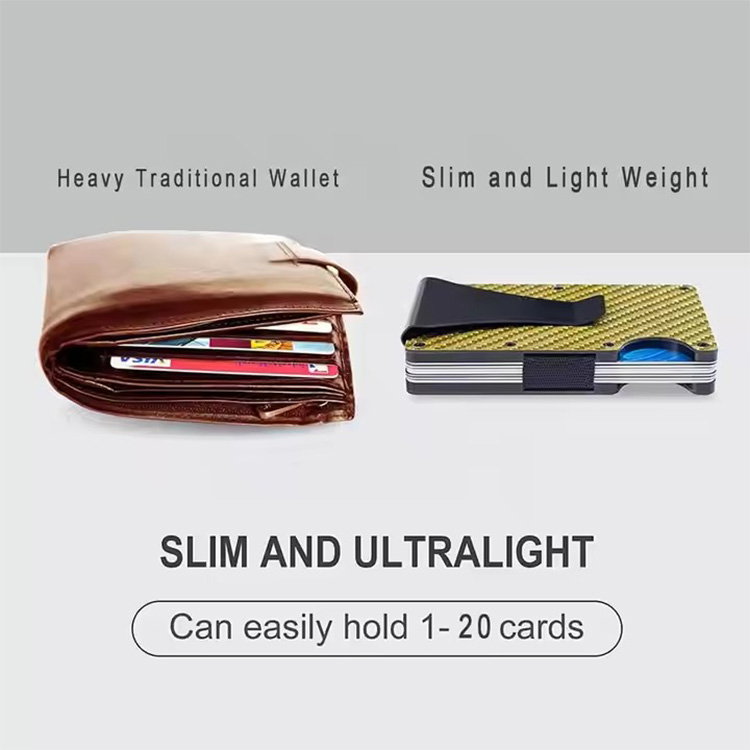
To truly appreciate the superior strength of industrial aluminum, it is helpful to compare it to other popular materials in the EDC market.
Titanium is often touted as the ultimate EDC material. While titanium is stronger and lighter than 6061 aluminum, it is significantly more expensive and difficult to machine. For the vast majority of users, the performance gap between 7075 aluminum and titanium is negligible in a pocket environment, but the price difference is substantial. Aluminum offers the "sweet spot" of high performance at a justifiable price point.
Carbon fiber is incredibly light and has high tensile strength, but it is brittle. If a carbon fiber card clip is subjected to a sharp impact or high torsional stress, it can crack or delaminate. Aluminum, being a metal, is ductile. Under extreme stress, it may dent or slightly bend, but it will not shatter. For an item that is likely to be dropped or sat upon, the impact resistance of aluminum alloy is often a safer bet.
There is a psychological component to carrying an industrial-grade tool. When a person carries a high-strength aluminum card clip, they are making a conscious choice to prioritize utility and preparedness. The tactile feel of cold, precision-machined metal provides a sense of security that leather cannot match. It is the feeling of a tool that is ready for any situation.
As we move toward a "cashless" society, the card clip becomes the most important accessory we own. It holds our identity and our ability to transact. Entrusting those items to a flimsy piece of fabric or plastic seems illogical when industrial-grade metallurgy offers a superior alternative. The transition to a metal card clip is often the first step in a larger journey toward a more intentional and organized lifestyle.
The industrial-grade aluminum alloy card clip with superior strength is not just a trend; it is the logical conclusion of wallet evolution. By leveraging the materials and manufacturing techniques of the aerospace and defense industries, manufacturers have created an accessory that is perfectly suited for the 21st century.
It provides a level of physical and digital protection that was previously unavailable, all while maintaining a sleek, minimalist profile. The use of 6061 and 7075 alloys ensures that these tools can withstand the harshest environments and the longest durations. As we look to the future, we may see further integrations—biometric locks, GPS tracking, or modular expansion—but the core will remain the same: a high-strength aluminum chassis that is built to endure. For those who demand the best from their gear, the search ends with industrial-grade aluminum.
Q1: What is the difference between "Industrial-Grade" and standard aluminum?
A: "Industrial-grade" typically refers to specific high-performance alloys like 6061 or 7075 that have been heat-treated (tempers like T6) to enhance their mechanical properties. Standard or "commercial" aluminum is often softer, less durable, and more prone to bending or breaking under stress. Industrial-grade aluminum also implies higher precision in manufacturing, such as CNC machining rather than stamping.
Q2: Will an aluminum card clip scratch my credit cards?
A: High-quality industrial card clips are designed with smooth interior surfaces and beveled edges to prevent scratching. Additionally, the cards are generally held in place by tension rather than being slid against a rough surface. However, over long periods, the natural friction of cards rubbing against each other is more likely to cause wear than the aluminum plates themselves.
Q3: Is the RFID blocking feature permanent?
A: Yes. The RFID blocking capability of an aluminum card clip is a physical property of the metal itself. As long as the metal plates are intact and surrounding your cards, the "Faraday cage" effect will continue to work indefinitely. Unlike electronic blocking cards that may have batteries or circuits that fail, aluminum provides passive, permanent protection.
Q4: Can I take an industrial-grade aluminum card clip through airport security?
A: Yes, you can. While it is made of metal, it is not a prohibited item. You will simply need to place it in the bin with your phone and keys when passing through the X-ray machine. Its "industrial" look might occasionally prompt a second glance, but it is a standard personal accessory.
Q5: How do I maintain and clean my aluminum card clip?
A:** Maintenance is minimal. Because of the anodized finish, the metal is resistant to most environmental factors. To clean it, simply use a soft cloth with mild soap and water. Avoid using abrasive pads or harsh chemicals that could scratch or degrade the anodized layer. If the clip uses elastic bands, check them occasionally for wear and replace them if necessary.


