

Views: 248 Author: Princee Lee Publish Time: 03-25-2026 Origin: Princee Lee


Content Menu
● Introduction to the Digital Shield
● The Technical Foundations of RFID Technology
>> How RFID Works in Daily Life
>> The Mechanics of Signal Interference
● The History and Evolution of the RFID Wallet
>> From Industrial Use to Personal Security
>> The Modern Landscape of Design
● Analyzing the Risk: Is RFID Skimming a Real Threat?
>> The Reality of Electronic Pickpocketing
● Materials Used in RFID Blocking Construction
>> Traditional Metals: Aluminum and Copper
>> Specialized Shielding Fabrics
>> Carbon Fiber: The High-Tech Alternative
● Choosing the Right RFID Blocking Wallet
>> Identifying Quality and Testing
● The Drawbacks and Limitations of RFID Protection
>> The Issue of Intentional Scanning
● The Future of Physical and Digital Security
>> Conclusion: A Practical Tool for the Modern Age
● Related Questions and Answers
In an era where technology permeates almost every facet of our lives, the way we carry and protect our financial assets has undergone a radical transformation. Gone are the days when a simple leather pouch was sufficient to keep your cash and coins safe from the physical hands of a pickpocket. Today, a new type of threat exists—one that is invisible, silent, and capable of stealing your information without ever touching your pocket. This threat is known as electronic pickpocketing or RFID skimming, and the primary defense against it is the RFID blocking wallet.
To understand what an RFID blocking wallet is, one must first understand the technology it is designed to counteract. RFID stands for Radio Frequency Identification. It is a technology that uses electromagnetic fields to automatically identify and track tags attached to objects. These tags contain electronically stored information. In the context of personal finance, these tags are the tiny chips embedded in your "tap-to-pay" credit cards, debit cards, and even your passport. An RFID blocking wallet is essentially a portable Faraday cage designed to disrupt these radio frequencies, ensuring that your sensitive data remains shielded from unauthorized scanning devices.

RFID technology is not inherently malicious; in fact, it is one of the most convenient innovations of the 21st century. It operates through a simple two-part system: a tag and a reader. The tag, which is what you have in your credit card, consists of a tiny antenna and a microchip. When this tag comes into proximity with an RFID reader, the reader emits a radio signal that powers the tag. Once powered, the tag transmits its stored information back to the reader.
This process happens in milliseconds and requires no physical contact, which is why you can pay for groceries by simply waving your wallet near a terminal. There are different frequencies used for RFID, but the most common for financial cards and identification is the High Frequency (HF) band of 13.56 MHz. While this convenience is undeniable, the "always-on" nature of these passive tags means they will respond to any compatible reader that sends the right signal, whether it belongs to a legitimate store clerk or a high-tech thief sitting next to you on a bus.
The "blocking" part of an RFID wallet relies on basic principles of physics. Most of these wallets use a layer of conductive material—usually a specialized metal or a metallic fabric—to create a shield. When a radio wave from an external scanner hits this conductive layer, it creates an encounter with what is known as the Faraday Cage effect.
A Faraday cage is an enclosure used to block electromagnetic fields. In a wallet, this shielding material distributes the electromagnetic charges around the exterior of the "cage" rather than allowing them to penetrate the interior where your cards are stored. This effectively "cancels out" the signal from the reader before it can reach the chip on your card. Without that energy from the reader, the chip remains dormant and cannot broadcast its data.
RFID technology dates back several decades, originally used for tracking livestock and managing inventory in large warehouses. However, it wasn't until the early 2000s that the technology was integrated into consumer credit cards and national passports. As the prevalence of "contactless" payment increased, security researchers began to demonstrate how easily these cards could be read by off-the-shelf equipment.
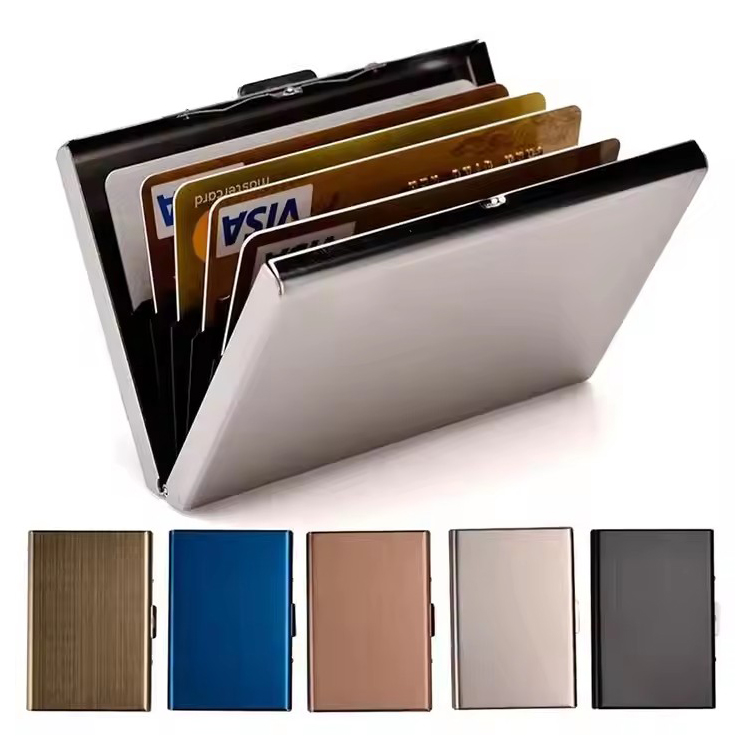
The first generation of RFID blocking products was often clunky and strictly functional. They were frequently sold as simple foil-lined sleeves that users would slide their cards into before placing them back in a standard wallet. These were effective but inconvenient. Recognizing a growing market for digital privacy, traditional leatherworkers and modern tech-accessory brands began integrating shielding materials directly into the lining of wallets. This led to the birth of the dedicated RFID blocking wallet, which looks and feels like a premium fashion accessory while providing a high-tech security barrier.
Today, the market for these wallets has expanded into various niches. We see minimalist aluminum cardholders, traditional leather bifolds with hidden metallic layers, and even tactical wallets made of carbon fiber. The evolution has moved from "protection at all costs" to "protection with style." Modern manufacturing techniques allow for the creation of ultra-thin shielding fabrics that are virtually indistinguishable from standard nylon or polyester linings, allowing designers to create slim, lightweight wallets that do not compromise on security.
There is a significant debate among cybersecurity experts regarding the actual frequency of RFID skimming in the real world. While it is technically possible for a thief to walk through a crowded airport with a concealed reader and gather card numbers and expiration dates, there are very few documented cases of this happening on a large scale.
One reason for this is the advancement in the cards themselves. Most modern EMV (Europay, Mastercard, and Visa) chips do not transmit the actual card number in plain text. Instead, they use "tokenization," creating a one-time use code for each transaction. Even if a thief intercepts this code, it cannot be used to make another purchase. However, some older cards and many forms of identification still transmit data that could be useful to a sophisticated identity thief.
Despite the technological safeguards implemented by banks, the demand for RFID blocking wallets remains high. For many consumers, the value of an RFID blocking wallet lies in "peace of mind." In a world where news of data breaches and identity theft is constant, taking a proactive step to shield one's physical pocket feels like a necessary precaution. It is a one-time investment in a piece of gear that addresses a "what if" scenario, much like a seatbelt or a home security system. Even if the statistical likelihood of being skimmed is low, the cost of the protection is also low, making it a logical choice for many.
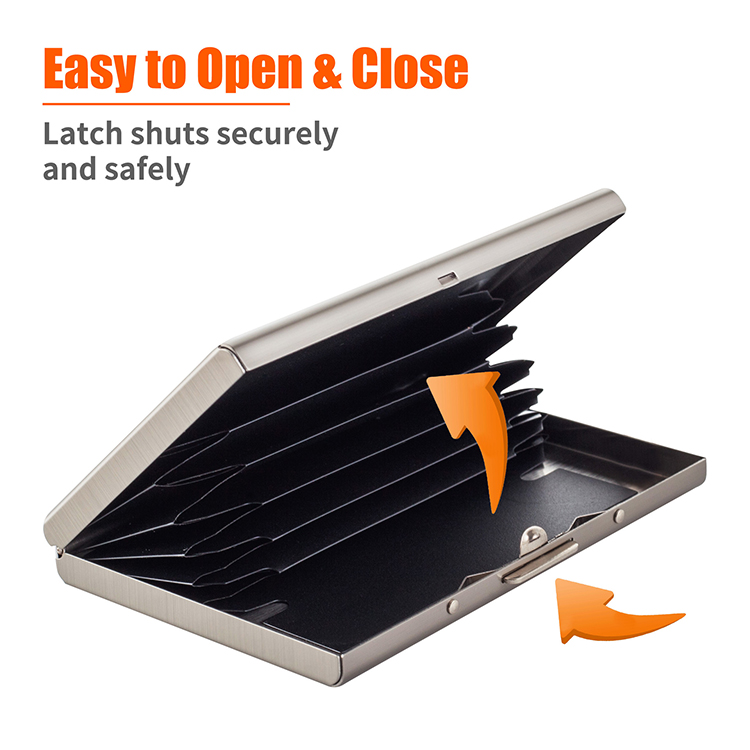
Aluminum is the most common material used in rigid RFID blocking wallets. It is lightweight, durable, and highly conductive, making it an excellent barrier against high-frequency radio waves. Many "minimalist" wallets are made entirely of two aluminum plates held together by elastic. Copper is even more conductive but is rarely used in its pure form due to weight and cost; however, it is often found in the specialized alloys used for flexible shielding fabrics.
For leather and fabric wallets, manufacturers use what is often called "RFID-shielding cloth." This is typically a polyester or nylon fabric that has been infused or coated with microscopic particles of silver, nickel, and copper. This fabric is sewn between the outer leather and the inner lining of the wallet. Because the particles are so small, the fabric remains flexible and soft to the touch, allowing the wallet to maintain the classic feel of high-quality leather while acting as a functional electronic shield.
Carbon fiber has become a favorite in the "tactical" and "luxury" wallet markets. While pure carbon fiber is not as conductive as aluminum, many carbon fiber wallets are reinforced with metallic layers to ensure they meet the 13.56 MHz blocking standards. Carbon fiber offers an incredible strength-to-weight ratio, appealing to users who want a wallet that is virtually indestructible as well as electronically secure.
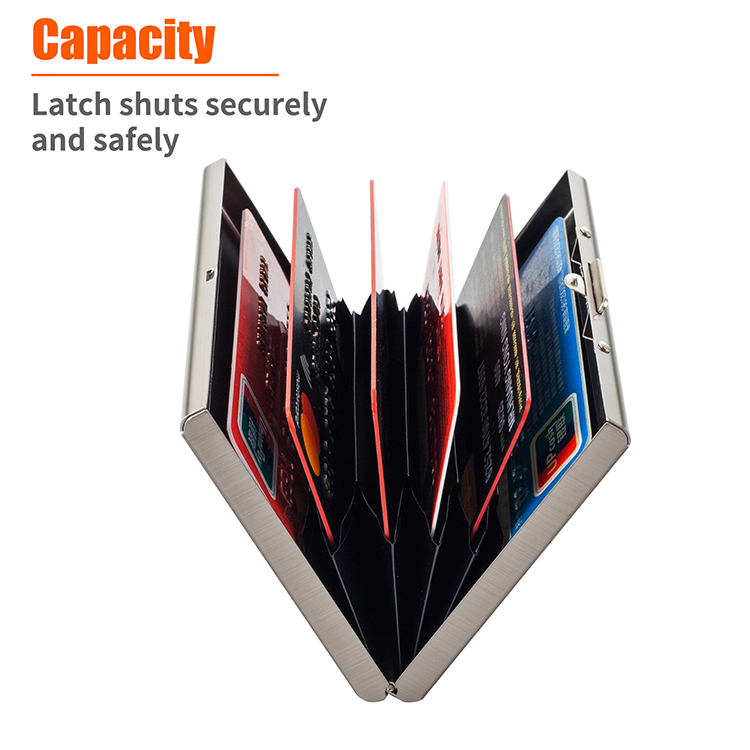
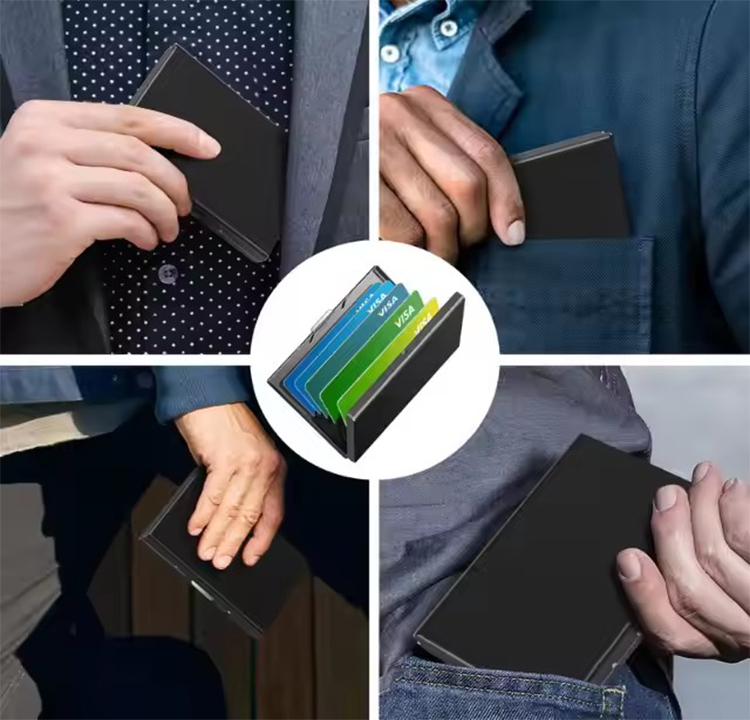
When shopping for an RFID blocking wallet, the first consideration should be your daily carry habits. If you carry a large number of cards and cash, a traditional leather bifold with integrated shielding might be the best fit. If you are a minimalist who only carries three or four cards, a slim metal cardholder could be more appropriate.
It is also important to consider which items you actually need to protect. Not every card in your wallet uses RFID. Standard "swipe" cards with only a magnetic stripe are not affected by radio waves and do not require shielding. Similarly, the newer "contact-only" chip cards that must be inserted into a reader are also safe from remote skimming. The protection is primarily for cards with the "wave" or "contactless" symbol.
Not all RFID blocking wallets are created equal. Some cheaper versions use low-quality foil that can tear or degrade over time, leaving gaps in the shield. To ensure a wallet is effective, look for products that specify they block the 13.56 MHz frequency, which is the standard for credit cards.
A simple way to test your wallet at home is to try using a contactless payment terminal or a card-access door while your card is inside the closed wallet. If the reader cannot detect the card, the shielding is working. There are also smartphone apps that can turn your phone into a temporary RFID reader, allowing you to "scan" your own wallet to see if any data can be retrieved through the material.

One of the main inconveniences of a high-quality RFID blocking wallet is that it is too good at its job. If you use an RFID-enabled transit card for subways or buses, or a work ID badge to enter your office building, you will likely find that these cards no longer work while they are inside your wallet. You will have to physically remove the card to scan it, which can be frustrating for those used to simply tapping their entire wallet against a reader.
To solve this, some "hybrid" wallets feature one non-shielded pocket on the exterior. This allows you to keep your sensitive credit cards inside the protected "vault" while placing your transit or access cards in the outer pocket for easy tapping.
It is a common misconception that an RFID blocking wallet blocks all wireless signals. Most are tuned specifically to the 13.56 MHz frequency. They typically do not block lower frequencies (like 125 kHz used by older building access cards) or higher frequencies (like cellular signals, Bluetooth, or GPS). This is actually a benefit, as it means your wallet won't interfere with your phone's signal if they are in the same pocket, but it also means you must be aware of exactly what technology your cards are using.
As we look toward the future, the concept of the "wallet" is continuing to shift toward the digital realm. Mobile payment systems use advanced encryption and biometric authentication (like fingerprints or facial recognition) that are arguably more secure than any physical card. However, as long as physical cards exist, there will be a need for physical protection.
We are beginning to see "smart wallets" that integrate tracking technology, allowing users to find their wallet via a smartphone app if it is lost. Interestingly, these trackers often use Bluetooth, which operates at a much higher frequency than RFID, allowing the tracker to function even while the credit cards remain shielded.
The RFID blocking wallet is more than just a trend; it is a response to the changing landscape of personal security. While the debate over the actual risk of skimming continues, the integration of shielding technology into our daily accessories represents a logical evolution. Just as we use antivirus software for our computers and passwords for our phones, using an RFID blocking wallet is a simple, passive way to add a layer of defense to our personal data. Whether you choose a rugged metal cardholder or a classic leather bifold, the fundamental purpose remains the same: ensuring that in an increasingly connected world, your private information stays exactly where it belongs—with you.
Q1: How can I tell if my credit card even has RFID technology?
A: Look for a small symbol on the front or back of your card that looks like a series of four curved lines, similar to a Wi-Fi icon turned on its side. This is the universal symbol for contactless payment. If your card has this symbol, it contains an RFID chip and antenna. Additionally, if you have ever "tapped" your card to pay at a terminal rather than swiping or inserting it, your card is RFID-enabled.
Q2: Does an RFID blocking wallet protect my smartphone or its mobile wallet?
A: No, it does not. Mobile wallets like Apple Pay or Google Pay use a technology called NFC (Near Field Communication), which is a branch of RFID. However, smartphones have their own built-in security. Your phone does not broadcast your payment information unless you specifically activate the wallet and authenticate the transaction with a passcode or biometrics. Furthermore, placing your phone inside an RFID blocking wallet would likely block its cellular and Wi-Fi signals, making it temporarily useless.
Q3: Can I make my own RFID blocker at home?
A: Yes, it is technically possible. Wrapping your cards in a layer of heavy-duty aluminum foil will create a basic Faraday cage that blocks most 13.56 MHz signals. However, this is not a very durable or aesthetic solution, as the foil will quickly tear and degrade with daily use. Commercial RFID blocking wallets use specialized metallic fabrics or thicker metal plates that are much more reliable for long-term protection.
Q4: Will an RFID blocking wallet damage my credit cards over time?
A: No, the shielding materials are completely passive. They do not emit any radiation, magnetism, or electrical signals that could harm the chips or magnetic stripes on your cards. The shielding simply acts as a barrier to external radio waves. In fact, many RFID blocking wallets are designed to hold cards more securely than traditional wallets, which can actually help prevent physical wear and tear on the card's surface.
Q5: Do I need an RFID blocking wallet for my passport?
A: Most modern passports (e-Passports) issued in the last decade contain an RFID chip that stores your photo and personal information. While these chips are encrypted and many passport covers now have built-in shielding, using a dedicated RFID blocking travel wallet or passport sleeve provides an extra layer of security against unauthorized attempts to read your digital identity while traveling through high-traffic areas like airports and train stations.
Q6: Does an RFID wallet block GPS trackers if I put one inside?
A: Generally, no. Most RFID blocking wallets are specifically designed to block the 13.56 MHz frequency used by cards. GPS and Bluetooth trackers (like AirTags) operate at much higher frequencies (usually around 2.4 GHz). Unless the wallet is specifically designed to block all radio frequencies (often marketed as "signal blocking pouches"), a tracker placed inside will usually still be able to communicate with your phone or satellites.


