

Views: 255 Author: Princee Lee Publish Time: 03-19-2026 Origin: Princee Lee


Content Menu
>> The Evolution of Professional Identification Gear
● Material Excellence: The Science of 6061-T6 Aluminum
>> Aerospace Alloys in Everyday Utility
>> Precision Manufacturing via CNC Machining
● The Clear ID Panel: Bridging Visibility and Protection
>> Polycarbonate vs. Acrylic: Choosing the Right Shield
>> Anti-Glare and UV Protection Features
● Security in the Digital Age: RFID and Physical Protection
>> The Faraday Cage Effect of Aluminum
>> Preventing Physical Degradation of High-Tech Cards
● Ergonomics and Attachment: Designed for the Worker
>> Optimizing Weight and Balance
>> Heavy-Duty Attachment Points
● Sector-Specific Applications
>> Manufacturing and Heavy Industry
>> Healthcare and Laboratories
>> Construction and Field Engineering
● Conclusion: A Wise Investment in Professionalism
In the modern professional landscape, the simple act of carrying an identification card has transformed from a mere administrative requirement into a critical component of operational security and personal branding. Whether in a high-tech laboratory, a rugged construction site, or a fast-paced corporate office, the equipment used to display and protect these credentials must meet increasingly stringent standards. For years, the market was dominated by flimsy plastic sleeves and fragile vinyl pouches that offered little more than a temporary housing for badges. However, as the value of access cards has increased—incorporating RFID chips, magnetic stripes, and high-resolution security holograms—the need for a more robust solution has become apparent. Enter the industrial-grade aluminum card holder with a clear ID panel, a product that marries aerospace engineering with everyday utility.
The shift toward metal-based carriers represents a broader trend in professional "everyday carry" (EDC) items where durability is prioritized over the disposable nature of traditional office supplies. These holders are not merely aesthetic upgrades; they are engineered tools designed to survive the rigors of industrial environments where heat, chemical exposure, and physical impact are daily occurrences. By replacing soft plastics with hard-anodized aluminum alloys, manufacturers have created a category of card holders that can last a career rather than a few months. This evolution reflects a growing understanding that a broken badge holder is not just a nuisance but a potential security breach, as lost or damaged cards can lead to unauthorized access or costly replacements.
At the heart of any industrial-grade card holder is the material from which it is forged. Most premium models utilize 6061-T6 aluminum, an alloy that is frequently referred to as "aircraft-grade" due to its widespread use in airframe construction and high-performance automotive parts. The "T6" designation indicates that the metal has undergone a specific heat-treatment and artificial aging process, which significantly enhances its mechanical properties. This results in a material that boasts a high strength-to-weight ratio, ensuring that while the holder is incredibly tough, it does not feel heavy or cumbersome when worn around the neck for twelve hours a day.
Compared to standard aluminum, 6061-T6 offers superior yield strength—typically around 240 MPa—which means it can withstand significant pressure and impact without deforming. In an industrial setting, this is vital. A worker leaning against a metal railing or accidentally dropping their holder onto a concrete floor needs to know that the internal electronics of their ID card remain protected. Furthermore, this alloy provides excellent corrosion resistance. Unlike steel, which can rust if exposed to moisture or industrial chemicals, aluminum naturally forms a protective oxide layer that prevents degradation, making it ideal for outdoor use or humid environments like maritime facilities or chemical plants.

The manufacturing process for these holders is as sophisticated as the materials themselves. Instead of being stamped out of thin sheets, industrial-grade holders are often CNC (Computer Numerical Control) machined from solid blocks of aluminum. This subtractive manufacturing process allows for incredibly tight tolerances and complex internal structures that would be impossible with traditional molding. CNC machining ensures that every edge is perfectly aligned and every corner is precisely chamfered, eliminating the sharp burrs often found on cheaper metal products.
Following the machining process, the aluminum undergoes anodization. This electrochemical process thickens the natural oxide layer on the surface of the metal, creating a finish that is not only harder than the raw aluminum but also capable of holding vibrant dyes. Anodized finishes are integral to the metal itself, meaning they will not chip, peel, or flake off over time. This surface treatment also provides a non-reflective, matte finish that is essential for certain security environments where glare can interfere with facial recognition software or biometric scanning.
While the aluminum frame provides the structural integrity, the clear ID panel is the window to the card's information. In industrial-grade holders, this panel is typically made from one of two high-performance thermoplastics: polycarbonate or acrylic. Polycarbonate is the preferred choice for high-impact environments. Often sold under brand names like Lexan, polycarbonate is virtually unbreakable and is the same material used in bulletproof glass and riot shields. Its impact resistance is roughly 250 times that of standard glass, ensuring that the face of the ID card is shielded from flying debris or heavy drops.
Acrylic, on the other hand, is known for its exceptional optical clarity and superior scratch resistance. While it is more brittle than polycarbonate, its surface is harder, meaning it will stay clear and legible even after months of being rubbed against clothing or tools. Many industrial-grade holders compromise by using UV-stabilized polycarbonate, which offers the toughness required for heavy duty work while incorporating coatings that mitigate the material's natural tendency to scratch. This ensures that the barcode or QR code on the ID card remains scannable even after years of use.
In outdoor industrial settings, such as oil rigs or open-pit mines, sunlight can be a significant obstacle to badge legibility. Premium card holders often incorporate anti-glare technology into their clear panels. This is achieved through a fine etching or a specialized coating that diffuses reflected light, allowing the ID to be read from various angles without the blinding shine of the sun. Additionally, UV protection is built into the panel to prevent the ID card itself from fading. Many printed cards utilize thermal transfer or dye-sublimation inks that can degrade quickly when exposed to direct sunlight; a UV-blocking clear panel acts as a sunscreen for the credential, preserving its security features and professional appearance.
One of the most significant advantages of an aluminum card holder is its inherent ability to block Radio Frequency Identification (RFID) signals. Modern access cards often contain chips that communicate with readers via radio waves. While convenient, this technology is susceptible to "electronic pickpocketing" or skimming, where a malicious actor uses a handheld reader to steal the data from the card without ever touching the holder. Aluminum is a conductive material that creates a natural Faraday cage. When an ID card is encased in an aluminum frame, the metal redirects electromagnetic fields around the card, preventing unauthorized readers from activating the chip inside.
This digital security is a major selling point for corporate and government employees who handle sensitive data. However, the design of the clear ID panel is often adjusted to allow for "intentional" scanning. Some holders feature a partially open back or a specific alloy thickness that allows the card to be read when held directly against an authorized reader, while still providing protection against long-range skimming. This balance of security and convenience is a hallmark of industrial-grade design.
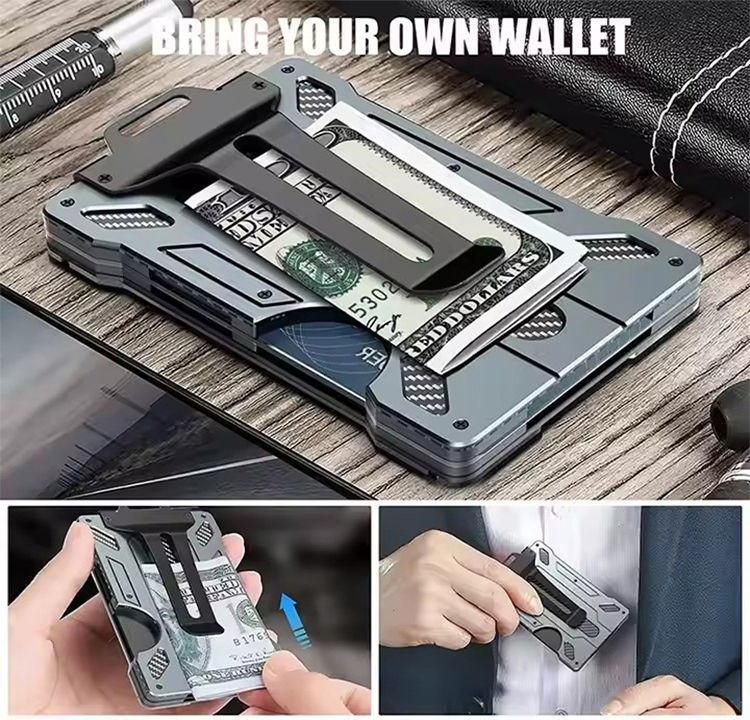
Beyond digital security, the rigid nature of an aluminum holder prevents the physical bending and "creasing" that often plagues plastic holders. Many modern badges contain delicate internal antennas or magnetic stripes that can be damaged if the card is flexed repeatedly. In industrial environments, where workers might be bending, lifting, or climbing, a card kept in a pocket or a soft sleeve is likely to snap. The aluminum chassis acts as an exoskeleton, keeping the card perfectly flat and rigid. This prevents the internal circuits from breaking and ensures that the magnetic stripe is not scratched by dirt or grit that might enter a softer pouch.
A common misconception is that a metal card holder will be heavy and uncomfortable. In reality, by utilizing aerospace aluminum and precision machining, manufacturers can create holders that weigh only a few grams more than their plastic counterparts. The ergonomics of the design often include rounded edges and a slim profile to ensure the holder does not snag on equipment or clothing. Furthermore, the weight is carefully balanced so that the holder hangs straight, keeping the ID panel visible at all times—a critical requirement for security compliance in many high-stakes facilities.
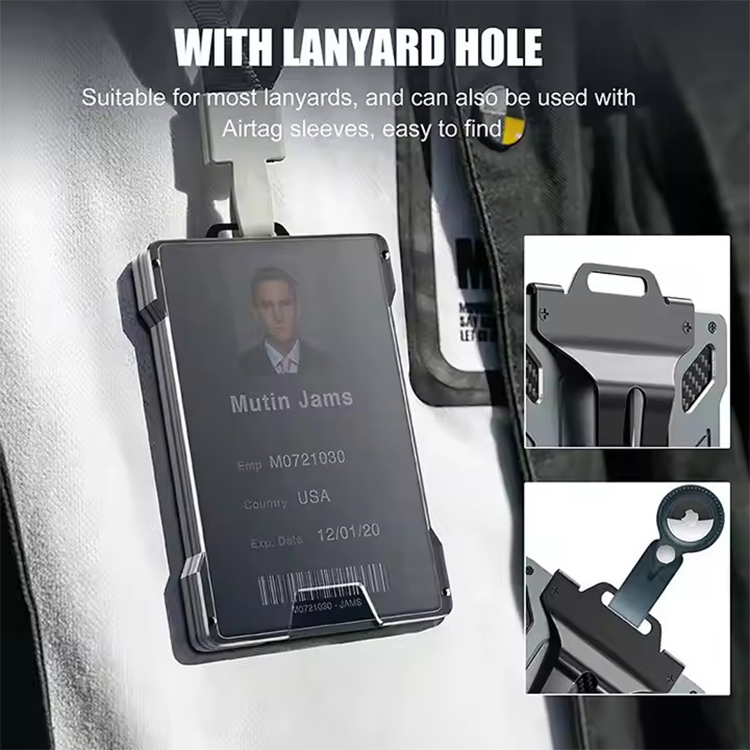
The connection between the holder and the wearer is often the weakest link in a badge system. Industrial-grade aluminum holders address this by incorporating integrated attachment points that are part of the metal frame itself, rather than glued-on plastic tabs. These slots are designed to accommodate heavy-duty lanyards, steel-wire retractable reels, or tactical carabiners. By milling the attachment slot directly into the 6061-T6 aluminum, the risk of the holder breaking off during a snag is virtually eliminated. Some models even feature dual-attachment points, allowing the holder to be worn in either portrait or landscape orientation depending on the card's design.
In manufacturing plants, environment is everything. Workers are often exposed to oils, coolants, and extreme temperatures. A plastic holder in such an environment will quickly become brittle or clouded by chemical vapors. The anodized aluminum of an industrial-grade holder is resistant to most industrial solvents and maintains its structural integrity from -40°F to over 300°F. This makes it the only viable choice for foundries, cold storage facilities, and automotive assembly lines where the gear must be as tough as the machinery.
While healthcare might not seem "industrial," the cleaning protocols in hospitals are incredibly harsh. Card holders must be regularly disinfected with bleach or high-alcohol solutions to prevent the spread of pathogens. Aluminum holders excel here because the anodized finish is non-porous and does not harbor bacteria, and it can withstand repeated chemical cleanings without losing its color or clarity. The clear polycarbonate panel is also resistant to the "fogging" that occurs when cheaper plastics react with medical-grade disinfectants.
For engineers and construction workers, the primary threats are dust and physical impact. An aluminum holder with a sealed or tight-tolerance clear panel prevents fine silica dust from getting between the panel and the card, which can act like sandpaper and ruin the ID's finish. The ability to clip the holder directly to a safety vest or harness using a metal carabiner provides a level of security that a simple plastic clip cannot match, ensuring the worker's credentials are never lost on a vast, busy job site.
The industrial-grade aluminum card holder with a clear ID panel represents the pinnacle of badge protection technology. By combining the legendary durability of 6061-T6 aluminum with the impact resistance of polycarbonate, these holders provide a level of security—both digital and physical—that plastic alternatives simply cannot offer. While the initial cost may be higher, the longevity and reduced need for card replacements make them a more economical and sustainable choice in the long run. In an era where professional identity and facility security are paramount, upgrading to an industrial-grade carrier is not just a choice of style, but a commitment to operational excellence.
Q1: Will the aluminum holder block my badge from working at the office gate?
A1: It depends on the design. Most industrial-grade holders are designed with "RFID-friendly" zones or specific metal thicknesses that allow short-range proximity scanning (like tapping a reader) while still blocking long-range unauthorized "skimming" attempts. If your holder is a full Faraday cage, you may need to slide the card out slightly to scan it.
Q2: Is the clear panel replaceable if it gets scratched?
A2: Many high-end industrial holders feature a modular design where the clear polycarbonate or acrylic panel can be popped out and replaced if it becomes damaged, extending the life of the aluminum frame indefinitely.
Q3: Can the aluminum frame be laser-engraved for company branding?
A3: Yes. One of the benefits of anodized aluminum is that it is an excellent substrate for laser engraving. Companies often engrave logos, employee names, or emergency contact information directly onto the metal frame.
Q4: How does the holder perform in extreme cold?
A4: Unlike plastic holders, which become brittle and snap in freezing temperatures, 6061-T6 aluminum maintains its strength and flexibility in sub-zero conditions, making it ideal for outdoor winter work or refrigerated environments.
Q5: Is this holder heavy enough to cause neck strain?
A5: No. By using aircraft-grade aluminum and CNC thinning techniques, these holders typically weigh between 20 and 40 grams. When paired with a wide, ergonomic lanyard, the weight is negligible and comparable to a heavy-duty plastic holder.


