

Views: 289 Author: Princee Lee Publish Time: 03-18-2026 Origin: Princee Lee


Content Menu
>> The Philosophy of the Modern Carry
>> The Soul of the Wallet: Premium Leather
>>> Full-Grain vs. Top-Grain Leather
>>> The Vegetable Tanning Tradition
>> The Edge of Innovation: Carbon Fiber Accents
>>> The Aesthetic of the Weave
>> The Engineering of a Hybrid Design
>> Functionality in the Digital Age: RFID Protection
>> Ergonomics and User Experience
>> Versatility Across Environments
>> The Psychology of Ownership
>> Conclusion
>> Related Questions and Answers
The modern gentleman's pocket has undergone a radical transformation over the last decade. Gone are the days of the "Costanza wallet"—that bloated, overstuffed leather brick that ruined the silhouette of a tailored suit and caused back pain from sitting on an uneven surface. In its place, a new philosophy of "Everyday Carry" (EDC) has emerged, prioritizing efficiency, minimalism, and material excellence. At the pinnacle of this evolution sits the durable leather card wallet with carbon fiber accents. This accessory is not merely a container for currency; it is a sophisticated marriage of ancient craftsmanship and space-age engineering. By combining the organic, timeless appeal of premium leather with the high-tech resilience of carbon fiber, designers have created a tool that meets the rigorous demands of the 21st-century lifestyle while maintaining an aura of classic luxury.
To understand the appeal of a hybrid leather and carbon fiber wallet, one must first understand the shift toward minimalism. As society moves toward a cashless economy, the need to carry thick stacks of paper bills and a dozen plastic loyalty cards has evaporated. Digital wallets on smartphones handle many transactions, yet the physical wallet remains essential for government IDs, primary credit cards, and emergency cash.
The "minimalist wallet" movement isn't just about carrying less; it's about carrying better. It's an intentional choice to surround oneself with objects that serve a purpose and age gracefully. A durable leather wallet provides that tactile satisfaction and emotional connection, while carbon fiber accents introduce a level of structural integrity and modern flair that leather alone cannot achieve. This combination speaks to a person who respects tradition but embraces the future.

Leather has been the gold standard for wallets for centuries, and for good reason. It is a biological material that possesses a unique ability to adapt to its user. However, not all leather is created equal. In a high-quality card wallet, the choice of hide and the tanning process are critical to its longevity.
When discussing durability, full-grain leather is the undisputed king. Unlike corrected-grain leathers that are sanded down to remove imperfections, full-grain leather retains the entire thickness of the hide's outermost layer. This layer contains the densest fibers, providing maximum strength and breathability. Over time, full-grain leather does not wear out; instead, it develops a "patina"—a rich sheen and darkening of color that reflects the history of its use.
Top-grain leather is also a popular choice for carbon fiber hybrid wallets. It is slightly thinner and more pliable, making it easier to wrap around rigid carbon fiber inserts. While it may not develop a patina as deeply as full-grain, it offers a consistent finish and excellent resistance to stains. In either case, the use of genuine animal hide ensures that the wallet feels warm and natural in the hand, providing a necessary contrast to the cold, industrial nature of carbon fiber.
The process of turning hide into durable leather is an art form. Vegetable tanning, which uses natural tannins found in tree bark and leaves, is the preferred method for high-end EDC gear. This process can take weeks or even months, but it results in a sturdy, eco-friendly leather that holds its shape. When combined with carbon fiber, vegetable-tanned leather provides the structural "backbone" needed to support the rigid accents without stretching excessively over time.
If leather represents the past, carbon fiber represents the pinnacle of modern material science. Originally developed for aerospace and high-performance racing, carbon fiber is a polymer consisting of extremely thin strands of carbon atoms bonded together in a crystalline alignment.

The primary reason designers integrate carbon fiber into leather wallets is its incredible strength-to-weight ratio. Carbon fiber is five times stronger than steel and twice as stiff, yet it weighs significantly less. In a card wallet, carbon fiber accents serve as protective shields. They prevent the wallet from bending or snapping when kept in a back pocket and protect the sensitive chips inside credit cards from physical crushing.
Beyond its mechanical properties, carbon fiber offers a unique visual language. The most common pattern is the 3K twill weave, characterized by a diagonal "staircase" appearance that catches the light in a mesmerizing way. Whether finished in a high-gloss coat that looks like liquid glass or a tactical matte finish that feels stealthy and modern, carbon fiber adds a layer of visual depth that standard leather cannot provide. It transforms a simple wallet into a piece of precision engineering.
Creating a durable leather card wallet with carbon fiber accents is not as simple as gluing two materials together. It requires meticulous engineering to ensure that the transition between the soft leather and the rigid carbon fiber is seamless and durable.
In many designs, carbon fiber plates are used as the internal frame of the wallet. This creates a "skeleton" that maintains the wallet's slim profile even when it is fully loaded. Without this reinforcement, a purely leather slim wallet can eventually lose its shape, becoming "baggy" as the leather stretches. The carbon fiber ensures the wallet remains as thin on day 1,000 as it was on day 1.
The point where leather meets carbon fiber is often the most vulnerable. Master craftsmen use specialized heavy-duty threads, such as bonded nylon or polyester, and employ techniques like the saddle stitch. Unlike a machine-made lockstitch, a hand-sewn saddle stitch uses two needles to pass the thread through each hole in a figure-eight pattern. If one thread breaks, the other remains intact, preventing the entire seam from unraveling.
Furthermore, advanced adhesives are used to bond leather overlays to carbon fiber surfaces. These adhesives must be flexible enough to handle the expansion and contraction of the leather while being strong enough to resist the shearing forces that occur when sliding the wallet in and out of tight pockets.
One of the most practical benefits of incorporating carbon fiber accents into a leather wallet is the inherent security it provides. We live in an era of "electronic pickpocketing," where thieves can use handheld RFID (Radio Frequency Identification) scanners to read information from credit cards and passports without ever touching the victim.
Carbon fiber, especially when integrated with metallic mesh or specialized liners, acts as a Faraday cage. It creates a conductive shield that blocks electromagnetic signals from reaching the cards inside. A well-designed leather and carbon fiber wallet offers 360-degree RFID protection, giving the user peace of mind in crowded subways, airports, and urban environments. This marriage of physical and digital security is a hallmark of modern EDC design.
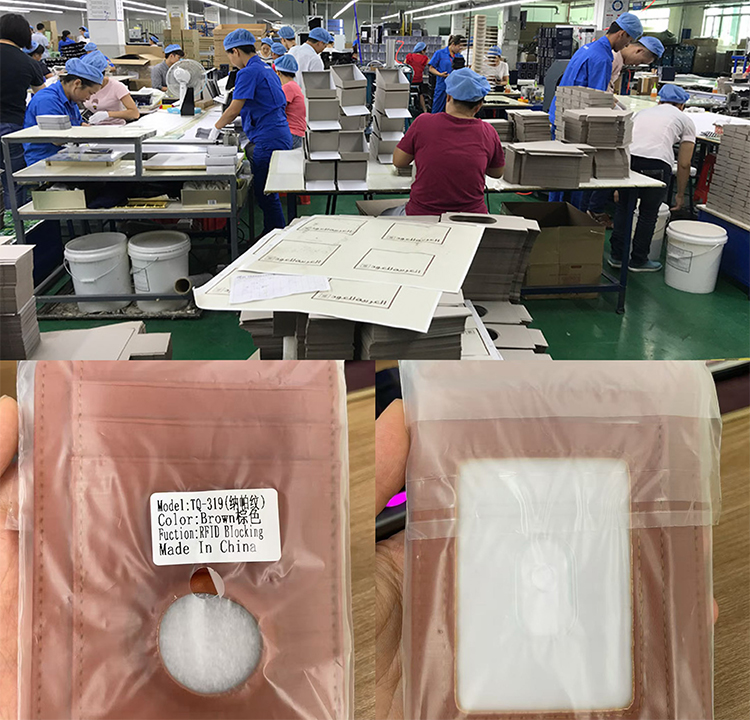
A wallet is an object of constant interaction. We touch it multiple times a day, and its ergonomics can significantly impact our daily comfort. The hybrid design excels here by offering "tactile diversity."
The exterior leather provides a high-friction surface that prevents the wallet from accidentally sliding out of a pocket. Meanwhile, carbon fiber thumb-notches or slide-out mechanisms allow for the quick deployment of cards. Many modern card wallets feature a "fanning" mechanism where a simple flick of a lever or a push through a carbon fiber window spreads the cards out, allowing the user to select the right one in seconds. This eliminates the frustration of digging through deep pockets and broken fingernails.
The beauty of the leather and carbon fiber combination lies in its versatility. A purely carbon fiber or metal wallet can often feel too "tactical" or "industrial," looking out of place in a formal setting or a high-stakes boardroom. Conversely, a traditional leather bifold can feel too old-fashioned when paired with modern tech-wear or athletic attire.
The hybrid wallet bridges this gap. It has the professional elegance required for a black-tie event, thanks to the premium leather, but maintains a sporty, cutting-edge vibe due to the carbon fiber. It is equally at home in the pocket of a bespoke Italian suit or a pair of technical hiking trousers. It is the ultimate "crossover" accessory.
Durability is the core promise of this product. While carbon fiber is virtually indestructible under normal conditions—resistant to water, heat, and most chemicals—leather requires a bit more care. However, the maintenance is part of the reward.
To keep the leather supple, an occasional application of a high-quality leather conditioner is recommended. This prevents the hide from drying out and cracking. The carbon fiber accents can be wiped clean with a microfiber cloth to remove fingerprints and oils. Because the carbon fiber provides a rigid structure, the leather is less likely to undergo the heavy creasing and "dog-earing" that plagues traditional wallets. When properly cared for, a durable leather card wallet with carbon fiber accents can easily last a decade or more, becoming a personal artifact rather than a disposable commodity.
In a world of "fast fashion" and planned obsolescence, investing in a high-quality hybrid wallet is a sustainable choice. Cheap synthetic wallets made from "vegan leather" (usually polyurethane or PVC) often peel and fall apart within six months, ending up in landfills where they take hundreds of years to decompose.
A wallet made from responsibly sourced leather and durable carbon fiber is built for the long haul. By choosing a product that lasts ten times longer than a cheap alternative, the consumer reduces their overall environmental footprint. Furthermore, many high-end manufacturers are now using recycled carbon fiber from the aerospace industry, giving a second life to this high-value material.

Finally, there is a psychological component to owning such a well-crafted tool. Carrying a wallet that feels substantial, looks beautiful, and functions perfectly provides a small but consistent boost to one's sense of organization and preparedness. It is a reminder that quality matters. In a world of digital bits and ephemeral interactions, having a physical object that embodies the peak of material science and human craft provides a grounding experience. It is a silent statement of taste and a commitment to excellence.
The durable leather card wallet with carbon fiber accents represents the perfect synthesis of two worlds. It takes the warmth, history, and evolving beauty of leather and reinforces it with the strength, security, and precision of carbon fiber. It addresses the modern need for minimalism and digital security without sacrificing the tactile luxury that has defined men's accessories for generations. Whether you are an urban professional navigating the corporate jungle, a tech enthusiast who appreciates material science, or simply someone tired of the bulk of traditional bifolds, this hybrid design offers a solution that is as functional as it is beautiful. It is not just a wallet; it is a testament to how we can honor the past while building for the future.
Q1: How does carbon fiber protect my credit cards compared to a standard leather wallet?
A1: Carbon fiber acts as a rigid shield that prevents your cards from bending or cracking under pressure, such as when you sit down. More importantly, when combined with specific shielding layers, it provides RFID blocking, which prevents hackers from scanning your card information wirelessly—a feature most standard leather wallets lack.
Q2: Will the leather part of the wallet still develop a patina if it has carbon fiber accents?
A2: Yes, the leather sections will continue to age and develop a unique patina based on your handling and environment. The carbon fiber will remain unchanged, creating a beautiful contrast over time between the evolving leather and the "frozen in time" look of the carbon fiber.
Q3: Is this type of wallet uncomfortable to carry in a back pocket?
A3: Actually, it is often more comfortable. Because the carbon fiber allows the wallet to be much thinner than a traditional bifold, it creates a smaller profile. However, many users prefer carrying these slim wallets in the front pocket for better ergonomics and security, which is only possible because of their minimalist design.
Q4: Can carbon fiber accents scratch my cards when I slide them in and out?
A4: High-quality wallets feature polished or coated carbon fiber edges and smooth interior linings (like microfiber or silk) to ensure that cards slide smoothly without any scratching. The carbon fiber is usually placed on the exterior or as a structural mid-layer to avoid direct abrasive contact with card strips.
Q5: How do I clean a hybrid wallet if it gets dirty?
A5: You should use a damp microfiber cloth to wipe the carbon fiber parts. For the leather, use a dedicated leather cleaner and a soft brush for any stains, followed by a light conditioner. Avoid submerging the wallet in water or using harsh chemicals, as these can damage the leather's natural oils and the adhesive bonds.


