

Views: 224 Author: Princee Lee Publish Time: 03-20-2026 Origin: Princee Lee


Content Menu
>> The Evolution of the Modern Wallet: From Bulk to Precision
>> Understanding the Materials: Why Carbon Fiber?
>> The Timeless Appeal of Genuine Leather
>> The Synergy of the Hybrid Design
>> Security in the Digital Age: RFID Blocking
>> Ergonomics and Functionality: The Pop-Up Mechanism
>> Slimming Down Your Carry: The Front Pocket Advantage
>> Aesthetics: The Visual Language of Success
>> Durability and Longevity: An Investment Piece
>> Versatility Across Different Lifestyles
>> Maintaining Your Hybrid Card Holder
>> The Future of Everyday Carry
>> Conclusion: Making the Switch
>> Related Questions and Answers
For decades, the traditional leather bifold wallet was a symbol of adulthood. It was thick, often overflowing with paper receipts, expired coupons, and a stack of cash that made sitting down uncomfortable. However, as the global economy shifted toward digital payments and contactless transactions, the necessity for a "brick" in one's back pocket vanished. The modern user demands efficiency, security, and a refined aesthetic. Enter the hybrid leather and carbon fiber card holder—a pinnacle of everyday carry (EDC) engineering that merges the heritage of fine leather with the futuristic resilience of carbon fiber.
This transition isn't just about size; it's about a lifestyle change. The "minimalist movement" has encouraged professionals and travelers alike to carry only what is essential. A hybrid card holder facilitates this by providing a structured, high-tech home for credit cards, IDs, and a few emergency bills, all while maintaining a profile so slim it virtually disappears in a front pocket.
Carbon fiber is often associated with supercars, aerospace engineering, and high-end sporting equipment. It is prized for having one of the highest strength-to-weight ratios in the material world. When integrated into a card holder, carbon fiber serves as the "exoskeleton."
Unlike plastic or thin aluminum, carbon fiber does not bend or warp under pressure. This is crucial for protecting the delicate EMV chips and magnetic strips on modern credit cards. If you accidentally sit on your wallet or drop it on a hard surface, the carbon fiber plates act as a shield, absorbing the impact and maintaining the structural integrity of the cards inside. Furthermore, its distinct woven pattern provides a visual depth that screams modern sophistication. It feels cool to the touch, resists scratches, and offers a tactical grip that ensures the holder won't slip out of your hand.
While carbon fiber provides the "brains and brawn," leather provides the "soul" of the hybrid card holder. Leather has been the preferred material for personal accessories for millennia because of its tactile warmth and ability to age gracefully. In a hybrid design, the leather components—often used for outer pockets or decorative wraps—soften the technical edges of the carbon fiber.
High-quality top-grain or full-grain leather is typically used in these premium holders. Over time, as the leather interacts with the oils from your hands and the friction of your pocket, it develops a "patina." This unique sheen and darkening of the leather make every card holder one-of-a-kind. It balances the industrial look of the carbon fiber with a touch of organic luxury, making the accessory suitable for both a high-stakes boardroom meeting and a casual weekend outing.
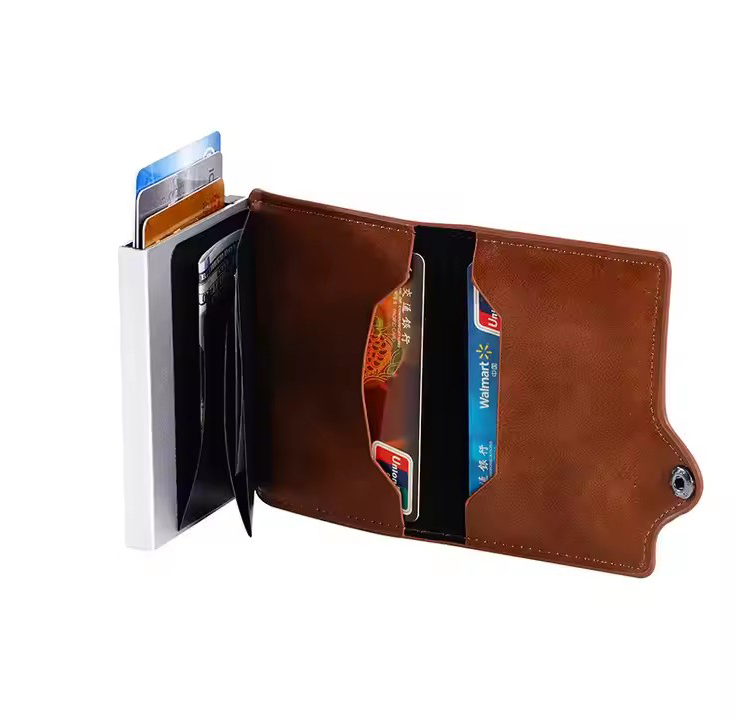
The magic happens when these two disparate materials are fused. A pure carbon fiber wallet can sometimes feel too rigid or "cold," while a pure leather card holder can lose its shape over time, leading to cards slipping out. The hybrid model solves both issues.
The internal frame or plates are usually made of carbon fiber to ensure the wallet stays slim and rigid, while the leather exterior provides slots for "quick-access" cards. This combination ensures that the wallet remains thin even when fully loaded. It represents a harmony between the old world and the new—the durability of modern chemistry and the classic touch of traditional craftsmanship.
In the modern world, physical theft isn't the only concern. Electronic pickpocketing, or RFID skimming, is a technique where thieves use handheld scanners to read the information from your contactless credit cards without ever touching your wallet.
One of the inherent benefits of a hybrid card holder featuring carbon fiber or metallic reinforcements is RFID blocking. The conductive nature of the carbon fiber weave creates a "Faraday cage" effect. This shield prevents electromagnetic signals from reaching your cards, ensuring that your sensitive financial data remains encrypted and inaccessible to unauthorized scanners. For the modern traveler who frequents crowded airports or metro stations, this peace of mind is invaluable.
Many high-end hybrid card holders incorporate a mechanical element often referred to as a "pop-up" or "fan" mechanism. With the flick of a small lever at the bottom of the device, your cards are ejected in a tiered fashion, allowing you to see and select the specific card you need instantly.
This eliminates the frustrating "thumb-shuffling" common with traditional wallets. Instead of digging through deep pockets, the hybrid holder presents your tools to you with precision. This mechanical reliability, combined with the lightweight nature of the carbon fiber frame, transforms a mundane task—paying for a coffee or tapping into the office—into a seamless, satisfying experience.

Chiropractors have long warned against the "fat wallet syndrome," where sitting on a bulky bifold causes spinal misalignment and sciatica. The hybrid card holder is designed specifically for the front pocket.
By migrating your wallet to the front, you not only improve your posture but also increase security. Front pockets are significantly harder for pickpockets to access than back pockets. The slim profile of the leather and carbon fiber hybrid means there is no unsightly bulge in your trousers, preserving the clean lines of a well-tailored suit or slim-fit jeans. It is the ultimate accessory for the style-conscious individual who refuses to sacrifice comfort for utility.
The visual contrast between the matte or gloss finish of carbon fiber and the rich, matte texture of leather creates a powerful aesthetic. It suggests that the owner is someone who values innovation but respects tradition.
In professional settings, your accessories are an extension of your personal brand. Pulling out a battered, overstuffed leather wallet can look disorganized. In contrast, a sleek hybrid holder looks intentional. It fits perfectly alongside other modern essentials like a high-end smartphone, a mechanical watch, or a precision-engineered pen. It is a subtle indicator of attention to detail and a preference for quality over quantity.
While a cheap synthetic wallet might last a year before the edges start to fray and the "leather" begins to peel, a hybrid carbon fiber and genuine leather holder is built to last a decade or more.
Carbon fiber is virtually indestructible in the context of daily use; it won't crack, rust, or corrode. When paired with high-quality leather and reinforced stitching, the card holder becomes an investment. Instead of buying a new wallet every few years, the modern user invests in a piece that grows more beautiful with age (thanks to the leather) while remaining functionally perfect (thanks to the carbon fiber). It is a move toward sustainable consumption—buying one thing that lasts rather than multiple things that end up in a landfill.

Whether you are a tech-focused software engineer, a frequent-flying executive, or an outdoor enthusiast, the hybrid card holder adapts to your environment.
For the executive, it offers the sleekness required for formal attire. For the engineer, it satisfies the appreciation for advanced materials and mechanical efficiency. For the outdoorsman, the ruggedness of the carbon fiber ensures that the wallet can survive drops, moisture, and the general wear and tear of an active life. It is perhaps the most versatile accessory in the modern EDC catalog.
To ensure your hybrid holder lasts a lifetime, a small amount of maintenance goes a long way. The carbon fiber elements are low-maintenance; a simple wipe with a damp microfiber cloth will remove fingerprints and dust.
The leather components benefit from an occasional application of a high-quality leather conditioner. This keeps the hide supple and prevents it from drying out or cracking, especially if you live in a dry climate. Avoiding overstuffing is also key; while these holders are strong, forcing too many cards into the leather slots can stretch the fibers beyond their breaking point. Treat it with respect, and it will remain a centerpiece of your pocket for years.
As we look toward the future, the trend of integration will only continue. We may eventually see hybrid holders that incorporate "Find My" technology or biometric locks. However, the core philosophy will remain the same: combining the best of nature and the best of science.
The hybrid leather and carbon fiber card holder is more than just a place to store plastic. It is a reflection of the modern world—a place where technology and tradition coexist. It simplifies our lives, protects our data, and enhances our style. In an era where we are constantly bombarded with "smart" gadgets that need charging, there is something deeply satisfying about a "dumb" object that is engineered so perfectly that it performs its job without fail, every single day.

Transitioning to a hybrid card holder requires a bit of discipline. You have to let go of the receipts you don't need and the coins that weigh you down. But once you make the switch, you rarely look back. The feeling of a light pocket, the security of RFID blocking, and the tactile pleasure of carbon fiber and leather create a superior user experience. It is the definitive wallet for the 21st century—a perfect blend of form, function, and futuristic flair.
Q1: Is carbon fiber better than aluminum for a card holder?
A: Both materials offer excellent protection and RFID blocking. However, carbon fiber is generally lighter than aluminum and has a much higher tensile strength. While aluminum can dent or scratch relatively easily, carbon fiber is highly resistant to impact and maintains its aesthetic finish for longer. Additionally, carbon fiber offers a unique "tech" look that many users prefer over the industrial feel of aluminum.
Q2: How many cards can a typical hybrid card holder carry?
A: Most hybrid designs are optimized for 5 to 8 cards in the main carbon fiber compartment. Additionally, many models feature external leather pockets that can hold another 2 to 4 cards for quick access. While it is possible to find larger versions, the goal of these holders is to maintain a slim profile, so carrying 6 to 10 cards is the standard capacity.
Q3: Does the RFID blocking feature interfere with my phone's signal?
A: No, the RFID blocking technology is localized to the card holder itself. It uses a passive shield (a Faraday cage) to block short-range radio frequencies used by credit cards and IDs. It does not emit any signals and will not affect your smartphone's cellular, Wi-Fi, or Bluetooth connectivity, even if they are in the same pocket.
Q4: Can I carry cash in a hybrid card holder?
A: Yes, most modern hybrid holders include a solution for cash. This is typically in the form of a "money clip" attached to the back made of spring steel or carbon fiber, or a "money strap" made of high-quality elastic or leather. These are designed to hold a few folded bills securely without adding significant bulk.
Q5: Will the carbon fiber edges scratch my phone if they are in the same pocket?
A:** While carbon fiber is very hard, most high-quality hybrid holders have chamfered (rounded) edges and a smooth finish to prevent scratching. However, because carbon fiber is harder than the glass or metal on most phones, it is always a best practice to keep your wallet in a separate pocket from your smartphone to avoid any potential cosmetic damage.


