

Views: 382 Author: Professor Leon Publish Time: 09-01-2026 Origin: Site


Content Menu
● 1. Understanding the Secrid Mini Wallet: What Are You Actually Comparing?
● 2. Quality and Performance Factors: What Makes a Mini Wallet Better?
● 3. How to Evaluate RFID Mini Wallet Suppliers
● 4. Relevant Industry Standards and Certifications for RFID Wallets
● 5. Production Process: From Raw Material to Finished Wallet
● 6. How We Meet These Standards as a Manufacturer
● 7. Customization and OEM/ODM Options for Mini Wallets
● 8. Ordering Process: MOQ, Lead Time, and Shipping
● 9. What Are the Best Alternatives to Secrid?
● 10. Can You Customize the Mechanism for Your Brand?
● 11. A Final Word on Sourcing
12 min read
When a product manager from a German accessories brand opened a sample box from a Shenzhen factory, the first thing she did was flip the aluminum wallet open and closed thirty times in a row. She was not checking the finish. She was counting the milliseconds it took for the cards to fan out. Her customers had been asking for "something like Secrid, but faster" for two seasons. The sample in her hand was close. But close does not clear a purchase order.
The Secrid Mini Wallet holds a peculiar position in the accessories market. It is a design icon, a functional benchmark, and a procurement headache all at once. For B2B buyers — brand owners, wholesalers, and online retailers — the question is not whether Secrid is good. The question is whether you can source something that performs better, costs less, or offers more room for your brand's identity. This guide covers the technical specifications, procurement frameworks, and supplier evaluation criteria you need to make that call.
The Secrid Mini Wallet is a compact cardholder with a rigid aluminum casing and a leather or polycarbonate sleeve. Its defining feature is the Card Protector mechanism: a spring-loaded lever that pops a stack of cards upward for quick access. It typically holds 4 to 6 embossed cards and has a small compartment for folded cash. RFID blocking is built into the casing.
Direct answer: A "better than Secrid mini wallet" is one that improves on the original's mechanism speed, material quality, durability, or price point while maintaining the compact form factor. For B2B buyers, "better" also means easier to customize and more cost-effective at scale.
The benchmark status of Secrid comes from three design decisions. First, the mechanical interaction — the pop-up action — creates a tactile experience that flat cardholders cannot match. Second, the aluminum shell provides genuine RFID protection and structural rigidity. Third, the brand's retail presence made the mechanism familiar to consumers worldwide.
But familiarity creates a problem for your brand. If you sell a wallet that looks and operates exactly like a Secrid, you are competing on price against a brand with massive marketing muscle. To win, you need a point of differentiation. That could be a faster mechanism, a more premium material mix, or a price point that creates margin for your retail partners.
Evaluating a mini wallet for procurement is different from evaluating one as a consumer. Consumers feel the mechanism and judge aesthetics. Buyers need to quantify performance so they can compare quotes from different factories.
The card lifter is the heart of this product category. Secrid uses a lever-and-spring system. When the user pushes the lever, a spring-loaded platform lifts the cards. The feel of this action depends on spring tension, lever geometry, and the tolerances between moving parts.
Request these specifications from any supplier:
Cycle life: A quality mechanism should survive 50,000+ actuations without losing spring tension. Ask for test reports.
Spring material: Stainless steel springs maintain tension longer than carbon steel. Carbon steel can rust in humid environments.
Actuation force: Measured in Newtons. Too light feels flimsy; too heavy feels stiff. The sweet spot is typically 8–12 N for a one-thumb operation.
Return action: The cards should retract cleanly without jamming. This depends on the guide rails inside the casing.
One imperfect insight worth noting: faster is not always better. A lightning-fast pop-up mechanism can accidentally deploy in a pocket or bag. Some premium manufacturers add a locking slider to prevent this, which adds a small amount of complexity to the mechanism. You need to decide which trade-off your target customer prefers.
The casing material determines the wallet's weight, durability, and perceived value. Most mechanical mini wallets use aluminum. The grade matters:
| Material | Pros | Cons | Typical Use |
|---|---|---|---|
| 6061-T6 Aluminum | Lightweight, good corrosion resistance, easy to anodize | Soft enough to scratch with heavy use | Standard cardholders |
| 7075 Aluminum | Higher strength-to-weight ratio, more scratch-resistant | More expensive, harder to machine | Premium segment |
| Stainless Steel | Very durable, premium weight | Heavy, more expensive to machine | High-end or gifting |
| Polycarbonate | Lightweight, low cost | Feels less premium, scratches more visibly | Entry-level price points |
Surface finishing matters for brand perception. Anodized aluminum (Type II or Type III hard anodizing) provides color options and wear resistance. Sandblasting creates a matte texture that hides fingerprints. PVD (Physical Vapor Deposition) coating offers a metallic finish with high durability but adds cost. Laser engraving is the most common method for logos, but it is not suitable for all finishes — discuss compatibility with your supplier.
RFID blocking is a critical selling point, but not all blocking is equal. Contactless payment cards operate at 13.56 MHz. A wallet should attenuate the signal by at least -50 dB at this frequency to prevent accidental card reads. Ask suppliers for test reports that show the actual attenuation curve. Verbal claims of "RFID protection" without data are not acceptable in a procurement context.
The supplier evaluation process determines whether your product launch succeeds or fails. A beautiful sample from a trade show means nothing if the factory cannot replicate it at scale with consistent quality.
Direct answer: Evaluate suppliers on mechanism testing data, in-house manufacturing capability, QC processes, and MOQ flexibility. Visit the factory or request a video audit of the production line before committing to a purchase order.
Do you have in-house CNC machining? Factories that outsource machining have less control over tolerances and lead times.
Can you modify the mechanism design? This is the difference between OEM (custom logo on an existing product) and ODM (custom product development). If you want a "better than Secrid" mechanism, you need a partner who can adjust spring tension, lever shape, and internal geometry.
What is your defect rate? A 2% defect rate is acceptable for many accessory categories. Above 5% is a warning sign.
Can you provide cycle-life test reports? This data should exist for every mechanical product. If it does not, the mechanism has not been properly validated.
What is your MOQ for custom tooling? Some suppliers require 2,000+ units for any customization. Others offer flexible MOQs starting at 500 units.
What are your lead times? Industry standard is 15–25 days for production after sample approval, plus 30–45 days if new tooling is required.
No mechanism test data: If the supplier cannot show cycle-life results, the product is likely untested.
Refusal to modify the mechanism: A supplier who only offers an off-the-shelf Secrid clone is a supplier who cannot help you differentiate.
Vague material specifications: If they cannot tell you the exact aluminum grade or leather type, they may be using lower-grade substitutes.
Overpromising on delivery: A supplier who promises 7-day production for a custom mechanical wallet is either lying or skipping QC steps.
Choose a full-service ODM partner if: You want a unique mechanism feel, custom materials, or a differentiated brand story. You are willing to invest in tooling and longer lead times.
Choose an off-the-shelf OEM supplier if: You need a quick market entry, low MOQs, and your differentiation comes from branding and price rather than product innovation.
The wallet category has no single mandatory certification, but several standards apply to specific claims:
RFID blocking: Tested against ISO 14443 (contactless payment cards) and ISO 15693 (vicinity cards). Ask for test reports from qualified labs.
Material safety: REACH compliance (EU) and Prop 65 (California) are relevant for metals and leather treatments. These are not optional for brands selling in regulated markets.
Leather sourcing: If you claim genuine leather, suppliers should provide documentation of the leather type (full-grain, top-grain, bonded) and tanning process.
Packaging: FSC-certified packaging is increasingly expected by retail partners in Europe and North America.
Understanding the production process helps you evaluate supplier claims and set realistic timelines. The process for a mechanical aluminum mini wallet involves these steps:
Material preparation: Aluminum sheets are cut to size. The grade is verified against the spec sheet.
CNC machining: The casing halves are milled from aluminum blocks or sheets. This is the most time-consuming step. Tolerances for the slider mechanism are typically ±0.05 mm. Tighter tolerances mean smoother action but higher cost.
Surface finishing: The machined parts are sandblasted, anodized, and possibly PVD coated. Anodizing creates a hard, colored oxide layer. The process takes several hours per batch.
Leather cutting and stitching: If the wallet has a leather sleeve, the leather is cut, edge-painted, and stitched. Full-grain leather requires careful cutting to avoid surface defects.
Mechanism assembly: Springs, levers, and the card platform are assembled into the casing. This is delicate work; a misaligned spring causes an uneven pop-up action.
Final assembly: The RFID blocking plate is inserted, and the casing is closed.
Inspection: Each unit is tested for mechanism function. A sample from each batch is tested for RFID attenuation and drop resistance.
As a manufacturer specializing in RFID wallets and card holders, we see the gap between branded benchmarks and what is achievable with the right engineering partner. When buyers ask us for a "better than Secrid" mini wallet, we do not start with marketing claims. We start with the mechanism.
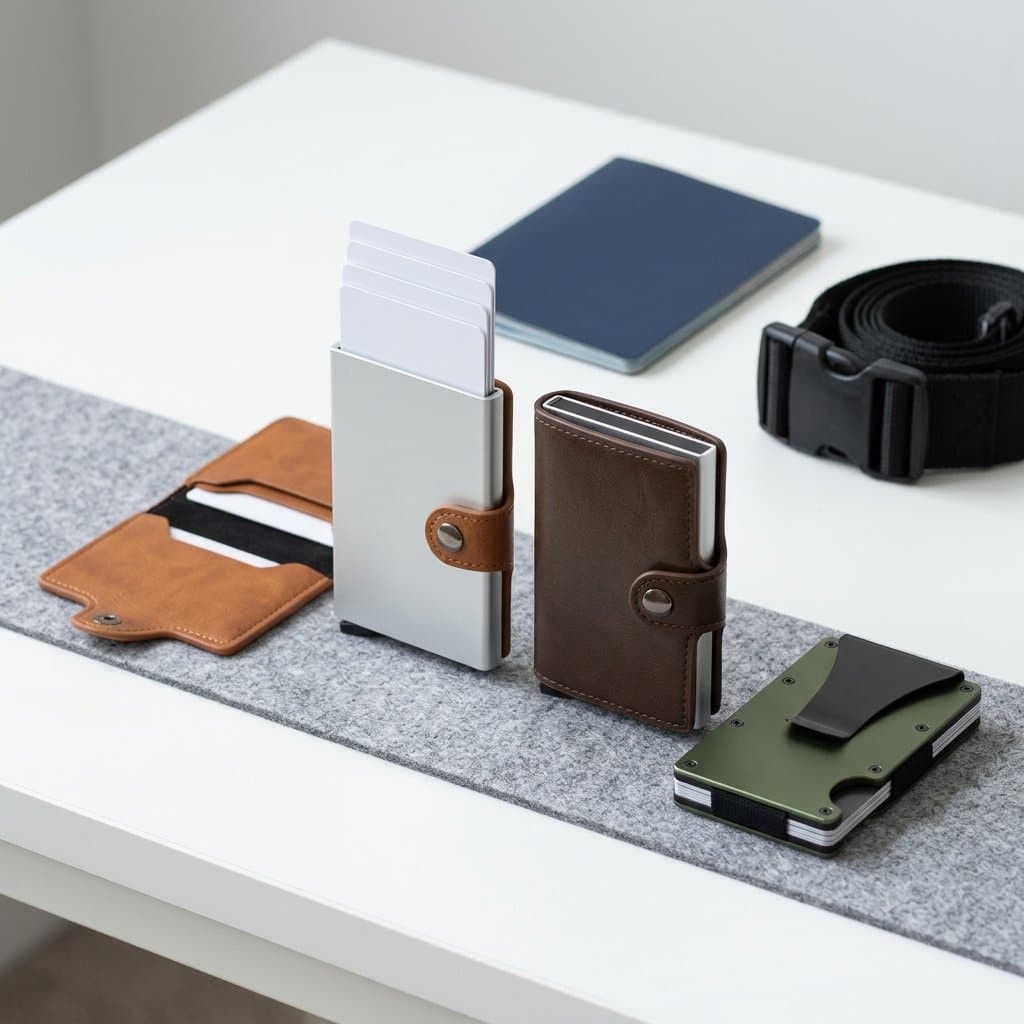
Our in-house CNC machining allows us to prototype and refine card lifter mechanisms with tight tolerances. If a client wants a faster pop-up action, we adjust the spring tension and lever geometry — not just on paper, but in physical prototypes that we test through hundreds of cycles in our workshop. This is the difference between buying a clone and developing a product with a distinct feel.
We offer material flexibility that off-the-shelf products cannot match. Aluminum (6061-T6 or 7075), stainless steel, and a range of leather options mean your brand can build a wallet that looks like the benchmark but feels more premium — or costs less, depending on your positioning. Our 13+ years of manufacturing experience and 300,000+ monthly production capacity support both startup MOQs and supermarket-scale volume orders.
From custom logos to entirely new mechanism designs, our OEM/ODM capabilities are built for brands that need differentiation. We provide a quote within 24 hours and can discuss your target price points, material preferences, and timeline. If you are evaluating suppliers, we would welcome the opportunity to show you our mechanism test data and production line. Contact our team to discuss your custom mini wallet project.
Customization in this category ranges from surface-level branding to full product development. Understanding the levels helps you communicate clearly with suppliers.
This is the simplest option. The supplier has an existing wallet design. You choose the casing color, the leather type, and the logo placement. Tooling costs are minimal or zero. MOQs are typically 500–1,000 units. Lead time is 15–20 days after sample approval.
You keep the existing mechanism but change the material mix or finish. For example, you might switch from anodized aluminum to a PVD-coated stainless steel casing, or upgrade from PU leather to full-grain leather. This requires more engineering input and a slightly higher MOQ.
This is the most ambitious path. You develop a new mechanism, a new casing shape, or both. This requires upfront tooling investment (typically $5,000–$15,000 depending on complexity), a longer development timeline (45–60 days for prototypes), and a committed MOQ. The payoff is a product that cannot be directly compared to any competitor.
The procurement timeline matters for planning your inventory and cash flow. A typical order flow for a custom mini wallet looks like this:
| Stage | Timeline | Notes |
|---|---|---|
| Inquiry and quote | 24 hours | Provide your spec sheet or target price |
| Sample development | 7–15 days | Standard samples are faster; custom mechanisms take longer |
| Sample approval | 3–5 days | Test the mechanism thoroughly during this stage |
| Tooling (if new) | 20–30 days | Only for full custom designs |
| Production | 15–25 days | Depends on order volume and complexity |
| Quality inspection | 2–3 days | Third-party inspection is available |
| Shipping | 5–15 days | Air freight vs. sea freight; sea freight requires 30+ days |
MOQs vary by supplier and product complexity. Off-the-shelf OEM products may start at 300–500 units. Custom mechanisms typically require 1,000–2,000 units to amortize tooling costs. Some suppliers offer lower MOQs for first orders to help startups enter the market — always ask.
Ekster uses a different mechanism called the "Card Slapper" — a magnetic and lever combination that claims faster card deployment. For consumers, Ekster often feels quicker. For B2B buyers, the comparison is more nuanced. Ekster's mechanism is more complex, which can increase production costs and failure rates. Secrid's lever system is simpler and has a longer track record of durability. If you are sourcing for a budget-conscious line, a simpler mechanism is easier to manufacture consistently.
The Ridge wallet has no mechanical assist whatsoever. It uses an elastic tension band and a manual pull. This makes it slimmer and lighter than any mechanical wallet. However, card access is slower and requires two hands. For B2B buyers, the Ridge-style product is cheaper to manufacture and has fewer failure points. But it does not offer the distinctive "wow" moment of a pop-up mechanism. Choose the Ridge style if your target customer values minimalism over interaction.
There is no absolute "best" — there is only the best fit for your target market. For retail customers who want a distinctive daily carry item, a mechanical wallet with a fast card lifter is the strongest selling point. For minimalist customers, a slim non-mechanical cardholder wins. For corporate gifting, a premium material mix (stainless steel, full-grain leather) matters more than mechanism speed.
Yes, with an ODM partner who has in-house engineering. The process involves specifying your desired actuation force, deployment speed, and card capacity. The manufacturer then adjusts spring specifications, lever geometry, and internal tolerances to match. Prototypes are produced and tested through hundreds of cycles before you approve the design.
This is where the "better than Secrid" opportunity lives. Secrid's mechanism is good, but it is fixed. A custom mechanism can be tuned to your target customer's preference — faster, smoother, or with a different tactile feel. The constraint is cost and tooling investment, not engineering capability.
The wallet market rewards differentiation. If you sell a product that looks and works like every other aluminum cardholder, you compete on price. If you develop a product with a distinct mechanism feel, premium materials, or a unique form factor, you compete on value. The right manufacturer helps you do the latter.
We have worked with brands that came to us with a clear goal: beat the benchmark. They did not want a copy. They wanted a wallet that their customers would notice, recommend, and reorder. That is a different conversation from "what is the cheapest way to make a cardholder?"
If that conversation sounds like your project, get a quote and share your spec sheet. We will tell you what is achievable at your target price point.
Secrid. "Miniwallet | Compact yet spacious." https://secrid.com/en/miniwallet
Ekster. "Ekster vs Secrid Wallets." https://www.ekster.com/blogs/news/ekster-vs-secrid
The New York Times. "The Best Wallets and Cardholders." https://www.nytimes.com/wirecutter/reviews/best-wallets-and-cardholders/


