

Views: 213 Author: Princee Lee Publish Time: 03-12-2026 Origin: Princee Lee


Content Menu
● The Cultural Shift Toward Minimalism
● Understanding the Material: Why Leather Remains Supreme
>> Full-Grain vs. Top-Grain Leather
>> The Tanning Process: Chrome vs. Vegetable Tan
● The Science of Security: Demystifying RFID Protection
● Engineering the "Ultra-Thin" Profile
>> Edge Finishing and Construction
>> Pocket Geometry and Accessibility
● Health and Ergonomic Benefits of Slimming Down
● Styling Your Ultra-Thin Leather Accessory
>> Professional and Casual Aesthetics
● Maintenance and Care for Longevity
● Conclusion: The Future of Personal Carry
In the modern era of digital transactions and minimalist lifestyles, the way we carry our most essential items has undergone a radical transformation. For decades, the traditional "bifold" or "trifold" wallet reigned supreme—a bulky, leather brick stuffed with old receipts, expired coupons, and a thick stack of cash. However, as the world shifts toward a cashless society and digital security becomes a primary concern, the ultra-thin leather RFID credit card holder has emerged as the definitive solution for the contemporary professional. This guide explores the intersection of style, security, and structural engineering that makes this accessory an indispensable part of modern life.
The rise of the "minimalist" movement is not merely an aesthetic choice; it is a response to the information and physical clutter of the 21st century. The philosophy of "Every Day Carry" (EDC) emphasizes the importance of carrying only what is functional and necessary. In the context of personal finance, this means moving away from the "Costanza wallet"—a term popularized by the sitcom *Seinfeld* to describe a wallet so overstuffed it causes physical discomfort and social embarrassment.
An ultra-thin credit card holder forces the user to curate their essentials. Most people rarely use more than three to five cards on a daily basis: a primary credit card, a debit card, a driver's license, and perhaps a transit card or office key card. By limiting the physical space available, these holders encourage a more organized, efficient way of living. This reduction in bulk does not just improve the silhouette of a tailored suit or slim-fit jeans; it fundamentally changes how we interact with our belongings.
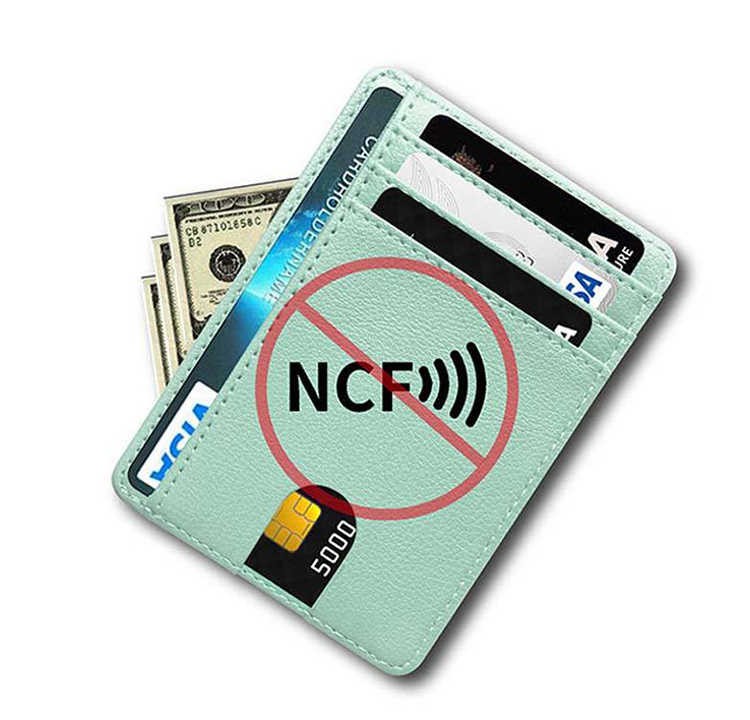
Despite the advent of high-tech materials like carbon fiber, titanium, and aerospace-grade aluminum, leather remains the gold standard for card holders. There is a primal, tactile satisfaction in high-quality leather that synthetic materials simply cannot replicate. However, not all leather is created equal, and understanding the differences is crucial for anyone looking for a long-lasting accessory.
When seeking an ultra-thin profile, the quality of the hide determines the durability of the product. Full-grain leather is the highest quality available. It comes from the top layer of the hide and includes all of the natural grain. Because it is not sanded or buffed to remove imperfections, the fibers remain intact and strong. Over time, full-grain leather develops a "patina"—a rich sheen and darkening that reflects the life and usage of the owner.
Top-grain leather is the second-highest grade. It has had the "top" layer sanded off to remove scars or bites, making it thinner and more pliable than full-grain. While it is excellent for achieving an "ultra-thin" profile, it lacks the legendary durability of full-grain and will not develop the same depth of patina. For a card holder, top-grain is often preferred when a perfectly uniform, sleek appearance is desired.
The process by which a raw hide becomes leather also impacts its performance. Chrome tanning is a modern, chemical-heavy process that results in soft, flexible leather with consistent coloring. It is highly resistant to water and stains, making it ideal for a card holder that will be handled dozens of times a day.
Vegetable tanning, on the other hand, is an ancient artisanal process using natural tannins from tree bark and plants. This leather is stiffer initially but molds to the shape of the cards over time. It is also more environmentally friendly and carries a distinct, pleasant earthy scent. For those who view their card holder as a heritage piece, vegetable-tanned full-grain leather is the ultimate choice.
The most significant functional advancement in the modern wallet is the integration of RFID-blocking technology. To understand why this is necessary, one must understand how modern credit cards communicate.
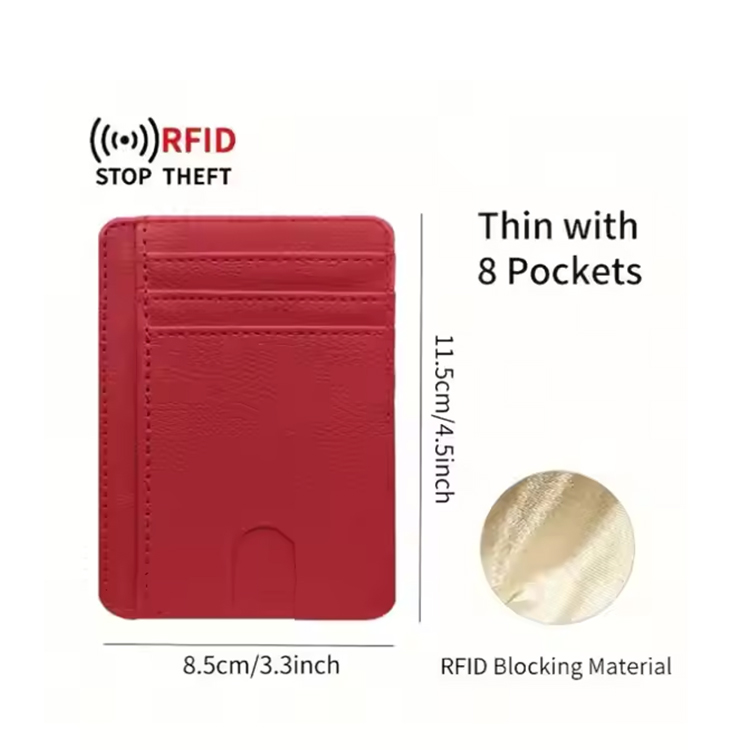
Radio Frequency Identification (RFID) and Near Field Communication (NFC) allow for "contactless" payments. Your credit card contains a tiny chip and an antenna that broadcasts your encrypted payment data when triggered by a nearby reader. While convenient, this technology opened the door to "electronic pickpocketing" or "skimming."
In a skimming attack, a thief uses a handheld RFID reader to "ping" the cards in a victim's pocket. If the cards are unprotected, the reader can capture the card number and expiration date from several inches away. This can happen in crowded subways, airports, or coffee shops without the victim ever realizing their pocket has been "picked."
An RFID-blocking credit card holder acts as a Faraday cage. It incorporates a thin layer of metallic material—usually a blend of nickel, copper, or specialized aluminum—between the leather layers. This metallic mesh disrupts the electromagnetic field. When an external reader tries to ping your card, the radio waves are reflected or absorbed by the shielding, preventing them from reaching the chip inside.
High-quality ultra-thin holders manage to integrate this shielding without adding noticeable thickness. They are specifically tuned to block the 13.56 MHz frequency, which is the standard for credit cards and passports, while sometimes allowing lower-frequency signals (like some older building access badges) to pass through, offering a balance of security and convenience.
Creating a leather card holder that is "ultra-thin" yet durable requires exceptional craftsmanship. Every millimeter counts when the goal is a total thickness of less than 5mm when empty.
There are two primary ways to finish the edges of a leather card holder: turned edges and painted edges. In a turned-edge construction, the leather is thinned (skived) at the edges, folded over, and stitched. This creates a classic, rounded look but adds a slight amount of bulk.
Painted or "raw" edges involve cutting the leather cleanly and applying several layers of specialized edge paint or wax to seal the fibers. This is the preferred method for ultra-thin designs as it keeps the profile as flat as possible. The precision of the stitching also plays a role; high-density polyester thread or bonded nylon is used to ensure the seams do not burst under the pressure of multiple cards.
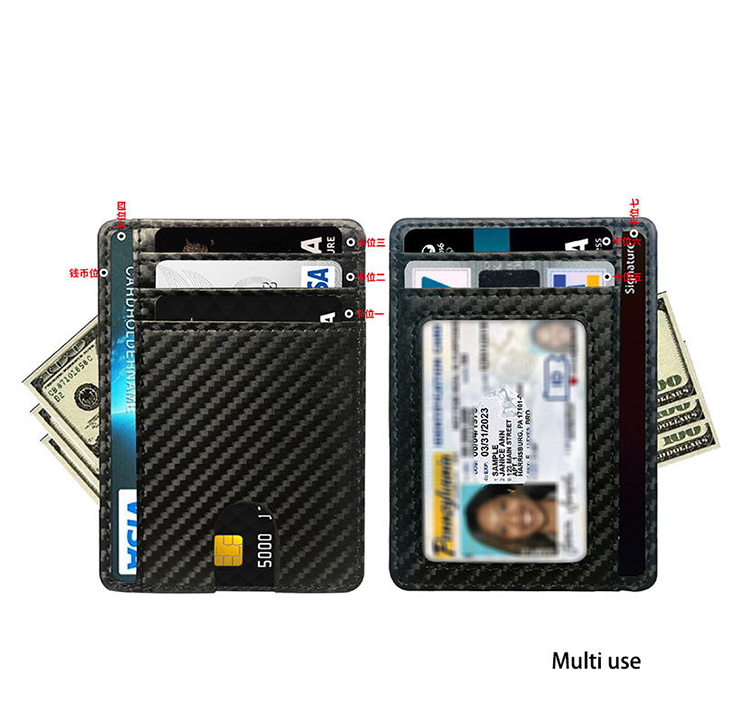
A well-designed card holder isn't just thin; it's functional. Designers use "staggered" pocket layouts to ensure that the thumb-slots of the cards do not overlap in a way that creates a lump. Some modern designs include a "pull-tab" mechanism—a small nylon ribbon that allows the user to eject their most-used cards with a single tug, eliminating the need to dig into tight pockets.
The "thumb slide" is another common feature, where a cutout at the bottom or side of a pocket allows the user to push the card out with one hand. These engineering choices allow for a holder that remains slim even when carrying six or eight cards.
While often overlooked, the transition to a slim card holder has significant health benefits, particularly for those who sit for long periods.
Carrying a thick bifold wallet in the back pocket is a leading cause of "wallet sciatica" or Piriformis Syndrome. When you sit on a thick wallet, your pelvis is tilted at an angle. To compensate, your lower spine bends to keep your head level. This creates a constant strain on the lower back muscles and can compress the sciatic nerve, leading to chronic pain, numbness, and long-term postural issues.
Switching to an ultra-thin card holder allows the user to move their essentials to the front pocket. Front-pocket carry is not only more ergonomic but also significantly more secure against traditional physical pickpocketing. It is much harder for a thief to lift a card holder from a tight front pocket than from a loose back pocket.
The credit card holder has evolved from a utility item into a fashion statement. Because it is smaller and more minimalist, the details—texture, color, and finish—become much more prominent.
For professional environments, a smooth black or deep navy calfskin leather is the standard. It exudes a sense of quiet luxury and discipline. In more casual or creative settings, pebbled leathers, exotic grains like ostrich or alligator, or bold colors like cognac, racing green, or oxblood allow for personal expression.
The beauty of a high-quality leather card holder is its versatility. It looks just as appropriate resting on the table during a high-stakes boardroom meeting as it does in the hand of someone buying a coffee at a weekend farmer's market. It is an accessory that matures with the owner, losing its "new" stiffness and gaining a character that is unique to the individual's habits.

To ensure that an ultra-thin leather card holder lasts for a decade or more, a small amount of maintenance is required. Leather is an organic material that can dry out, crack, or become water-damaged if neglected.
Every few months, the holder should be wiped down with a damp (not soaking) cloth to remove salt from sweat and dirt from pockets. Once dry, a high-quality leather conditioner should be applied. These conditioners contain natural oils and waxes that penetrate the pores of the leather, keeping the fibers supple and resilient.
The quickest way to ruin an ultra-thin card holder is to overstuff it. Leather has a "memory." If you force three cards into a slot designed for one, the leather will stretch. Once stretched, it will not return to its original shape. If you later decide to carry only one card, it may fall out of the loose pocket. To maintain the integrity of the design, it is best to strictly adhere to the intended capacity of the holder.
The ultra-thin leather RFID credit card holder represents the pinnacle of modern EDC design. It solves the problems of the past—bulk, back pain, and disorganization—while addressing the threats of the future, such as digital theft. By combining the ancient, artisanal craft of leatherworking with modern electromagnetic shielding, manufacturers have created an accessory that is both timeless and technologically advanced.
As we move toward an era where our phones may eventually replace physical cards entirely, the leather card holder remains a bridge. It provides a tactile, reliable backup for our most sensitive information and a physical expression of our personal style. In a world of disposable gadgets and fast fashion, a well-made, slim leather wallet is a reminder that some things are worth carrying for a lifetime.

Q1: Does RFID blocking protect against all types of theft?
A1:No, RFID blocking only protects against "contactless" skimming of the information stored on your card's RFID/NFC chip. It does not protect against traditional physical theft, online data breaches, or "shimming" (where a device is placed inside a physical card reader). However, it is a vital layer of defense in crowded public spaces.
Q2: Can an RFID-blocking wallet damage my credit cards?
A2:Absolutely not. The RFID-blocking material is passive; it does not emit any energy or magnetic fields. It simply acts as a shield to block incoming radio waves. It will not demagnetize your cards or affect the chip's functionality in any way.
Q3: How many cards can an "ultra-thin" holder typically hold?
A3:Most ultra-thin designs are optimized for 4 to 8 cards. Typically, there are 2-3 slots on each side and a central pocket for an ID or a few folded bills. Exceeding this limit is generally discouraged as it ruins the "slim" profile and may stretch the leather permanently.
Q4: Is genuine leather the same as high-quality leather?
A4:Actually, "Genuine Leather" is often a marketing term for one of the lowest grades of real leather. It is made from the remaining layers of the hide after the top layers are stripped off. For the best longevity and "ultra-thin" performance, look for "Full-Grain" or "Top-Grain" leather.
Q5: Can I carry cash in an ultra-thin card holder?
A5:Yes, but with limitations. Most slim holders have a center compartment where you can store a couple of banknotes folded into thirds or fourths. However, these holders are not designed for "cash-heavy" users. If you carry a large volume of bills, a dedicated money clip or a slim bifold might be a better fit.


