

Views: 239 Author: Princee Lee Publish Time: 03-12-2026 Origin: Princee Lee


A wallet with a built-in AirTag holder combines everyday card storage with integrated item tracking. For consumers, the main attraction is simple: the wallet and tracker stay together. For brands, however, developing this type of product involves much more than adding an AirTag slot to an existing wallet.
The holder affects the wallet's structure, thickness, material selection, card capacity, RFID shielding, assembly method, appearance, and long-term usability. For an OEM or ODM project, these requirements should be considered during the initial product development stage rather than added after the wallet has already been designed.
GSTAR Technology develops RFID wallets, metal card wallets, leather wallets, and EDC accessories for brands, wholesalers, and other B2B customers. Its manufacturing capabilities include CNC machining, metal stamping, surface finishing, prototyping, assembly, and OEM/ODM customization.
This guide explains how brands can approach the design and sourcing of wallets with built-in AirTag holders, including holder structures, materials, RFID integration, customization, prototype testing, manufacturing considerations, and supplier evaluation.
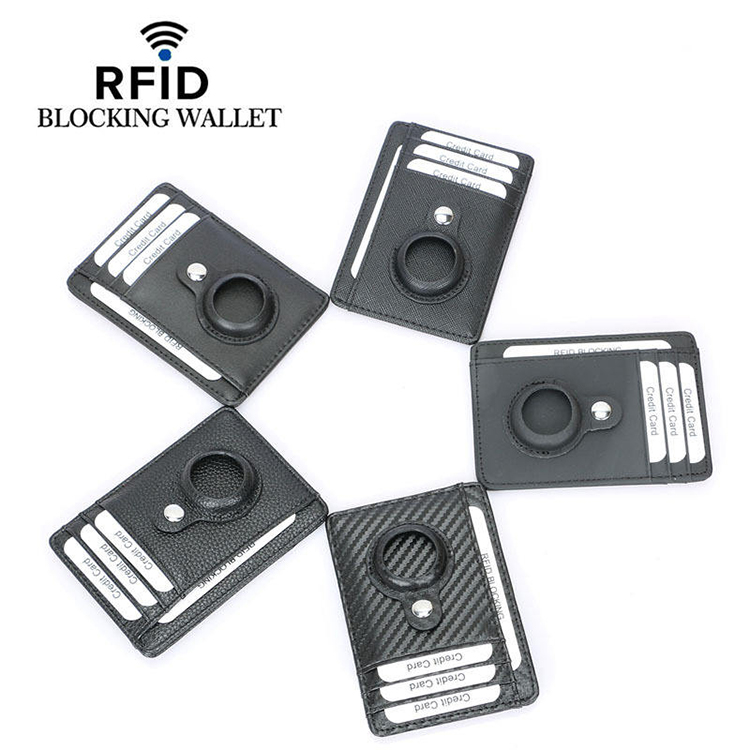
A wallet with a built-in AirTag holder is designed with a dedicated structure that keeps an AirTag physically connected to the wallet.
Instead of carrying an AirTag separately or attaching a generic accessory to an existing wallet, the tracker holder becomes part of the wallet design.
Depending on the product architecture, the holder can be integrated into:
A metal wallet frame
A leather pocket
An external metal plate
A silicone or TPU component
An elastic retention system
A dedicated internal cavity
A removable modular component
The most suitable structure depends on the wallet type, target market, materials, desired thickness, card capacity, price positioning, and manufacturing process.
For B2B product development, the key question is not simply whether an AirTag can fit inside the wallet.
The better question is:
How can the AirTag be integrated without compromising the wallet's core functions?
A successful design needs to balance tracking functionality with card accessibility, structural strength, appearance, comfort, manufacturability, and cost.
Adding a tracker holder after a wallet has already been designed can create unnecessary compromises.
For example, an existing minimalist wallet may already have limited internal space. Adding an AirTag afterward could increase thickness, reduce card capacity, interfere with hardware, or create an unattractive external attachment.
Integrating the AirTag holder during the initial design stage gives the manufacturer more options.
The engineering team can consider:
Holder position
Wallet dimensions
Card capacity
Material thickness
Fastener placement
Surface treatment
RFID shielding
Battery access
Assembly sequence
Packaging requirements
This is especially important for custom metal wallets because CNC machining, stamping, finishing, and assembly requirements need to work together.
GSTAR's current manufacturing information highlights in-house CNC machining, metal stamping, surface finishing, prototyping, and integrated OEM/ODM development capabilities.
There is no single best AirTag holder structure for every wallet.
The correct solution depends on the product architecture and intended market.
A screw-fixed holder is particularly suitable for rigid metal wallets.
The holder can be attached to an aluminum, stainless steel, or titanium structure using screws or other mechanical fasteners.
Advantages include:
Strong mechanical retention
Easy structural inspection
Premium industrial appearance
Suitable for metal wallet construction
Potentially easier component replacement
The engineering team should evaluate screw size, thread engagement, material thickness, assembly sequence, and the effect of the fastener on the wallet's overall dimensions.
For premium EDC products, the screws can also become part of the product's visual language rather than being treated as hidden hardware.
Leather wallets can incorporate an AirTag holder as a dedicated pocket.
The pocket may be:
Stitched onto the wallet
Integrated between leather layers
Reinforced with an internal structure
Secured by a flap or closure
This approach is suitable for brands targeting traditional, premium, or lifestyle-oriented markets.
The key considerations include leather thickness, stitching strength, deformation, AirTag retention, and access for battery replacement.
GSTAR already offers AirTag-compatible leather and leather-metal wallet products, including models combining leather, metal, RFID protection, and an AirTag holder.
Flexible materials such as silicone or TPU can be used as a dedicated AirTag retention component.
This approach can provide:
Flexible retention
Impact protection
Soft contact surfaces
Easier insertion and removal
Compatibility with hybrid wallet structures
The holder can be developed as an independent component or integrated into a larger wallet assembly.
An external plate is common in minimalist metal wallet concepts.
The AirTag is positioned on the exterior of the wallet rather than inside the main card compartment.
This configuration can create a recognizable product appearance while keeping the main card storage structure relatively simple.
However, designers should evaluate:
Overall thickness
Plate dimensions
AirTag retention
Surface finish
Logo placement
Screw position
Pocket comfort
An internal cavity hides the tracker within the wallet structure.
This can produce a cleaner appearance, but it creates additional engineering requirements.
The design needs to provide sufficient space for the tracker while allowing reasonable access for removal and battery replacement.
The surrounding materials and structure should also be evaluated during prototype testing.
For an OEM project, holder selection should not be based on appearance alone.
A simple evaluation can be made using five criteria:
| Requirement | Questions to Consider |
|---|---|
| Retention | Can the AirTag remain secure during daily use? |
| Thickness | Does the holder make the wallet unnecessarily bulky? |
| Accessibility | Can the AirTag be removed when required? |
| Manufacturing | Can the holder be produced consistently at volume? |
| Appearance | Does the holder look integrated with the wallet? |
The right structure is the one that meets the product's commercial and technical requirements simultaneously.
The material of the wallet affects weight, durability, manufacturing cost, appearance, and the way the AirTag holder is integrated.
Aluminum is particularly suitable for lightweight metal wallets.
GSTAR identifies aluminum alloy, including 6061-T6, among its metal material options and highlights its machinability and suitability for modern wallet designs.
For OEM projects, aluminum supports processes such as:
CNC machining
Surface finishing
Anodizing
Laser engraving
Color customization
It is a strong option for brands looking for a balance between weight, durability, and manufacturing flexibility.
Stainless steel provides a heavier and more substantial feel.
It can be appropriate for premium products where strength, durability, and a solid tactile experience are important.
However, its higher density should be considered when developing a slim everyday-carry wallet.
GSTAR lists stainless steel 304 among its metal material options for wallet manufacturing.
Titanium is suitable for premium EDC positioning where weight-to-strength performance and material differentiation are important.
GSTAR currently lists titanium as one of its metal wallet material options and also offers a slim titanium RFID wallet with an AirTag holder as an existing product configuration.
For a custom titanium AirTag wallet, the engineering process should consider machining requirements, surface finishing, component thickness, and the cost implications of the material.
Leather provides a different product experience from machined metal.
It is suitable for:
Traditional wallets
Premium lifestyle products
Hybrid metal-leather wallets
Private-label collections
The AirTag holder can be integrated into a leather pocket or combined with a metal wallet core.
GSTAR's existing AirTag wallet range demonstrates both leather and metal-leather configurations.
Flexible materials are useful when the AirTag holder needs additional grip, flexibility, or impact protection.
They are particularly suitable for hybrid constructions where the main wallet body and tracker holder use different materials.
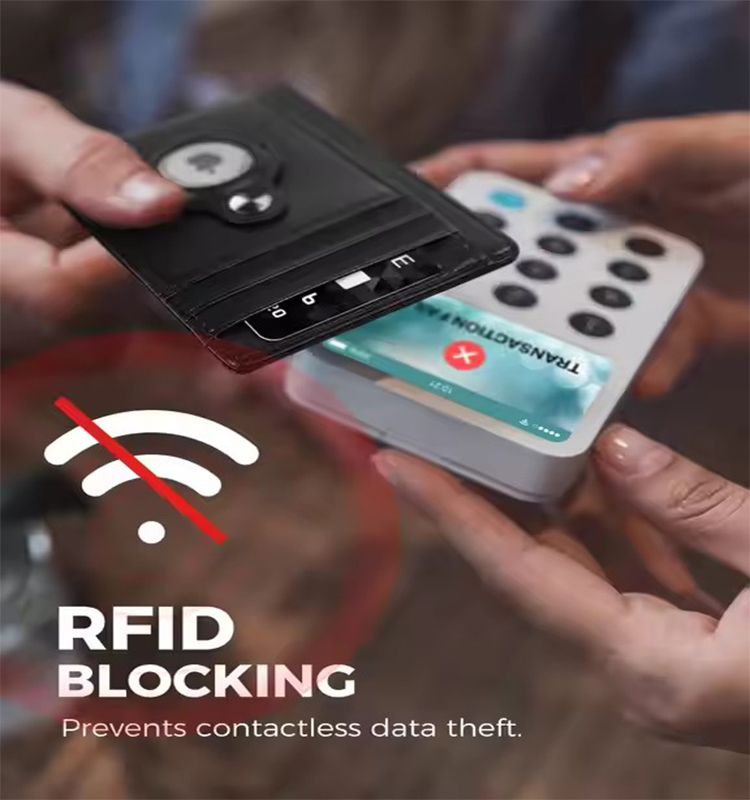
Yes, an AirTag wallet can be designed with RFID blocking, but the two functions should be considered together during product development.
RFID shielding is generally intended to protect the card storage area.
The AirTag holder, meanwhile, needs to be positioned and constructed appropriately for the intended tracking function.
The final result depends on:
Shielding material
Wallet architecture
Holder position
Material thickness
Surrounding metal components
Exposed areas around the tracker
Therefore, a manufacturer should not treat RFID protection and AirTag integration as two completely independent features.
The final prototype should be evaluated as a complete wallet.
For an OEM project, buyers may want to evaluate:
RFID blocking performance
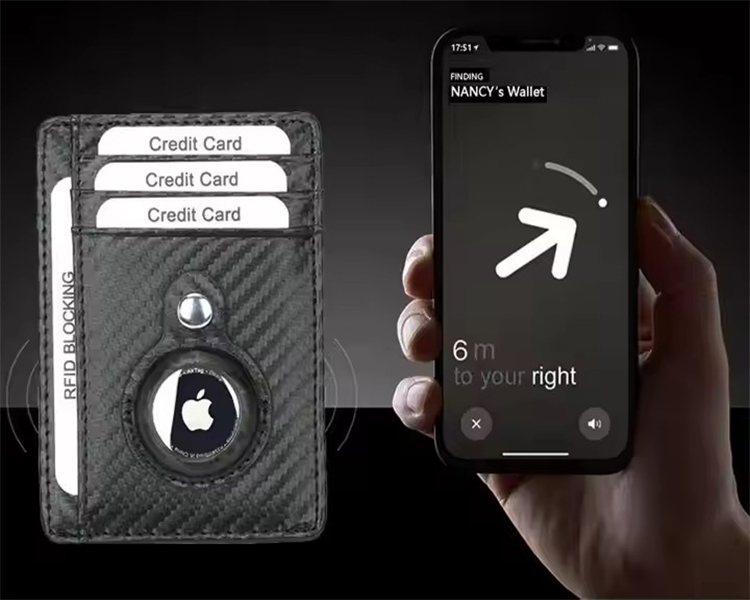
AirTag tracking performance
AirTag retention
Card accessibility
Overall wallet functionality
This is more useful than evaluating individual components separately.
A wallet can have strong RFID shielding and still require additional design work to optimize the placement of the tracker holder.
An integrated AirTag holder creates additional opportunities for product differentiation.
Instead of simply adding a tracker slot to an existing product, brands can develop the entire wallet around a specific target market.
Possible customization areas include:
Card capacity
Wallet dimensions
Bifold construction
Metal cardholder structure
Pop-up mechanism
Money clip
Elastic strap
Leather-metal hybrid structure
AirTag holder position
The holder itself can be customized in terms of:
Shape
Position
Material
Retention method
Cover
Attachment method
Accessibility
Brands may specify:
Logo engraving
Laser marking
Printing
Embossing
Debossing
Custom colors
Surface finishes
Hardware finishes
GSTAR's OEM/ODM services include customization of logo, color, mold, product structure, and packaging.
For B2B projects, packaging can be developed together with the wallet.
Possible requirements include:
Private-label boxes
Custom inserts
User manuals
Barcode labels
Retail packaging
Shipping cartons
Packaging should be defined before mass production so that packaging dimensions and product protection can be evaluated together.
A vague inquiry such as:
"We need a custom AirTag wallet. Please send price."
usually does not provide enough information for an accurate quotation.
A better RFQ should include the following.
For example:
Metal card wallet
Leather wallet
Pop-up wallet
Bifold wallet
Titanium wallet
Aluminum wallet
Hybrid wallet
Specify:
Built-in or external
Preferred position
Preferred holder structure
Fixed or removable
Required appearance
If the design is not finalized, provide sketches, reference images, or a sample product.
Specify the preferred material if known.
For metal wallets, this could include:
Aluminum
Stainless steel
Titanium
For hybrid products:
Leather
Carbon fiber
TPU
Silicone
Specify the expected card range.
For example:
4–6 cards
6–8 cards
8–12 cards
Card capacity affects the wallet dimensions and internal structure.
Specify whether RFID blocking is:
Required
Optional
Required only for specific compartments
If a specific testing standard is required, include it in the RFQ.
Specify:
Logo method
Logo location
Logo size
Color
Surface treatment
Include:
Sample quantity
Expected trial order
Estimated mass-production quantity
Number of SKUs
This helps the manufacturer evaluate the appropriate production approach.
Specify whether you need:
Standard packaging
Private-label packaging
Retail packaging
Custom color box
Insert card
Barcode labeling
The destination market can affect:
Product positioning
Packaging
Compliance requirements
Material selection
Testing requirements
Providing this information at the beginning can reduce unnecessary revisions later.
A reliable OEM project should move through several stages rather than directly from idea to mass production.
The buyer provides:
Product concept
Reference images
Target dimensions
Materials
AirTag holder requirement
Card capacity
Branding requirements
The manufacturer evaluates:
Structural feasibility
Manufacturing process
Material selection
Holder structure
Assembly
Surface treatment
Estimated tooling requirements
GSTAR's manufacturing information describes an integrated workflow covering design, prototyping, CNC machining, mold customization, and production.
A prototype is produced so the buyer can evaluate:
Dimensions
Appearance
AirTag fit
Card capacity
Holder retention
User experience
The buyer and manufacturer identify changes.
Typical revisions may involve:
Holder position
Thickness
Hardware
Surface finish
Card capacity
Logo
Packaging
The final sample becomes the reference for mass production.
The approved sample should clearly define the product structure and key quality requirements.
Once the specifications are approved, production can proceed according to the agreed quantity, materials, processes, packaging, and quality requirements.
GSTAR currently describes standard OEM RFID wallet production as approximately 15–25 working days after sample approval, with actual timing depending on complexity, customization, and order quantity.
A prototype should be evaluated as a complete product.
Check:
AirTag retention
Holder strength
Screw security
Repeated insertion and removal
Drop resistance
Structural deformation
Component movement
Check:
AirTag tracking performance
RFID blocking
Battery access
Card accessibility
Card retention
Wallet opening mechanism
Check:
Overall thickness
Weight
Pocket comfort
Edge smoothness
Card access
AirTag access
Noise or rattling
Visual appearance
The manufacturer should also confirm:
Dimensional consistency
Surface finish
Hardware consistency
Assembly quality
Logo quality
Packaging fit
The goal is not simply to confirm that the prototype works.
The goal is to confirm that the design can be manufactured consistently at the required volume.
A loose holder can cause movement, noise, and potential separation.
The retention mechanism should be evaluated through repeated-use testing.
A poorly integrated holder can significantly change the profile of a minimalist wallet.
The holder should therefore be considered together with the wallet frame rather than added after the main structure has been finalized.
A holder that looks good but requires excessive disassembly for battery replacement can create a poor user experience.
Battery access should be considered during the initial design stage.
This is particularly important for premium brands.
A good AirTag wallet should make the holder look like part of the original product architecture.
The holder should visually match:
Wallet geometry
Materials
Hardware
Surface finish
Brand style
Testing the RFID layer and AirTag holder independently may not reveal how the complete wallet performs.
The final product should therefore be tested in its assembled configuration.
A concept may work as a handmade prototype but become expensive or inconsistent during mass production.
The manufacturer should review:
Part count
Assembly time
Tooling
Machining requirements
Tolerances
Surface finishing
Component sourcing
before finalizing the design.
Choosing the right factory is especially important for a custom AirTag wallet because the product combines multiple manufacturing disciplines.
A suitable supplier should be able to support more than logo customization.
Ask whether the factory can handle:
3D design
Structural development
CNC prototyping
Mold development
Product modification
GSTAR states that its R&D workflow covers 3D design, prototype development, CNC machining, and mold customization.
For metal AirTag wallets, relevant capabilities can include:
CNC machining
Metal stamping
Drilling
Surface finishing
Assembly
GSTAR's current manufacturing information identifies CNC machining, metal stamping, surface finishing, assembly, and related production capabilities.
Ask how the factory handles:
Incoming material inspection
In-process inspection
Final inspection
Functional testing
Packaging inspection
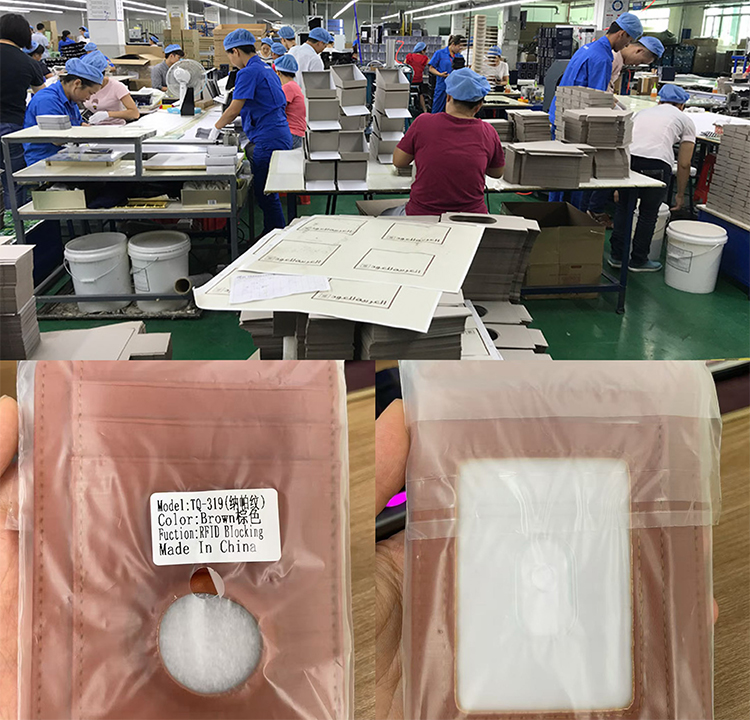
GSTAR states that it performs material inspection before production and quality supervision before packing, and reports TUV and SGS certification.
A manufacturer experienced with custom projects should be able to explain the development process rather than simply quote an existing product.
GSTAR's OEM/ODM page currently includes an AirTag Tracking Wallet among its development cases, indicating that AirTag-related product development is part of its stated OEM/ODM offering.
A standard wallet mainly needs to solve:
Card storage
Cash storage
Durability
Appearance
Branding
An AirTag wallet adds another layer:
Tracker retention
Tracker positioning
Battery access
Signal considerations
Additional thickness
Additional components
This means the product should be treated as a small engineering project rather than a simple branding exercise.
For brands planning to launch a new AirTag wallet, working with a manufacturer that can support design, prototyping, machining, assembly, and quality control can reduce the number of supplier handoffs during development.
GSTAR Technology focuses on RFID wallets, metal card wallets, leather wallets, key organizers, graded card accessories, and other EDC products for B2B customers.
Its current manufacturing information describes an 8,000-square-meter factory, in-house CNC machining, multiple production lines, metal stamping, surface finishing, prototyping, and OEM/ODM customization.
For AirTag wallet projects, GSTAR can support different product directions, including:
Metal AirTag wallets
Leather AirTag wallets
RFID AirTag wallets
Aluminum AirTag wallets
Titanium AirTag wallets
Hybrid metal-leather designs
The company also lists an existing slim titanium RFID wallet with an AirTag holder, as well as AirTag leather and RFID wallet configurations.
For a new OEM or ODM project, buyers can provide their existing design or discuss a new product concept with the manufacturer.
The development process can cover:
Concept → Engineering Review → Prototype → Sample Approval → Mass Production → Packaging
This approach allows the AirTag holder, wallet structure, materials, branding, and manufacturing process to be evaluated as one product.
Yes. GSTAR's current product range includes AirTag-compatible wallet configurations, including leather, RFID, metal, and titanium designs. Its OEM/ODM offering also lists an AirTag Tracking Wallet development case.
The holder can be considered as part of the overall product design. Depending on the wallet structure, customization can include its position, shape, material, retention method, and appearance.
Yes. GSTAR manufactures RFID wallets and AirTag-compatible wallet configurations. However, RFID shielding and AirTag integration should be evaluated together during prototype development.
OEM projects can be developed around a buyer's existing product concept, drawings, reference samples, or specifications. The manufacturer can then review the design for manufacturability and prototype requirements.
For ODM and product-development projects, GSTAR describes support covering design, prototyping, mold customization, and production. The exact development scope depends on the project requirements.
Common options include aluminum, titanium, stainless steel, leather, carbon fiber, silicone, and TPU, depending on the wallet structure and product requirements. GSTAR's current RFID wallet manufacturing information specifically lists aluminum, titanium, stainless steel, leather, and carbon fiber among its material options.
At minimum, provide the wallet type, material, card capacity, AirTag holder requirement, RFID requirement, logo, packaging, expected quantity, target market, and sample requirements.
GSTAR currently states that standard OEM RFID wallet production generally takes around 15–25 working days after sample approval, although the actual schedule depends on product complexity, customization, and order quantity.
MOQ depends on the product structure, materials, customization, packaging, and production requirements. GSTAR's current OEM/ODM page states a standard MOQ of 500 pieces per SKU for custom OEM wallets and card holders, while other product information notes that MOQ can vary by project. Buyers should confirm the MOQ for the specific AirTag wallet design during quotation.
Before approving an AirTag wallet for mass production, confirm:
Wallet structure is finalized
AirTag holder position is approved
AirTag retention has been tested
Battery access has been confirmed
Wallet thickness is acceptable
Card capacity meets the specification
RFID requirements have been tested
Materials have been approved
Surface finish has been approved
Logo placement has been approved
Packaging has been approved
Prototype has passed functional testing
Mass-production specifications are documented
MOQ and production schedule are confirmed
A wallet with a built-in AirTag holder should not be treated as a conventional wallet with one additional slot.
The AirTag holder affects the product architecture, thickness, materials, retention, accessibility, RFID configuration, assembly, and manufacturing process. For brands developing a private-label or OEM product, these requirements should be addressed during product development rather than after the wallet structure has already been finalized.
The most successful AirTag wallet projects start with a clear product brief, continue through engineering review and prototype testing, and only move into mass production after the complete product has been validated.
For brands looking for a manufacturing partner, the key is to evaluate not only whether a supplier can produce an AirTag wallet, but whether the supplier can support the complete path from product concept and prototyping to production and quality control.
GSTAR Technology combines RFID wallet manufacturing with CNC machining, metal processing, prototyping, OEM/ODM customization, and production capabilities, making it positioned to support brands developing custom AirTag wallet products.
Planning a custom AirTag wallet? Send your product concept, reference images, target material, card capacity, AirTag holder requirements, and expected quantity to GSTAR for an OEM/ODM evaluation.


