

Views: 225 Author: Princee Lee Publish Time: 03-25-2026 Origin: Princee Lee


Content Menu
>> The Fundamental Definition: Radio Frequency Identification
>> The Historical Evolution: From War Machines to Wallets
>> The Technical Mechanics: How the Technology Inside Your Wallet Works
>>> The Role of the Antenna and the Chip
>>> Frequency Ranges and Standards
>> The Concept of RFID Skimming: Digital Pickpocketing
>> The Reality Check: Is RFID Skimming a Real Threat Today?
>>> Encryption and Tokenization
>>> Crime Statistics
>> How RFID-Blocking Wallets Work: The Science of Shielding
>>> The Faraday Cage Principle
>> What Items Specifically Need Protection?
>>> Passports and Travel Documents
>> Types of RFID Wallets Available
>>> The Minimalist Metal Wallet
>>> The Shielded Leather Bifold
>>> Tactical and Adventure Wallets
>> The Role of NFC and Smartphones
>> Expert Opinions: Is It Worth the Investment?
>> Conclusion
>> Related Questions and Answers
In the modern era of seamless transactions and digital connectivity, the term "RFID" has transitioned from a specialized industrial acronym to a ubiquitous buzzword found on the packaging of almost every premium wallet. For most consumers, the label "RFID-blocking" is synonymous with security, representing a shield against invisible digital predators. However, to truly understand what RFID means in the context of your wallet, one must look beyond the marketing slogans and delve into the intersection of electromagnetism, historical cryptography, and the evolving landscape of financial crime.

At its most basic level, RFID stands for Radio Frequency Identification. It is a wireless technology that uses electromagnetic fields to identify and track tags attached to objects. Unlike a traditional barcode, which requires a direct line of sight to be scanned, RFID tags can be read from several centimeters to several meters away, depending on the frequency and the power of the reader.
In the context of a wallet, "RFID" refers to the small chips and antennas embedded in your credit cards, debit cards, and passports. These chips contain sensitive data—such as your card number, expiration date, and sometimes your name—which can be transmitted to a payment terminal with a simple tap. When a wallet is advertised as having RFID protection, it means the wallet is constructed with a special layer of material designed to block these radio waves, effectively creating a "Faraday cage" that keeps your cards' information from being broadcast to anyone other than a legitimate merchant.
The history of RFID technology is a testament to the concept of "dual-use" technology—innovations that begin in the military and eventually find their way into our back pockets. The roots of RFID can be traced back to World War II. The British Royal Air Force utilized a precursor to RFID called the "Identification Friend or Foe" (IFF) system. By equipping aircraft with transponders that responded to radar signals with a specific code, the British could distinguish their own planes from German Luftwaffe bombers, preventing tragic "friendly fire" incidents.
Following the war, the academic world began to formalize the physics of this wireless communication. In 1948, Harry Stockman published a seminal paper titled "Communication by Means of Reflected Power," which predicted that radio waves could be used to identify objects without a direct power source for the tag. It took several decades for the electronics to catch up with Stockman's vision. Throughout the 1970s and 1980s, RFID was primarily used for industrial applications, such as tracking cattle, toll collection on highways, and managing inventory in massive warehouses.
The transition to consumer finance happened in the early 2000s when major credit card companies like American Express, Visa, and Mastercard began embedding RFID chips into their cards to facilitate "contactless payments." As tap-to-pay became the global standard for speed and convenience, the potential for unauthorized scanning—known as "skimming"—gave birth to the RFID-blocking wallet industry.

To understand why a wallet needs to "mean" something about RFID, you must understand the interplay between the tag (your card) and the reader (the terminal). Most consumer-grade RFID applications, including credit cards and passports, utilize what is known as "Passive RFID."
Every contactless card contains a tiny integrated circuit (the chip) and a copper or aluminum wire coiled around the edge of the card (the antenna). Because the tag is passive, it has no battery. Instead, it waits for an "interrogation pulse" from an RFID reader. This reader emits a high-frequency electromagnetic field. When your card enters this field, the copper coil in the card catches the energy through a process called electromagnetic induction, which provides just enough power to wake up the chip. The chip then transmits its data back to the reader via radio waves.
RFID operates across several frequency bands, but not all are relevant to your wallet.
- Low Frequency (LF): 125–134 kHz. Used for pet microchips and some older access badges. It has a very short read range and is rarely used for financial cards.
- High Frequency (HF): 13.56 MHz. This is the "sweet spot" for wallets. Almost all contactless credit cards, smart IDs, and passports operate on this frequency. It is also the foundation for Near-Field Communication (NFC), the tech used by Apple Pay and Google Pay.
- Ultra-High Frequency (UHF): 860–960 MHz. Used for long-range tracking like highway toll tags or warehouse logistics. These can be read from 30 feet away, which is why some tactical wallets claim to block UHF as well as HF signals.

The primary reason RFID exists as a feature in wallets is the threat of "skimming." In theory, a criminal with a handheld RFID reader could walk through a crowded airport or subway station and scan people's pockets. Because radio waves can pass through traditional leather or fabric, the reader can activate the card inside the wallet and record the card number and expiration date without the victim ever realizing it.
This theoretical threat led to the term "digital pickpocketing." In the early 2010s, several viral videos demonstrated how easy it was to capture card data using a smartphone with NFC capabilities. While these videos were often used as marketing tools for wallet manufacturers, they did highlight a genuine vulnerability in early RFID implementations where data was transmitted in "plain text."
Despite the massive popularity of RFID-blocking wallets, modern security experts often debate their necessity. The technology used in cards has evolved significantly since the first "skimming" scares.
Modern EMV (Europay, Mastercard, and Visa) chips do not transmit your actual credit card number in a way that is useful to a thief. Instead, they use a process called "tokenization." For every transaction, the chip generates a unique, one-time-use code. Even if a skimmer captured this code, it could not be used for a second transaction. Furthermore, the sensitive three-digit CVV code on the back of your card is never transmitted via RFID. Without that code, most online merchants will reject a transaction.
To scan a card successfully, a thief must be extremely close—usually within 1 to 4 centimeters. In a crowded environment, it is physically difficult to get a reader that close to someone's pocket for a sustained period without being noticed. Additionally, if you have two or more RFID cards in your wallet, their signals often "clash," resulting in a read error for the thief's device.
Major law enforcement agencies, such as the FBI and the UK's National Fraud Intelligence Bureau, report that documented cases of RFID skimming in the real world are virtually non-existent. The vast majority of credit card fraud occurs through online data breaches, phishing emails, or physical "shimmers" placed inside ATMs, which read the chip during physical contact.

If the threat is mostly theoretical, how does the wallet actually "block" the signal? The answer lies in the physics of a Faraday Cage. [ekster](https://www.ekster.com/blogs/the-journal/what-is-rfid-blocking-and-how-does-it-work)
Named after the scientist Michael Faraday, a Faraday cage is an enclosure made of conducting material that blocks external static and non-static electric fields. When an RFID-blocking wallet is closed, the conductive layer inside the leather or fabric creates a continuous shield. When radio waves hit this shield, they are distributed around the exterior of the material rather than passing through it. This prevents the electromagnetic field from reaching the card's antenna, meaning the chip never "wakes up."
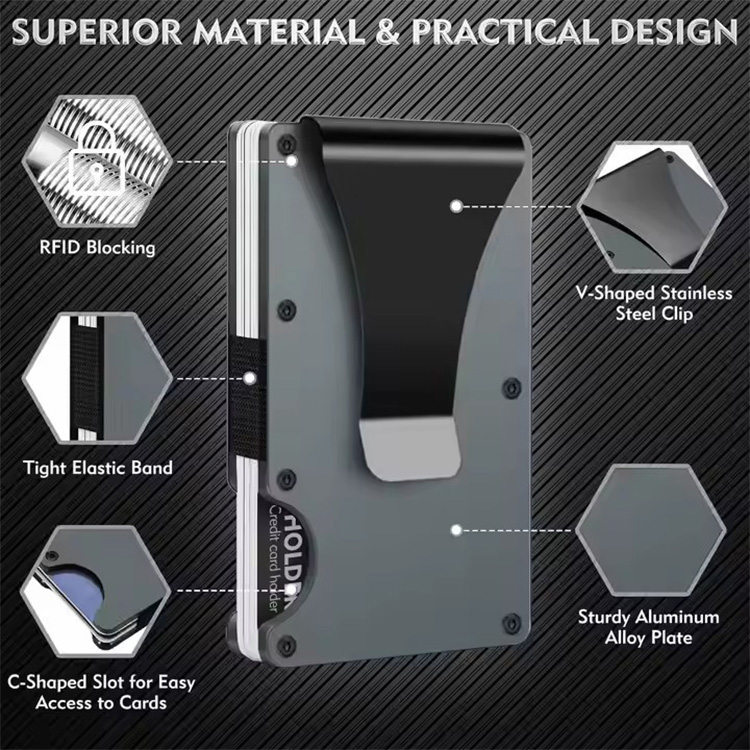
- Aluminum: Many minimalist metal wallets use solid aluminum plates. This is highly effective at blocking a wide range of frequencies.
- Copper and Nickel Linings: Traditional leather wallets often hide a thin, flexible mesh made of copper or nickel between the layers of leather. These metals are excellent conductors and provide superior shielding for the 13.56 MHz frequency.
- Carbon Fiber: While stylish and strong, carbon fiber's effectiveness as an RFID blocker depends on its weave and thickness. High-end carbon fiber wallets usually include an additional metal liner to ensure full protection.
While your average library card or gym pass might use RFID, they rarely contain data worth stealing. However, certain items are higher priority for shielding.
Any card with the "contactless" symbol (four curved lines similar to a Wi-Fi icon) is an RFID-enabled device. These are the primary targets of RFID-blocking marketing.
Since 2006, the United States and many other countries have issued "e-Passports." These contain a biometric chip that stores your photo and personal details. While the passport's data is heavily encrypted and usually requires a special "handshake" with a government reader, many travelers prefer the peace of mind that comes with an RFID-blocking passport holder, especially when traveling in high-traffic international hubs.
Unlike the passport booklet, which has a thick cover that provides some natural shielding, the U.S. Passport Card is a thin plastic card used for land and sea travel. These cards are specifically designed to be read from a distance (often to speed up border crossings) and are highly susceptible to long-range scanning. The government actually provides a protective sleeve with these cards for a reason.
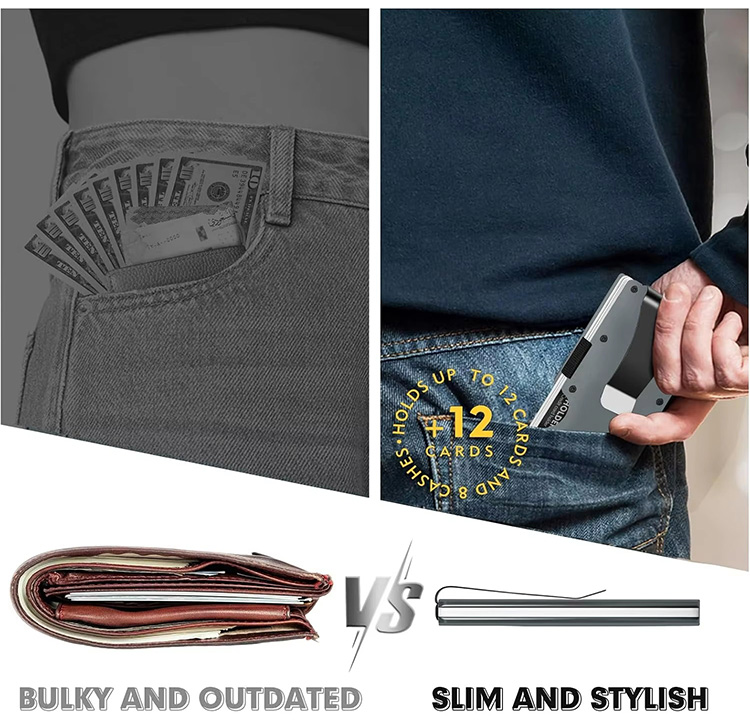
The market has expanded to offer protection for every aesthetic preference, proving that you don't have to carry a metal box to be secure.
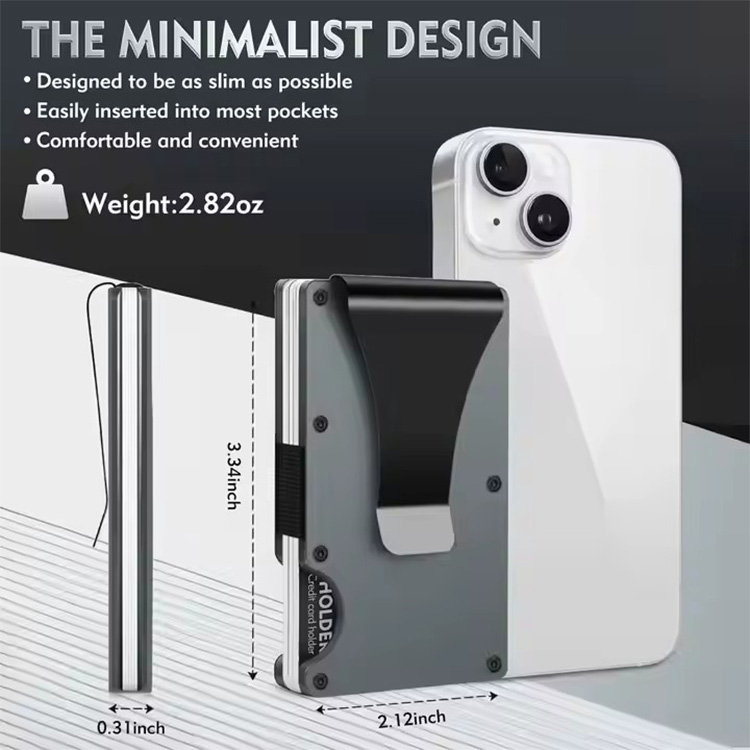
Popularized by brands like Ridge and Aviator, these wallets consist of two metal plates held together by an elastic band. They are inherently RFID-blocking due to their material and appeal to users who want to reduce pocket bulk.
For those who prefer a traditional look, these wallets look identical to a standard bifold or trifold. The "RFID" meaning here is hidden—special metalized fabric is sewn into the lining. This allows you to have the tactile feel of Italian leather with the security of a high-tech barrier.
Designed for the rugged outdoors, these often use military-grade materials like Cordura nylon or titanium. They frequently offer "multi-band" protection, shielding against not just 13.56 MHz signals but also the lower and higher frequencies used in some enterprise security systems.
It is important to distinguish between the RFID cards in your wallet and the mobile wallets on your phone (like Apple Pay). When you use your smartphone to pay, you are using Near-Field Communication (NFC), which is a branch of RFID technology.
However, your phone is inherently more secure than a plastic card. To transmit its "RFID" signal, your phone usually requires biometric authentication (FaceID or a fingerprint) and a physical action (double-clicking a side button). An RFID-blocking wallet does not affect your phone's payment capabilities, as the phone is usually not inside the wallet when you are using it.
When asking what RFID means in a wallet, one must weigh the cost against the benefit. Most experts categorize RFID-blocking wallets as "peace-of-mind insurance."
Critics argue that the technology solves a problem that doesn't really exist, as encryption has made skimming unprofitable for criminals. They suggest that your time is better spent setting up two-factor authentication on your banking apps or monitoring your statements for unusual activity.
On the other hand, proponents argue that as contactless technology becomes more powerful and readers become more discreet, having a passive shield is a low-cost, zero-effort way to eliminate one potential vector of identity theft. In 2025, since most high-quality wallets include RFID protection at no extra cost, there is little reason *not* to have it.
In a wallet, RFID means a balance between modern convenience and digital vigilance. It represents the "silent guardian" that stands between your hard-earned financial data and the invisible radio waves that facilitate our fast-paced global economy. While the real-world risk of skimming may be lower than many advertisements suggest, the technology behind RFID-blocking is sound, rooted in established physics and historical military strategy. Whether you choose a sleek titanium minimalist wallet or a classic shielded leather bifold, understanding RFID means taking a proactive step in managing your digital footprint in an increasingly connected world.
Q1: Can I make my own RFID-blocking wallet at home?
A: Yes. Because RFID blocking relies on the Faraday cage principle, you can wrap your cards in ordinary aluminum foil. While not as durable or stylish as a commercial wallet, a layer of foil is highly effective at reflecting the 13.56 MHz signals used by credit cards.
Q2: Will an RFID-blocking wallet damage my credit cards over time?
A: No. RFID-blocking materials are passive shields. They do not emit any radiation, magnets, or electricity. They simply act as a barrier to outside signals. Your cards' chips and magnetic strips will remain completely unaffected by the wallet's lining.
Q3: Does RFID protection block cell phone signals or GPS?
A: Generally, no. Most RFID wallets are designed specifically to block the 13.56 MHz frequency used by cards. Cell phones and GPS operate on much higher frequencies (typically 800 MHz to 5 GHz). Unless you place your phone entirely inside a very high-grade, sealed RFID pouch, it will still receive calls and track your location.
Q4: Can a thief use an RFID reader to steal money directly from my card?
A: It is theoretically possible but extremely difficult. A thief would need to be a registered "merchant" with a bank to process a payment, or they would need to clone your card. Because of modern encryption and one-time tokens, cloning a contactless card for a second transaction is nearly impossible with current skimming technology.
Q5: Are all "contactless" cards RFID-enabled?
A: Yes. If your card has the contactless symbol (the four radio waves), it uses RFID technology (specifically NFC) to communicate with terminals. Older cards that only have a magnetic strip or a contact-only chip (where you must insert the card) do not use RFID and do not need an RFID-blocking wallet.


