10 min read
The complaint reads the same every time: “The cards fall out when I open it.” Then a photo of a slim wallet held upside down with two cards sliding toward the floor. The buyer assumes the design is bad. Usually the design is fine and the fit is wrong — the same drawing produced with 0.4 mm of extra clearance in one mold cavity and minus 0.2 mm in another.
Card retention is the hardest thing to hold in a slim wallet, because the whole product category is a negotiation between holding cards and letting them go. Any fix that adds grip adds thickness. Any fix that removes thickness removes grip.
Short answer: how do you improve retention without bulk?
Retention comes from four places: side-wall friction, spring tension, a mechanical detent, and a physical stop. The cheapest way to improve it without adding thickness is to make the side walls grip over a short distance — 3 to 5 mm of contact instead of full-length contact — and to make that contact surface slightly compliant. Full-length rigid contact gives you a wallet that is too tight at the top and too loose at the bottom.
Why cards fall out of a slim wallet
A slim wallet holds cards in a stack. The stack is not a solid block. Card thickness varies between 0.76 mm and 1.0 mm across the market, and embossed cards are thicker at the numbers. When a buyer loads four cards instead of the six you designed for, the stack is 2 mm short and the retention that depended on compression is gone.
That is the first design rule, and it is routinely ignored: retention must work at the minimum load, not the maximum. A wallet that holds six cards snugly and drops two is a wallet that generates returns.
Four retention mechanisms, compared
1. Elastic band or strap
Compliant, cheap, and forgiving of card-count variation. It works from two cards to eight. The trade-off is that elastic ages: natural rubber loses tension with heat and UV, and a wallet left on a dashboard in July becomes loose by October. If you use elastic, specify a silicone or TPE band rather than latex, and test it after accelerated aging.
2. Spring steel tension plate
A thin stainless plate behind the card stack pushes the cards against the front wall. It holds a range of loads and takes almost no space — a 0.3 mm 301 stainless plate is enough. The failure point is the anchor: if the plate is riveted at one point, it will fatigue there. A full-width folded tab lasts far longer than a single rivet.
3. Detent nubs
Two small bumps on the inner side walls, usually molded or machined, that catch the edge of the card. Cheap and effective. The problem is that the nub wears a groove into the card edge over time, and some buyers notice. Place nubs at the bottom third of the card, not at the top, so the wear lands where the card is not handled.
4. Mechanical index or pop-up
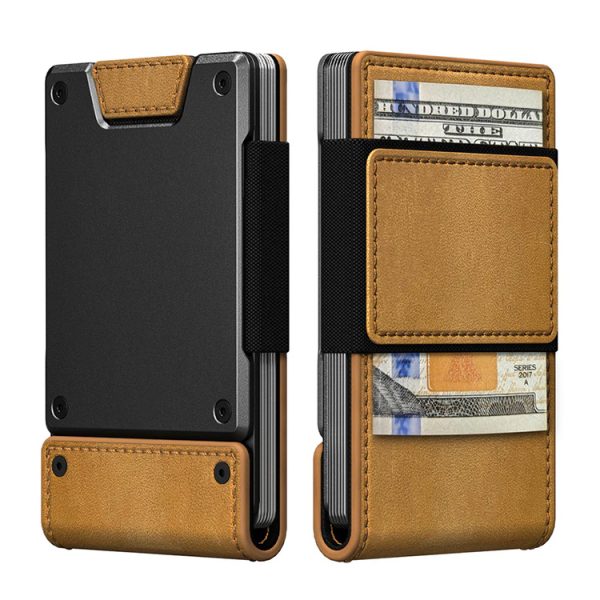
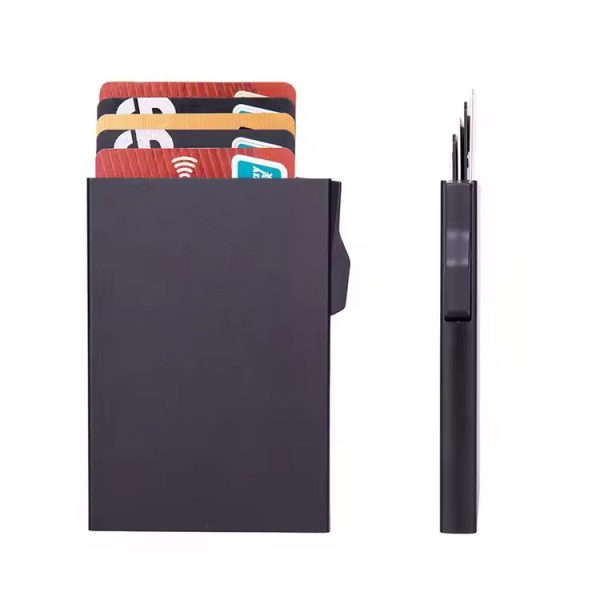
The pop-up mechanism holds cards by design: a spring-loaded carriage indexes them one at a time. Retention is excellent until the spring or the track wears. This is where most functional returns come from, because the mechanism is the only part of the wallet with moving parts.
| Mechanism | Added thickness | Works across card counts | Main failure mode |
|---|---|---|---|
| Elastic band | 0.5–1.0 mm | Yes, wide range | Tension loss with age and heat |
| Spring steel plate | 0.3–0.5 mm | Yes, medium range | Fatigue at the anchor point |
| Detent nubs | 0.1–0.2 mm | Partly | Edge wear, reduced grip over time |
| Pop-up index | 2.0–3.5 mm | Fixed by carriage | Spring and track wear |
How to measure retention instead of guessing
Retention is a force, and it can be measured with equipment that costs less than a sample shipment.
- Pull-force test. Clamp the wallet, attach a small luggage scale to a card, and pull slowly. Record the force at which the card releases. Do this at the minimum and maximum advertised card counts.
- Shake test. Hold the wallet open and upside down, and shake it five times at roughly one shake per second. Nothing should fall. This is crude and it correlates with complaints better than any lab number.
- Drop test. Drop from 1.2 m onto concrete, five times, on each face and each edge. Then repeat the shake test.
- Cycle test. Insert and remove cards 1,000 times. Re-run the pull-force test. A drop of more than 30 percent in pull force means the mechanism is wearing out, not settling in.
- Aging test. 72 hours at 60 °C and 90 percent relative humidity, then repeat the pull-force test. Elastic and adhesive both fail here before they fail in the field.
Run all five on three units from three different mold cavities. The spread between cavities is the number that predicts your return rate, not the average.
Where the bulk actually comes from
Buyers ask for “slim” and then specify a wallet that has to hold eight cards, cash, and a coin pocket. That is not a retention problem, it is an arithmetic problem. A stack of eight cards is about 7 mm. Add a cash fold, and you are at 9 mm before the shell. No retention mechanism fixes that.
The useful conversation is about the everyday load, not the maximum. In our experience with OEM programs, most buyers carry four to six cards and a folded note. Designing for that stack — and stating it clearly on the packaging — removes a large share of “it doesn’t hold my cards” complaints before they happen.
Retention problems that are really tolerance problems
Three production issues show up again and again:
- Cavity-to-cavity variation. A 0.2 mm difference in the card bay is enough to change the feel from snug to loose. Ask for a first-article inspection report across cavities, not just one sample.
- Anodizing build-up. Type II anodizing adds 5 to 15 microns per surface. That is small, but on a tight-tolerance card bay it can mean the difference between a card that slides and a card that jams. Specify the post-anodize dimension, not the pre-anodize one.
- Material creep in plastics. A molded plastic retention rib under constant load relaxes over months. Metal does not. If the retention depends on a plastic rib, design it as a spring, not as a rigid stop.
When to use a pop-up mechanism and when not to
Pop-up wallets sell well because the mechanism is visible and satisfying. They also generate the most functional returns, because a spring-loaded carriage has more ways to fail than a static card bay: the spring loses tension, the track collects grit, the index arm skips.
If you are launching a pop-up, budget for a 500-cycle test on every production lot, and expect the mechanism to be the item you re-tool first. If your channel is corporate gifting or low-support retail, a static bay with a spring plate is the lower-risk product.
Frequently asked questions
How many cards should a slim wallet hold?
Design for the everyday load, not the maximum. Most buyers carry four to six cards. A wallet that holds five comfortably and eight with effort feels better than one that holds eight loosely and drops two.
Why do my cards fall out when the wallet is new but not after a month?
That is usually the opposite of what buyers report, and it points to a compliant retention element — elastic or a plastic rib — that has taken a set. If the wallet gets looser with use, the retention is relying on compression rather than on a spring or a detent.
Does a metal wallet hold cards better than leather?
Metal holds its shape, so the card bay does not stretch. That is an advantage for retention and a disadvantage for tolerance: a metal bay that is 0.3 mm too wide stays too wide forever, while leather adapts. The fix is tighter process control, not a different material.
Can I add retention without changing the tooling?
Sometimes. A thin stainless spring plate or a silicone insert can be added to an existing cavity if there is 0.3 to 0.5 mm of clearance. Detent nubs usually require a tool change because they sit on the side wall.
Next step
Send us your target card count and the thickness you are trying to hit. We will tell you which retention method fits inside that envelope, and what tolerance the tool has to hold. Start with our metal wallet range or the pop-up aluminum card holder, and see OEM manufacturing for sampling and first-article inspection.