9 min read
An aluminum wallet looks like the simplest product in the category. Two shells, a hinge, a band. Then you carry one for a month and notice three things nobody mentions in the listing: the edges catch on your pocket lining, the hinge develops a click, and after the anodizing wears at the corners, the wallet starts to look older than it is.
None of those are reasons to avoid aluminum. They are the things to check before you buy, or before you put your brand on a few thousand units.
Short answer: what makes a good aluminum wallet for daily carry?
For most buyers: 6061-T6 aluminum, 1.2 to 1.5 mm wall, Type II anodizing, a stainless pin hinge, and a spring-plate or elastic retention that is replaceable. Choose 7075-T6 only if you need a thinner wall for a premium product, and choose a mechanical pop-up only if you are prepared to support a moving part.
Alloy: 6061 or 7075
These two alloys cover almost every aluminum wallet on the market, and the difference is real but narrower than marketing suggests.
| Property | 6061-T6 | 7075-T6 |
|---|---|---|
| Typical yield strength | ~276 MPa | ~503 MPa |
| Density | 2.70 g/cm³ | 2.81 g/cm³ |
| Anodizing response | Even, predictable color | Less even, harder to color-match |
| Machining cost | Lower | Higher, more tool wear |
| Best use | Standard shells, high volume | Thin-wall premium, tight bend radii |
6061 is the default for a reason. It anodizes evenly, machines predictably, and costs less per part. A 1.2 mm 6061 wall survives a front pocket without denting, as long as the shell is a closed box rather than an open frame.
7075 earns its price when you cut the wall to 0.8 mm to hit a thickness target. At that wall, 6061 dents at the corners after a few drops and 7075 does not. If your product story is “thinnest wallet in the range,” 7075 is the honest choice. If it is “a wallet that lasts five years,” 6061 at 1.2 mm is the better engineering call, and it anodizes better.
Wall thickness and weight, without the guesswork
Aluminum weighs about 2.7 grams per cubic centimeter. A card-sized shell of 85 × 55 mm with 1.2 mm walls and two faces works out to roughly 45 to 55 grams, depending on how much material the hinge and the retention cut-outs remove. At 2 mm walls it climbs toward 80 grams, which is heavier than most leather bifolds.
That is the trade: 0.4 mm of wall buys you a lot of dent resistance and costs you about 15 grams. For a wallet that lives in a front pocket, 50 grams is the number most people stop noticing. Above 80 grams, they notice.
Anodizing is where quality shows up first
Anodizing is an oxide layer grown from the aluminum itself, not a coating sitting on top. Two types matter:
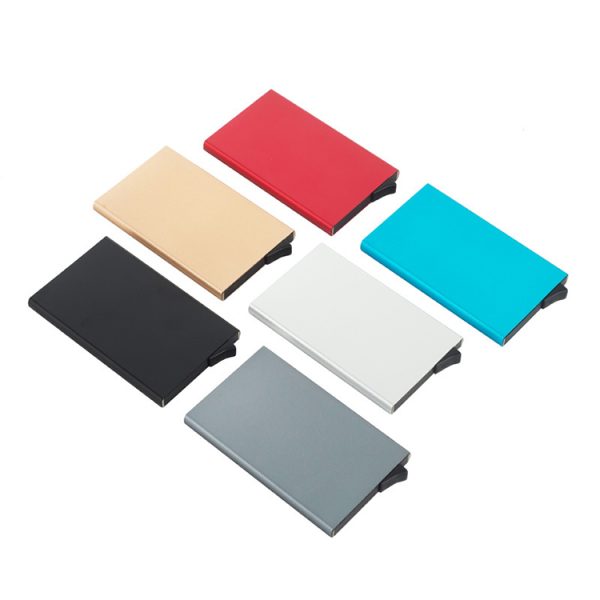
- Type II (sulfuric anodize) — 5 to 25 microns, full color range, standard for consumer products.
- Type III (hard anodize) — 25 to 50 microns, harder surface, darker and more limited color range, used where abrasion resistance matters more than appearance.
Three practical checks:
- Edge coverage. Anodizing does not cover cut edges as well as flat faces unless the part is deburred and racked correctly. Look at a chamfer under a light: a pale, inconsistent line means the rack contact points were badly placed.
- Color across parts. Ask for a color chip from the same lot as the production run, not from the sample run. Anodizing color shifts with bath chemistry, and a re-run six months later will not match unless the dye lot is held.
- Dimensional change. Anodizing grows the part by roughly half the coating thickness per surface. On a card bay toleranced to 0.15 mm, that matters. Specify post-anodize dimensions.
The hinge is the part that fails
Most aluminum wallets fail at the hinge before they fail anywhere else. Three common constructions:
Pin hinge. A stainless pin through interlocking knuckles. Strong, repairable, and the only type that survives years of one-handed opening. Specify a 304 or 316 stainless pin; plated mild steel will rust at the knuckle within a season of humid weather.
Living hinge in plastic. Cheap, silent, and it will crack. A polypropylene living hinge is rated for tens of thousands of cycles in a lab, but a wallet is opened in a pocket, at an angle, with grit in it. Expect a two-year life at best.
Folded tab hinge. The shell folds onto itself. No separate part, no rattle, but the fold work-hardens and can crack if the bend radius is too tight. Minimum radius for 6061-T6 is roughly equal to the material thickness; anything tighter needs 7075 or an annealed bend.
RFID: an aluminum wallet is only a shield if it closes
Aluminum blocks the field a reader uses, but only where the metal surrounds the card. An open-frame wallet with exposed card edges is not a Faraday cage. A card slot machined through the front face leaks. A wallet that stays slightly open under load leaks.
If RFID blocking is part of your claim, the test is simple: put a card in the wallet, close it, and try to read it with a handheld reader at 2 cm. Then try the same at 5 cm. If it reads at either distance, the enclosure is incomplete.
Two design rules follow. First, the card bay should be a closed box with no through-slots. Second, the closure should hold the shell shut under load, because a 2 mm gap at the seam is enough for a near-field reader.
Read more on this in our RFID wallet range and the RFID sourcing guide.
Practicality: the things that decide whether it stays in your pocket
Edges
A chamfer of 0.3 to 0.5 mm is the difference between a wallet that slides into a pocket and one that catches. This is the single cheapest quality upgrade in the product, and it is the first thing a low-cost tool skips.
Screws
Two M2 screws holding the shell together will loosen with vibration. Thread-locker on the assembly line solves it; a split washer does not. If the design uses screws, specify pre-applied thread-locker patches, not a bottle on the bench.
Retention
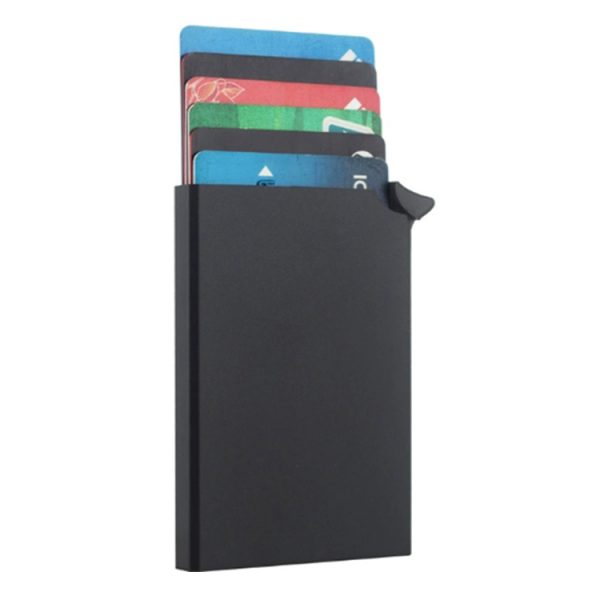
Elastic bands age. Spring plates fatigue at the anchor. Whatever the retention is, it should be replaceable, because it will be the first thing to go. A wallet with a riveted elastic band is a disposable wallet.
Cash
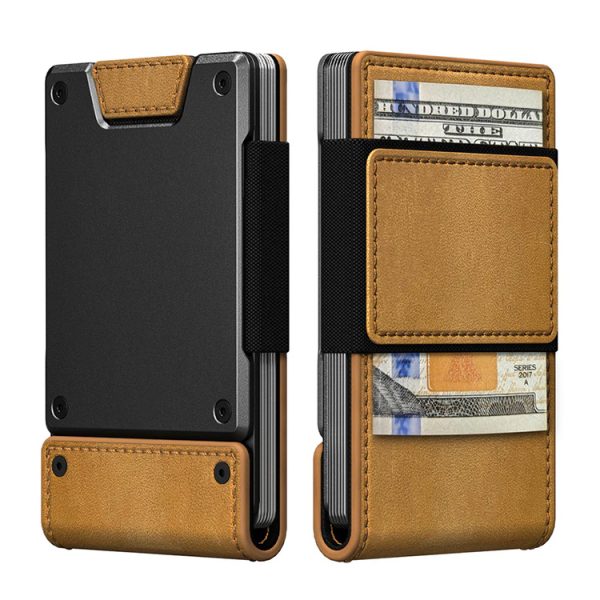
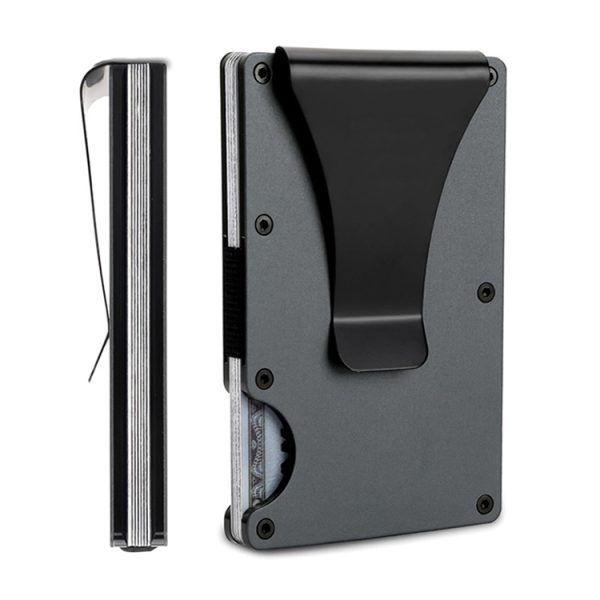
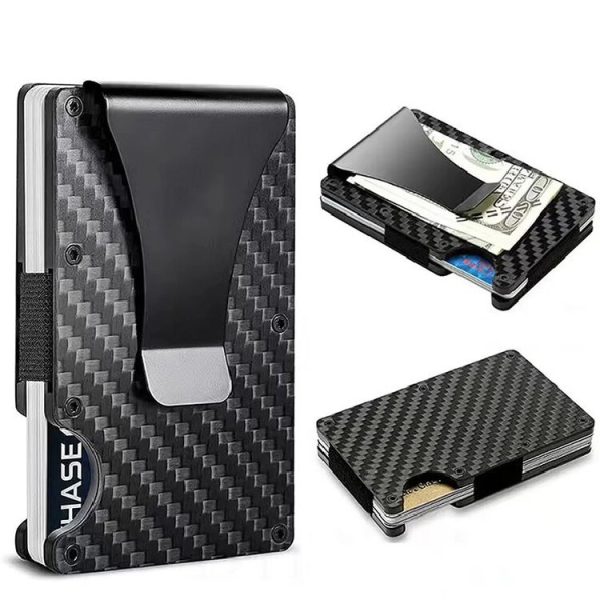
An aluminum shell holds cards well and cash badly. A money clip, a cash strap, or an elastic band over the shell solves it. If your buyers still carry notes — and in most of Europe and Asia they do — plan for one of the three.
A buyer’s checklist before you commit
- Weigh it loaded with your real card count. Above 80 grams, you will leave it at home.
- Open and close it 50 times in the shop. Listen for a click at the hinge, and feel for a change in resistance.
- Hold it upside down, open, and shake. Cards should stay.
- Check the corners under a light. Anodizing that is thin at the edges will turn white within months.
- Try to read a card with a reader while the wallet is closed. If it reads, the RFID claim is marketing.
- Look for a replaceable retention part. If it is riveted, ask what happens in year two.
Specifying an aluminum wallet for an OEM program
If you are the buyer rather than the end user, the checklist above becomes a spec sheet. Six items decide most of the cost and almost all of the complaints:
- Alloy and temper, stated explicitly (6061-T6, not “aluminum”)
- Wall thickness with a tolerance, and whether it is measured before or after anodizing
- Anodize type, color standard, and the dye lot retention requirement
- Hinge type and pin material
- Retention method and its rated cycle life
- Drop test height and surface, agreed before tooling
Our sourcing guides cover the rest of the RFQ, and the custom wallet program covers tooling, sampling, and packaging.
Frequently asked questions
Is an aluminum wallet better than leather?
Aluminum holds its shape and blocks RFID when fully closed. Leather adapts to a changing card count and does not dent. If you carry the same four to six cards every day, aluminum is the better fit. If your load changes constantly, leather is more forgiving.
Will an aluminum wallet scratch my cards?
A poorly finished card bay will. Burrs and sharp edges at the bay entrance abrade card faces and stripe edges. A deburred, chamfered bay with 0.3 mm radius or more does not.
How thin can an aluminum wallet be?
For six cards: roughly 9 to 11 mm including the shell. Below that, you are trading wall thickness or card capacity, and the wallet starts to dent or bow.
Does an aluminum wallet block phone signals?
It can block a phone’s own signal if the phone is inside it, which is why aluminum wallets should not be used as a phone sleeve with a live SIM inside. It does not affect a phone placed next to the wallet.
Next step
If you are evaluating aluminum for a retail or corporate program, send us your target thickness, card count, and finish, and we will tell you which alloy and hinge get you there without denting. Browse the metal wallet range, or look at how materials and finishing affect color consistency across production runs.