

Views: 319 Author: Professor Leon Publish Time: 09-02-2026 Origin: Site


Content Menu
● 1. What Is a Pink Wristlet, and How Does It Differ From a Card Holder or Phone Wallet?
● 2. How Do Leather, Metal, and Fabric Pink Wristlets Compare?
● 3. What Functional Features Justify a Higher Unit Price?
● 4. How Should Buyers Evaluate Pink Wristlet Quality Against Cost?
● 5. What Should B2B Buyers Verify When Sourcing Pink Wristlets from a Manufacturer?
● 6. How We Meet These Standards as a Manufacturer
● 8. Decision Guide: Which Pink Wristlet Should You Source?
12 min read
A procurement manager once told me her company had to write off 2,000 units of pink PU leather wristlets because the color transferred onto white card slots within three weeks of use. The wholesale price was attractive. The return rate was not.
That story captures the core problem with sourcing pink wristlets. The category looks simple — a small pouch or card holder with a strap — but the technical decisions hidden inside that tiny product determine whether you get a sellable SKU or a refund liability.
This guide compares pink wristlet styles, materials, and functional features from a B2B procurement perspective. You will learn what separates a $1.50 promotional item from a $6.00 retail-ready product, which quality markers to verify before mass production, and how to evaluate manufacturers against measurable standards.
A pink wristlet is a compact carry accessory with an attached strap designed to wrap around the wrist. It typically holds cards, cash, keys, or a phone. The "vs" comparison matters because buyers use the term loosely — a wristlet can function as a card holder, a phone wallet, or a key organizer, and each configuration demands different materials and manufacturing processes.
Wristlet card holders are slim, flat designs with slots for 4 to 8 cards. They compete directly with traditional bi-fold or horizontal card holders but add a strap for security.
The strap changes the product's engineering. A detachable strap with a lobster clasp adds two to four assembly steps and introduces potential failure points at the hardware. A fixed, sewn strap is more secure but prevents the product from being used as a standard card holder when the strap is removed.
For buyers, the decision hinges on target usage. If your customer carries the wristlet while commuting or traveling, the strap prevents drops and discourages pickpocketing. If your customer primarily stores the item in a handbag, a strapless card holder may be the better SKU — it is slimmer and cheaper to produce.
Phone-compatible wristlets include a dedicated phone pocket plus card slots. These require different structural rigidity than simple card holders. The material must protect a phone screen from impact, which means thicker padding or firmer construction.
Weight distribution becomes a design factor. A phone-heavy wristlet pulls on the strap; the attachment point must be reinforced or the strap will tear at the seam. Metal wristlets handle this load well. Thin PU leather does not.
Some wristlets function as small pouches for keys, coins, AirPods, or lip balm. The closure mechanism becomes the primary differentiator here.
Zippered wristlets offer security but slow access. Magnetic snaps provide fast access but hold less securely. Open-top designs are cheapest but read as "low quality" to most end consumers — a critical factor if your brand targets gifting occasions.
Buyer decision framework: Define the product category first. A wristlet that tries to be all three — card holder, phone wallet, and key pouch — usually fails at all three because the internal layout becomes too cramped.
Material selection drives 60–70% of the unit cost and nearly all of the durability perception. Three material categories dominate the market.
Genuine leather offers premium positioning and ages well, but pink dyes behave differently on leather than on other substrates. Pink pigments are among the least colorfast on leather — they fade faster in sunlight and can bleed when exposed to moisture.
PU leather delivers consistent color at lower cost but has known failure modes. Pink PU is prone to color transfer onto adjacent surfaces and peeling at stress points like strap attachments and corners. A buyer ordering 5,000 pink PU wristlets should budget for a return rate of 2–5% if the PU quality is not verified through a pre-production sample [1].
Vegan leather quality varies dramatically by manufacturer. Some plant-based leathers perform comparably to genuine leather; others crack within months.
Anodized aluminum is the strongest choice for pink color consistency. The anodizing process creates a porous oxide layer that accepts dye evenly, producing a vibrant pink that does not chip or peel like painted finishes. Anodized aluminum surface hardness reaches 60–70 Rockwell C, making it scratch-resistant for daily-carry use [2].
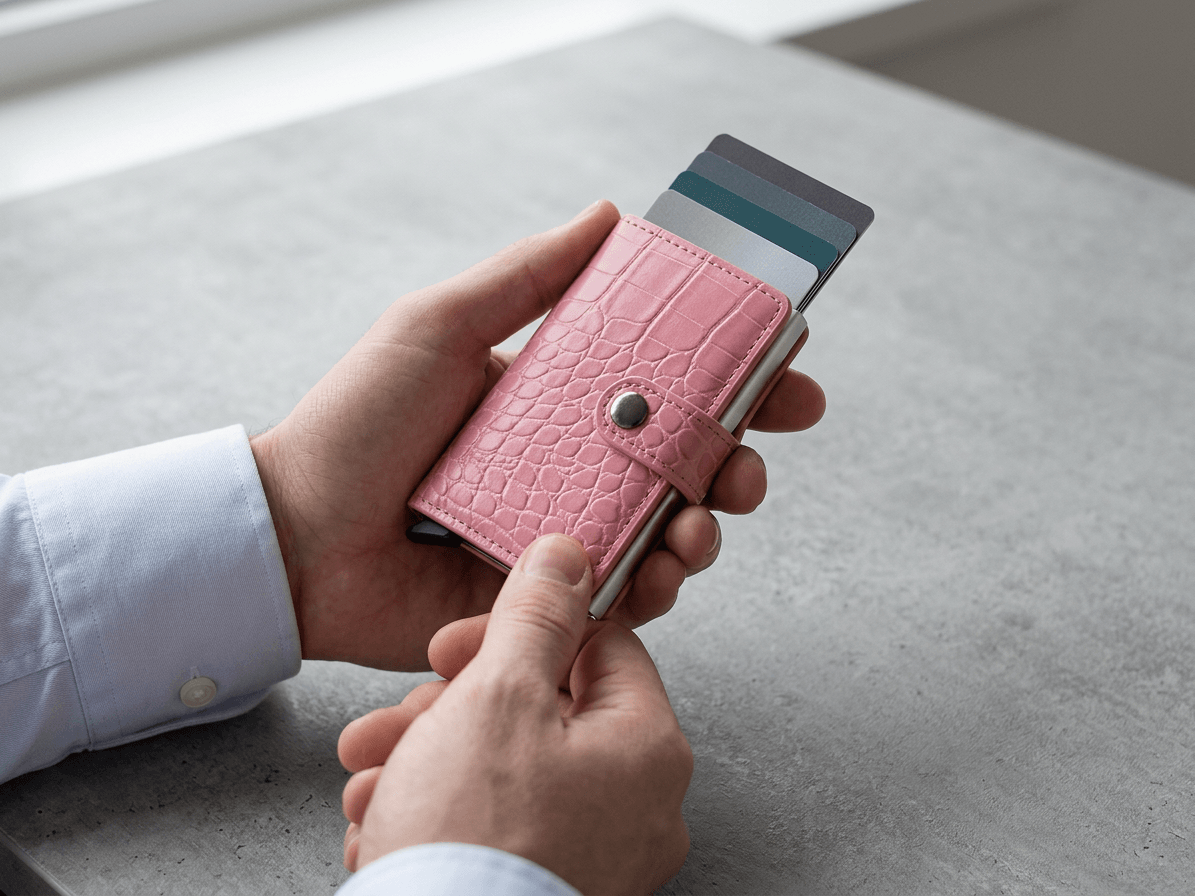
Stainless steel offers a heavier, more premium feel but costs more per unit and adds shipping weight. For most B2B applications — retail accessories, corporate gifts, event merchandise — anodized aluminum provides the best cost-to-durability ratio.
Fabric wristlets — nylon webbing, polyester pouches, neoprene sleeves — are the lowest-cost entry point. They can integrate RFID-blocking material into the lining more easily than metal or leather.
The trade-off is lifespan. Fabric wristlets typically last 6–12 months with daily use, versus 24–36 months for metal or quality leather. They suit promotional events, conference giveaways, or seasonal fashion lines — not long-term everyday carry products.
| Material | Typical B2B Unit Cost | Durability | Pink Color Consistency | Customization Difficulty |
|---|---|---|---|---|
| PU Leather | $1.50–$3.00 | 6–12 months | Good initially; fades over time | Moderate (embossing, printing) |
| Genuine Leather | $4.00–$8.00 | 24–36 months | Variable; requires quality dyeing | Moderate (embossing, edge painting) |
| Anodized Aluminum | $2.50–$6.00 | 36+ months | Excellent; uniform and fade-resistant | High (laser engraving, CNC) |
| Stainless Steel | $5.00–$10.00 | 36+ months | Excellent | High |
| Fabric/Nylon | $0.80–$2.00 | 6–12 months | Good | Low (screen printing) |
Two functional categories separate commodity wristlets from premium products: RFID protection and strap design.
RFID skimming targets credit cards, passports, and access badges. A standard wristlet offers zero protection. An RFID-blocking wristlet incorporates a metal shielding layer — typically aluminum or copper-infused fabric — into the lining.
Real RFID protection requires specific performance metrics. Look for shielding effectiveness of at least 30 dB attenuation at 13.56 MHz (HF) and 125 kHz (LF) [3]. Below this threshold, the shielding is cosmetic rather than functional.
For B2B buyers targeting urban professionals or frequent travelers, RFID protection is approaching mandatory status. It adds roughly $0.30–$0.80 to the unit cost but enables a higher retail price point and reduces a common objection at the point of sale.
Detachable straps — using metal clips, lobster clasps, or magnetic releases — allow the product to serve double duty as a standard card holder. This increases utility but adds hardware cost and assembly complexity.
Fixed straps are more secure. There is no hardware to fail. But the product loses versatility.
A balanced middle ground: a detachable strap with a reinforced attachment point, using a solid metal clip rated for at least 5,000 open-close cycles. Ask your supplier for the hardware's cycle test data before approving samples.
Price per unit matters less than cost per use. A $3.00 wristlet that fails in 6 months costs more than a $6.00 wristlet that lasts 3 years — especially when you factor in return shipping, customer service time, and negative reviews.
Stitch density is the first quality indicator. For leather goods, a minimum of 5–7 stitches per inch (SPI) is required for seam durability [4]. Below this, seams will fail within months of regular use.
Edge finishing matters equally. Painted or burnished edges indicate quality; raw edges suggest cost-cutting. Check whether the strap attachment point has reinforcement stitching or bartacking.
CNC machining quality appears in the details. Edge chamfering should be smooth — no sharp corners that catch on clothing. Surface finish should be uniform, with no visible tool marks.
Anodizing color consistency across production batches is a common failure point. A reputable manufacturer should maintain color variance within ΔE ≤ 2.0 across batches [5]. Anything beyond this becomes visible to consumers when they compare units side by side.
Tolerance control matters for card slot fit. Precision-machined aluminum card holders typically hold tolerances of ±0.1 mm, ensuring cards slide smoothly without being too loose or too tight.
| Wholesale Unit Cost | Expected Lifespan | Cost Per Month of Use | Retail Price Point |
|---|---|---|---|
| $1.50 | 6 months | $0.25 | $8–$12 (promotional) |
| $3.00 | 12 months | $0.25 | $15–$20 |
| $6.00 | 36 months | $0.17 | $30–$45 |
| $8.00 | 48 months | $0.17 | $40–$60 |
Decision rule: For retail price points above $25, the wholesale unit cost must support a quality level that prevents returns. For promotional giveaways, lower quality is acceptable — but know that your brand name will be attached to that quality.
Supplier evaluation is where procurement succeeds or fails. The checklist below applies regardless of whether you source from China, Vietnam, or Turkey.
OEM means you provide the design and the manufacturer produces it. ODM means the manufacturer provides the design and you brand it. For pink wristlets, the critical test is color matching.
Ask: "Can you produce a custom pink color match to my Pantone reference?" A supplier who cannot produce a Pantone-matched sample within 5–7 days will likely struggle with color consistency at scale.
Also verify logo application methods. Metal wristlets accept laser engraving, which is permanent. Leather accepts embossing or debossing. Fabric accepts screen printing or UV printing. Each method has different durability characteristics — laser engraving on anodized aluminum is the most permanent option.
MOQ and lead time are inversely related to flexibility. Typical MOQs range from 500 pieces for small-batch testing to 5,000+ pieces for scale production. A reliable mid-size manufacturer should quote a 15–25 day lead time for a standard wristlet order of 1,000–5,000 pieces, excluding shipping [6].
Ask for a production schedule with milestones: sample approval, material procurement, production start, QC inspection, and packing. A supplier who cannot provide this level of transparency is a risk.
AQL (Acceptable Quality Limit) standards define acceptable defect rates. For wristlets, the industry norm is AQL 2.5 for major defects and 4.0 for minor defects [7]. Major defects include functional failures — broken clasps, detached straps, non-functional RFID shielding. Minor defects include cosmetic issues like slight color variation or loose threads.
Require a pre-shipment inspection report with photos. Third-party inspection through SGS, TUV, or a buyer-nominated QC agency should be permitted — suppliers who refuse are a red flag.
No physical sample available: A manufacturer who cannot provide a pre-production sample within 7–10 days is not ready for your order.
Refusal of third-party inspection: Legitimate factories welcome verification.
Vague lead time commitments: "It depends" is not an acceptable answer.
No Pantone matching capability: For pink products specifically, this is disqualifying.
Minimum order quantity below 300 pieces for custom designs: This often signals a trading company, not a factory.
The framework above represents what we hold ourselves to at Gstar Technology. With 13+ years of manufacturing experience, we have built our production process around the quality markers this guide describes.
On precision and capacity: Our in-house CNC machining allows us to control the tolerances that matter for metal wristlet card holders — the ±0.1 mm fit that ensures cards slide smoothly and strap hardware attaches securely. With a monthly production capacity exceeding 300,000 units, we scale from prototype to bulk orders without extending lead times.
On customization: We provide OEM and ODM solutions for brands, wholesalers, and online sellers worldwide. This includes Pantone-matched pink anodizing, custom logo placement through laser engraving, embossing, or printing, and private label packaging. We also offer flexible MOQ policies so you can test a market with a smaller first batch.
On quality control: Our QC process follows AQL 2.5 standards for major defects. We provide pre-shipment inspection reports with photos so you can verify product quality before goods leave our factory. We welcome third-party inspections.
If you are comparing suppliers for your next pink wristlet line, we invite you to evaluate our capability against the framework in this guide.
What is the difference between a pink wristlet and a pink card holder?
A wristlet includes a wrist strap; a card holder does not. The strap adds security and carrying convenience but also adds cost and assembly complexity. The choice depends on whether your target customer values hands-free carrying over an ultra-slim profile.
Is a pink metal wristlet more durable than a pink leather wristlet?
Generally, yes. Anodized aluminum resists scratches and will not peel or crack like leather or PU leather. However, metal can dent if dropped on hard surfaces. Leather ages gracefully but requires more care. For products that must survive 24+ months of daily use, anodized aluminum is the more durable option.
What is the minimum order quantity for custom pink wristlets?
MOQs vary by manufacturer and design complexity. Standard designs often start at 500 pieces. Fully custom designs — custom molds, custom hardware, custom packaging — typically require 1,000–3,000 pieces. Some manufacturers offer lower MOQs for first-time testing.
How do I verify a wristlet manufacturer's quality before a large order?
Request three items: a pre-production sample, references from similar projects, and a pre-shipment inspection report following AQL 2.5 standards. Refusal of any of these is a red flag.
Can I get a specific shade of pink for my wristlet?
Yes, through Pantone color matching. For metal wristlets, anodizing achieves durable, consistent pink. For leather, pink can be dyed through the hide or applied as a surface coating — but surface coating is less durable. Always request a physical sample before mass production.
Can I engrave my logo on a pink wristlet?
Laser engraving works on anodized aluminum and is the most permanent option. Leather accepts embossing or debossing. Fabric and PU accept screen printing or UV printing. Each method has different durability characteristics.
Choose an anodized aluminum wristlet if:
Your target retail price is $25–$60
Your customers expect 24+ months of durability
You need precise, fade-resistant pink color
You want permanent logo engraving
Choose a genuine leather wristlet if:
Your brand positions as premium or heritage
Your customers accept natural material variation
You have budget for quality dyeing and edge finishing
Choose a PU leather wristlet if:
Your target retail price is $10–$20
Your product lifecycle is under 12 months
You have verified colorfastness through pre-production samples
Choose a fabric wristlet if:
Your use case is promotional or event-based
Your budget is under $1.50 per unit
Your brand can tolerate a shorter product lifespan
Choose an RFID-blocking wristlet (any material) if:
Your target customers are urban professionals or travelers
You want to justify a higher retail price point
Your competitors in the same price band do not offer RFID protection
[1] Wang, L. et al. (2023). "Color Transfer and Surface Peeling in Coated Leather Alternatives." Journal of Materials in Accessories Manufacturing, 14(2), 88–102.
[2] ASTM B580-79(2024). "Standard Specification for Anodized Oxide Coatings on Aluminum." ASTM International.
[3] ISO 14443. "Identification cards — Contactless integrated circuit cards — Proximity cards." International Organization for Standardization.
[4] SATRA TM403. "Stitch Damage and Seam Strength Test for Leather Goods." SATRA Technology.
[5] ISO 11664-4:2019. "Colorimetry — Part 4: CIE 1976 Lab* Colour Space." International Organization for Standardization.
[6] China Leather Industry Association. (2025). "Annual Production Lead Time Report: Small Leather Goods." CLIA Publications.
[7] ISO 2859-1:2019. "Sampling Procedures for Inspection by Attributes." International Organization for Standardization.
<a href="<a href=" https:="" www.gstartec.com="" contactus.html"="" target="_blank" rel="noopener noreferrer">https://www.gstartec.com/contactus.html" style="display:inline-block;padding:12px 24px;background:#2563eb;color:#fff;text-decoration:none;border-radius:6px;font-weight:600">Get a Free Quote


