

Views: 469 Author: Professor Leon Publish Time: 09-02-2026 Origin: Site


Content Menu
● 1. What Makes a Leather Wallet "Best"? Understanding Material Grades
● 2. How Does Construction Technique Affect Wallet Quality?
● 3. Why Is RFID Blocking Now Expected in Leather Wallets?
● 4. What Design Innovations Drive the Current Leather Wallet Market?
● 5. How Should Buyers Evaluate Leather Wallet Manufacturers?
● 6. What Industry Standards Apply to Leather Wallet Manufacturing?
● 7. How Do OEM and ODM Partnerships Work for Leather Wallets?
● 8. Our Manufacturing Approach: Meeting the Standards Above
10 min read
A purchasing manager once asked me to source 5,000 leather wallets for a lifestyle brand launch. The samples from three different factories looked nearly identical in photos. Side by side, the differences were stark — one had edges that felt like glass, another was already peeling at the corners after a week of pocket carry.
The "best" leather wallet is rarely a single product. It's a specific combination of material grade, construction technique, and design features that serve a target demographic. For brands and retailers, identifying the best means understanding what you're actually paying for — and which factory can replicate quality at scale.
This guide breaks down the anatomy of a premium leather wallet from a procurement perspective, covering material grades, construction methods, trending features, and the factory capabilities required to produce them consistently.
Full-grain leather is the gold standard for premium wallets because it retains the natural grain structure of the hide, develops a unique patina over time, and offers superior durability compared to corrected or split leathers.
The material grade determines everything downstream — price point, target customer, and manufacturing complexity. Here's what B2B buyers need to know before sourcing.
| Grade | Source | Characteristics | Typical Use |
|---|---|---|---|
| Full-Grain | Top layer of hide, unaltered surface | Natural markings visible, develops patina, most durable, highest cost | Premium/luxury wallets |
| Top-Grain | Top layer, sanded/buffed | Uniform appearance, more scratch-resistant surface, slightly less breathable | Mid-to-high range, saffiano finishes |
| Genuine/Bonded | Lower layers or reconstituted fibers | Inconsistent quality, shorter lifespan, lower cost | Budget products, promotional items |
Full-grain hides cost 30-60% more than top-grain equivalents. That price difference shows up in the end product. But there's a trade-off: full-grain hides have natural imperfections — scars, insect marks, grain variations — that require skilled cutting to work around. Yield loss during cutting can reach 15-20% on lower-grade hides. This is why "genuine leather" claims at suspiciously low prices should raise flags.
The market has shifted toward hybrid designs. Leather exteriors paired with aluminum or carbon fiber interior frames now appear in some of the best leather wallets available. These structures offer card protection and quick-access mechanisms that pure leather cannot achieve.
The procurement implication is significant. Hybrid wallets require two completely different production disciplines: traditional leather stitching and CNC machining for metal components. Factories that only do leatherwork cannot handle these products. Factories that only do metalwork cannot finish the leather properly. Finding both capabilities under one roof is rare.
Traceability matters more than most buyers realize. EU-sourced hides (Italian, Spanish) carry different tanning regulations than South American or Asian sources. For export to the European market, REACH compliance restricts certain chemicals in the tanning process. For the US market, Proposition 65 compliance affects materials that come into contact with skin.
Ask suppliers where their leather originates. Ask for tanning certificates. Good suppliers provide them without hesitation.
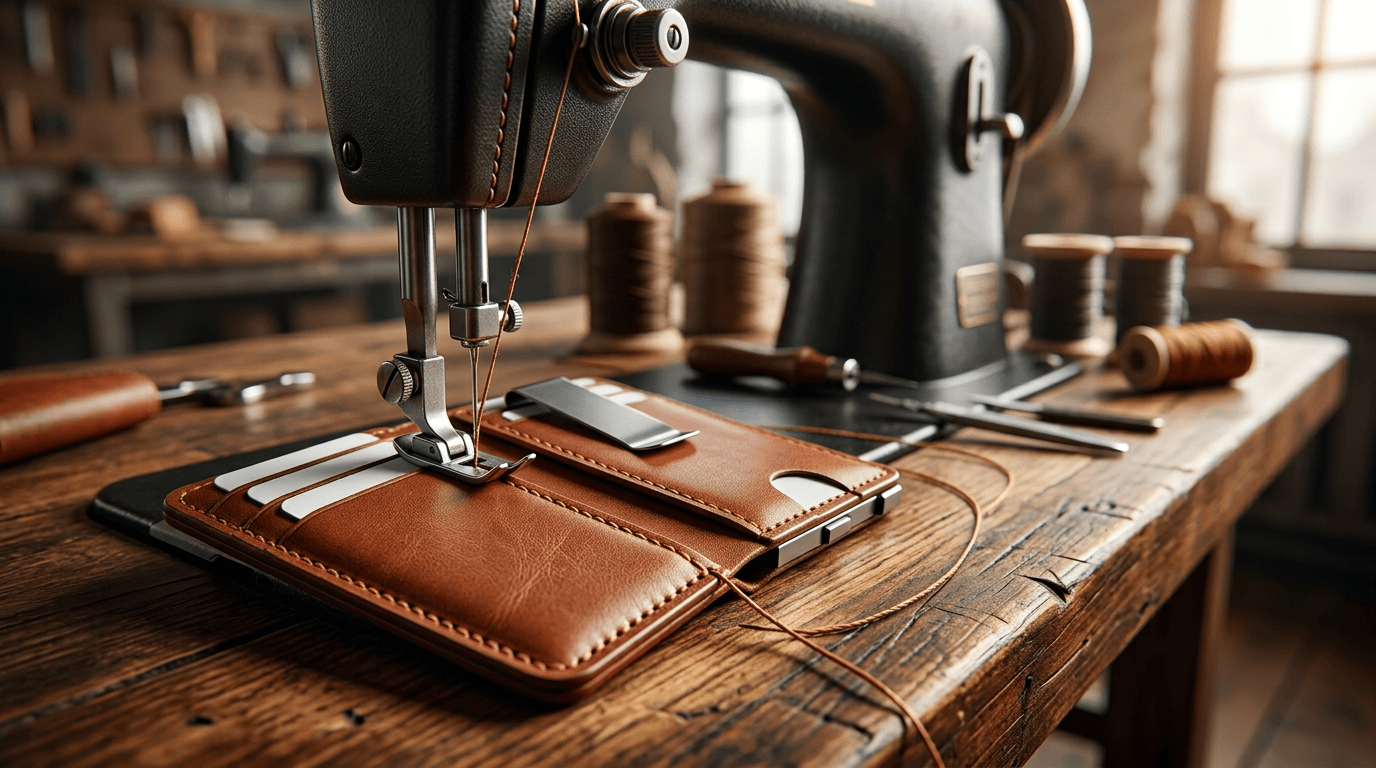
Saddle stitching is the industry standard for durable leather wallets because it uses two needles and interlocking threads that don't unravel when a single thread breaks — unlike standard machine stitching.
Construction separates premium wallets from mass-market products more than material grade does. Two wallets cut from identical leather can have dramatically different lifespans based on how they're assembled.
Machine stitching uses a single thread looped through the material. When one loop breaks, the entire seam can unravel. Saddle stitching uses two needles passing through the same hole from opposite directions, creating an interlocking pattern. If one thread breaks, the remaining thread holds the seam together.
Thread quality matters equally. Bonded nylon threads (V69, V138 thickness ratings) resist abrasion and UV degradation better than standard polyester. A wallet expected to last five years needs thread that won't dry-rot by year three.
Cheap wallets have edges that look painted — a single coat applied and left to dry. Premium wallets have edges that look like polished plastic. The difference is labor.
Proper edge coating requires 3-5 layers of edge paint, each sanded and polished before the next application. This process takes time and skill. It's also the first place factories cut corners because consumers rarely inspect edges closely — until they start peeling.
Snap buttons should be zinc alloy or stainless steel, not cheap brass-plated alternatives that corrode. If the wallet design includes mechanical card ejection (common in hybrid aluminum wallets), the tolerance of CNC machining becomes critical. A tolerance of ±0.1mm separates a smooth mechanism from one that jams or spits cards across the room.
RFID blocking in wallets works by creating a Faraday cage effect — a continuous conductive barrier that prevents radio frequency signals at 13.56 MHz (contactless payment frequency) from reaching the cards inside.
The technology behind RFID protection has matured. Two approaches dominate:
Woven metallic fabric: Thin, flexible, can be integrated into leather lining. Less effective but more comfortable.
Metal plates or frames: Solid barriers, highly effective, but add rigidity and bulk.
The challenge is integration. Inserting stiff blocking materials into soft leather structures changes the wallet's hand-feel and profile. Smart designs layer the blocking material strategically — only around card pockets — rather than across the entire wallet.
Testing matters. Effective blocking requires a continuous conductive shield. Stitching holes that break the circuit can create leaks. A reliable manufacturer tests the final assembled product, not just the raw material. Ask for test reports before committing to a production run.
Quick-access card mechanisms, AirTag compatibility, and custom engraving are the three design features most influencing consumer choice in the leather wallet segment.
Consumer preference has shifted toward front-pocket wallets. The bulky bi-fold is declining. This matters for B2B buyers because minimalist designs require tighter tolerances — cards that fit snugly but not too tightly, edges that don't dig into pockets, and construction that maintains shape without stiffening.
Wallets designed to hold AirTags or Tile trackers are growing demand. The design challenge is creating a dedicated pocket for the tracker without adding visible bulk or interfering with the RFID shield. Some manufacturers integrate tracker slots into the card organizer section. This feature adds production complexity but commands premium retail pricing.
Laser engraving adds perceived value and reduces return rates — personalized products are less likely to be returned. But engraving has production realities. It must be done after assembly to avoid damaging stitching. The laser settings must match the leather's tannage; some leathers burn rather than engrave. A factory with dedicated engraving QC prevents costly waste.
Evaluating wallet manufacturers requires assessing process control, not just reviewing product samples. Buyers should verify in-house capabilities, QC protocols, and MOQ flexibility before committing to a production partner.
The "top 10 wallet brands" lists that dominate consumer searches are mostly marketing exercises. Many of those brands don't manufacture anything — they source from OEM factories in China, Vietnam, or Turkey. For a B2B buyer, the question isn't "which brand is best" but "which factory can produce what I need, consistently."
Assembly means gluing and stitching pre-cut pieces. Manufacturing means controlling the entire process — cutting, edge painting, hardware production, CNC machining for metal components, quality inspection. Factories that control the full process produce more consistent output because they can adjust variables at every stage.
Vague material claims: "Genuine leather" without specifying full-grain, top-grain, or origin.
Refusal of factory audits: Suppliers who won't do video calls or accept third-party inspections.
Limited customization: Factories that only offer stock designs with no ability to adjust dimensions or features.
No defect rate data: Established factories track and share their defect rates. If they don't know their numbers, they're not measuring quality.
What is your current defect rate, and how do you measure it?
Do you perform edge painting in-house or outsource it?
Can you match specific Pantone colors for stitching and lining?
What RFID testing standards do you follow?
Do you offer drop-shipping services for e-commerce sellers?
The primary standards affecting leather wallet production are REACH (EU chemical safety), Proposition 65 (California), and ISO 9001 (quality management). RFID blocking performance is typically verified against ISO 14443 or ISO 10373-6 test methods.
Compliance requirements vary by target market:
| Market | Standard | What It Covers |
|---|---|---|
| European Union | REACH | Chemical substances in tanning and finishing |
| California, USA | Prop 65 | Materials with prolonged skin contact |
| International | ISO 9001 | Quality management systems |
| RFID Performance | ISO 14443 / ISO 10373-6 | Contactless card communication and blocking efficacy |
Leather itself should meet or exceed the requirements of the Leather Working Group (LWG) protocol for environmental and social responsibility — though this certification is more common in footwear and larger goods than in small leather goods.
OEM means you provide the design and the factory manufactures to your specification. ODM means the factory provides the design or co-develops it with you based on market trends. ODM is typically faster for new brands; OEM ensures exclusivity.
The choice depends on your starting point. A brand with a detailed 3D file and clear specifications should pursue OEM. A brand with a concept sketch and a target price point benefits more from ODM, where the factory's engineering team translates the idea into manufacturable specifications.
Minimum order quantities exist because raw material purchasing power depends on volume. A factory buying 10,000 full-grain hides gets better pricing than one buying 500. That discount is passed to buyers. But flexible MOQs matter for startups testing the market.
The "fast fashion of wallets" dynamic means quick turnaround matters. Standard production runs take 4-6 weeks. Factories with in-house capabilities can compress this to 3-4 weeks by eliminating outsourced steps like edge painting or hardware production.
When evaluating manufacturers against the framework discussed, the most successful partnerships are built on engineering capability, not just sewing speed. As a manufacturer with 13+ years in this industry, we've watched brands fail because their supplier couldn't handle hybrid materials or didn't understand RFID integration.
Our approach bridges traditional leather craftsmanship with modern tech accessories. We operate in-house CNC machining for metal frames and precision molds — not because it's impressive, but because it eliminates the tolerance errors that occur when leather and metal parts are produced by different vendors. When a leather pocket must align perfectly with a metal card slot, controlling both processes matters.
Our experience spans beyond standard leather wallets into complex structures: graded card holders, key organizers, and RFID bumper guards. This breadth means we've already encountered — and solved — the design flaws that typically emerge at the tooling stage. When our engineering team reviews a client's design, we flag potential production issues before they become expensive problems.
We provide complete OEM and ODM services. Clients come to us with detailed 3D files or rough sketches. Our engineering team provides Design for Manufacturing (DFM) feedback — suggesting material changes, adjusting tolerances, or simplifying construction steps that add cost without adding value.
We understand that not every brand begins with a 10,000-unit order. Our flexible MOQ structure lets startups launch premium products without overcommitting inventory. At the same time, our 300,000+ monthly production capacity supports established brands during peak seasons when demand spikes and other factories are already booked.
Our QC protocol checks aesthetics and functionality. We test RFID blocking on finished products, not raw material samples. We verify stitch tensile strength and snap closure durability — the failure points that generate customer returns and damage brand reputation. For hybrid products, we inspect CNC tolerances and metal finishing standards. This is the difference between a factory that ships boxes and one that ships consistent, saleable products.
The best leather wallet is not a single product. It's a standard of manufacturing excellence — the right materials, precise construction, and a factory that understands both traditional leatherwork and modern technology features. Your choice of production partner determines whether your product meets that standard.
Choose a full-service manufacturer if you need hybrid (leather + metal) designs, RFID integration, or complex construction. Choose a specialized leather workshop if your product is simple and your volume is under 1,000 units — though check whether their pricing justifies the lack of in-house capabilities.
Choose ODM if you need to launch quickly with proven market designs. Choose OEM if you have a distinctive design that requires exclusivity.
Ready to discuss your next project? Our team can review your design requirements and help you bring a durable, market-ready product to life.
Leather Working Group. (2025). Protocol for Leather Manufacture Environmental Stewardship. https://www.leatherworkinggroup.com
European Chemicals Agency. (2024). REACH Regulation Guidance for Articles. https://echa.europa.eu
ISO. (2023). ISO 14443: Contactless integrated circuit cards. https://www.iso.org
California Office of Environmental Health Hazard Assessment. (2025). Proposition 65 in Plain Language. https://oehha.ca.gov
International Organization for Standardization. (2024). ISO 9001:2015 Quality Management Systems. https://www.iso.org


