

Views: 568 Author: Professor Leon Publish Time: 09-02-2026 Origin: Site


Content Menu
● 1. Why Front Pocket Wallets Have Become a Retail Mainstream
● 2. What Defines a High-Quality Front Pocket Wallet
● 3. How to Verify Build Quality Before Placing an Order
● 4. The Global Manufacturing Landscape
● 5. OEM vs. ODM vs. Off-the-Shelf: Which Sourcing Model Fits?
● 6. A Procurement Framework for Evaluating Wallet Suppliers
● 7. Industry Standards and Certifications Buyers Should Know
● 8. Our Manufacturing Approach: How GSTAR Aligns with These Standards
● 9. Common Buyer Questions, Answered
● 10. Making Your Sourcing Decision
11 min read
The sample arrives on your desk. Aluminum shell, matte black finish, a satisfying click when you slide the card out. It feels right. Then the production quote comes back, and the MOQ is triple what you budgeted. The lead time is 45 days, not the 20 the salesperson promised over email. Now you are stuck.
This scenario repeats across the industry because most buyers evaluate a front pocket wallet the way consumers do — by holding it. That approach does not work for procurement. You need to evaluate the factory, the material certifications, the QC process, and the cost structure before you ever touch a sample. This guide provides that framework.
Back pain from sitting on a thick bifold is a genuine medical complaint, not just a fashion excuse. Chiropractors have documented the link between bulky wallets and sciatic nerve compression when drivers or office workers sit for hours with a loaded wallet in their back pocket. This drove a measurable shift: men began carrying wallets in their front pocket, which demands a slimmer profile.
Search data reflects this. Queries for "slim front pocket wallet," "minimalist wallet," and "RFID blocking wallet" have shown steady growth over the past five years as direct-to-consumer brands built entire product lines around the category. Amazon's best-seller lists in men's accessories consistently feature slim cardholders alongside traditional bifolds.
For wholesale buyers and online retailers, the implication is straightforward. A front pocket wallet SKU is no longer an experimental category — it is a volume driver. The challenge is sourcing one that survives returns and negative reviews. A wallet that stretches after three weeks or whose RFID shielding fails will generate return rates that erase your margin.
Full-grain leather is the top tier for durability. It retains the natural fiber structure, which means it develops a patina and lasts decades if maintained. Top-grain leather is sanded to remove imperfections, making it thinner and more uniform — slightly less durable but cheaper. Bonded leather is reconstituted from leather scraps and should be avoided for any product claiming quality; it peels within months.
Aluminum wallets (typically 6061 or 7075 alloy) require CNC machining. The difference between these alloys matters: 6061 is corrosion-resistant and easier to anodize, while 7075 is roughly twice as strong but more expensive to machine. Titanium sits at the premium end — lighter than steel, hypoallergenic, and extremely durable — but machining costs run significantly higher.
Hybrid designs — a leather exterior wrapped around a metal or plastic card mechanism — dominate the premium retail segment. They offer the tactile appeal of leather with the card-protection of a rigid frame. The manufacturing complexity is higher because two very different production lines must be integrated.
RFID blocking is standard marketing language now, but the actual protection varies. The technology works through a metallic shielding layer — either a foil lining in leather wallets or the metal enclosure itself in aluminum models. The shielding blocks electromagnetic fields at specific frequencies.
Two frequency ranges matter: 13.56 MHz (contactless payment cards and passports) and 125 kHz (access cards and some ID badges). A wallet that only blocks one frequency is not fully protective.
Buyers should request the attenuation value — measured in decibels (dB) — from the manufacturer. A shielding effectiveness of 30 dB blocks about 99.9% of signal strength. Reputable manufacturers test to standards like ISO 14443 for contactless payment cards. Ask for the test report. If the factory cannot produce one, treat the RFID claim as marketing, not a specification.
A true front pocket wallet has physical constraints. The ideal dimensions are roughly 8–10 cm in height, 6–8 cm in width, and under 1.5 cm thick when loaded with cards. Anything thicker defeats the purpose.
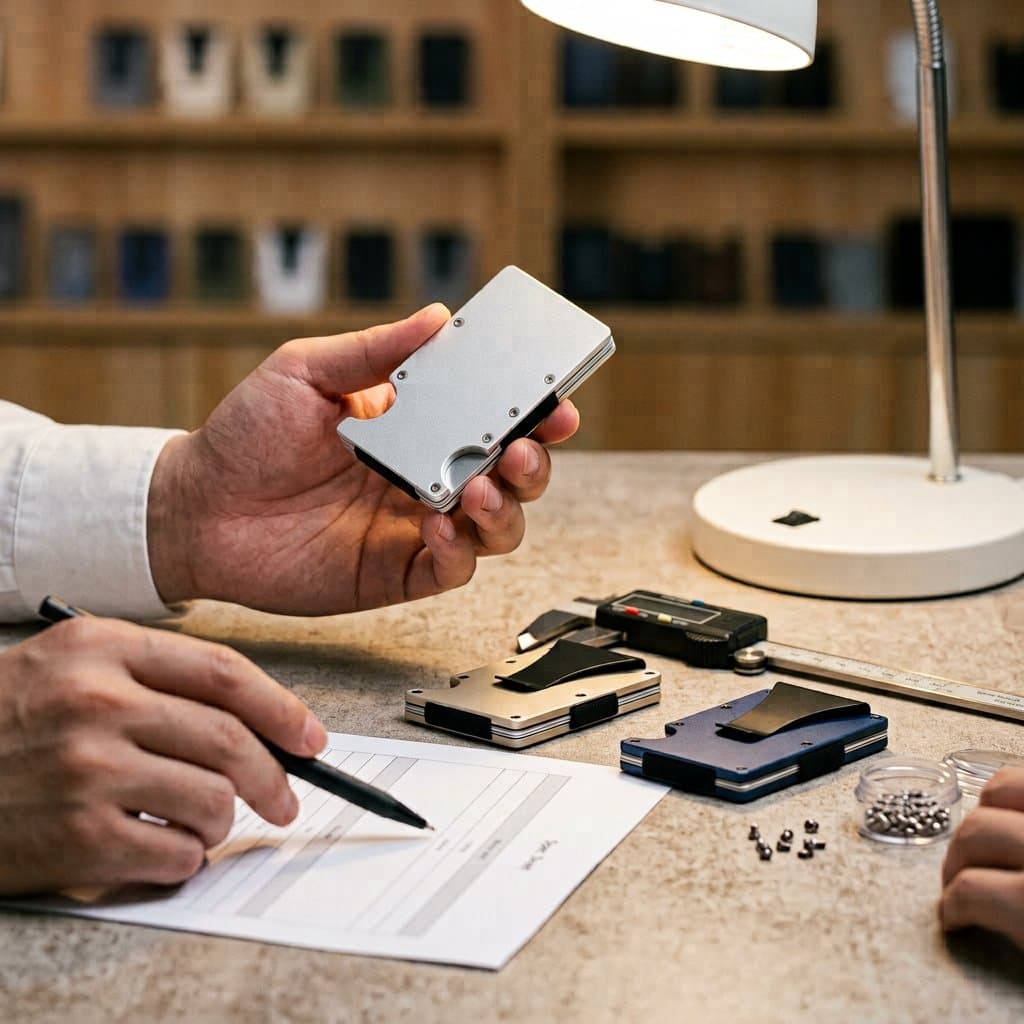
Card capacity is a balance. A minimalist wallet holds 4–6 cards. A "traveler" model holds 8–10. The key is how the wallet handles capacity: a good design distributes thickness evenly rather than bulging at the center. Quick-access mechanisms — thumb slots, pull-tabs, or spring-loaded dispensers — add convenience but also add failure points. A spring mechanism rated for 10,000 cycles sounds adequate, but heavy users will exceed that within two years.
Leather wallets live or die by their stitching. Thread should be nylon or bonded polyester — both resist rot and UV damage better than cotton. Stitch density matters: 6–8 stitches per inch is standard for durability; anything less suggests a cost-cutting factory. Edge painting should be smooth and even, with no cracks at flex points.
Hardware specifications are equally concrete. Zippers should be YKK or equivalent — the global benchmark for zipper reliability. Snaps must be rust-resistant; brass or stainless steel are safe choices. Magnetic closures are common but require care — a magnet strong enough to hold a wallet closed can demagnetize hotel key cards or damage magnetic strips on older credit cards.
A trained eye catches defects in seconds. Check edge alignment — the front and back panels should align within 0.5 mm. Examine stitching for uniformity; skipped stitches or loose tension indicate poor machine calibration. Hardware finish should be free of scratches or plating inconsistencies. Surface defects on leather — scars, holes, or color variation — should be minimal and positioned away from visible areas.
Card insertion and removal is the primary wear mechanism. Quality factories test to 10,000+ cycles. Drop tests from 1.5 meters onto concrete assess structural integrity. Flex tests — bending the wallet 500 times — reveal weak points in stitching or hinges. Ask the factory for their test reports. If they do not have them, that is a red flag.
Genuine leather has a distinct fiber structure visible under magnification. A water drop test — genuine leather absorbs moisture quickly, while bonded leather beads it up — is a quick field check. For aluminum wallets, request the alloy certificate. The difference between 6061 and 7075 affects both strength and price. Certifications to request include RoHS (restriction of hazardous substances) and REACH (chemical safety for EU markets).
China — specifically the Guangdong and Zhejiang provinces — dominates production of metal and hybrid front pocket wallets. The reason is the mature CNC machining supply chain. Shenzhen alone has thousands of precision machining shops serving the electronics and accessories industries. This ecosystem means shorter lead times for custom tooling and competitive pricing driven by intense local competition. Vietnam and India have growing leather goods industries, but their metal wallet capabilities lag. Turkey produces excellent full-grain leather goods but at higher price points.
When evaluating factories, look for in-house CNC machining rather than outsourced. Factories that outsource lose control over tolerances and lead times. In-house machining — combined with injection molding for plastic components and a dedicated leather workshop — indicates vertical integration, which translates to consistent quality and better pricing.
You provide designs and specifications; the factory executes. This model suits established brands with unique intellectual property. Expect MOQs of 500–1,000+ units. Lead times run longer due to tooling and prototyping. The advantage is exclusivity — no other retailer sells your exact design.
The factory adapts an existing design with your branding — color, logo, material choices. This is the fastest route to market for new entrants. MOQs can be as low as 100–300 units. Turnaround is quicker because the core design is proven. The trade-off: your competitors may source similar designs from the same factory.
Existing stock models shipped immediately. No customization, but the fastest logistics — often 3–7 days for air freight. This model works for testing a market or filling urgent stock gaps.
Choose OEM if you have a proven retail channel and need product differentiation. Choose ODM if you are entering the market and need speed with low risk. Choose off-the-shelf if you need inventory now and branding can wait.
The evaluation process should be systematic, not intuitive. Use this framework to compare factories objectively.
AQL (Acceptable Quality Limit) standards: AQL 2.5 for major defects is the industry norm for accessories. Factories should conduct final random inspection based on this standard.
Pre-shipment inspection: A third-party inspection report (SGS, Bureau Veritas) confirms the factory's QC claims.
Material certificates: RoHS, REACH, and specific material certifications (e.g., leather origin, aluminum alloy grade).
Sample approval process: The factory should provide pre-production samples for your sign-off before mass production begins.
Factories that cannot explain their QC process in specific terms.
A reluctance to provide material certificates or third-party inspection reports.
MOQs that fluctuate between conversations without justification.
Lead times that sound too good to be true — they usually are.
What is your AQL inspection standard, and can I request a third-party inspection?
Do you have RoHS and REACH documentation for the materials used?
What is your defect rate on comparable products over the past year?
Can you provide reference clients in my market segment?
What is your policy for defective units found after shipment?
The wallet industry does not have a single governing standard, but several certifications indicate quality:
ISO 9001: Quality management systems certification. Indicates the factory has documented processes.
BSCI (Business Social Compliance Initiative): Audits working conditions. Important for EU market compliance.
RoHS: Restricts hazardous substances. Mandatory for EU electronics but relevant for metal wallets with electronic components.
REACH: Regulates chemical safety in the EU. Relevant for leather treatment chemicals.
ISO 14443: Standard for contactless payment cards. Relevant for RFID testing claims.
A factory holding ISO 9001 and BSCI certifications demonstrates institutional quality control. Smaller factories may lack formal certifications but offer equivalent processes — verify through third-party audits.
The standards above are the baseline we work to at Gstar Technology (Shenzhen) Co., Ltd. Our position is simple: we have built our production system around the requirements that matter to professional buyers.
We operate with 13+ years of experience manufacturing RFID wallets, key organizers, and card holders. Our factory in Shenzhen runs in-house CNC machining, which means we control the tolerances that determine whether a card slides in smoothly or sticks after six months of use. We hold metal wallet dimensions to ±0.1 mm — a specification that directly affects product longevity and user satisfaction.
Our monthly production capacity exceeds 300,000 units. That volume is not just about scale — it is about stability. Wholesalers and online sellers need consistent replenishment, not one-off production runs. Our location in Shenzhen gives us direct access to raw material supply chains — aluminum stock, full-grain leather, RFID shielding fabric — and proximity to major shipping ports for efficient logistics.
For OEM and ODM projects, we provide Design for Manufacturing (DFM) feedback during the engineering phase. This means we flag potential production issues before they become expensive problems. If a design element is difficult to machine or will increase cost without adding value, we tell you upfront. Our sampling process takes 7–10 days; mass production runs 20–30 days depending on complexity.
Quality assurance follows AQL 2.5 inspection standards, with pre-shipment sample approvals and RoHS/REACH documentation for EU and US markets. Our MOQs are flexible — we work with both startups testing their first product and established brands scaling production.
There is a trade-off worth acknowledging: factory-direct pricing from Shenzhen is competitive, but it is not the cheapest option globally. Lower-cost production exists in less mature manufacturing regions. Buyers who choose us pay for consistency, transparent communication, and a production partner who understands that a returned wallet costs more than a manufactured one.
If you are evaluating manufacturers for your next front pocket wallet line, we welcome you to review our capabilities and start a conversation. Contact Our Team to discuss your project specifications.
A front pocket wallet should be under 1.5 cm thick, hold 4–8 cards, and be made of full-grain leather or CNC-machined aluminum. RFID blocking is recommended for urban users. These features are the baseline specification when sourcing.
Brand rankings change yearly, and most top brands source from specialized OEM factories in China. For B2B buyers, the "best brand" is the one whose product specifications, supply chain reliability, and pricing match their target market. Evaluate manufacturers, not just consumer labels.
High-net-worth individuals typically prefer minimalist, high-quality leather wallets or custom metal cardholders. The common thread is craftsmanship and material integrity, not logos. This signals demand for premium materials — full-grain vegetable-tanned leather, titanium — and precise finishing.
The question reflects a growing niche: physical wallets with hidden compartments designed to store hardware crypto keys or seed phrase backup plates. These require precision metal machining and custom compartment design. If exploring this niche, seek a manufacturer with experience in both CNC machining and security-conscious product design.
MOQ varies by product type. ODM (customizing an existing design) can be as low as 100–300 units. Full OEM (new design) typically ranges from 500–1,000 units. Factories with in-house tooling and CNC capabilities often offer more flexible MOQs because they control their production costs.
Sampling takes 7–15 days, including design review and revisions. Mass production requires 20–35 days depending on volume and material availability. Shipping to the US or EU adds 10–20 days by sea or 3–7 days by air.
The "best front pocket wallet" is not a single product — it is a specification that matches your market. A premium leather hybrid suits a luxury retail channel. A CNC-machined aluminum model fits a tech-focused audience. An entry-level nylon option captures budget-conscious buyers.
Choose the premium hybrid if you target customers who value craftsmanship and will pay $50+ retail. Choose aluminum if your audience prioritizes durability and modern aesthetics. Choose an ODM model if you need market entry within weeks. Choose full OEM if you have the volume to justify exclusivity.
The manufacturing partner determines product consistency, cost structure, and market readiness. Evaluate factories on material certifications, QC processes, and production capacity — not on sample quality alone. A beautiful sample from a factory without quality systems is a gamble.
American Chiropractic Association. "Wallet Health: Preventing Back Pain." https://www.acatoday.org/patients/health-wellness-information/wallet-health/
ISO 14443: Contactless Payment Card Standard. International Organization for Standardization. https://www.iso.org/standard/73598.html
RoHS Directive 2011/65/EU. European Commission. https://environment.ec.europa.eu/topics/waste-and-recycling/rohs-directive_en
REACH Regulation (EC) No 1907/2006. European Chemicals Agency. https://echa.europa.eu/regulations/reach/understanding-reach
ISO 9001:2015 Quality Management Systems. International Organization for Standardization. https://www.iso.org/iso-9001-quality-management.html
AQL (Acceptable Quality Limit) Sampling Standards. https://aqldatabase.com/


