

Views: 587 Author: Professor Leon Publish Time: 09-01-2026 Origin: Site


Content Menu
● 1. How to Source the Best RFID Wallet for Your Brand: A Manufacturer's Guide
● 2. What Is an RFID Wallet and How Does It Work?
● 3. What Materials Actually Block RFID Signals?
● 4. How Do You Test Whether an RFID Wallet Actually Blocks?
● 5. What Are the Best RFID Wallet Designs for Different Markets?
● 6. How to Evaluate RFID Wallet Suppliers: A Procurement Framework
● 7. Key Quality Indicators for RFID Wallet Buyers
● 8. Understanding Wallet Materials and Construction: What Affects Quality
● 9. Relevant Industry Standards and Certifications
● 10. How to Choose Between ODM and OEM Partnerships
● 11. Common Questions Buyers Ask
● 12. Our Manufacturing Approach at GSTAR
● 13. Ready to Start Your Sourcing Project?
11 min read
When a buyer opens a returned "RFID blocking" wallet and holds it up to a card reader—only to hear the beep of a successful scan—they learn the hard way that not all shielding is equal. The market is flooded with wallets that claim protection but fail at the one job they exist to do.
For B2B buyers, the stakes are different than for individual consumers. A consumer buys one wallet. A brand owner orders 5,000 units and lives with the consequences of every material and manufacturing decision for years. High return rates, warranty claims, and damaged brand reputation trace back to choices made at the sourcing stage.
This guide breaks down what actually separates a quality RFID wallet from a decorative one. We will cover the materials, the testing standards, and the supplier evaluation framework that protects your margin and your brand name.
An RFID wallet is a card holder designed to block radio-frequency identification signals from being read remotely. It prevents unauthorized scanning of credit cards, debit cards, passports, and ID cards that use contactless technology.
Most payment cards and passports operate at 13.56 MHz (High Frequency, HF) using the ISO 14443 standard. An RFID-blocking wallet creates a barrier—either through metal construction or a metallic lining—that attenuates the radio signal before it reaches the card. When the signal drops below a certain threshold, the reader cannot communicate with the card's chip.
Three main construction types dominate the market:
| Type | Shielding Method | Typical Price Range | Primary Risk |
|---|---|---|---|
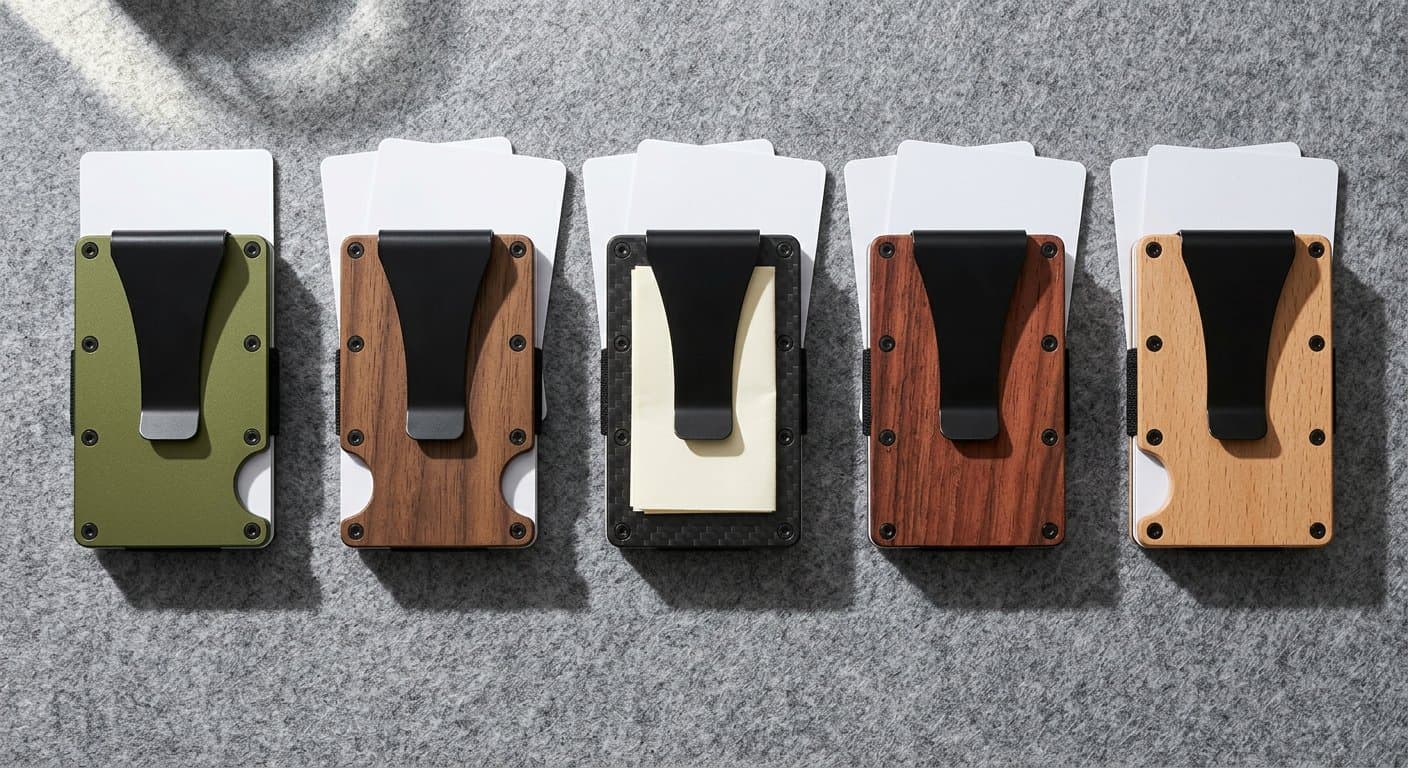
| Aluminum/Carbon Fiber | Inherent Faraday cage effect | $25–$60 | Edge durability, card fit tolerance |
| Leather with Metallic Lining | Woven copper/nickel mesh interlayer | $40–$120 | Lining cracking after repeated bending |
| Plastic/TPU with Mesh Insert | Embedded metallic fabric | $10–$25 | Mesh degradation, cheap feel |
The "best RFID wallet" is not a single product. It is the one whose construction matches your target customer's expectations. A minimalist aluminum wallet at $45 and a full-grain leather bifold at $110 both qualify—they serve different customers.
Aluminum blocks RFID signals inherently. The metal structure acts as a Faraday cage, disrupting electromagnetic fields. This is why aluminum wallets don't need additional shielding layers.
Carbon fiber behaves similarly, though its conductivity is lower than metal. Most carbon fiber wallets still incorporate a metal layer for reliable blocking.
Leather is transparent to RFID signals. A leather wallet only blocks when the manufacturer inserts a metallic lining—typically woven copper or nickel mesh—between the outer leather and the inner card pocket. The quality of this lining determines real-world performance.
The critical failure point in leather RFID wallets is the metallic lining itself. Cheaper manufacturers spray a conductive coating onto fabric instead of weaving metal fibers into it. After 300–500 bends, sprayed coatings crack and lose conductivity. The wallet stops blocking without showing any visible wear.
Woven metallic mesh costs more but survives thousands of flex cycles. When evaluating suppliers, ask specifically: "Is your lining woven or coated?" The answer predicts your return rate better than any other single question.
Aluminum wallets also split into quality tiers based on manufacturing method:
CNC Machined: Cut from solid aluminum blocks. Precise tolerances (±0.1mm), clean edges, consistent card fit. Higher cost per unit.
Stamped/Formed: Pressed from aluminum sheets. Cheaper, but edges may be sharp or inconsistent. Tolerances vary more between units.
For a "best RFID wallet" claim, CNC machining is the standard. Stamped frames work for budget lines but expect more quality variance in production runs.
Testing is straightforward at the basic level. Place a programmable RFID card inside the wallet. Hold a standard reader 2–3 cm away and attempt to scan. If the reader cannot detect the card, the wallet blocks effectively.
For bulk orders, demand more rigor.
Professional testing measures signal attenuation in decibels (dB). The industry benchmark is a minimum of -40 dB attenuation at 13.56 MHz. Some premium wallets achieve -60 dB or better.
Key standards to reference:
ISO 14443: The standard for proximity cards used in payment and identification
EN 13757-1: Communication systems for meter reading (often used as a testing reference)
ASTM D4935: Standard test method for electromagnetic shielding effectiveness
Request a test report from your supplier that specifically shows attenuation at 13.56 MHz. A report that only tests lower frequencies (125 kHz) is insufficient—your customers' payment cards operate at HF, not Low Frequency.
A wallet can have excellent shielding material and still fail. Signal leaks occur at seams, stitching holes, and closure gaps. If the metallic lining has gaps where the leather folds, the signal escapes.
Quality manufacturers test finished products, not just raw materials. Ask suppliers whether they conduct finished-product testing on random samples from each production batch.
Imperfect insight: A -40 dB attenuation rating does not mean the wallet is useless if it drops to -30 dB after a year of use. Real-world performance degrades. The best protection is specifying a higher initial attenuation so the wallet remains effective after normal wear.
Design choice affects both manufacturing cost and customer satisfaction. Different market segments respond to different form factors.
These dominate online sales. Slim profile, 4–8 card capacity, often with a money clip or elastic band. They appeal to urban professionals who carry minimal items.
Sourcing priorities: CNC tolerances (cards must fit snugly but not too tightly), anodizing quality (color must not fade), and hinge durability for flip-open designs.
Traditional aesthetics, multiple compartments, and a professional appearance. Higher price point, higher perceived value. Customers expect these to last 5+ years.
Sourcing priorities: Full metallic interlayer (not spray coating), edge painting quality, stitching tension consistency. Leather wallets fail most often at the edges and stitching—not the RFID function.
Metal frames combined with leather sleeves, or wallets with integrated tracking cards. These target tech-savvy customers willing to pay premium prices.
Sourcing priorities: Assembly complexity, PCB sourcing for smart cards, and quality control across multiple material types in one product.
Pop-up (trigger) mechanisms use moving parts. They are satisfying to use but introduce failure points. Springs break, triggers jam. Every moving part is a potential warranty claim.
Pull-out (slit) designs use friction to hold cards. Fewer moving parts means fewer failures. The trade-off is less convenient access to cards.
For a brand concerned about post-sale support, friction-based designs typically generate fewer returns. The "best RFID wallet" for your bottom line may not be the flashiest option.
Finding the right factory requires more than comparing prices. Use this framework to assess supplier capability.
Some "manufacturers" are actually trading companies that assemble components from various sources. They can produce samples, but quality control is fragmented.
Ask these questions:
Do you own the production facility, or do you outsource?
Which production steps do you handle in-house?
Can you show factory floor photos or a video tour?
In-house production matters because it centralizes quality control. When CNC machining, anodizing, and assembly happen under one roof, defects are caught earlier.
A serious supplier can provide:
Raw material certificates for aluminum or leather
RFID attenuation test reports at 13.56 MHz
Anodizing thickness specifications
Leather grade certifications
If a supplier cannot produce these documents, they likely do not test their products. Move on.
The difference between A-grade and B-grade inventory is quality control. Ask about:
In-line inspection during production
Final random inspection using AQL (Acceptable Quality Limit) standards
Anodizing color consistency checks
Common QC failures: anodizing color variation between batches, uneven leather edge painting, and inconsistent card slot widths. These defects drive customer returns.
A supplier that offers both custom OEM and stock ODM programs gives you flexibility:
Stock ODM: Select an existing design, add your logo. Lower MOQ, faster turnaround. Good for market testing.
Custom OEM: Provide your own design or CAD files. Higher MOQ due to tooling costs. Good for differentiated products.
Red flag: Suppliers requiring huge minimums for simple private-label orders may be inefficient or overbooked.
Production time for RFID wallets typically runs 15–25 days for stock designs and 30–45 days for custom OEM work. Add 20–30 days for ocean freight.
A supplier promising impossibly fast turnaround may cut corners—skipping adhesive curing times or rushing anodizing baths. Both lead to premature product failure.
Build your supplier scorecard around these measurable factors:
Cards should slide in and out smoothly without being loose. Loose cards fall out; tight cards are frustrating. For aluminum wallets, CNC tolerance of ±0.1mm ensures consistency. For leather, the stitching pattern and pocket width determine fit.
The wallet must block not just on day one, but after 1,000 uses. Ask suppliers how they test long-term durability. Have they flex-tested leather linings? Have they stress-tested pop-up mechanisms?
Aluminum: Anodizing should be uniform. Check for color variation between units in the same batch.
Leather: Edge painting should be smooth and even. Stitching should be tight with no loose threads.
Plastic: No visible mold lines or rough edges.
The "best RFID wallet" for most customers is slim. Bulky wallets fail in the market regardless of RFID function. Check that the design doesn't exceed reasonable dimensions for its card capacity.
Beyond RFID blocking, material quality determines whether your product survives contact with the customer.
Aerospace-grade aluminum (6061-T6 or similar) resists bending and scratching. Cheaper alloys may dent or warp. When sourcing, ask which aluminum grade the supplier uses. This is not a trivial detail—it affects both durability and machining quality.
Full-grain leather is the top tier—the hide's outermost layer with natural markings intact. It develops a patina over time and lasts decades with proper care. Top-grain leather is sanded to remove imperfections, making it thinner and less durable. Genuine leather is a lower grade with a coated finish.
A quality leather RFID wallet has several layers:
Outer leather (aesthetic surface)
Metallic shielding layer (woven mesh)
Inner lining (protects cards and hides the mesh)
The adhesive bonding these layers must cure fully. Rushed production means layers separate over time—a common failure in cheap leather RFID wallets.
Imperfect insight: Full-grain leather is not always the right choice. For customers who prefer a uniform, flawless finish, top-grain leather—with its imperfections sanded away—may actually serve better. The "best" leather is the one that matches your customer's aesthetic preference, not the objectively highest grade.
When evaluating suppliers, request compliance documentation for:
| Standard | Purpose |
|---|---|
| ISO 14443 | Contactless card communication protocol |
| ISO 9001 | Quality management systems |
| REACH | EU chemical safety compliance |
| RoHS | Restriction of hazardous substances |
| Proposition 65 | California chemical disclosure |
These certifications indicate a supplier's commitment to quality and regulatory compliance. They are not optional for brands selling into regulated markets.
Choose ODM if:
You are entering the RFID wallet market for the first time
You want to test demand before committing to custom tooling
Your brand differentiation comes from marketing, not product design
You need low MOQs for initial market entry
Choose OEM if:
You have a unique design or mechanism
You need specific material combinations not in the supplier's catalog
You plan large production runs and want exclusive designs
Your brand competes on product innovation
Most successful brands start with ODM to validate the market, then move to OEM once they understand what sells. This phased approach reduces risk.
For B2B buyers, focusing on consumer brands misses the point. The "best" brand is the one you build on top of a reliable manufacturing base. Working directly with a factory eliminates retail markup and lets you control quality, pricing, and brand identity.
Aluminum and carbon fiber block inherently due to their conductive properties. Leather requires a woven metallic mesh interlayer. The best choice depends on your target price point and aesthetic. There is no universally "best" material—only the right fit for your market segment.
Request their test reports. Specifically, ask for attenuation testing at 13.56 MHz. If the supplier can't produce this documentation, they probably haven't tested. Consider having a third-party lab verify a sample from your production batch.
In leather wallets, sprayed-on conductive coatings crack after repeated bending. In metal wallets, the issue is usually structural—a hinge or closure gap that appears after wear. Quality construction minimizes both failure modes.
No. RFID blocking creates a passive barrier. It does not damage the card's chip or magnetic stripe. Cards function normally when removed from the wallet.
As a manufacturer with 13+ years in metal and leather fabrication, we built our production lines to address the specific failure points this guide has covered.
Our approach to the best RFID wallet starts with in-house CNC machining. We control aluminum wallet tolerances to within ±0.1mm, ensuring cards fit securely without stretching the housing over time. For leather lines, we use a woven copper-impregnated lining—not a sprayed coating—and test it specifically for 13.56 MHz attenuation.
Our monthly capacity of 300,000 units lets us offer flexible MOQs for market testing while scaling up for national retail distribution. We support both OEM and ODM partnerships. Our engineering team handles custom Pantone color matching for anodized metal and custom stitching patterns for leather, so your product stands apart from generic stock.
We measure our success by your return rate. Every design decision and material specification we recommend is aimed at reducing post-sale failures.
The best RFID wallet is not a single product. It is the combination of reliable materials, verified blocking technology, and a manufacturing partner who executes consistently at scale.
Whether you are launching a minimalist aluminum line or a premium leather collection, your success depends on the supply chain behind it. We are happy to review your drawings or suggest our best-selling stock designs for private labeling.
Or Contact Our Team to discuss your project requirements. We respond within 24 hours.
ISO 14443 Standard Overview — International Organization for Standardization. https://www.iso.org/standard/73531.html
EN 13757-1 Communication Systems for Meter Reading — European Committee for Standardization. https://standards.cencenelec.eu/
ASTM D4935 Standard Test Method for Measuring Shielding Effectiveness — ASTM International. https://www.astm.org/d4935-18.html
RFID Blocking Technology Fundamentals — RFID Journal. https://www.rfidjournal.com/
ISO 9001 Quality Management Systems — International Organization for Standardization. https://www.iso.org/iso-9001-quality-management.html


