

Views: 375 Author: Professor Leon Publish Time: 08-21-2026 Origin: Site


Content Menu
● 1. What Is an AirTag Wallet?
● 2. How Thick Is an AirTag Wallet by Design Type?
● 3. How Material Choice Affects Thickness
● 4. AirTag Wallet vs. Regular Wallet: The Thickness Delta
● 5. Manufacturing Tolerances: What Buyers Should Specify
● 6. How to Evaluate AirTag Wallet Suppliers
● 7. Production Process: From Raw Material to Finished Wallet
● 8. Quality Control: Multi-Stage Inspection for Dimensional Accuracy
● 9. Customization and OEM/ODM Options
● 10. Certifications and Industry Standards
● 11. Ordering Process: MOQ, Lead Time, and Shipping
13 min read
When a procurement manager opens a sample box from a new supplier, the first thing they check is rarely the stitching or the logo. They reach for calipers. Because in the AirTag wallet category, thickness is the specification that determines everything else — pocket comfort, card capacity, signal reliability, and ultimately, whether the product sells or sits in a warehouse.
Most AirTag wallets measure between 8mm and 18mm in total thickness. That range is wider than most buyers expect. The variance comes from material selection, construction method, and whether the AirTag sits in a simple sleeve or a spring-loaded compartment.
This guide breaks down the thickness specifications by design type, explains how materials shift those numbers, and provides the technical framework buyers need when evaluating suppliers.
An AirTag wallet is a cardholder or billfold with a dedicated, integrated compartment designed to house an Apple AirTag. Unlike attaching an AirTag to a keychain, the wallet form factor keeps the tracker discreet and protected.
The core functionality relies on two wireless technologies. Bluetooth Low Energy (BLE) provides the connection to nearby Apple devices. Ultra-Wideband (UWB) enables precision finding — the directional arrow that guides you to within a few centimeters. Both signals must penetrate the wallet material to reach the Find My network.
Thickness directly affects this. A wallet built with dense leather layers or a continuous metal shell can attenuate the RF signal. Manufacturers typically test signal transparency at thicknesses between 10mm and 15mm to confirm the AirTag remains locatable at standard distances (10–15 meters indoors).
The answer depends on which design category you are sourcing. Each construction approach produces a different thickness profile.
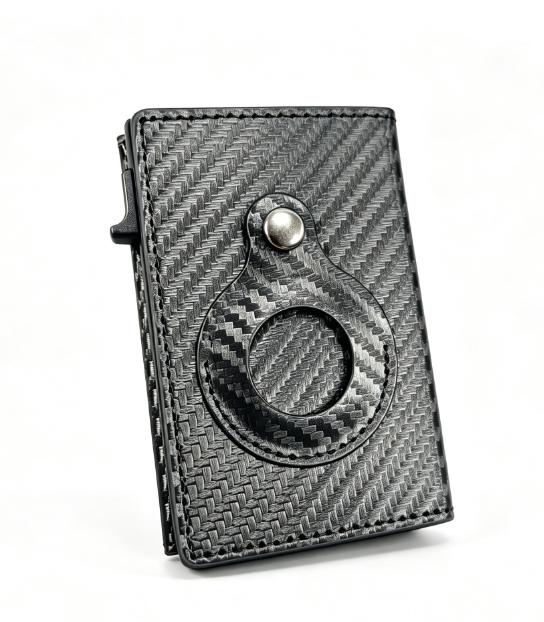
The thinnest option. A cardholder uses one or two flat card pockets with the AirTag seated in a dedicated external sleeve or a recessed internal slot.
Typical thickness: 8–12mm
Card capacity: 4–6 cards
AirTag concealment: Partial — a visible bump or outline is common
Best for: Front-pocket users, minimalist buyers, budget product lines
The trade-off is straightforward. You get a slim profile, but the AirTag is often visible as a raised contour on the back or edge. Some designs solve this with a cut-out window that shows the white AirTag face — a deliberate aesthetic choice that also improves signal.
The mid-range option. A bifold uses a folded construction with the AirTag slot integrated near the center or along one panel.
Typical thickness: 12–15mm
Card capacity: 6–10 cards
AirTag concealment: Good — the tracker is hidden between folded layers
Best for: Mainstream retail, gift purchases, users replacing a standard bifold
Compare this to a regular leather bifold, which measures 8–10mm empty and 12–15mm when loaded. The AirTag adds 3–5mm of effective thickness because the device itself is 7.8mm in diameter and 8mm tall.
The thickest category. CNC-machined aluminum shells with sliding or hinged card compartments.
Typical thickness: 14–18mm
Card capacity: 4–8 cards (depending on mechanism)
AirTag concealment: Excellent — fully enclosed
Best for: Premium positioning, protective-case users, buyers who prioritize durability over slimness
Metal wallets are heavier and bulkier. They also introduce RF challenges. A fully enclosed aluminum shell can block the AirTag signal entirely unless the design includes a signal window — typically a plastic insert or a cut-out on the rear panel.
| Design Type | Thickness Range | Card Capacity | AirTag Concealment | Typical Materials |
|---|---|---|---|---|
| Cardholder / Slip | 8–12mm | 4–6 cards | Partial (visible bump) | PU leather, thin metal, carbon fiber |
| Bifold / Traditional | 12–15mm | 6–10 cards | Good (hidden between layers) | Full-grain leather, synthetic leather |
| Metal / Aluminum Armored | 14–18mm | 4–8 cards | Excellent (fully enclosed) | CNC aluminum, stainless steel |
| Hybrid (Leather + Core) | 10–13mm | 6–8 cards | Good | Leather exterior, plastic or metal core |
Material selection is the primary driver of thickness variation. Buyers comparing quotes from different suppliers must understand how each material stacks up.
Full-grain leather runs 2.0–3.0mm per layer. A bifold needs at least four layers (two exterior, two interior), plus lining that adds another 1–2mm. That puts a leather bifold at 10–14mm before the AirTag compartment is even added.
Synthetic leather (PU) is thinner at 1.0–1.5mm per layer. A PU cardholder can achieve 8–9mm total thickness. The trade-off is durability — PU leather cracks and peels faster than full-grain.
Buyer tip: When requesting specs from suppliers, ask for the "finished thickness" of the assembled wallet, not the raw hide thickness. The difference can be 3–5mm once lining, stitching, and the AirTag pocket are added.
CNC-machined aluminum panels typically run 1.2–2.0mm per shell panel. A two-panel clamshell design with interlocking rails or a sliding mechanism adds another 2–4mm of structural depth.
Metal wallets are consistent. Machining tolerances of ±0.1mm mean every unit from a production run has the same thickness. This is a quality advantage — leather naturally varies by 0.5–1.0mm between hides.
Carbon fiber layers are thin at 0.8mm, but achieving structural rigidity requires multiple layers. A carbon fiber cardholder lands at 10–13mm total.
Hybrid designs — leather exterior bonded to a plastic or aluminum core — offer a middle ground at 10–12mm. These are increasingly popular for OEM programs because they balance the premium feel of leather with the structural consistency of a rigid core.
A standard leather bifold measures 8–10mm empty. Load it with 6–8 cards and it expands to 12–15mm. An AirTag wallet starts at 10mm and goes up to 18mm depending on design.
The key insight for product developers: the AirTag adds 3–5mm of effective thickness. This is non-negotiable. The device itself is 8mm tall, and it needs at least 1–2mm of material around it for protection and retention.
Consumer perception data suggests 15mm is the comfort threshold for most buyers. Above 18mm, wallets are considered bulky and get negative reviews about pocket fit. Below 10mm, the AirTag is usually exposed or the card capacity is too limited for practical use.
Thickness is not just a design decision — it is a manufacturing specification that requires tolerance control.
For metal AirTag wallets, the industry standard is ±0.1mm for CNC-machined parts. This level of precision ensures the AirTag fits snugly without rattling, and that card slots hold cards firmly without being too tight.
Why it matters: A tolerance of ±0.3mm or worse leads to loose AirTag fit in some units and impossible card removal in others. Inconsistent thickness across a production batch is a common source of customer complaints and returns.
For plastic and hybrid designs, injection molding typically achieves ±0.2mm. This is adequate for most AirTag wallet designs, but buyers should verify that the mold design includes proper draft angles and gate placement to avoid warpage.
The retention system directly affects thickness. Friction-fit slots add minimal bulk (1–2mm). Spring-loaded holders or magnetic plates add 2–3mm. Cut-out windows that expose the AirTag face allow the thinnest profile while actually improving signal transmission.
Any wallet over 12mm thick should be tested for signal attenuation. The test protocol is straightforward: place the AirTag in the wallet, walk 10–15 meters away, and verify the Find My network still reports the location. For metal wallets, test with the compartment closed — a fully sealed aluminum shell will block the signal completely.
B2B buyers need a structured evaluation framework. Here is what to check before committing to a supplier.
What is the finished thickness tolerance? The answer should be ±0.1mm for metal, ±0.2mm for plastic. Anything looser means inconsistent quality.
Can you provide 3D drawings (STEP/IGES files) with the thickness specification? Reputable suppliers share CAD files before sampling.
What is your RF signal test protocol? The supplier should have a documented procedure for verifying AirTag connectivity through the finished wallet.
What is your MOQ and lead time for a custom thickness variant? Custom thickness requires new tooling or CNC programming — confirm the cost and timeline.
Do you test AirTag retention? Ask about drop tests (1.2m) and vibration tests that verify the AirTag does not eject during normal use.
Cannot state their tolerance specifications in writing. If a supplier says "we make it good" without numbers, they do not control their process.
Quote a thickness range wider than ±0.5mm for a single SKU. That is not a specification; it is a guess.
Have no RF testing capability. For metal wallets, this is a dealbreaker — the product will fail in the field.
Refuse to share DFM (Design for Manufacturing) feedback before sampling. A good supplier will flag design issues that affect thickness, card capacity, or signal performance before you spend money on tooling.
Choose a cardholder design (8–12mm) if: your target market prioritizes slimness, your retail price point is under $30, or your customers carry fewer than 6 cards.
Choose a bifold design (12–15mm) if: you are targeting mainstream consumers replacing a standard bifold, or you need 6–10 card capacity.
Choose a metal armored design (14–18mm) if: you are positioning a premium product above $50, your brand emphasizes durability, or your customers want maximum protection for the AirTag.
Understanding the manufacturing steps helps buyers identify where thickness variation can creep in.
For a CNC-machined aluminum AirTag wallet, the process is:
Billet cutting: Aluminum stock is cut into blanks slightly larger than the final part.
CNC machining: The blanks are milled to final dimensions, including the AirTag compartment, card slots, and any interlocking rails. Tolerance is held at ±0.1mm.
Deburring and surface finishing: Edges are smoothed, and the surface is brushed, blasted, or anodized. Anodizing adds 0.02–0.05mm — negligible but real.
Assembly: The two panels are joined with hinges, slides, or a friction fit. The AirTag compartment is tested for fit.
Functional testing: Each unit is checked for AirTag insertion/removal, card fit, and RF signal through the closed wallet.
Packaging: Units are individually wrapped and boxed.
For leather wallets, the process differs:
Cutting: Leather hides are die-cut to pattern.
Skiving: Edges are thinned to reduce bulk at fold points.
Stitching: Panels are sewn together. The AirTag pocket is stitched in place.
Edge painting or burnishing: Finishing the edges.
Final inspection: Thickness is verified with calipers at multiple points.
The lesson for buyers: thickness is controlled at the machining or cutting stage, but verified at the final inspection stage. Ask suppliers for their inspection protocol — specifically, how many points on the wallet are measured and what the acceptable deviation is.
Dimensional consistency is the hallmark of a reliable AirTag wallet manufacturer. Quality control should include:
Incoming material inspection: Verify that raw materials (aluminum, leather, plastic) meet thickness specifications before production begins.
In-process checks: During CNC machining, sample parts are measured at regular intervals to ensure the tooling has not worn and tolerances remain within ±0.1mm.
Final inspection: Every batch undergoes thickness gauge verification. For a 1,000-unit order, a typical AQL (Acceptable Quality Limit) inspection samples 80–125 units, measuring thickness at 3–5 points per wallet.
Functional testing: AirTag insertion and removal cycles (typically 50–100 cycles) to confirm the retention mechanism does not loosen over time. Drop testing from 1.2m onto concrete to verify the AirTag does not eject.
RF signal verification: A sample from each batch is tested to confirm the Find My network can locate the wallet at 10–15 meters.
For brands sourcing AirTag wallets, customization typically involves:
Thickness specification: Adjust the design to hit a target thickness (e.g., 10mm for a slim line, 16mm for an armored line).
Material selection: Full-grain leather, PU leather, aluminum, carbon fiber, or hybrids.
Card capacity: 4, 6, or 8-card configurations.
AirTag retention: Friction slot, spring-loaded holder, magnetic plate, or cut-out window.
Branding: Logo embossing, debossing, or metal badge attachment.
Packaging: Custom boxes, inserts, and retail displays.
A competent OEM partner provides DFM feedback before tooling. This means reviewing the design for manufacturability — flagging wall thicknesses that are too thin for CNC machining, card slots that are too tight for standard card sizes, or AirTag compartments that will not retain the device securely.
While there is no universal "AirTag wallet" certification, buyers should look for:
ISO 9001: Quality management system certification for the manufacturing facility.
FCC / CE / RoHS: Required for any product containing electronic components or sold in regulated markets. The wallet itself may not need these, but the AirTag is an electronic device and the wallet must not interfere with its operation.
Material certifications: For leather, REACH compliance (EU) and Proposition 65 compliance (California) for chemical safety. For aluminum, confirmation of the alloy grade (typically 6061 or 7075 for CNC parts).
RF testing reports: Verification that the wallet does not attenuate the AirTag signal beyond acceptable limits.
For B2B buyers, the ordering process follows a standard path:
Inquiry and specification: Submit your design files or describe your requirements (thickness, material, capacity, branding).
DFM review and quotation: The supplier reviews the design for manufacturability and provides a quote within 24–48 hours.
Sampling: Pre-production samples are created and shipped for approval. This is the critical stage for verifying thickness, card fit, and AirTag retention.
Tooling and production: Once samples are approved, tooling (if required) is commissioned, and mass production begins.
Inspection: Batch inspection is performed before shipment, with photos and reports shared with the buyer.
Shipping: Goods are shipped via air or sea, depending on order size and urgency.
Typical lead times: 10–15 days for sampling, 20–30 days for mass production after sample approval, plus shipping time.
---
As a manufacturer with 13+ years in RFID wallet and cardholder production, our approach to thickness control is straightforward: we build it into the process, not just the spec sheet.
Our in-house CNC machining gives us direct control over wall thickness tolerances at ±0.1mm on aluminum AirTag wallets. We do not outsource this step, which means we can adjust thickness specifications without coordination delays across multiple vendors. When a client needs a 10mm slim cardholder or a 16mm armored model, we program the tool path and machine it.
Our mold-making team supports plastic and hybrid leather designs, achieving ±0.2mm consistency through injection molding. Monthly production capacity of 300,000+ units allows scaling from pilot runs of 500 pieces to mass production of 50,000+ without changing the dimensional quality.
Quality control is multi-stage. Every batch undergoes thickness gauge verification. We perform functional tests — AirTag insertion/removal cycles, drop tests from 1.2m, and RF signal verification at 10–15 meters — before shipment. Our inspection protocol follows ISO 9001-type procedures, with AQL sampling on orders above 1,000 units.
For OEM and ODM projects, we provide DFM feedback within 24 hours of receiving your design. This means we flag thickness issues, retention mechanism concerns, or material choices that could affect signal performance before you commit to tooling. We support private label programs with flexible MOQs, making it practical to test new thickness variants without committing to large volumes.
Ready to source AirTag wallets with precise thickness control? Contact Our Team to discuss your specifications and receive a custom quote.
---
What are the disadvantages of AirTag?
The main disadvantages are privacy concerns (the tracker can be used for stalking), battery replacement every 8–12 months (CR2032, user-replaceable), and potential signal interference when the AirTag is enclosed in thick metal or dense leather wallets. For buyers, the signal interference issue is the most relevant — it is a design problem that must be solved at the manufacturing stage.
Is AirTag a monthly fee?
No. AirTag has no subscription fee. The Find My network is free to use. The only ongoing costs are replacement batteries and optional accessories. This is a selling point — the upfront cost of the wallet plus the AirTag is the total cost of ownership.
Is an AirTag wallet a good idea?
Yes, for users who misplace their wallets. The AirTag enables location tracking via the Find My network. The trade-off is a 3–5mm increase in wallet thickness compared to standard designs. For buyers, the question is whether the target market values the tracking capability enough to accept the added bulk. Data suggests they do — the category continues to grow.
What is the point of having an AirTag?
The AirTag allows you to locate your wallet through the Apple Find My network using Bluetooth and Ultra-Wideband. When the wallet is out of Bluetooth range, the Find My network uses other Apple devices to anonymously report its last known location. This is the core value proposition of the AirTag wallet category.
How thick is the thinnest AirTag wallet available?
The thinnest designs measure approximately 8mm. These are typically cardholder styles with a recessed AirTag slot and minimal material around the device. Below 8mm, the AirTag protrudes or the wallet lacks structural integrity.
Can a thick wallet block the AirTag signal?
Yes. Full-metal enclosures or dense leather layers above 15mm can attenuate the Bluetooth signal. Reputable manufacturers test RF transparency during development. If you are sourcing a metal wallet, confirm the design includes a signal window — a plastic insert or cut-out on the rear panel.
What is the standard thickness tolerance for OEM AirTag wallets?
The industry standard is ±0.1mm for CNC-machined metal parts and ±0.2mm for injection-molded plastic parts. These tolerances ensure consistent AirTag fit, card slot function, and overall product quality across a production run.
---
Choose a cardholder design if your customers prioritize slimness. Choose a bifold if you need mainstream appeal and higher card capacity. Choose a metal armored design if you are building a premium brand around durability and protection.
The specification that ties all three together is thickness — and it is the one specification you should verify before committing to any supplier.
Apple Support. "Find items with AirTag." https://support.apple.com/en-us/HT211227
Apple Technical Specifications. "AirTag." https://www.apple.com/airtag/specs/
International Organization for Standardization. "ISO 9001:2015 Quality management systems." https://www.iso.org/standard/62085.html
UL Solutions. "What is REACH compliance?" https://www.ul.com/resources/


