

Views: 477 Author: Professor Leon Publish Time: 08-21-2026 Origin: Site


Content Menu
● 1. Why the AirTag Wallet Is a Distinct Product Category
● 2. Material Selection: Leather, Metal, and Durability
● 3. How to Evaluate AirTag Wallet Suppliers
● 4. Production Methods: OEM, ODM, and Customization
● 6. Logistics, Lead Times, and After-Sales Support
● 7. Partnering with a Specialized Manufacturer
● 8. Choosing the Right Partner: A Decision Guide
9 min read
A buyer in Shenzhen once told me the hardest part of sourcing an AirTag wallet is finding a factory that treats the AirTag slot as an engineering problem, not a sewing task. A leather pouch with a circle cut out of it will fail. The AirTag is 31.9mm in diameter and 8mm thick. If the pocket is 1mm too loose, the tracker rattles. If it is 1mm too tight, the leather stretches permanently within weeks. Wholesale buyers need to evaluate suppliers on this kind of tolerance, not on marketing photos. This guide covers the technical specifications, material science, and procurement frameworks that separate reliable AirTag wallet manufacturers from the rest.
An AirTag wallet is not a regular wallet with an extra pocket. It is a hybrid accessory that combines traditional leather goods craftsmanship with precision-machined hardware and antenna-friendly design.
The Apple Find My network has turned the AirTag into a $29 insurance policy for everyday carry items. Consumers who lose wallets—and most people lose wallets eventually—now expect the option to track them. For wholesalers, this means the AirTag wallet commands a higher price point than standard wallets. The average retail price sits between $40 and $80, compared to $20–$40 for a standard leather wallet. That margin difference is worth the extra sourcing effort.
Standard RFID-blocking wallets use a metallic lining to block 13.56 MHz signals from credit card scanners. An AirTag operates at 2.4 GHz (Bluetooth). These are different frequencies with different material interactions. A wallet that blocks RFID signals effectively might also block the AirTag's Bluetooth signal—turning the tracker useless.
The design solution requires one of the following:
A non-metallic window on the face where the AirTag sits
A metal frame that holds the AirTag exposed on the edge
A thin leather layer (under 2mm) that allows Bluetooth pass-through
Buyers should ask suppliers specifically: "How does your design maintain AirTag signal transparency?" If the supplier cannot answer with a specific mechanism, they likely have not tested it.
Full-grain leather is the top tier. It retains the natural grain, develops a patina over time, and lasts 10+ years with proper care. It is the most expensive option—leather accounts for roughly 30–40% of the total production cost. Full-grain suits premium retail positioning where the wallet is sold as a lifetime product.
Top-grain leather is sanded to remove imperfections and then finished. It looks uniform, resists stains better than full-grain, and costs about 20–30% less. For most wholesale programs, top-grain is the sweet spot between quality and price.
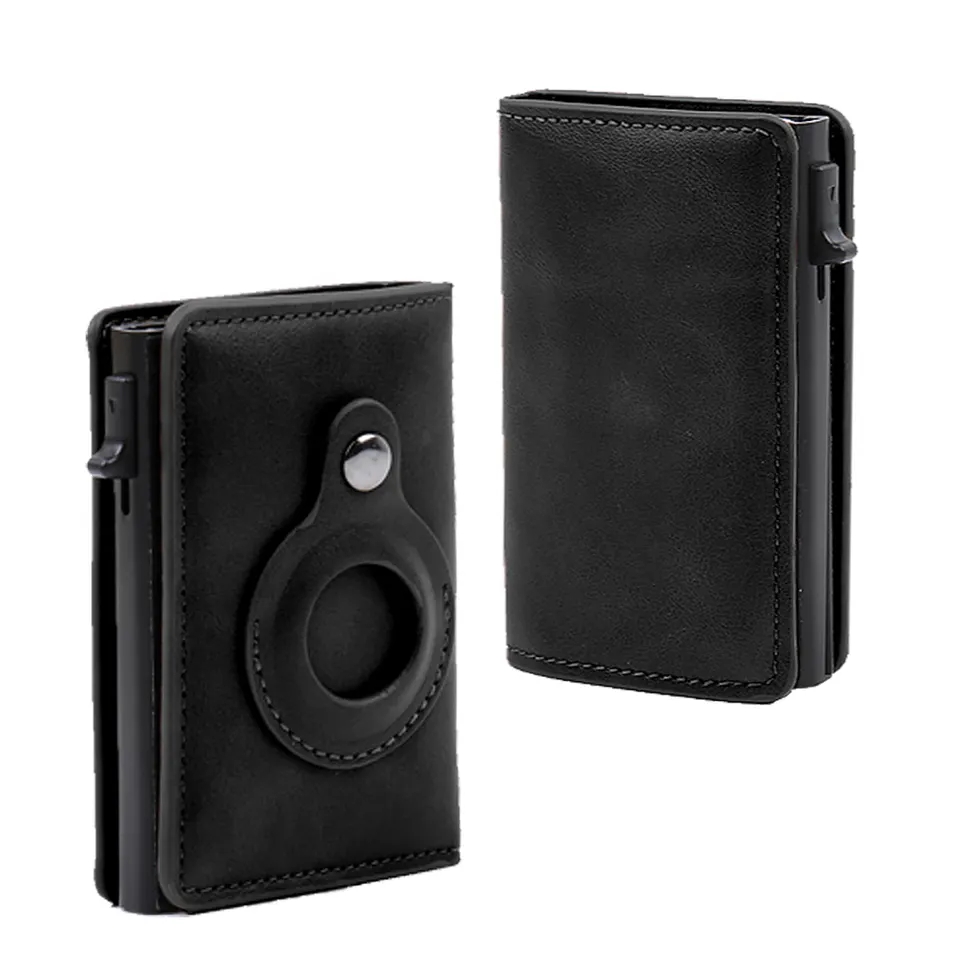
PU leather is synthetic. It is cheap, vegan-friendly, and consistent in color. The durability is significantly worse—PU leather typically cracks and peels within 1–2 years of daily use. For budget inventory aimed at trend-driven purchases, it works. For repeat customers, it creates warranty returns.
Many AirTag wallets combine leather with a CNC-machined aluminum frame that holds the tracker. The aluminum serves three purposes: structural rigidity, a mechanical lock for the AirTag, and a premium aesthetic.
The key specification is the alloy. 6061-T6 aluminum is the industry standard for this application. It offers good strength-to-weight ratio and responds well to anodizing. Softer alloys like 5052 can bend under daily pocket stress.
Surface finish matters too. Anodizing creates a scratch-resistant oxide layer that is 3–4 times harder than the base aluminum. Painted finishes chip. For a product that goes in and out of pockets dozens of times daily, anodized finishes are the correct choice.
Stitches per inch (SPI) is the quality metric that matters. Good leather goods use 7–8 SPI. Fewer stitches per inch means the leather is more likely to tear along the seam. Buyers can check this with a simple magnifying glass on a sample.
Edge painting is another quality indicator. Hand-painted edges seal the leather core and prevent delamination. Machine-burned edges are cheaper but less durable. For a wallet that holds a metal tracker, edge durability matters because the AirTag frame rubs against the leather constantly.
Before placing a bulk order, request a golden sample and use it daily for 30 days. Here is what to check:
AirTag fit: Does the tracker stay seated without rattling? Does it come out easily when you want it to?
Leather deformation: Does the leather around the AirTag pocket stretch permanently?
Signal reliability: Open Find My and walk around a store. Does the AirTag connect consistently?
Stitching integrity: Any loose threads after a month of use?
A supplier who hesitates to send a golden sample is signaling they lack confidence in their own production.
Ask direct questions about manufacturing processes:
Do you have in-house CNC machining? Suppliers who outsource machining have less control over tolerances and longer lead times.
What is your defect rate? Industry standard is 1–2%. Anything above 3% means their quality control is weak.
Can you provide a tolerance spec for the AirTag pocket? A competent supplier will give you a number like ±0.1mm. A vague answer means they have not measured it.
No sample policy: Any supplier who refuses to send samples before bulk production is not worth your time.
Vague material sourcing: If they cannot name the tannery or at least the leather grade, they are likely using cheap bonded leather.
No quality control documentation: A supplier without QC checkpoints in their production process will deliver inconsistent batches.
Unrealistic pricing: If the quoted price is significantly below market rate, ask what is being sacrificed. It is usually the leather thickness or the metal quality.
You provide the design; the factory manufactures it. This is for brands with established design teams who want full control over the product. Key requirements: a signed NDA, a clear tooling cost breakdown, and a written agreement on intellectual property ownership.
The factory provides the design; you add your logo. This is the fastest path to market because the supplier has already solved the engineering problems—the AirTag fit, the signal transparency, the leather selection. ODM is ideal for wholesalers who want to test the market without R&D costs.
Beyond logos, buyers can customize:
Leather color and texture
Stitching thread color
Edge paint color
Packaging (custom boxes with your branding)
Hardware finish (silver, gold, black anodized)
Custom packaging is often overlooked but matters for retail shelf presence. A $50 wallet in a generic box sells for less than a $50 wallet in branded packaging.
| Cost Component | Typical Percentage | Notes |
|---|---|---|
| Leather | 30–40% | Hide selection and grade |
| Labor | 20–30% | Skilled stitching is labor-intensive |
| Hardware (AirTag frame) | 10–15% | CNC machining adds $1–$3 per unit |
| Packaging | 5–10% | Custom boxes cost more |
| Overhead + Profit | 15–20% | Factory margin |
MOQs vary by supplier and design complexity:
Stock designs (ODM): 100–300 units
Custom designs with existing molds: 500 units
Fully custom designs requiring new tooling: 1,000+ units
Tiered pricing means the unit price drops as quantity increases. A typical structure might be $18/unit at 500 pieces, $15/unit at 2,000 pieces, and $12/unit at 10,000 pieces. Always request tiered quotes upfront so you can plan inventory purchases against cash flow.
One honest caveat: the lowest-priced supplier is rarely the cheapest in the long run. AirTag wallets with defective frames generate returns, chargebacks, and damaged brand reputation. A slightly higher unit cost from a reliable factory is usually the better financial decision.
Stock designs: 15–25 days
Custom orders including sampling: 30–45 days
Sample production: 7–10 days
Buyers should maintain an 8-week inventory buffer. This accounts for production time, sea freight (typically 25–35 days to the US or Europe), and customs clearance. Stockouts during shipping delays are the most common inventory failure among small wholesalers.
Air freight (DHL/FedEx): 3–5 days, expensive, for urgent restocks
Sea freight (FCL/LCL): 25–35 days, economical, for regular orders
FOB (Free On Board) is the most common Incoterm for Chinese suppliers. EXW (Ex Works) shifts all logistics responsibility to the buyer. DDP (Delivered Duty Paid) is the most buyer-friendly—the supplier handles everything including customs and duties. New importers should request DDP quotes to simplify their first orders.
The industry standard defect rate is 1–2%. A reputable supplier will replace defective units at no cost, not just offer a discount on the next order. Get this in writing before placing your first order.
The industry standards described above—precision CNC work for the AirTag frame, high-grade leather for the exterior, signal-transparent design—demand a factory that masters both metalwork and leathercraft. Many suppliers excel at one but not the other. That is the gap that creates quality problems for wholesalers.
GSTAR (Gstar Technology, Shenzhen) is a professional manufacturer of RFID wallets, key organizers, and graded card holders. Our facility operates in-house CNC machining centers, which means we control the AirTag slot tolerance to within ±0.1mm. We do not outsource the critical components and hope they arrive on spec. We make them.
With over 13 years in the industry, we have refined our production processes to handle the dual challenge of leather craftsmanship and precision metalwork. Our monthly production capacity exceeds 300,000 pieces, so we can scale with your sales growth without compromising delivery schedules.
We offer material options across full-grain leather, top-grain leather, and premium aluminum alloys. This lets you position your product line at the price point that fits your target market—without sacrificing the engineering quality that keeps the AirTag functional.
We know not every wholesaler starts with a 10,000-unit order. Our MOQs are structured to let you test the market first. We provide both OEM and ODM solutions. Whether you need a specific leather color, a custom logo, or a completely new AirTag pocket design, our engineering team is available to support your project.
We provide quotes within 24 hours. That speed lets you plan inventory with confidence instead of waiting weeks for pricing.
Choose a full-service manufacturer if you want one partner who can handle both the leather exterior and the precision metal frame. Coordination between separate suppliers for these two components creates quality risk and longer lead times.
Choose an ODM supplier if you are entering the AirTag wallet category for the first time and want to minimize R&D costs and time-to-market. Leverage their existing molds and tested designs.
Choose a flexible-MOQ supplier if you are testing a new market or a new product line. Locking yourself into a 5,000-unit minimum before validating demand is a common and costly mistake.
Choose a supplier with in-house CNC if you plan to offer custom frame designs or need tight tolerances on the AirTag fit. Outsourced machining adds at least a week to lead times and removes your visibility into quality control.
The right supplier relationship is a strategic asset. When you find a factory that understands both the technical precision and the aesthetic quality required, you have found a partner who can grow with your business.
Contact Our Team to discuss your AirTag wallet project. We will respond within 24 hours with a detailed quote.
---
Apple Inc. AirTag Technical Specifications. https://www.apple.com/airtag/specs/
Bluetooth SIG. Bluetooth Core Specification (2.4 GHz operation). https://www.bluetooth.com/specifications/
Leather Working Group. Leather Manufacturing Standards and Environmental Protocols. https://www.leatherworkinggroup.com/
ASTM International. Standard Specification for Aluminum 6061-T6. https://www.astm.org/
International Chamber of Commerce. Incoterms 2020 Rules. https://iccwbo.org/incoterms/


