
Views: 249 Author: Princee Lee Publish Time: 03-13-2026 Origin: Princee Lee


Content Menu
● Introduction: The Modern Wallet Revolution
● The Core Material: Why Aluminum Alloy Matters
>> Structural Integrity and Lightweight Performance
>> Corrosion Resistance and Longevity
● The Exterior Aesthetic: The Versatility of PU Leather
>> Defining PU Leather: Ethics and Engineering
>> Texture and Hand-Feel: The Luxury Experience
● The Engineering Behind the Spring Mechanism
>> Quick-Access Ejection: Speed and Efficiency
>> Secure Card Retention: The Internal Friction System
● Security in the Digital Age: RFID Blocking Technology
>> Understanding the Threat: Digital Skimming Explained
>> The Faraday Cage Effect: How Metal Protects Your Data
● Functional Design: Organizing Your Essentials
>> Card Capacity and Versatility
>> Slim Profile: The Benefits of Minimalism
● Target Demographics: Who is This For?
>> The Everyday Carry (EDC) Enthusiast
● Comparison: Traditional Bifolds vs. Aluminum Card Holders
● Care and Maintenance for Longevity
>> Cleaning the PU Leather Surface
>> Maintaining the Spring Mechanism
● Environmental Impact and Sustainability
● Conclusion: The Ultimate Fusion of Style and Utility
>> Related Questions and Answers
The way we carry our essentials has undergone a radical transformation over the past decade. For centuries, the traditional leather bifold wallet was the undisputed king of personal organization, designed primarily to hold thick stacks of paper currency, coins, and a handful of identification cards. However, as the global economy shifts toward a cashless society and digital transactions become the norm, the bulky, "costanza-style" wallet has become an ergonomic burden. Enter the Aluminum Alloy Spring Card Holder with PU Leather, a sophisticated piece of pocket engineering that represents the pinnacle of modern Everyday Carry (EDC) philosophy.
This hybrid accessory is not merely a container for plastic cards; it is a response to the needs of the contemporary individual who values security, efficiency, and aesthetics. By combining the industrial strength of aerospace-grade aluminum with the refined tactile experience of high-quality PU leather, designers have created a tool that bridges the gap between rugged utility and professional elegance. In this comprehensive exploration, we will dive deep into why this specific combination of materials and mechanics has become the gold standard for minimalist organization.
At the heart of any high-performance card holder lies its structural core. The use of aluminum alloy in the construction of a spring-loaded card holder is a deliberate choice based on several critical engineering factors. Unlike plastic or thin fabric, aluminum provides a rigid exoskeleton that protects the sensitive electronics within your cards.
Aluminum is celebrated in industries ranging from aerospace to high-end electronics for its incredible strength-to-weight ratio. In a wallet, this means you get a frame that will not bend, crack, or warp, even if you sit on it or drop it on a hard surface. Standard credit cards are made of PVC, which is prone to "creeping" or becoming brittle over time. If kept in a soft leather bifold, these cards often develop micro-cracks or lose their flat shape. The aluminum housing acts as a protective vault, ensuring that your cards remain perfectly flat and functional for years.
Furthermore, the "alloy" aspect is crucial. Pure aluminum is relatively soft, but when alloyed with elements like magnesium or silicon, it gains significant hardness. This allows the card holder to maintain a slim wall thickness—often less than 2mm—without sacrificing the ability to withstand daily pressure. This contributes to a "featherlight" feel in the pocket, reducing the drag and bulk associated with traditional carrying methods.

One of the most significant enemies of everyday tools is moisture. Whether it is sweat from being in a pocket during a summer hike or an accidental splash of water, traditional materials can degrade. Aluminum naturally forms a thin, protective layer of oxide that prevents further corrosion. This makes the internal mechanism of the card holder highly resistant to rust. When you invest in an aluminum alloy card holder, you are essentially purchasing a product that can last a lifetime, contrasting sharply with the "fast fashion" wallets that fall apart at the seams after six months of heavy use.
While the aluminum core provides the "muscle," the PU leather wrap provides the "soul." To many, a pure metal wallet can feel cold or overly industrial. The addition of a PU leather exterior solves this by introducing warmth, grip, and a classic silhouette that fits seamlessly into both casual and formal environments.
PU leather, or polyurethane leather, is a synthetic material designed to mimic the look and feel of genuine hide without the environmental and ethical baggage associated with the leather industry. Modern PU leather has evolved significantly; it is no longer the "pleather" of the 1990s. Today's high-grade PU is breathable, highly durable, and can be embossed with various textures—from smooth nappa to rugged pebble grain.
For the environmentally conscious consumer, PU leather offers a vegan alternative that requires significantly less water and land use to produce compared to bovine leather. Furthermore, it allows for a level of color consistency and water resistance that natural leather cannot always guarantee. Because it is a manufactured material, it can be engineered to be thinner than traditional leather while maintaining high tensile strength, which is essential for keeping the wallet's overall profile as slim as possible.
A wallet is one of the few items we touch dozens of times a day. The tactile experience is just as important as the visual one. The PU leather used in these card holders often features a soft-touch finish that provides an excellent grip. This prevents the wallet from sliding out of your pocket or your hand. Over time, while it doesn't "patina" in the same way as vegetable-tanned leather, it maintains its original color and crisp edges much longer, ensuring the wallet looks "new" for a greater portion of its lifespan.
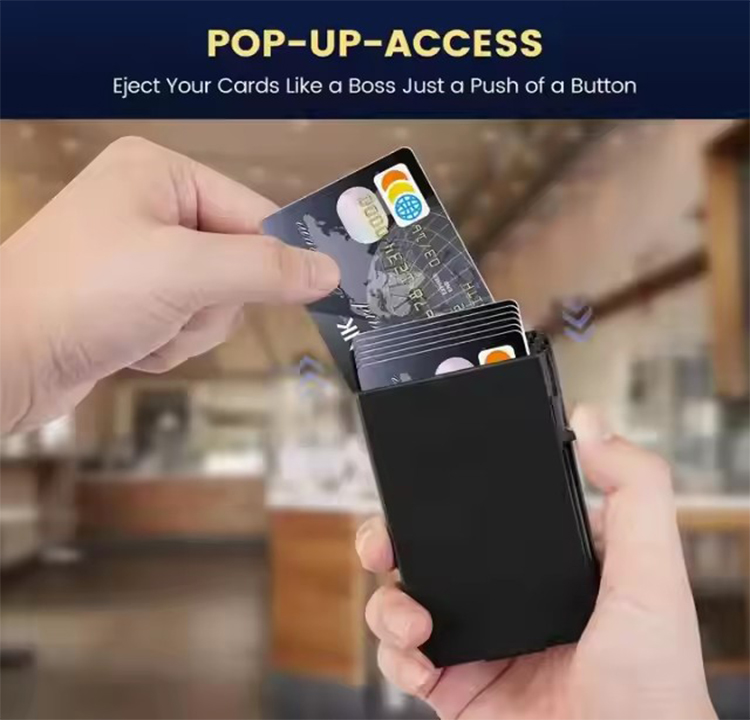
The most distinctive feature of this card holder is the integrated spring-action ejection system. This is where mechanical engineering meets daily convenience. Instead of fumbling through a stack of cards or digging into a tight leather pocket, the user simply triggers a small lever or button, usually located at the base of the aluminum housing.
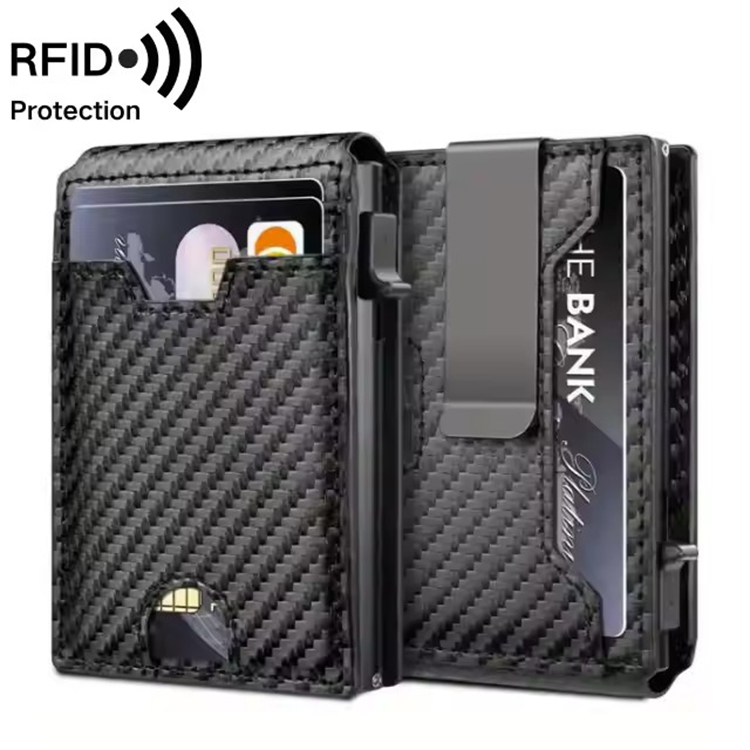
The spring mechanism is designed to fan out the cards in a tiered, staggered fashion. This allows you to see the top edge of every card simultaneously, making it effortless to select the specific one you need—be it a credit card, a transit pass, or an ID. This "pop-up" action is not just about speed; it is about the "fidget-friendly" satisfaction of a well-calibrated machine. The tension in the spring is carefully balanced: it must be strong enough to eject the cards reliably but smooth enough to operate with a single finger.
A common concern with mechanical card holders is the fear of cards falling out if the wallet is turned upside down. To prevent this, the aluminum chamber is equipped with internal friction pads or silicon strips. These components apply just enough pressure to the sides of the cards to hold them securely in place, even if you only have one card in a six-card-capacity slot. This engineering ensures that gravity is never an enemy to your financial security.
In the modern world, theft has moved beyond physical pickpocketing. Electronic pickpocketing, or "RFID skimming," is a method where thieves use handheld scanners to read the information stored on the chips of your credit cards and passports from a distance.
Most modern cards are equipped with Radio Frequency Identification (RFID) or Near Field Communication (NFC) chips for contactless payments. These chips broadcast a signal that a reader can pick up. Without protection, a thief standing near you in a crowded subway or a coffee shop could potentially "sniff" your card's data without ever touching your wallet.
This is where the aluminum alloy construction becomes a vital security feature. Aluminum is a conductive material that acts as a "Faraday Cage." When your cards are tucked inside the aluminum housing, the metal creates a shield that blocks electromagnetic fields. Incoming signals from a thief's scanner are distributed across the exterior of the metal shell rather than penetrating the cards inside. This effectively renders your cards "invisible" to electronic scanners, providing a layer of digital armor that a traditional leather wallet simply cannot offer.
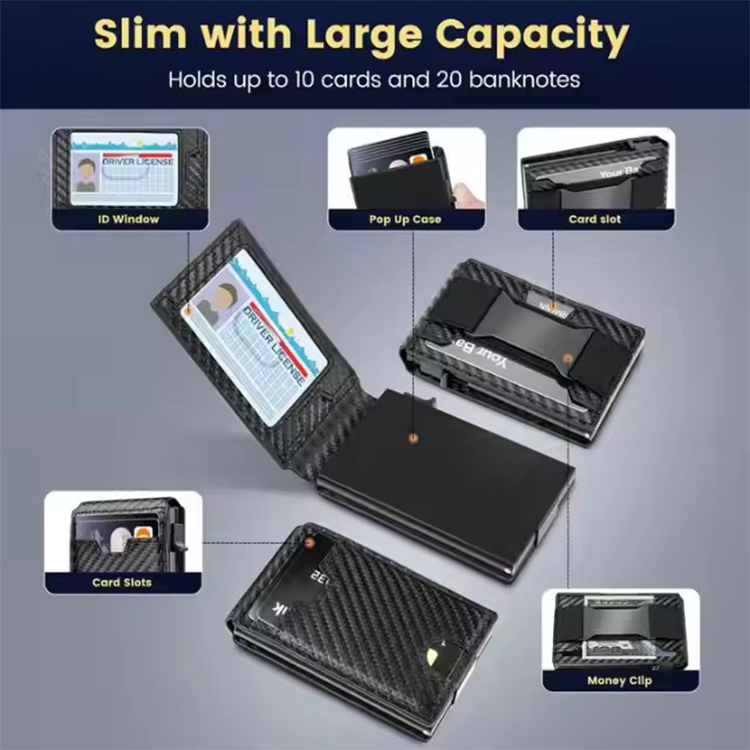
The marriage of the spring-loaded metal case and the leather wrap creates a multi-layered organizational system. Most models are designed to hold 5 to 7 cards within the metal chamber, which are the ones you use most frequently.
Beyond the primary metal compartment, the PU leather wrap usually includes additional pockets. These are perfect for items that do not require RFID protection or for those that you need to tap frequently without removing them from the wallet (like a building access card). Some designs also incorporate a slim cash strap or a dedicated bill compartment, allowing you to carry a few emergency banknotes without adding significant thickness. This "hybrid" approach ensures that you don't have to sacrifice the utility of a traditional wallet while enjoying the benefits of a modern card holder.
The primary goal of the minimalist wallet movement is to reduce the "pocket bulge." A bulky wallet doesn't just look bad—it can cause physical discomfort. Sitting on a thick wallet for hours can misalign the spine and lead to lower back pain, often referred to as "wallet sciatica." Because the Aluminum Alloy Spring Card Holder maintains a consistent, slim shape regardless of how much it's carrying, it can be comfortably worn in the front pocket. Front-pocket carry is widely considered a safer option as it is much harder for traditional pickpockets to access.
The versatility of the Aluminum Alloy Spring Card Holder with PU Leather makes it an attractive choice for a wide variety of users.
For the business traveler or the office executive, a wallet is a part of their professional attire. The sleek metal lines paired with the sophisticated leather finish complement a suit or a high-end briefcase. It sends a message of organization, tech-savviness, and attention to detail.
Travelers benefit most from the RFID-blocking capabilities and the compact nature of the device. When navigating busy airports or foreign cities, having your primary cards secured in a metal vault provides peace of mind. The quick-access trigger also makes it easy to pull out an ID or a corporate card while on the move.
The EDC community focuses on the philosophy of "Utility, Durability, and Style." They look for tools that serve a clear purpose and are built to withstand the rigors of daily life. The mechanical nature of the spring holder appeals to the gear enthusiast who appreciates precision engineering in their everyday tools.
When comparing the two, the differences are stark. Traditional bifolds are "bottomless pits" where receipts, old business cards, and expired coupons tend to accumulate. This leads to a disorganized and bulky mess.
The Aluminum Alloy Spring Card Holder enforces a "minimalist discipline." Because space is finite, you are encouraged to carry only what you actually use. Furthermore, the access speed is incomparable. In the time it takes to open a bifold and dig through three different leather slots to find a specific card, the user of a spring-loaded holder has already completed their transaction.
While these wallets are built for durability, a small amount of care can extend their life even further.
PU leather is non-porous, making it very easy to clean. A simple wipe with a damp cloth is usually enough to remove dirt or oils from your hands. Unlike real leather, it does not require expensive conditioners or creams. However, it is best to avoid harsh chemicals or alcohol-based cleaners, as these can strip the protective coating and cause the material to crack over time.
The internal spring is a robust component, but it can occasionally be affected by fine dust or sand if you take the wallet to the beach or use it in very dusty environments. A quick blast of compressed air into the card slot can clear out any debris that might be causing the mechanism to feel "gritty." It is important not to lubricate the mechanism with oils, as these will attract more dust and could potentially damage your cards.
The debate between natural leather and PU leather is ongoing. While natural leather is biodegradable, the tanning process often involves heavy metals and high environmental costs. High-quality PU leather, especially when paired with a recyclable aluminum frame, offers a different path to sustainability: durability. By creating a wallet that lasts five years instead of one, the total waste generated is significantly reduced. Aluminum is also one of the most recycled materials on earth, meaning that at the very end of the product's long life, its core components can be melted down and reused without loss of quality.
The Aluminum Alloy Spring Card Holder with PU Leather is more than just a trend; it is the logical evolution of the personal wallet. It addresses the digital security concerns of the 21st century while acknowledging that we still value the touch and appearance of traditional craftsmanship. By combining the rigid, RFID-blocking protection of aluminum with the elegant, versatile wrap of PU leather, this accessory provides the perfect balance of form and function.
Whether you are looking to declutter your pockets, protect your digital identity, or simply upgrade your daily gear to something more efficient, this card holder stands as a testament to what happens when smart engineering meets thoughtful design. It is a compact, secure, and stylish companion that is perfectly suited for the fast-paced, card-centric world we live in today.
Q1: How many cards can the aluminum compartment typically hold?
A1: Most aluminum spring card holders are designed to hold between 5 and 7 standard-sized cards (like credit cards or IDs) inside the metal chamber. The exact number depends on whether your cards have embossed (raised) lettering. If all cards are flat, you can usually fit the maximum capacity.
Q2: Will my cards fall out if I shake the wallet?
A2: No. These wallets feature internal silicone or friction strips that grip the cards securely. The mechanism is designed to keep cards in place regardless of the wallet's orientation. Even with just one card inside, the friction is sufficient to prevent it from sliding out accidentally.
Q3: Can I carry cash in this type of wallet?
A3: Yes, most models include a PU leather wrap that features extra pockets or a dedicated cash strap/compartment. While it is not designed to hold large stacks of bills, it can comfortably accommodate several folded banknotes for emergency use.
Q4: Does the aluminum block all types of signals?
A4: It specifically blocks high-frequency RFID/NFC signals (13.56 MHz), which are used for credit cards and modern passports. It generally does not block low-frequency signals (125 kHz) often used for older building access badges or hotel key cards, allowing you to use those without removing them if they are placed in the outer leather pockets.
Q5: Is PU leather as durable as real leather?
A5: While genuine leather is famous for its long-term aging and "patina," high-quality PU leather is exceptionally durable for daily use. it is more resistant to water and stains than natural leather and does not require maintenance. For a slim wallet design, PU leather is often preferred because it can be made thinner and more consistent.


