

Views: 227 Author: Gstar Technology Publish Time: 08-12-2026 Origin: Site


Content Menu
● What Should You Put in a Wallet Every Day?
>> The Essential Wallet Checklist
● What Should Not Be Kept in a Wallet?
>> Avoid Carrying These High-Risk Items
>> Why Receipt Clutter Is More Serious Than It Looks
● How Much Cash Should You Carry in a Wallet?
● How to Organize a Minimalist Wallet
● Choose a Wallet Based on What You Carry
>> Front-Pocket vs. Back-Pocket Carry
● Does an RFID Wallet Change What You Put Inside?
>> What RFID Protection Cannot Do
● Expert Product Design Insights for Wallet Brands
>> Five Features That Improve Daily Wallet Use
● What to Do If Your Wallet Is Lost or Stolen
● Build a Better Everyday Carry With Gstar Technology
● FAQ
>> What are the most important things to put in a wallet?
>> Should I keep my Social Security card in my wallet?
>> How many cards should a minimalist wallet hold?
>> Is it safe to carry cash in a wallet?
>> What is the best wallet for front-pocket carry?
>> Do RFID wallets protect against all types of fraud?
>> How often should I clean out my wallet?
>> What should brands consider when sourcing custom wallets?
What to put in a wallet depends on more than how many card slots it has. The best wallet carries your daily essentials, protects sensitive information, stays comfortable in your pocket, and removes the clutter that slows you down.
At Gstar Technology (Shenzhen) Co., Ltd., we manufacture RFID card holders, Ridge-style minimalist wallets, ultra-slim wallets, genuine leather wallets, key organizers, graded-card protectors, and accessory components for international brands, wholesalers, and OEM buyers. After years of working with metal, leather, RFID-blocking layers, pop-up mechanisms, and custom wallet structures, one lesson is clear: a better wallet starts with carrying less—but carrying the right things.
This expert guide explains what to keep in a wallet, what should never go inside, how to organize a minimalist wallet, and how brands can develop wallet products that solve real everyday-carry problems.
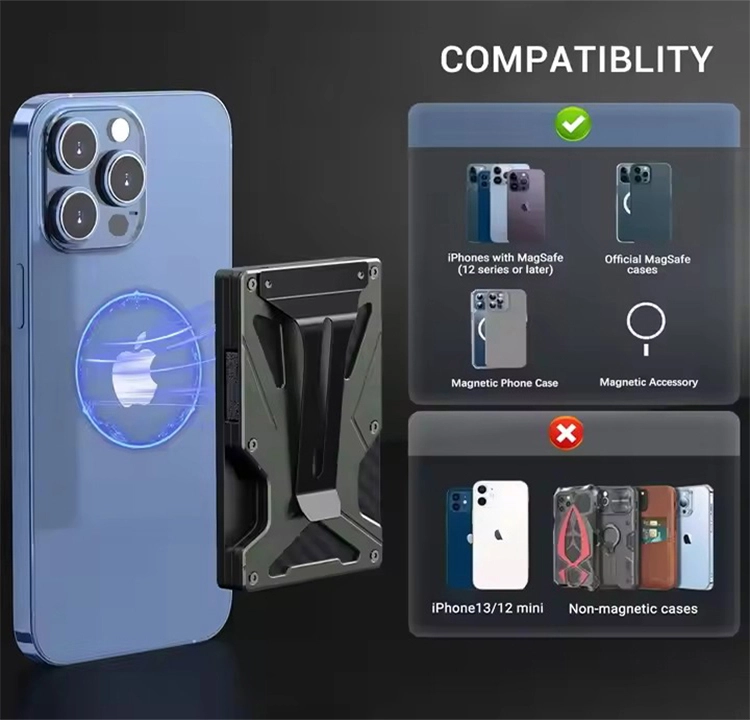
For most people, the ideal wallet contains four to eight daily essentials. This number is not a fixed rule; it is a practical starting point that keeps the wallet thin, organized, and easy to use.
Your wallet should hold items you use regularly, not every card or document you own.
Here is what to put in a wallet for everyday use:
- One government-issued photo ID, such as a driver's license or national ID card
- One primary payment card for regular purchases
- One backup payment card for emergencies or payment-network acceptance
- One debit card, if you routinely use cash withdrawals or direct account payments
- A small amount of emergency cash in local currency
- A transit, work-access, or building-entry card if you use one several times a week
- One health insurance card only when it is genuinely needed for daily life
- A business card or emergency contact card, if appropriate for your work or travel needs
The purpose is not to fill every slot. It is to create a fast, repeatable system. When every item has a reason to be there, you can find it immediately.
| Wallet Item | Should You Carry It? | Best Practice |
|---|---|---|
| Driver's license or photo ID | Yes, when required | Keep it in an easy-access slot |
| Primary credit card | Yes | Place in the most accessible position |
| Backup card | Usually | Use a different bank or payment network when possible |
| Cash | Yes, in a small amount | Fold neatly; replace after use |
| Transit or access card | If used frequently | Keep separate from payment cards if possible |
| Receipts | No, except temporarily | Remove weekly or scan digitally |
| Social Security card | No | Store securely at home |
| Passwords or PINs | Never | Use a secure password manager instead |
The U.S. Consumer Financial Protection Bureau advises people to carry only the identification and financial cards they truly need, while keeping highly sensitive documents, including Social Security cards, in a secure place.

A wallet is convenient, but convenience should not become a security risk. If a wallet is lost or stolen, every unnecessary document inside increases the potential impact.
Do not keep the following in your daily wallet unless there is a short-term and specific reason:
- Your Social Security card
- A written PIN, password, or account login
- A master list of bank accounts
- Unused gift cards with stored value
- Multiple backup credit cards
- Birth certificates, passports, or immigration documents
- Old receipts with account details
- Spare keys with your home address attached
- A large amount of cash
- Medical documents that are not needed daily
The Federal Trade Commission explains that identity theft occurs when someone uses personal or financial information without permission. Sensitive records, financial documents, Social Security cards, and Medicare cards should be stored safely rather than carried unnecessarily.
A wallet should be treated as an everyday tool, not a portable filing cabinet.
Receipts appear harmless, but they create several problems:
- They make a slim wallet thick and uncomfortable
- They hide cards and make checkout slower
- They may reveal transaction, location, or partial payment information
- They create a messy impression of wallet capacity
- They weaken a leather wallet's shape over time
Remove receipts at the end of each week. For expense tracking, scan them into an accounting app or take a secure digital photo before disposing of them responsibly.
The right amount of cash depends on where you live, how you travel, and your payment habits. For a digital-first daily routine, a modest emergency amount is often enough.
A practical approach is to carry one or two small notes for parking, tips, cash-only shops, public transport disruptions, or temporary payment-terminal failures. Avoid carrying cash that would create a meaningful loss if your wallet disappears.
Use this three-step method:
1. Identify your local cash-only needs. Consider taxis, small restaurants, markets, tips, or emergency transportation.
2. Set a personal cash limit. Choose an amount you can lose without disrupting your finances.
3. Fold and separate notes. Keep one small note accessible and store the remainder behind a money clip or elastic strap.
For cash-focused users, a metal wallet with a money clip or a leather bifold with a dedicated bill compartment provides fast access without turning loose notes into clutter. Gstar Technology develops metal card wallets, pop-up wallets, leather wallets, and money-clip structures that can be customized for these different carry habits. [gstartec]
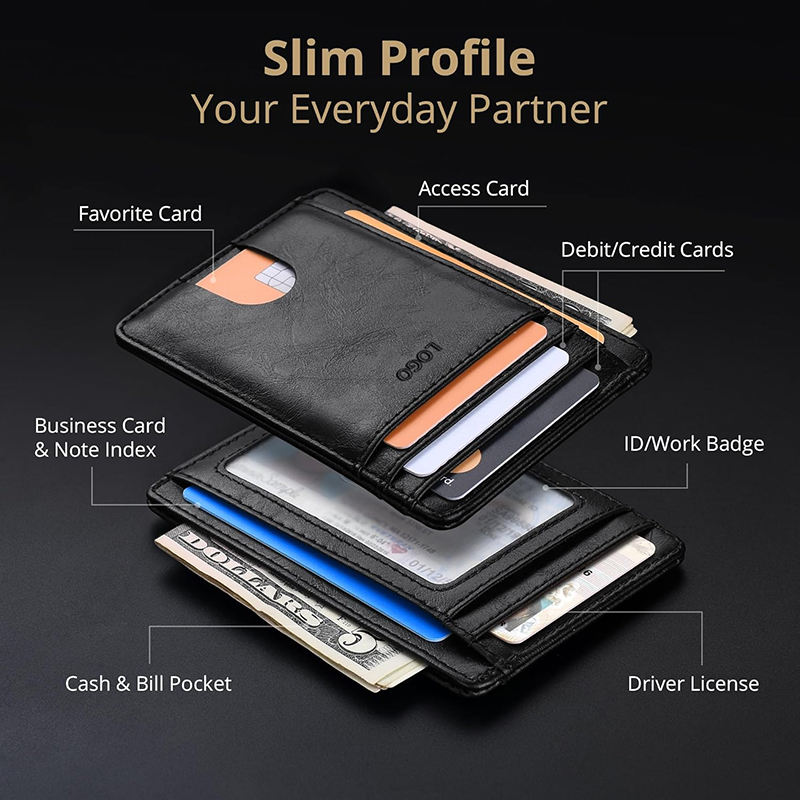
A minimalist wallet does not mean carrying nothing. It means assigning every item a purpose and a position.
For a typical front-pocket wallet, the most efficient arrangement is:
1. Front slot: Primary payment card
2. Second slot: Driver's license or photo ID
3. Internal slot: Backup payment card
4. Rear slot or center cavity: Folded emergency cash
5. Optional quick-access slot: Transit or work-access card
This layout reduces repeated searching. It also makes payment and identification faster because the most-used cards remain in predictable positions.
Empty your wallet and ask these questions about every item:
- Did I use this in the past 30 days?
- Would I be inconvenienced today if I left it at home?
- Does a digital version already exist?
- Does this item expose sensitive information?
- Is there another place where this belongs?
If the answer is "no" to the first two questions, remove it. If the answer is "yes" to the security question, store it elsewhere.
Minimalist wallet users commonly prioritize a photo ID, primary credit or debit cards, and frequently used access cards. Regular audits help prevent loyalty cards, old receipts, and expired cards from rebuilding bulk.
The phrase "what to put in a wallet" should also influence what kind of wallet you buy or develop. A wallet that looks thin when empty may become bulky when loaded with real cards, cash, and daily items.
| Carry Profile | Typical Contents | Recommended Wallet Type |
|---|---|---|
| Minimal daily carry | 3–6 cards and folded cash | Slim RFID card holder |
| Digital-first professional | ID, 2–4 cards, access card | Pop-up metal wallet |
| Traditional daily user | 6–10 cards and cash | Leather bifold wallet |
| Cash-first user | Cards and multiple notes | Money-clip wallet |
| Frequent traveler | Cards, passport, cash, boarding documents | Travel or zip-around wallet |
| Collector or reseller | Graded trading cards | PSA card protector or storage case |
| Key-focused EDC user | Keys, cards, cash | Wallet paired with key organizer |
Industry wallet guidance commonly maps 3–8 cards to slim cardholders and higher card counts to bifolds, trifolds, or zip-around formats. The key decision is not theoretical capacity; it is the wallet's thickness when loaded with your actual daily carry.
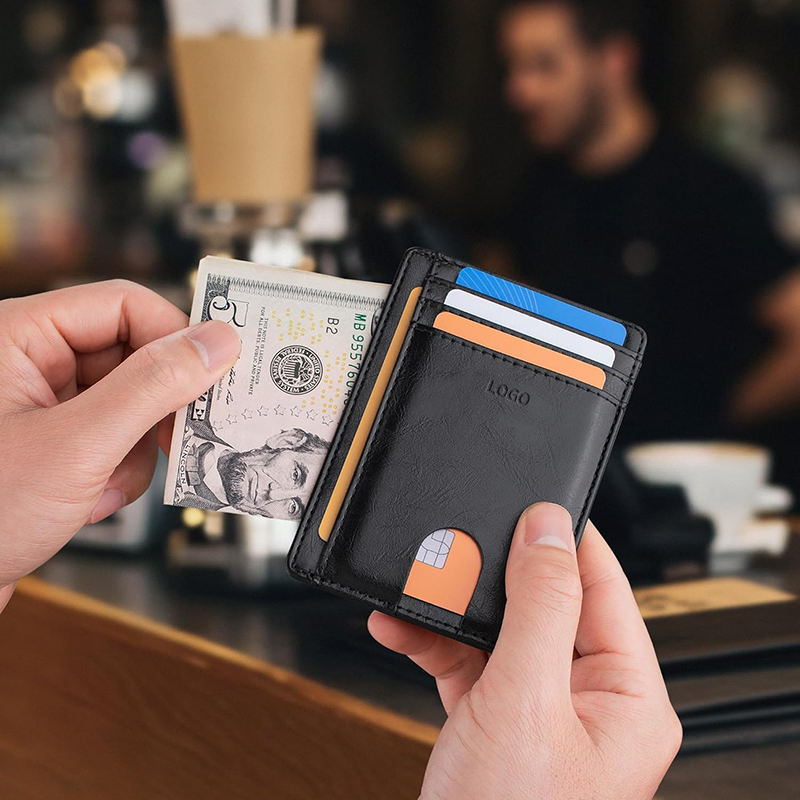
For front-pocket carry, prioritize a slim profile, rounded edges, and quick card access. A metal RFID card holder, elastic card wallet, or compact leather card case is usually more suitable than a thick trifold.
For back-pocket carry, a bifold may offer more familiar organization and additional cash capacity. However, avoid overfilling it. A wallet stuffed with receipts and rarely used cards can become uncomfortable, wear faster, and lose its intended shape.
An RFID wallet does not change the essentials you should carry. It changes how contactless cards are protected when the wallet is closed.
Many modern payment and access cards use contactless technology. RFID-blocking wallet materials can provide an additional physical barrier against unauthorized scans. However, RFID protection is only one part of personal security. It does not replace account alerts, strong passwords, two-factor authentication, careful card monitoring, or fast action after a loss.
The FTC recommends reviewing bills and bank statements, protecting personal information, and using strong passwords and multi-factor authentication for online accounts. [consumer.ftc]
RFID-blocking technology cannot:
- Stop phishing, scam calls, or fake websites
- Prevent card loss or physical theft
- Replace freezing or cancelling a stolen card
- Protect a compromised online account
- Stop unauthorized transactions caused by a data breach
For brands sourcing RFID products, the priority should be honest communication. Do not market RFID as a complete identity-theft solution. Present it as one useful layer within a broader security routine.
At Gstar Technology, RFID wallet configurations may include metal shielding structures for aluminum, stainless steel, titanium, and carbon-fiber designs, as well as protective internal layers for leather wallet constructions. [gstartec]
For OEM buyers, the question is not only what consumers put in a wallet. It is how the product design supports those items without adding frustration.
From a manufacturing perspective, wallet performance depends on the relationship between capacity, access, protection, durability, and branding.
- Controlled card capacity: Design around realistic card counts rather than exaggerated capacity claims.
- Quick-access layout: Place the primary card where it can be removed without taking out every card.
- Secure cash solution: Add a money clip, elastic band, leather bill pocket, or compact cash strap.
- Reliable material selection: Match aluminum, titanium, carbon fiber, stainless steel, PU, or genuine leather to the intended price point and user profile.
- Brand-consistent customization: Use laser engraving, silk-screen printing, UV printing, embossing, debossing, custom colors, and packaging to create a recognizable retail product.
Gstar Technology offers OEM and ODM customization across logos, colors, packaging, product design, and mold development. Its manufacturing capabilities include CNC machining, metal stamping, surface finishing, laser engraving, and quality-control processes for wallet production. [gstartec]
For brands, the strongest product brief begins with a realistic customer profile. A commuter needs easy access. A traveler values secure closure. A collector needs impact protection. A minimalist user wants fewer cards and less bulk. One wallet should not try to solve every situation.
A well-organized wallet makes recovery easier because you know exactly what was inside.
Take these actions quickly:
1. Freeze or lock payment cards through your bank app or card issuer.
2. Review recent transactions for unauthorized activity.
3. Contact card issuers to report lost or stolen cards.
4. Replace your driver's license or ID through the appropriate local authority.
5. Change relevant passwords if any account information may be exposed.
6. Create a written wallet inventory after the incident is resolved.
7. Report identity theft if you find unauthorized accounts, charges, or misuse of personal information.
The FTC states that consumers who believe their identity has been stolen can report the issue and obtain a personalized recovery plan through IdentityTheft.gov.
The answer to what to put in a wallet is simple: carry only what helps you move through your day safely and efficiently. Start with your ID, essential payment cards, limited cash, and any card you use regularly. Remove sensitive documents, excess cards, outdated receipts, and anything that does not serve a daily purpose.
For wallet brands, wholesalers, and product developers, this consumer insight creates a clear opportunity: design products around real behavior, not just appearance. A well-made RFID card holder, ultra-thin wallet, leather bifold, pop-up card wallet, key organizer, PSA card protector, or bumper guard should make organization easier from the first use.
Contact Gstar Technology to develop custom RFID wallets and everyday-carry accessories with OEM/ODM support, personalized logos, materials, colors, packaging, and product structures designed for your target market.
The most important items are a photo ID, one primary payment card, one backup payment card, a small amount of emergency cash, and a transit or access card if you use one frequently.
No. Store it in a secure location unless you have a specific, short-term need to carry it. Losing a wallet with a Social Security card can increase identity-theft risk.
A minimalist wallet usually works best with around three to eight cards. The ideal number depends on card thickness, cash needs, and whether you carry a transit card or work-access card.
Yes, but carry only a limited emergency amount. Keep notes folded securely in a money clip, elastic strap, or bill compartment, and avoid carrying an amount that would create a serious loss.
A slim RFID card holder, pop-up metal wallet, or compact leather card case is usually best for front-pocket carry because it reduces bulk and provides faster access to essential cards.
No. RFID wallets can provide a physical barrier for contactless cards, but they cannot prevent phishing, online account compromise, scams, card theft, or data breaches. Use them alongside good account-security practices.
Perform a quick check every week to remove receipts and expired cards. Complete a deeper wallet audit every one to three months to ensure every item still has a clear purpose.
Brands should consider target users, actual card capacity, loaded thickness, material quality, RFID requirements, access mechanism, logo customization, packaging, quality control, and the product's intended retail price range.
1. Gstar Technology (Shenzhen) Co., Ltd. — [RFID Wallet Manufacturer and OEM/ODM Capabilities]. Product range, manufacturing processes, RFID wallet construction, customization, quality control, and OEM/ODM services. [gstartec]
2. U.S. Federal Trade Commission — [What To Know About Identity Theft]. Consumer guidance on identity theft, document protection, account monitoring, strong passwords, two-factor authentication, and reporting. [consumer.ftc]
3. Consumer Financial Protection Bureau — [Money Smart for Older Adults Resource Guide]. Guidance on carrying only necessary identification and financial cards, storing sensitive documents safely, and maintaining card records. [files.consumerfinance]
4. Yukon Bags — [Leather Wallet Guide: How to Choose, Clean & Care for Your Wallet]. Practical wallet-type comparisons, card-capacity ranges, loaded-thickness considerations, and carry-profile guidance. [yukonbags]
5. Andar — [How to Use a Minimalist Wallet: Expert Guide]. Guidance on auditing wallet contents, prioritizing essential cards, keeping modest emergency cash, and reviewing a minimalist wallet regularly. [andar]
Hot Tags: China, Global, OEM, private label, manufacturers, factory, suppliers, manufacturing company


