

Views: 345 Author: Professor Leon Publish Time: 08-13-2026 Origin: Site


Content Menu
● 1. Understanding Travel Wallet for Men: Types and Applications
● 2. Travel Wallet for Men Quality and Performance Factors
● 3. How to Evaluate Travel Wallet for Men Suppliers
● 4. Key Quality Indicators for Travel Wallet for Men Buyers
● 5. Relevant Industry Standards and Certifications
● 6. Our Wallet Manufacturing Capabilities
● 7. A Real Sourcing Case: Scandinavian Travel Accessories Brand
● 8. Questions to Ask Before Ordering
● 9. Decision Guide: Choose A If... Choose B If...
12 min read
A procurement manager for a European luggage brand once told me his biggest sourcing headache wasn't finding factories. It was finding a factory that could consistently deliver a travel wallet for men that didn't come back with zipper failures or RFID shields that tested at useless attenuation levels. His team had cycled through three suppliers in two years.
That conversation captures the core challenge of sourcing travel wallets for men. The product looks simple. A folded piece of leather with some slots and a zipper. But the technical requirements—RFID blocking effectiveness, stitch density, material durability, hardware longevity—separate manufacturers who understand travel accessories from those who just stitch leather together.
This guide breaks down what B2B buyers need to know before placing a bulk order. We cover materials, manufacturing standards, quality control protocols, and the specific questions to ask suppliers. The goal is to give you a procurement framework that prevents costly mistakes.
A travel wallet for men is a structured organizer designed to hold passports, boarding passes, multiple currencies, cards, and sometimes a phone or pen. Unlike everyday wallets, travel wallets prioritize capacity and security over slimness. They typically measure between 4.5 to 5.5 inches in height and 7.5 to 9 inches in width when open, with a closed size that fits into a jacket pocket or carry-on compartment.
The market has segmented into distinct product types, each serving different traveler profiles:
| Type | Key Features | Best For | Typical Weight |
|---|---|---|---|
| Bifold Travel Wallet | Slimmer profile, 2 main sections, 6-10 card slots | Business travelers who want minimal bulk | 80-120g |
| Trifold Travel Wallet | 3 panels, passport slot, boarding pass pocket, zip coin pouch | Leisure travelers needing full organization | 120-180g |
| RFID Security Wallet | Metal or carbon fiber frame, full RFID shielding | Tech-conscious travelers in high-risk areas | 150-250g |
| EDC Crossover Wallet | Pen loop, SIM card slots, key holder, multi-tool pocket | Daily commuters who also travel frequently | 130-200g |
The application matters more than the aesthetic. A frequent flyer on short-haul European routes needs quick access to a boarding pass and passport. A long-haul international traveler needs currency compartments that accommodate different banknote sizes—Euros are wider than US dollars, and Japanese yen notes are longer. A travel wallet for men that fails to accommodate these variations creates friction at airport security.
The quality of a travel wallet for men is determined by five measurable factors: material grade, stitching integrity, hardware durability, RFID shielding effectiveness, and edge finishing. Each factor has specific industry benchmarks that serious buyers should verify.
Full-grain leather is the top tier. It retains the natural grain, develops a patina with use, and lasts decades. But it is heavier and more expensive. Top-grain leather is sanded to remove imperfections, making it thinner and lighter. It resists scratches better but lacks the character of full-grain.
For budget-tier orders, PU leather (polyurethane) offers a cost-effective alternative. A quality PU leather with a 0.8-1.2mm thickness can mimic the look of genuine leather at 30-40% of the cost. The trade-off is lifespan—PU leather typically degrades within 2-3 years of daily use.
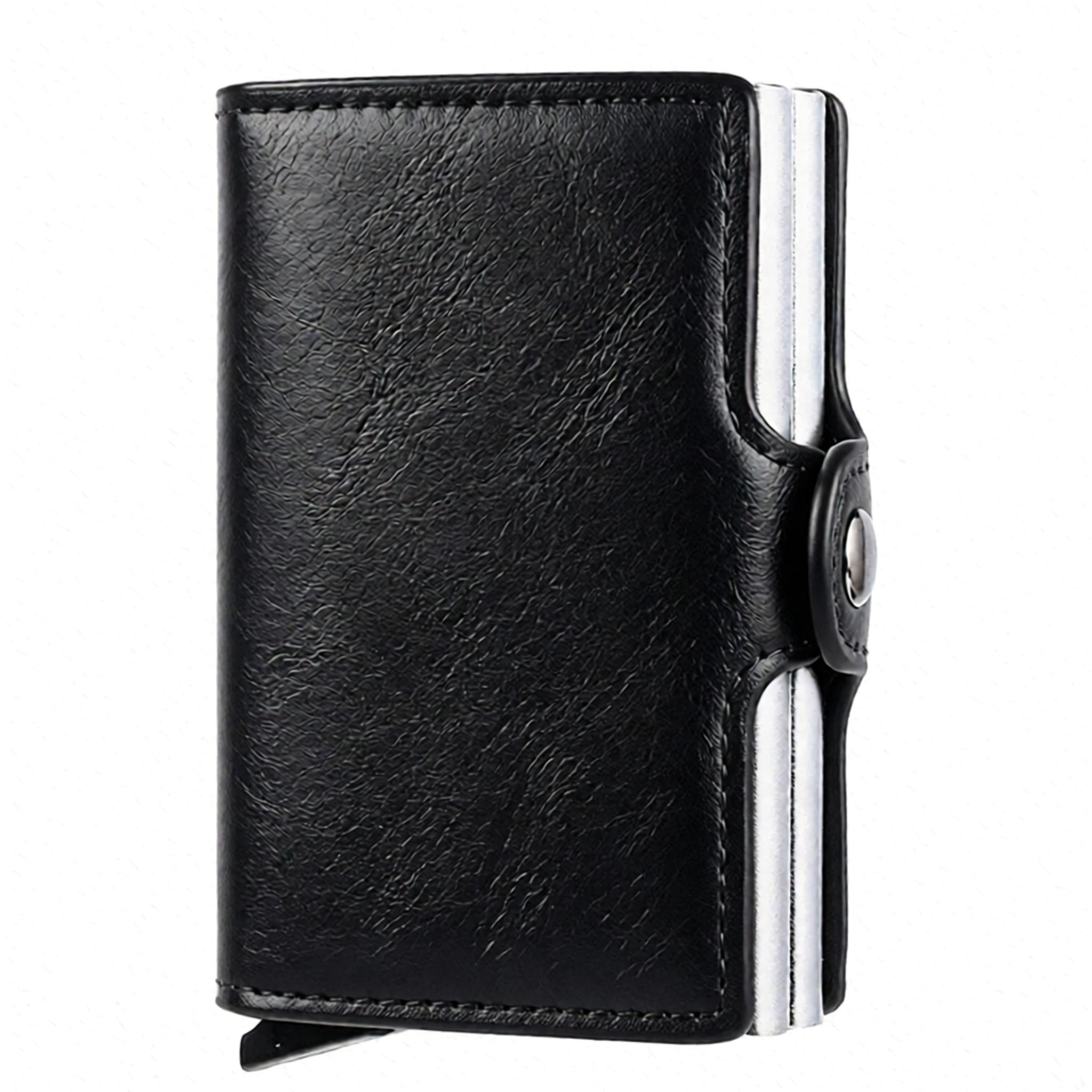
Aluminum and carbon fiber travel wallets for men serve a different purpose. They provide structural rigidity that prevents bending and crushing in packed bags. Aluminum wallets require CNC machining with tolerances of ±0.1mm to ensure smooth edges and proper alignment. Carbon fiber offers the same rigidity at 50% less weight but costs significantly more.
Zippers fail more often than any other component in a travel wallet for men. The industry benchmark is YKK zippers, which undergo 10,000+ open-close cycles in testing. Generic zippers may only last 2,000-3,000 cycles before teeth misalign or the slider jams.
Buyers should specify YKK or an equivalent brand in their tech packs. This is not a place to cut costs. A zipper failure on a passport wallet creates an immediate customer complaint and a product return. For a B2B buyer, the replacement cost plus shipping often exceeds the original profit margin.
Stitches Per Inch (SPI) is the standard measure of stitching quality. For travel wallets for men, 6-8 SPI using bonded nylon thread (size 20-30) is the benchmark. Bonded nylon resists abrasion and doesn't fray at the ends. Lower SPI counts (4-5) indicate weaker construction that will unravel under stress.
RFID blocking is no longer a premium feature—it is an expected standard for travel wallets for men in EU and North American markets. The threat is RFID skimming at 13.56 MHz (the frequency used by contactless payment cards and passports).
Effective RFID blocking requires a metallic shield—either aluminum foil (0.1-0.3mm thickness) or a conductive fabric—integrated into the wallet lining. The shield must cover the entire product footprint, including the zipper area. A partial shield creates a gap that defeats the purpose.
Testing follows ISO 14443 standards. The attenuation level should be -50 dB or lower, meaning the signal is reduced to 1/100,000 of its original strength. Buyers should request RFID test reports from suppliers to verify these figures. Marketing claims without test data are meaningless.
Evaluating a supplier for travel wallets for men requires a structured approach. The factory's capabilities determine whether your product meets quality standards, arrives on time, and stays within budget.
The cutting method affects precision and cost. Die-cutting uses steel dies to punch leather shapes rapidly—efficient for high volume but limited to simple geometries. Laser-cutting offers precision for complex shapes but can burn edges if not properly calibrated. A factory that offers both options gives buyers flexibility.
Edge finishing separates premium products from average ones. Painted edges require multiple coats of edge paint, each sanded smooth before the next application. This process takes time but produces a clean, durable edge that won't fray. Folded edges (where the leather is folded over itself) are faster but create visible seams.
Ask suppliers about their in-house capabilities. A factory that outsources stitching or printing has longer lead times and less quality control. In-house production ensures consistency and faster turnaround.
Pre-shipment inspection (PSI) follows AQL (Acceptable Quality Limit) standards. For travel wallets for men, the typical AQL is 2.5 for major defects and 4.0 for minor defects. This means in a random sample of products, the number of defective items must not exceed these thresholds.
Key inspection points include:
Zipper alignment and smooth operation
Stitch skipping or loose threads
RFID shield placement and coverage
Edge paint application (no bubbles or peeling)
Hardware attachment (rivets, snaps, buckles)
Overall dimensions versus tech pack specifications
Avoid suppliers who cannot provide RFID test reports. Avoid factories that refuse to share their AQL inspection criteria. Avoid manufacturers who quote prices significantly below market rates—they are cutting corners on materials or QC.
Also be wary of suppliers who claim "full customization" but cannot provide detailed tech pack feedback. A competent factory will flag design issues (e.g., a card slot too narrow for standard credit cards) before production begins.
When comparing quotes from different suppliers, use these quality indicators to evaluate offers objectively:
| Indicator | Standard | How to Verify |
|---|---|---|
| Material thickness | 1.0-1.4mm for leather | Request material samples with caliper measurement |
| Stitch density | 6-8 SPI | Count stitches in 1 inch on sample |
| Zipper brand | YKK or equivalent | Check zipper pull branding |
| RFID attenuation | -50 dB or lower | Request ISO 14443 test report |
| Edge finish | 3+ coats of edge paint | Visual inspection of sample edges |
| Hardware finish | No sharp edges | Run finger along all edges |
The cost per unit matters, but it should never be the sole deciding factor. A travel wallet for men priced 15% higher with superior zippers and RFID shielding will generate fewer returns and better reviews. For e-commerce sellers, the review score directly impacts conversion rates.
Several standards apply to travel wallets for men. Understanding them helps buyers specify requirements and verify supplier claims.
ISO 9001:2015 is the quality management system standard. A factory with this certification has documented processes for quality control, corrective actions, and continuous improvement. It is not a product certification—it certifies the factory's management systems.
ISO 14443 defines the communication protocol for contactless smart cards. This is the standard referenced for RFID blocking effectiveness. Test reports should show attenuation at 13.56 MHz.
REACH (Registration, Evaluation, Authorisation and Restriction of Chemicals) is an EU regulation. It restricts hazardous substances in materials. For leather products, this includes limits on chromium VI (used in tanning) and azo dyes. Buyers selling into the EU should request REACH compliance documentation.
California Proposition 65 requires warnings for products containing chemicals known to cause cancer or reproductive harm. For wallets, this typically relates to lead or phthalates in materials. US-based sellers should verify compliance.
As a manufacturer with 13+ years of experience, our approach to the technical demands of travel wallets for men starts with material sourcing. We maintain relationships with tanneries in China and South America for full-grain and top-grain leathers. Our in-house CNC machining department handles aluminum and carbon fiber components, ensuring the ±0.1mm tolerances mentioned earlier. For RFID compliance, we integrate standard testing into our QC process to meet ISO 14443 requirements.
Our production line for travel wallets for men follows a documented workflow:
Material inspection — Every leather hide is checked for defects (scars, holes, inconsistent grain) before cutting. Rejected hides are returned to the tannery.
Cutting — We use a mix of die-cutting for high-volume components and laser-cutting for complex shapes. The cutting precision is ±0.5mm.
RFID shield integration — The aluminum shield is cut and inserted into the lining pocket. The shield must cover the full product footprint with no gaps.
Stitching — Our operators use industrial machines set to 7 SPI with bonded nylon thread. Each operator checks stitch quality at the start of their shift.
Edge painting — We apply 3-4 coats of edge paint, sanding between each coat. The final coat is polished for a smooth finish.
Hardware attachment — Zippers, snaps, and rivets are attached. Zipper ends are reinforced with a double stitch.
Final inspection — Each wallet undergoes a 2-minute inspection covering zipper operation, stitch integrity, RFID shield placement, and overall appearance.
Our QC process follows the AQL 2.5 standard for major defects. We conduct four inspection stages:
Incoming material inspection — Leather, thread, zippers, and RFID shields are verified against spec upon arrival.
In-process inspection — Operators check their own work at each station. Supervisors conduct random hourly checks.
Final random inspection — A sample from each batch is fully tested, including RFID attenuation verification.
Pre-shipment inspection — An independent QC team (or third-party inspector if requested) reviews the finished goods before packaging.
For brands looking to differentiate, we offer full OEM and ODM services. This means we can adjust the stitch density, modify the card slot layout, or change the zipper hardware to match your brand's specific tech pack. We don't force a generic template—we build to your specification.
Customization options include:
Logo placement (embossing, debossing, foil stamping, screen printing)
Material selection (leather grade, color, texture)
Interior layout (card slots, currency pockets, passport windows)
Hardware finish (brushed nickel, antique brass, matte black)
Packaging (custom boxes, poly bags, display stands)
We offer flexible MOQs to accommodate both startup brands and established wholesalers. For standard designs using stock materials, the MOQ starts at 500 units. For fully custom designs with new materials or hardware, the MOQ is typically 1,000 units.
Standard production lead time is 15-30 days depending on order volume and customization complexity. Repeat orders with no design changes can ship in 10-15 days. We work with major freight forwarders for sea, air, and express shipping. Our location in Shenzhen provides access to the world's busiest port complex.
Our factory maintains ISO 9001:2015 certification for quality management systems. We provide REACH compliance documentation for EU-bound orders. RFID test reports are available for every production batch, verified against ISO 14443 standards.
In 2023, a Scandinavian brand approached us with a challenge. Their existing supplier in Vietnam had delivered a batch of RFID travel wallets for men where the shielding tested at -30 dB—insufficient for the EU market. They needed a replacement supplier who could deliver 8,000 units in 6 weeks.
We worked with their design team to refine the tech pack. The original design had a card slot that was 2mm too narrow for standard credit cards—a detail their previous supplier had missed. We corrected this, adjusted the zipper to YKK, and integrated a full-coverage RFID shield.
The order was completed in 5 weeks. The RFID attenuation tested at -55 dB, exceeding the -50 dB requirement. The brand launched the product on schedule and reported a return rate below 0.5% over the first six months.
This case illustrates why technical specifications and manufacturing expertise matter. The cost of a failed batch—in both money and brand reputation—far exceeds any savings from choosing a cheaper supplier.
Before you place your next order for travel wallets for men, ask these questions:
What is your AQL inspection standard? — The answer should be 2.5 or better for major defects.
Can you provide RFID test reports for past production batches? — If they can't, they likely don't test.
What zipper brand do you use? — YKK or equivalent should be the answer.
What is your stitch density (SPI)? — 6-8 SPI is the industry standard.
What is your defect rate on similar products? — A competent factory tracks this data.
What is your production lead time for a custom order of 5,000 units? — Compare this across suppliers.
Do you have in-house CNC machining for metal components? — Outsourcing this adds lead time and QC risk.
Can you provide REACH compliance documentation? — Required for EU sales.
What is your MOQ for a custom design? — Flexible MOQs indicate a factory that values partnerships.
Can you ship via sea, air, and express? — Logistics flexibility matters for inventory planning.
Choose a full-service OEM/ODM manufacturer if:
You need custom branding and packaging
Your order volume exceeds 1,000 units
You want in-house QC and testing capabilities
You need consistent quality across multiple reorders
You value a partner who can flag design issues before production
Choose a trading company or smaller workshop if:
Your order volume is under 500 units
You're testing a new product with minimal investment
You have a simple design with no custom requirements
You're comfortable managing quality issues yourself
Price is your primary decision factor
There is no universally correct choice. A startup testing a new product might prefer the lower MOQ of a smaller workshop. An established brand scaling a proven product needs the reliability of a full manufacturer. The key is matching your needs to the supplier's capabilities.
---
Sourcing travel wallets for men requires attention to material durability, RFID security, and production efficiency. The product must survive the rigors of travel while meeting the technical standards expected in today's market.
As a manufacturer, we meet these standards through in-house CNC machining, automated cutting, and documented QC processes. Our 300,000+ monthly production capacity ensures your supply chain remains stable even during peak seasons. We offer flexible MOQs, fast turnaround, and comprehensive customization options.
If you have a project in mind, we can provide a quote within 24 hours. Send us your tech pack or design sketches—we'll flag any issues and suggest improvements based on our manufacturing experience.
---
ISO 14443: Contactless Smart Card Standard — https://www.iso.org/standard/73598.html
ISO 9001:2015 Quality Management Systems — https://www.iso.org/standard/62085.html
REACH Regulation (EC) No 1907/2006 — https://echa.europa.eu/regulations/reach/understanding-reach
YKK Zipper Durability Testing — https://www.ykk.com/quality/
AQL Inspection Standards for Consumer Products — https://www.qualityinspection.org/aql/


