

Views: 375 Author: Professor Leon Publish Time: 09-01-2026 Origin: Site


Content Menu
● 1. 1. What "Mens Wallets Near Me" Actually Returns
● 2. 2. The Technical Shift: Moving Beyond Traditional Leather
● 3. 3. The Cost of Convenience: Price Points and Value
● 4. 4. How to Navigate the Search Results
● 5. 5. How to Evaluate Wallet Suppliers
● 6. 6. Production Process: From Raw Material to Finished Wallet
● 7. 7. From Local Search to Global Sourcing
● 8. 8. Practical Answers to Common Buyer Questions
13 min read
A buyer walks into a retail store searching for "mens wallets near me" and finds a wall of bifolds priced between $25 and $80. They pick one up, check the stitching, and put it back. Something feels off — the leather is thin, the RFID label looks printed on, and none of the options match what their customers actually want.
That scene plays out thousands of times daily. But here is the uncomfortable truth: the "near me" search serves personal shoppers well and fails business buyers almost completely. If you are stocking shelves, launching a brand, or filling a wholesale order, the nearest store is rarely your best supply chain option. This guide explains what local retail actually offers, what technical standards modern wallets demand, and how to shift from a geographic search to a procurement strategy.
The search results for "mens wallets near me" are dominated by department stores, big-box retailers, and local shops. These results serve one purpose well: immediate personal purchase.
Walmart, Target, Best Buy, and similar retailers stock mass-market wallets from established brands. The selection typically includes:
Bifold and trifold leather wallets in brown and black
Slim cardholders from fashion brands
Basic RFID-blocking models at a $10–$20 premium
Novelty or seasonal designs that rotate with inventory cycles
The advantages of buying locally are real. You can inspect stitching density, feel the leather grain, and test the hinge mechanism on a metal cardholder. You walk out with the product in hand — no shipping wait, no delivery risk.
The disadvantages matter more for business buyers. Retail inventory is shallow. A store might carry 30 SKUs across all wallet categories, and most are designed for mass appeal rather than technical performance. True RFID-blocking wallets — the kind tested to actually block 13.56 MHz signals — are rare on retail shelves because they cost more to produce and most consumers cannot verify the difference.
Here is the disconnect: if you are a business owner, your "near me" should refer to your supply chain, not your physical location. A retailer searching for inventory needs suppliers who can offer:
Consistent quality across large quantities (500 to 50,000 units)
Custom branding or private label options
Technical specifications like verified RFID blocking or CNC-machined metal frames
Pricing at wholesale margins, not retail markups
Local distributors and boutique shops rarely meet these requirements. They operate as middlemen, adding 30–50% to unit costs while offering no customization capability. If you are sourcing wallets to sell under your own brand, a local store cannot help you — they are your competitor, not your supplier.
Modern wallets have evolved beyond leather and stitching. Buyers searching for "mens wallets near me" in 2026 encounter products that did not exist a decade ago.
RFID (Radio-Frequency Identification) skimming is a real threat. Contactless payment cards, transit passes, and access badges transmit data at 13.56 MHz, and readers can capture that data from several feet away. RFID-blocking wallets use conductive materials — aluminum, copper, or specialized alloys — to create a Faraday cage around your cards.
Not all "RFID-blocking" wallets actually work. Many use a thin metallic lining that degrades with folding and wear. Verified blocking requires either:
A continuous metal layer (metal wallet body or full lining) with no gaps at the seams
Multi-layer construction where the shielding material is tested after assembly
Compliance with testing standards such as ASTM D4935 or similar electromagnetic shielding tests
Imperfect insight: RFID blocking adds cost and rigidity. A wallet that blocks all frequencies is less flexible and may feel bulky. For buyers who rarely use contactless payments, the trade-off may not be worth the premium.
The material choice determines durability, weight, and manufacturing complexity.
| Material | Durability | RFID Protection | Manufacturing Process | Typical Price Range |
|---|---|---|---|---|
| Full-grain leather | 5–10 years with care | Requires lining | Cutting, stitching, edge painting | $40–$150 retail |
| PU leather | 1–3 years | Requires lining | Casting, cutting, stitching | $10–$25 retail |
| Aluminum (CNC) | 10+ years | Inherent | CNC machining, anodizing, assembly | $30–$80 retail |
| Titanium | 15+ years | Inherent | CNC machining, surface treatment | $80–$200 retail |
| Hybrid (metal + leather) | 5–8 years | Inherent | CNC + leather work | $50–$120 retail |
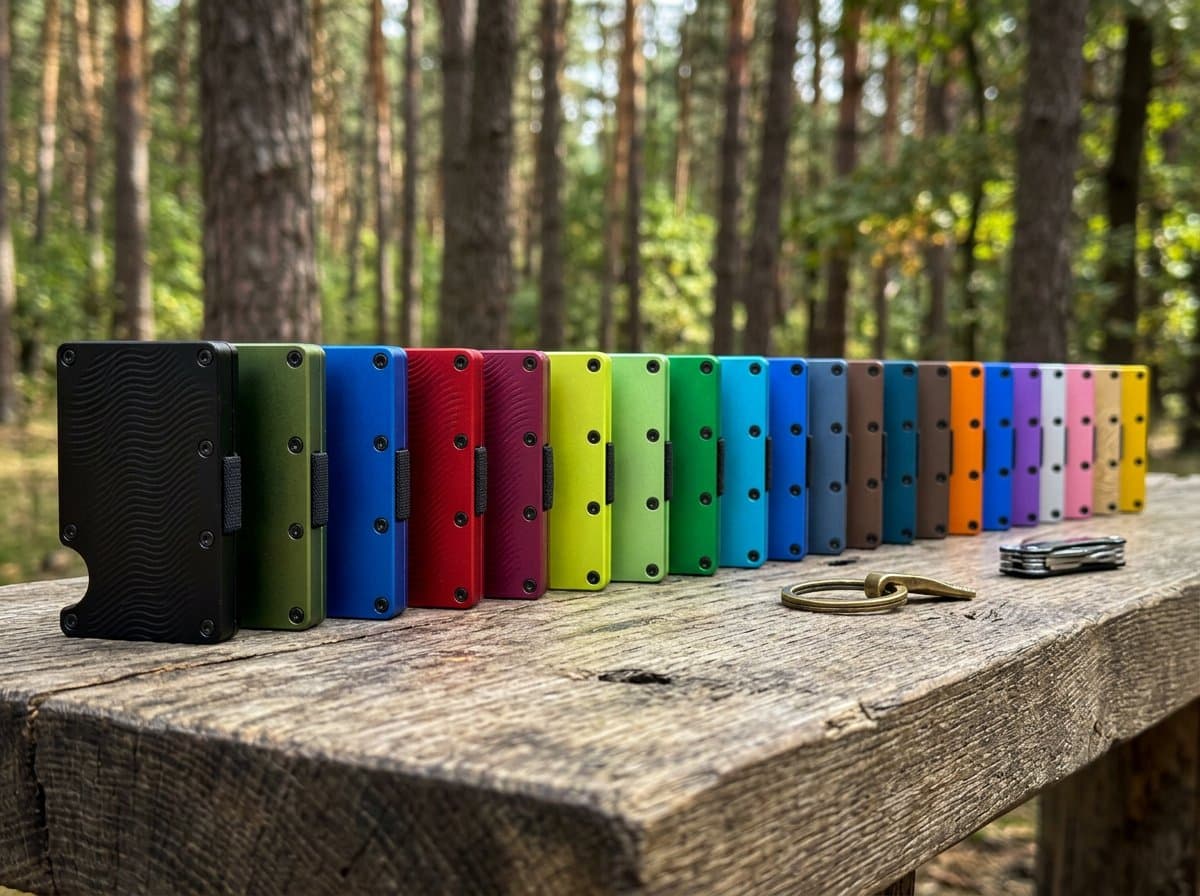
Metal wallets — particularly CNC-machined aluminum — offer inherent RFID protection because the metal body itself blocks signals. They are also slimmer than leather wallets holding the same card count. The trade-off is rigidity: metal wallets do not flex, and some users find them uncomfortable in back pockets.
The search for "mens wallets near me" rarely stops at wallets. Buyers seeking slim carry solutions also look for:
Minimalist card holders — holding 4–8 cards in a rigid frame
Key organizers — combining key storage with a pocket tool
Money clips — attaching to the wallet exterior for cash storage
Travel wallets — with passport slots and multi-currency compartments
The minimalist trend has driven significant demand for cardholders over traditional bifolds. A 2024 survey of men aged 25–40 found that 61% preferred slim cardholders for daily carry, reserving full wallets for travel or formal occasions. Manufacturers have responded by expanding cardholder production lines.
How much should a decent wallet cost? The answer depends on whether you are buying one or buying a thousand.
Retail pricing follows a predictable structure:
Budget tier (under $20): PU leather or bonded leather, basic stitching, no verified RFID protection. These wallets last 6–18 months with daily use.
Mid-range ($20–$60): Genuine leather or basic aluminum. Better stitching density and some RFID protection. The sweet spot for most consumers.
Premium tier (over $60): Full-grain or top-grain leather, CNC-machined metal, verified RFID blocking, branded hardware.
The "near me" tax is real. Retail stores typically apply a 50–100% markup over wholesale costs to cover rent, staffing, and inventory risk. A wallet that costs $12 to manufacture and $18 wholesale sells for $35–$40 at retail. For a business buying 500 units, that markup represents thousands of dollars in unnecessary cost.
Imperfect insight: Retail markup is not pure waste — it pays for the ability to see and touch the product before purchase. For single personal purchases, that value is worth the premium. For bulk orders, the value disappears because you cannot inspect all 500 units anyway.
When you do visit a local store, here is what separates quality from junk:
Stitching density: Count stitches per inch (SPI). Quality wallets use 7–10 SPI; cheap wallets use 4–5 SPI and are more likely to unravel.
Thread material: Bonded nylon or polyester thread resists UV damage and abrasion. Cotton thread rots over time.
Edge finishing: Painted and burnished edges indicate careful construction. Raw, rough edges suggest automation with no quality control.
Hinge mechanism (metal wallets): A quality hinge uses a stainless steel pin or screw assembly. Avoid wallets with plastic hinges or riveted joints that cannot be tightened.
Card tension: Insert a card and check how it seats. Loose cards fall out; cards that require force to insert will stretch the slot over time.
The SERP for "mens wallets near me" is cluttered with retail categories and delivery options. Understanding what those results represent helps you filter the noise.
Search engines aggregate wallets into predictable categories:
Bifold and trifold wallets — the traditional default, holding 8–12 cards plus cash
Money clip wallets — combining a metal clip with a slim card pocket
Travel wallets — passport-sized, with multiple compartments for documents and foreign currency
Smart wallets — with Bluetooth tracking or GPS capabilities, typically $80–$200
For business buyers, the category matters less than the manufacturing process behind it. A bifold from a factory with poor quality control fails differently than a cardholder from a precision CNC shop. The product category determines what your customers need; the supplier determines whether it survives daily use.
The rise of same-day delivery platforms — Instacart, Amazon Prime Now, and similar services — has blurred the line between local and remote purchasing. When you order a wallet through a delivery app, it ships from a regional warehouse, not a local craftsman.
This shift has an important implication: proximity no longer guarantees quality or origin. A "local" purchase may be manufactured 5,000 miles away. Conversely, a direct-from-manufacturer purchase can arrive in the same timeframe as a retail delivery — at a fraction of the cost per unit.
If you are sourcing wallets for resale, private label, or promotional use, the evaluation framework differs from personal buying. Here is a structured approach.
Step 1: Verify manufacturing capability. Ask for photos or video of the production floor. A factory that performs CNC machining in-house has different quality control than one that outsources metal work.
Step 2: Request material certifications. Legitimate suppliers provide material test reports — leather grain certificates, aluminum alloy grades, and coating compliance (such as REACH or RoHS for EU markets).
Step 3: Order samples — plural. One sample proves nothing. Order three to five samples of the same product and compare them for consistency. Inconsistent samples indicate poor production control.
Step 4: Check defect rates. Ask for the factory's internal defect rate (target: under 2%) and their return policy for defective units.
Step 5: Assess communication responsiveness. A supplier who answers technical questions clearly and quickly will handle production issues the same way. Vague answers about materials or processes are a red flag.
What is your defect rate on metal wallet production?
Can you provide a material test report for the aluminum or leather you use?
What is your lead time for a 1,000-unit order?
Do you offer mixed SKU containers?
What is your policy for defective units discovered after shipment?
Can you replicate a sample I provide, or do you only produce your own designs?
What certifications do you hold (ISO 9001, BSCI, REACH, RoHS)?
Cannot name their machinery. A manufacturer that uses CNC machining knows the machine models. Evasive answers suggest outsourcing.
Quote unrealistically low prices. If a quote is 40% below the market average, the supplier is cutting corners on materials or labor.
Refuse sample orders. Reputable suppliers encourage sampling. Reluctance indicates they cannot meet the quality they claim.
Have no quality control documentation. A factory without inspection records cannot prove consistency.
Choose a local retailer if: you need one wallet today, you value physical inspection, and you accept paying retail markup for convenience.
Choose a direct manufacturer if: you are buying 100+ units, you need custom branding, you want verified technical specifications, or you plan to build a recurring product line.
Understanding how wallets are made helps you evaluate supplier claims. The process differs significantly between leather and metal wallets.
Material selection: Full-grain leather is sourced from tanneries that process hides in batches. Top-grain is sanded to remove imperfections; full-grain retains the natural surface.
Cutting: Leather is cut using steel dies (clicker cutting) or CNC laser cutting. Laser cutting offers precision but can burn edges if settings are wrong.
Skiving: Edges are thinned where panels will fold, reducing bulk at seams.
Stitching: Panels are sewn using industrial machines. Quality factories use 7–10 SPI with bonded nylon thread.
Edge painting: Multiple layers of edge paint are applied and sanded between coats for a smooth, durable finish.
Assembly: Pockets, card slots, and RFID linings are inserted and secured.
Final inspection: Each wallet is checked for stitching defects, edge finish, and card fit.
Material selection: Aluminum 6061-T6 or 7075 alloy is common; titanium (Grade 5) is used for premium products.
CNC machining: Aluminum plates are milled into wallet bodies using 4-axis or 5-axis CNC machines. This process creates the card slots, hinge mounts, and exterior contours.
Deburring: Sharp edges are removed manually or via vibratory finishing.
Surface treatment: Anodizing (for aluminum) or bead blasting creates the final finish. Anodizing also adds corrosion resistance.
Assembly: Hinges, elastic bands, or leather inserts are added.
Quality control: Each unit is tested for hinge operation, card fit, and RFID blocking effectiveness.
RFID blocking is tested using a card reader and a signal meter. A wallet passes if the card's signal is reduced by a specific threshold (typically 20–30 dB) at 13.56 MHz. Reputable manufacturers conduct this test on a sample basis — typically 5–10 units per production batch.
The transition from "mens wallets near me" to "mens wallets from a verified manufacturer" is straightforward once you understand the supply chain.
Business buyers have two manufacturing paths:
OEM (Original Equipment Manufacturing): You provide the design, specifications, and materials. The factory manufactures to your exact requirements.
ODM (Original Design Manufacturing): The factory proposes designs based on market research and current trends. You select a design, add your branding, and the factory produces it.
OEM requires more upfront work but gives you full control. ODM is faster and lower-risk — you leverage the factory's design expertise. Most new wallet brands start with ODM and shift toward OEM as they learn what their customers want.
Here is how the industry standards translate to our production floor. As a manufacturer with 13+ years of experience, we operate in-house CNC machining lines for metal wallets and cardholders. This is not about cutting metal for its own sake — it is about controlling two critical variables: RFID shielding effectiveness and hinge durability.
A CNC-machined aluminum body provides inherent RFID blocking because the metal layer is continuous. There is no lining to delaminate or degrade. The hinge mechanism — the most common failure point on metal wallets — is machined to tolerances of ±0.05 mm, ensuring smooth operation over thousands of open-close cycles.
Our monthly production capacity of 300,000+ units means your inventory is not hostage to a boutique workshop's schedule. When your sales spike, we scale production. When you need to test a new design, our flexible MOQs let you place small trial orders without committing to container volumes.
Quality control follows a multi-stage inspection process. Incoming materials are verified against specifications — aluminum alloy grades are confirmed, leather lots are checked for grain consistency. In-process inspections occur at critical points: after CNC machining, after surface treatment, and after assembly. Final inspection checks every unit for defects, with a target defect rate under 2%.
This approach addresses the question of cost directly. Our scale allows us to source materials at competitive prices, and our in-house production eliminates middleman markups. The result is a wholesale unit cost that allows retailers to maintain healthy margins while pricing competitively against mass-market brands.
Reputable wallet manufacturers hold certifications that verify their quality systems and material compliance:
ISO 9001: Quality management system certification
BSCI: Business Social Compliance Initiative (labor and ethics)
REACH: EU regulation on chemical substances (relevant for leather treatments)
RoHS: Restriction of Hazardous Substances (relevant for electronics in smart wallets)
When evaluating a supplier, request copies of these certifications and verify them with the issuing body. A supplier who cannot produce certification documents is not a supplier — they are a risk.
Where is the best place to buy wallets?
For a single personal purchase, local department stores are acceptable — you can inspect the product physically. For businesses, the best source is a direct manufacturer. Wholesale pricing, customization options, and consistent quality are only available from factories, not retailers.
How much should a decent wallet cost?
A decent retail wallet costs between $30 and $60. Below $20, materials and construction degrade noticeably. Above $60, you are paying for brand name or premium materials. Wholesale costs should run $8–$20 per unit depending on material and complexity, with metal wallets at the higher end.
What 6 things should you not carry in your wallet?
Extra keys — they tear stitching and scratch metal finishes.
Coins — they stretch leather seams and add unnecessary bulk.
Excess receipts — they accumulate and throw off the wallet's balance.
Your Social Security card — identity theft risk if the wallet is lost.
A USB flash drive — rigid casings snap under sitting pressure.
Spare SIM card tools — they can press into and damage cards.
Are metal wallets better than leather wallets?
It depends on the user. Metal wallets offer superior RFID protection and longevity but are rigid. Leather is flexible and comfortable but wears out and requires a separate RFID lining. Hybrid designs combine a metal frame with leather or elastic interiors to get the best of both.
How do I choose a wallet manufacturer?
Look for verifiable manufacturing capability (in-house machinery), material certifications, sample consistency, and transparent communication. A manufacturer offering OEM and ODM services is typically more flexible than one selling only stock designs. Request defect rate data and quality control documentation before committing.
RFID Journal. "Understanding RFID Frequency Bands." https://www.rfidjournal.com
ASTM International. "D4935 - Standard Test Method for Measuring the Electromagnetic Shielding Effectiveness of Planar Materials." https://www.astm.org
International Organization for Standardization. "ISO 9001:2015 Quality Management Systems." https://www.iso.org
European Chemicals Agency. "REACH Regulation." https://echa.europa.eu
Business Social Compliance Initiative. "BSCI Code of Conduct." https://www.amfori.org
Statista. "Men's Wallet Market Size and Trends." https://www.statista.com
Ready to move beyond the "near me" search and source wallets directly from a manufacturer that meets the standards outlined above? We work with brands, wholesalers, and online sellers worldwide, offering OEM and ODM solutions with flexible MOQs. <a href="<a href=" https:="" www.gstartec.com="" contactus.html"="" target="_blank" rel="noopener noreferrer">https://www.gstartec.com/contactus.html">Get a quote within 24 hours and start your project with a partner who understands production.
<a href="<a href=" https:="" www.gstartec.com="" contactus.html"="" target="_blank" rel="noopener noreferrer">https://www.gstartec.com/contactus.html" style="display:inline-block;padding:12px 24px;background:#2563eb;color:#fff;text-decoration:none;border-radius:6px;font-weight:600">Get a Free Quote


