

Views: 362 Author: Professor Leon Publish Time: 09-01-2026 Origin: Site


Content Menu
● 1. 1. What Does "Wallets Near Me" Mean for B2B Buyers?
● 2. 2. Popular Wallet Categories to Source
● 3. 3. How to Vet a Wallet Manufacturer
● 4. 4. How Much Should a Decent Wallet Cost?
● 5. 5. Design Implications: What Not to Carry in a Wallet
● 6. 6. Sourcing Strategy: Where Is the Best Place to Buy Wallets?
● 7. 7. Production Process: From Raw Material to Finished Wallet
● 8. 8. How We Meet These Standards
● 9. 9. Quality Control: Our Multi-Stage Inspection Process
● 10. 10. Key Quality Indicators for Wallet Buyers
● 11. 11. Certifications and Industry Standards
● 12. 12. Customization and OEM/ODM Options
● 13. 13. Ordering Process: MOQ, Lead Time, and Shipping
● 14. 14. Common Questions About Sourcing Wallets
10 min read
A buyer once told me about a pallet of "premium" leather wallets that arrived with edges peeling after two weeks on the shelf. The factory photos looked great. The samples felt great. The bulk order did not.
That story explains why searching "wallets near me" as a business buyer means something different than it does for a consumer. A consumer wants a store within driving distance. A business buyer needs a supplier who can meet specifications, deadlines, and quality standards consistently.
Physical proximity to a factory is one factor. But production capability, quality systems, and customization experience often matter more than geography.
For procurement professionals, "near" is about supply chain efficiency, not just miles. A factory 5,000 miles away with express shipping and daily communication overlap can outperform a local workshop with inconsistent quality.
Three tiers exist in the wallet supply chain:
| Tier | What They Offer | Best For |
|---|---|---|
| Local retail stores | Finished products, no customization | Emergency stock, small quantities |
| Wholesalers/distributors | Bulk finished goods, limited branding | Resellers without volume commitments |
| Direct manufacturers | Custom OEM/ODM, private label, full control | Brands, e-commerce sellers, established resellers |
Wholesalers add a layer of markup. They also limit your control over materials, design, and quality. Direct manufacturer relationships eliminate the middleman markup and allow custom specifications.
A typical RFID-blocking leather wallet wholesales for $6–9 from a distributor. The same wallet sourced directly from a factory costs $3.50–5.50 depending on volume and materials. That difference is your margin.
When buyers ask about "near," they usually mean logistics. Key criteria:
Lead time: Sample turnaround (3–7 days is standard) and production time (20–45 days depending on complexity)
Shipping cost: Air freight vs. sea freight for your region
Communication overlap: Time zone differences that affect response speed
Sampling speed: How quickly you can iterate on designs
Global manufacturers using express shipping (DHL, FedEx) can deliver samples in 3–5 business days to most destinations. Prototype iterations often match local turnaround times.
Different wallet types require different manufacturing expertise. Matching product category to factory capability is the first filter.
Identity theft statistics continue driving RFID protection demand. The global RFID blocking market has grown steadily as contactless payment adoption increased.
Technical considerations:
Shielding effectiveness: Quality RFID wallets achieve >10 dB attenuation at 13.56 MHz (the frequency used by most contactless cards)
Shielding materials: Aluminum, copper, or specialized RFID-blocking fabric
Testing: Professional verification uses a standardized test method with a card reader and field strength meter
Leather sourcing matters. Full-grain leather offers durability and develops a patina. PU leather provides a lower-cost alternative with consistent appearance.
Production methods differ significantly:
Stitching: Machine stitching (lockstitch) vs. hand stitching (saddle stitch)
Edge painting: Multi-layer application for smooth, durable edges
Heat sealing: Used for synthetic materials to create clean edges without thread
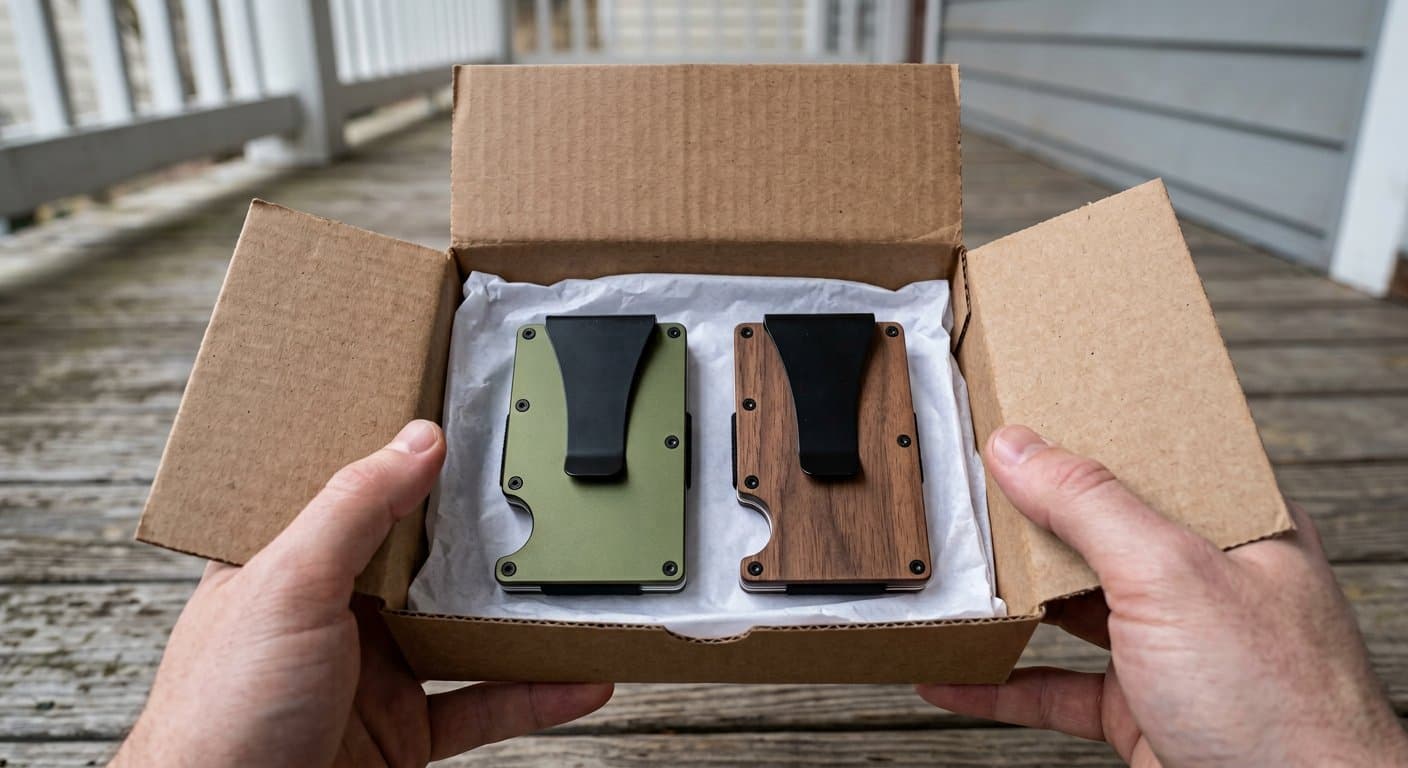
Metal wallets require CNC machining capability. Common alloys include 6061-T6 aluminum (lightweight, corrosion-resistant) and stainless steel (heavier, more durable).
Key processes:
CNC machining: Precise milling of pockets and card slots
Anodizing: Creates a hard, colored surface layer on aluminum
Laser engraving: Permanent logo application
Assembly: Screws, springs, and money clip attachments
Many metal wallets integrate bottle openers or money clips as functional additions.
A niche but growing category: graded card holders protect collectible trading cards in rigid slabs. Bumper guards protect phone-mounted card holders from impact damage.
These products require precise injection molding or CNC machining with tight tolerances. Card holders must fit graded slab dimensions exactly—even 0.5mm variation can make the product unusable.
Use this framework when evaluating any supplier, whether they are around the corner or across an ocean.
Ask direct questions:
Do you have in-house CNC machining, or do you outsource? (Outsourcing risks inconsistent quality and longer lead times)
What is your monthly production capacity? (A serious factory should answer in units, not vague terms)
Which wallet materials do you handle in-house?
Industry benchmarks include:
ISO 9001: Quality management system certification
REACH compliance: EU regulation for chemical safety
RoHS compliance: Restriction of hazardous substances
Inspection processes matter. Look for factories with in-line QC (checking during production) plus final random inspection (AQL sampling) before shipment.
Request specifics:
Can you handle logo application (laser engraving, embossing, screen printing)?
Do you offer custom mold design and tooling?
Can you produce custom packaging?
May I see previous OEM/ODM case studies?
A factory with genuine OEM experience will show you past projects without hesitation.
Wholesale pricing varies widely by material and construction:
| Wallet Type | Wholesale Price Range (USD/unit) |
|---|---|
| PU leather, basic card holder | $1.50–3.00 |
| Genuine leather, RFID blocking | $4.00–8.00 |
| Aluminum metal wallet | $3.00–6.00 |
| Titanium wallet | $8.00–15.00 |
| Graded card holder | $2.00–5.00 |
Price depends on material thickness, hardware quality (snaps, rivets), RFID fabric, and labor costs. MOQ affects unit price significantly—dropping from 500 to 5,000 units often reduces per-unit cost by 20–30%.
"Decent" is defined by durability testing, not appearance. Quality leather wallets withstand 50,000 flex cycles without cracking. Metal wallets undergo drop tests from 1.5 meters. RFID shielding must block consistently, not occasionally.
Most people carry too much. Common wallet-clogging items include:
Coins — add bulk and stress stitching
Extra keys — scratch card surfaces and stretch material
Thick paper receipts — distort the wallet's shape
Multiple loyalty cards — redundant when phone apps exist
Passport (when not traveling) — oversized and risky if lost
Loose paper notes — get damaged and create clutter
For manufacturers, this drives design decisions. Slim profiles require structured compartments that discourage overstuffing. RFID protection adds an extra consideration: the shielding layer must remain intact even with daily flexing.
Buyers should request designs that encourage minimalism. A slim wallet that lasts five years outperforms a bulky wallet that falls apart in eighteen months.
The honest answer depends on your order size and needs:
Local craft markets: Good for handmade, low-volume (50–200 units). Inconsistent for scaling.
B2B marketplaces: Wide supplier choice but variable quality. Requires careful vetting.
Direct manufacturer partnerships: Best for scaling. Offer flexible MOQs, custom design, and consistent quality control.
The "best" source offers three things: flexible MOQ for testing, fast sampling for iteration, and production capacity for growth.
Understanding production steps helps buyers evaluate factory claims.
For leather wallets:
Cutting — leather is die-cut or laser-cut to pattern
Skiving — edges are thinned where layers join
Stitching/Assembly — layers are bonded and stitched
Edge finishing — edge paint applied in multiple coats
Hardware installation — snaps, rivets, or magnetic closures
RFID layer insertion — shielding material placed between layers
Quality inspection — dimension checks, stitch density verification
Packaging — individual wrapping, box assembly
For metal wallets:
CNC machining — aluminum block milled to shape
Deburring — sharp edges smoothed
Surface finishing — sandblasting, brushing, or polishing
Anodizing — color application through electrochemical process
Laser engraving — logos and designs applied
Assembly — screws, elastic bands, or hinges installed
Function testing — card insertion/removal cycles
Packaging — protective wrapping to prevent scratches
Each step has failure points. Edge paint that is applied too thinly will peel. CNC tolerances that drift cause loose card retention. This is why single-stage inspection is insufficient—multi-stage quality control matters.
The framework above describes what serious buyers should look for. Here is how our manufacturing operation aligns with those criteria.
As a manufacturer specializing in RFID wallets, key organizers, graded card holders, and bumper guards, Gstar Technology (Shenzhen) Co., Ltd. approaches production with in-house precision capabilities. Our CNC machining department handles metal wallet production entirely in-house—we do not outsource critical tolerances.
With 13+ years serving brands, wholesalers, and online sellers worldwide, our production systems reflect lessons learned across thousands of orders. Our monthly capacity of 300,000+ units means we scale from pilot runs to container volumes without changing processes.
OEM/ODM is not an afterthought. We manage custom molds, logo application, and packaging design as standard workflow, not special requests. Clients receive samples within 3–7 days for standard designs, with custom tooling extending the timeline based on complexity.
Our quality control follows the multi-stage approach described in Section 7. In-line checks during production catch issues early. Final AQL random inspection protects your shipment before it leaves our facility.
Quality claims require specifics. Our process:
Incoming material inspection: Leather hides, aluminum stock, and RFID fabric verified against specifications
In-line QC during production: Operators check dimensions and finish at each station
First article inspection: The first unit from each production run is fully verified before mass production continues
Final random inspection: AQL 2.5 standard sampling before shipment
Durability spot checks: RFID shielding tested with field strength meters; leather flex tested; metal wallets drop tested
One imperfect insight worth noting: no factory ships 100% perfect orders. The difference is whether defects are caught before shipment or discovered by your customers. Our inspection process catches issues at the source, where they cost pennies to fix—not after a container ships, where they cost thousands to remedy.
When comparing suppliers, use these indicators:
Stitch density: 8–10 stitches per inch is standard for quality leather goods
RFID attenuation: Request test reports showing >10 dB at 13.56 MHz
Material thickness: Leather wallets typically use 1.0–1.2mm hides; metal wallets use 1.5–3.0mm aluminum
Hardware quality: YKK or equivalent zippers; brass or stainless steel snaps
Edge finish: Smooth, even edge paint without visible brush marks
Packaging: Individual dust bags or boxes prevent transit damage
Reputable manufacturers hold verifiable certifications. Request copies and verify with issuing bodies:
ISO 9001:2015 — Quality management systems
REACH — EU chemical safety compliance
RoHS — Restriction of hazardous substances in electronics and components
Prop 65 — California's chemical disclosure requirement
RFID products may also reference testing standards from organizations like the International Organization for Standardization for contactless card frequency performance.
Custom wallet projects typically involve one or more of these elements:
Logo application: Laser engraving, embossing, screen printing, or metal tags
Material selection: Specify leather type, metal alloy, or RFID fabric
Design modification: Adjust card slots, add money clips, change dimensions
Custom packaging: Printed boxes, poly bags with headers, display stands
Hardware branding: Custom snaps, rivets, or zipper pulls with your logo
Standard timelines for custom wallet orders:
| Step | Duration |
|---|---|
| Sample production (standard design) | 3–7 days |
| Sample production (custom mold) | 10–20 days |
| Mold/tooling creation | 15–25 days |
| Bulk production | 20–35 days |
| Sea freight to US West Coast | 18–25 days |
| Sea freight to Europe | 25–35 days |
| Air freight (door-to-door) | 5–8 days |
Flexible MOQs matter for new brands. Testing a market with 300 units is different from committing to 5,000. Look for manufacturers who accommodate initial low-volume orders with a path to scale.
A decision guide: Choose a local supplier if you need rush orders under 500 units, require in-person factory visits for compliance reasons, or your product requires face-to-face iteration. Choose a global manufacturer if you need custom OEM/ODM capabilities, competitive pricing at volume, or a partner who can scale from hundreds to hundreds of thousands of units.
Where is the best place to buy wallets in bulk?
Direct from a manufacturer or a specialized sourcing agent. Manufacturers offer the lowest per-unit pricing and full customization control. Sourcing agents add value when you lack experience with international suppliers.
Can I customize a wallet with my own brand logo?
Yes. OEM services include laser engraving, embossing, printing, and custom hardware. Each method suits different materials—laser engraving works on metal and leather; embossing suits full-grain leather; screen printing works on synthetics.
How long does it take to receive a sample?
Standard samples ship within 3–7 days. Custom designs requiring new molds or tooling take 10–20 days. Factor in shipping time (3–5 business days for express delivery to most destinations).
What is the typical MOQ for custom wallets?
MOQ varies by factory and product complexity. Standard leather wallets might require 300–500 units for custom branding. Metal wallets with new molds typically require higher minimums. Some manufacturers offer lower MOQs for first-time collaborations.
How do I verify a wallet supplier is legitimate?
Request business licenses, factory photos or video tours, and client references. Check certifications like ISO 9001. Ask for a sample order before committing to bulk production. Consider third-party inspection services for your first shipment.
Finding a wallet supplier is about matching capabilities, not just geography. The right partner offers consistent quality control, real customization experience, and production capacity that scales with your business.
Quality wallets require attention to material selection, production precision, and multi-stage inspection. A manufacturer who controls these processes in-house is better positioned to deliver consistent results than one who outsources critical steps.
Start with samples. Verify claims with data, not promises. And choose a partner who can grow with you—from first test order to full container shipments.
International Organization for Standardization. "ISO 9001:2015 Quality management systems — Requirements." https://www.iso.org/standard/62085.html
European Chemicals Agency. "REACH regulation." https://echa.europa.eu/regulations/reach/understanding-reach
RoHS Guide. "RoHS Compliance Guide." https://www.rohsguide.com/
California Office of Environmental Health Hazard Assessment. "Proposition 65." https://oehha.ca.gov/proposition-65
International Organization for Standardization. "ISO/IEC 14443 Identification cards — Contactless integrated circuit cards." https://www.iso.org/standard/73598.html


