

Views: 258 Author: Princee Lee Publish Time: 03-23-2026 Origin: Princee Lee


Content Menu
● The Evolution of Trading Card Security
>> From Penny Sleeves to the Grading Era
>> The Limitations of Standard Plastic Slabs
● Technical Analysis: Why Metal is the Ultimate Choice
>> The Superiority of 6061 Aluminum Alloy
>> Impact Resistance and Structural Integrity
● Built-in Magnetic Fasteners: The One-Touch Revolution
>> Engineering the Perfect Seal
>> Ease of Access vs. Security
● Optical Perfection: The Role of High Alumina Glass
>> Scratch Resistance and Clarity
>> The Science of UV Protection
● Aesthetics and the Art of the Display
>> Colors, Finishes, and Collector Personalization
>> Organizing Large Collections with Stackable Designs
● Compatibility with Major Grading Services
>> Accommodating the Thickness of BGS and SGC
● Practical Maintenance for the Discerning Collector
>> Cleaning and Care of Metal Surfaces
>> Avoiding Slab-to-Metal Friction Scratches
● Economic Justification for Premium Protection
>> Risk Mitigation for High-Value Assets
>> Resale Value and Professional Presentation
● Related Questions and Answers
The world of trading card collecting has undergone a seismic shift over the last decade. What once began as a hobby for children trading cards on playgrounds has evolved into a multi-billion-dollar alternative asset class. With the rise of professional grading services like BGS, and SGC, the value of a single piece of cardboard can now reach into the millions. As these assets appreciate, the demand for secondary protection has never been higher. Enter the durable metal grading card case with a built-in magnetic fastener—a pinnacle of engineering designed to provide the ultimate shield for the world's most prized collectibles.
To understand why a metal case is necessary, one must look at the history of card preservation. In the early days, collectors relied on soft "penny" sleeves and rigid plastic top-loaders. While these provided basic defense against fingerprints and light surface scratches, they offered almost no protection against bending, humidity, or significant impacts.
The introduction of third-party grading changed the landscape. Companies began "slabbing" cards in ultrasonically sealed plastic holders. These slabs provided a standardized way to view and protect cards while certifying their condition. However, as the market matured, collectors realized that the slabs themselves were vulnerable. Scratches on the plastic can obscure the card's beauty, and a drop onto a hard floor can chip the corners or even crack the seal of a $50,000 asset.

Standard slabs are made of various types of plastic, typically acrylic or polycarbonate. While durable, they are prone to "scuffing" over time. Furthermore, most standard slabs offer limited protection against ultraviolet light. Over years of display, the sun's rays can cause ink to fade and paper to yellow, permanently devaluing the card. This led to the development of the "slab protector" or "slab guard," which initially appeared as silicone bumpers or thin plastic sleeves. But for the serious investor, these were merely stop-gap measures. The need for a more robust, "vault-like" solution led to the creation of the metal grading card case.
Choosing a metal housing for a graded card is not just about aesthetics; it is a matter of structural engineering. Unlike plastic, which can warp under heat or become brittle over time, high-grade metals offer a level of stability and protection that is unmatched in the hobby industry.
Most premium metal card cases are constructed from 6061 aluminum alloy. This specific grade of aluminum is widely used in the aerospace and automotive industries because of its incredible strength-to-weight ratio. By using a CNC (Computer Numerical Control) machining process, manufacturers can carve a single block of aluminum into a precise frame that fits a grading slab with sub-millimeter accuracy. This ensures that there is no "rattle" inside the case, which is a major concern for collectors who worry about the slab edges wearing down against the metal frame.
Aluminum provides a rigid skeleton that absorbs energy during a fall. If a plastic slab drops, the shock is transmitted directly to the card. In a metal case, the frame acts as an exoskeleton. Many of these cases also feature internal gaskets or cushioned linings that act as a suspension system for the slab. This dual-layer defense—a hard metal exterior and a soft internal interface—is the gold standard for preventing damage from accidental drops or heavy pressure.

One of the most innovative features of modern high-end cases is the built-in magnetic fastener system. Traditional cases often relied on screws or snap-fit mechanisms. Screws are cumbersome and can be overtightened, potentially cracking the case, while snap-fits can wear out or lose their grip over time.
The built-in magnetic fastener uses high-strength neodymium magnets strategically placed at the corners or along the perimeter of the frame. These magnets provide a "one-touch" experience, allowing the collector to open and close the case in seconds without tools. The engineering challenge lies in the "pull force." The magnets must be strong enough to keep the case sealed even if it is dropped, yet calibrated so that a human can still open it without specialized equipment.
For many collectors, the ability to frequently swap cards or inspect them is vital. The magnetic fastener allows for this flexibility. Because the magnets are "built-in" or recessed into the metal frame, there is no risk of them falling out or scratching the card slab. This seamless integration creates a sleek, flush look that mimics the high-end feel of luxury watch packaging or premium electronics.
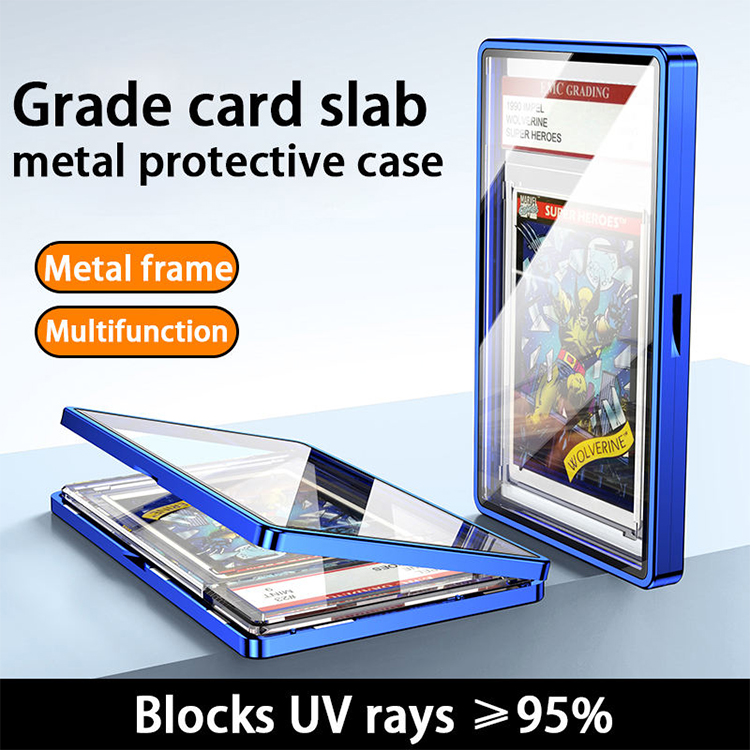
A metal frame is useless if you cannot see the card clearly. The "window" of the case is just as important as the frame itself. While early cases used acrylic, the modern durable metal grading card case often employs high alumina tempered glass.
Tempered glass is significantly harder than the plastic used in grading slabs. On the Mohs scale of mineral hardness, tempered glass sits much higher than typical plastics, meaning it is virtually immune to the hairline scratches that plague standard holders. This crystal-clear transparency ensures that the card's holographic foil and intricate artwork are displayed in their full glory without any distortion.
The silent killer of trading cards is UV radiation. Both natural sunlight and certain types of indoor lighting emit rays that break down the chemical bonds in ink. High-end metal cases often incorporate UV-blocking coatings or specialized glass that filters out up to 99% of harmful rays. This is a critical feature for collectors who wish to display their cards on shelves or in wall-mounted frames. By housing a slab inside a UV-resistant metal case, the collector adds a second, more powerful filter that ensures the card's colors remain vibrant for decades.
Collecting is as much about the "flex" or visual appeal as it is about the investment. A raw plastic slab looks clinical and uniform. A metal case, however, can be customized to complement the card it holds.
Through a process called anodizing, manufacturers can produce aluminum frames in a wide array of colors—from deep "Charizard Red" to sleek "Black Lotus" matte finishes. This allows collectors to create a cohesive look for their "Grail" cards. Some premium cases even offer "gradient" finishes or laser-etched patterns, turning the storage device into a piece of art itself.
For those with large collections, storage density is a concern. Many durable metal cases are designed with a "nesting" or stackable feature. The magnetic fasteners often help align the cases when they are placed on top of one another, preventing them from sliding around. This makes it possible to store dozens of high-value cards in a compact, organized, and extremely secure manner.
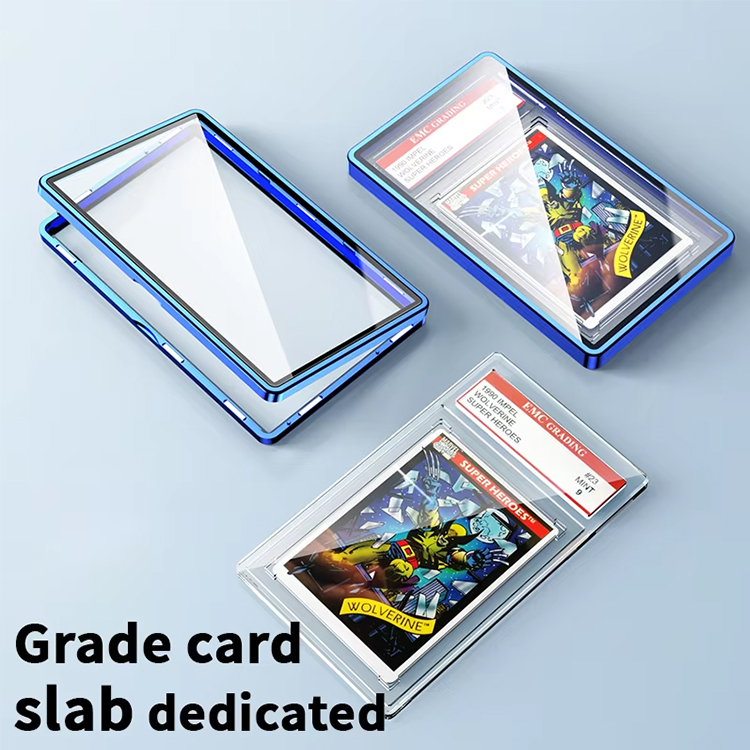
Not all grading slabs are created equal. A PSA slab is thinner than a BGS "thick" slab, and SGC slabs have their own unique footprint. A truly versatile metal case must account for these variations.
PSA is the most popular grading service, and their standard slabs are relatively thin. Metal cases designed for PSA usually focus on a slim profile that maintains the "pocketability" of the card while adding the necessary weight and protection. Precise machining ensures the slab doesn't slide vertically, which could damage the PSA label.
Beckett (BGS) slabs are famous for their thickness and "inner sleeve" design. To accommodate these, metal case manufacturers offer "High-PT" versions with deeper internal cavities. By offering interchangeable internal gaskets or specific models for each company, the durable metal grading card case ensures that every collector, regardless of their preferred grading house, has access to premium protection.
Owning a high-end metal case requires a small amount of upkeep to ensure it continues to look and perform its best. Since aluminum and glass are different materials than the plastic collectors are used to, the cleaning methods differ as well.
Anodized aluminum is very resistant to fingerprints, but it can still collect oils from skin over time. A simple wipe with a microfiber cloth is usually sufficient. It is important to avoid abrasive cleaners or harsh chemicals that could strip the anodized layer. For the glass portion, a standard lens cleaner used for eyeglasses is the safest option to maintain perfect clarity.
One criticism of early metal cases was that the hard metal edges could scratch the softer plastic of the grading slab. To solve this, modern designs incorporate "buffer zones." These may be small silicone pads in the corners or a thin TPU lining. When placing a card into a metal case, the collector should ensure that these buffers are clean and properly seated. This ensures that the only thing the metal touches is the protective lining, keeping both the case and the slab in mint condition.
Skeptics might ask why someone would spend $40 to $100 on a case for a card that is already in a plastic slab. The answer lies in the math of risk mitigation.
If a collector owns a 1st Edition Base Set Charizard PSA 10, that card represents an asset worth hundreds of thousands of dollars. A 1% chance of an accident causing a "re-holdering" event (which costs money and risks the card's grade being downgraded if the slab cracked) is a risk not worth taking. Spending a fraction of a percent of the card's value on a metal case is essentially a one-time insurance premium.
In the high-end "peer-to-peer" trading market, presentation matters. A card presented in a premium metal case with a magnetic fastener signals to potential buyers that the owner is a serious collector who takes care of their assets. It adds a "premium" feel to the unboxing experience, which can often lead to faster sales and higher closing prices.

The durable metal grading card case with a built-in magnetic fastener represents the ultimate intersection of hobby passion and industrial engineering. By combining the strength of 6061 aluminum alloy, the clarity of high alumina tempered glass, and the convenience of neodymium magnetic fasteners, these cases offer a level of protection that plastic simply cannot match. For the collector who views their cards as more than just cardboard, but as pieces of history and valuable investments, this type of housing is not a luxury—it is a necessity. As the hobby continues to grow and values continue to climb, the standard for protection will only rise, leaving the metal case as the undisputed king of the display shelf.
Q1: Will the magnets in the case damage the holographic foil or the card's surface?
A1: No. The neodymium magnets used in these cases are static and do not emit a electromagnetic field strong enough to affect the physical properties of a trading card. Trading cards do not contain magnetic storage media, so they are completely safe from magnetic interference.
Q2: Are these metal cases waterproof or airtight?
A2: While the built-in magnetic fastener provides a very tight seal that protects against dust and splashes, most metal cases are not 100% airtight or submersible. They are designed for atmospheric protection and impact resistance rather than underwater use.
Q3: Can I fit a "raw" card (ungraded) into a metal grading card case?
A3: Most of these cases are specifically machined to the dimensions of a graded slab (PSA/BGS). However, some manufacturers offer "raw card" inserts or frames that allow you to hold a card in a penny sleeve or semi-rigid holder within the metal frame. It is best to check the specific model's compatibility.
Q4: Does the added weight of the metal case make it harder to store in standard boxes?
A4: Yes, metal cases are significantly heavier and slightly larger than standard slabs. They will not fit into traditional plastic "slab bins" or cardboard "shoe boxes." Most collectors who use metal cases store them in specialized "Pelican-style" hard cases with foam inserts or on dedicated display stands.
Q5: Is it possible for the metal frame to interfere with the UV protection of the glass?
A5: No. In fact, the metal frame enhances protection by being completely opaque, meaning no light can enter through the edges of the slab. The UV-blocking occurs within the glass pane itself, so the metal frame acts as a perfect structural partner to the optical protection.


