

Views: 468 Author: Professor Leon Publish Time: 09-01-2026 Origin: Site


Content Menu
● 1. Best RFID Blocking Card: A B2B Buyer's Sourcing Guide
● 2. How Do RFID Blocking Cards Actually Work?
● 3. What Are the Main Types of RFID Blocking Cards?
● 4. How Should Buyers Verify RFID Blocking Performance?
● 5. How to Evaluate RFID Blocking Card Suppliers
● 6. How We Meet These Standards as a Manufacturer
● 7. Frequently Asked Questions
10 min read
A procurement manager for a European accessories brand opens a sample box from three different suppliers. Each box contains a metal card that claims to block RFID scanning. One card is magnetic. Another scratches a credit card after two weeks of use. The third works — but the laser engraving fades within a month.
This is the reality of sourcing RFID blocking cards. The phrase "best RFID blocking card" means something different to a consumer browsing Amazon than it does to a buyer placing a 5,000-unit order. For a consumer, "best" might mean the cheapest card that stops the contactless reader at the grocery store. For a B2B buyer, it means consistent shielding performance across every unit, reliable supply, and a manufacturer who can execute custom branding without cutting corners.
This guide covers the technology behind RFID blocking, the performance metrics that separate good cards from bad ones, and the sourcing framework professional buyers use before committing to a supplier.
An RFID blocking card contains a conductive material — typically aluminum, copper, or a solid metal body — that disrupts the electromagnetic field emitted by an RFID reader. When a reader sends out a signal to power a nearby chip, the conductive layer in the blocking card reflects or absorbs that signal, preventing the chip from receiving enough energy to transmit data.
To evaluate a card properly, buyers need to understand the frequency bands involved:
Low Frequency (LF) — 125 kHz: Used for access control, animal identification, and some older key fobs.
High Frequency (HF/NFC) — 13.56 MHz: The band used by contactless credit cards, passports, transit cards, and smartphone payment systems. This is the most critical band for consumer products.
Ultra-High Frequency (UHF) — 860 to 960 MHz: Used for toll tags, inventory tracking, and some logistics applications.
A card that only blocks HF frequencies may still leak signals at LF or UHF. The best RFID blocking card for commercial use should attenuate across all three bands, not just the one that protects credit card payments.
Shielding effectiveness (SE) is measured in decibels (dB) and represents how much a material reduces the strength of an electromagnetic signal. Industry consensus places effective blocking at –40 dB or better — this represents a 99.99% signal reduction. Premium cards achieve –60 dB or more, which is a 99.9999% reduction.
The testing method typically follows ASTM D4935, a standard for measuring the electromagnetic shielding effectiveness of planar materials. A loop antenna transmits a signal, and a spectrum analyzer measures what passes through the shielding material.
Cards that claim "NFC blocking" without specifying dB attenuation should raise a red flag. Without a measurable standard, the claim is marketing language, not engineering data.
Credit cards follow the CR80 standard: 85.6 mm × 54 mm × 0.76 mm. RFID blocking cards generally match this footprint so they can sit alongside credit cards in a wallet slot.
Here is an imperfect insight that most consumer reviews miss: a blocking card that performs well in isolation may fail in a crowded wallet. If the shielding layer is thin or discontinuous, the card it protects can still be read when both are stacked together. The geometry of the wallet, the position of the cards, and the power of the reader all affect real-world performance. This is why batch-level testing matters more than a single sample test.
There are three primary formats available to buyers. Each serves a different price point and brand position.
These cards use a metallic foil layer sandwiched between two PVC layers. They are the most common format in the market.
Pros: Low unit cost, full-color printing on both sides, embossing available
Cons: The foil layer can crack or delaminate with repeated flexing; durability typically spans 2–3 years of daily use
Best for: Promotional items, entry-level retail SKUs, multi-card bundles
Manufactured from stainless steel, aluminum, or titanium, these cards block RFID signals naturally because the entire body is conductive. No internal layer is needed.
Pros: Premium feel and weight, near-indestructible, consistent shielding for the life of the card
Cons: Higher unit cost; printing options limited to laser engraving, UV printing, or screen printing
Best for: Premium wallet accessories, high-end brand bundles, corporate gifts
A metal core wrapped in leather, carbon fiber, or another material combines blocking performance with an aesthetic finish.
Pros: Distinctive look, combines shielding with luxury materials
Cons: Thicker than CR80 standard; higher per-unit cost; material separation risk over time
Best for: Luxury wallets, executive gifts, branded merchandise
| Material | Shielding | Durability | Printing Options | Relative Cost |
|---|---|---|---|---|
| PVC with foil layer | Good (HF-focused) | Moderate (2–3 years) | Full-color offset | Low |
| Aluminum | Excellent (all bands) | High | Laser/UV | Mid |
| Stainless steel | Excellent (all bands) | Very high | Laser/UV | High |
| Titanium | Excellent (all bands) | Very high | Laser/UV | Highest |
The "best" RFID blocking card for a specific brand depends entirely on target price point and positioning. Metal cards dominate the premium segment. PVC cards win on cost and print flexibility.
The most common verification method — placing a card in a wallet and waving a smartphone over it — is not a reliable test. Smartphone NFC readers operate at variable power levels, and a card that appears to block a phone reader may still leak at frequencies used by other scanning equipment.
A proper shielding effectiveness test requires:
An RFID reader/writer capable of operating at the target frequency
A signal generator and spectrum analyzer
A calibrated loop antenna
A test transponder with known response characteristics
The procedure places the blocking card between the reader and the test transponder, then measures the signal drop. A card achieving –40 dB or better attenuation at 13.56 MHz and 125 kHz meets the industry benchmark for effective blocking.
Buyers should ask suppliers directly: "Can you provide shielding effectiveness test data at 13.56 MHz and 125 kHz?" A manufacturer with proper QC processes will have this data available. One that does not may be producing cards without any performance verification.
Several warning signs indicate a supplier may be overstating performance:
Vague language: Claims like "blocks all RFID" without specifying frequency ranges or dB attenuation
No test data: Inability or refusal to share shielding effectiveness measurements
Suspiciously thin cards: A PVC card that is too thin to contain a meaningful continuous metal layer
Unverifiable labels: Terms like "military-grade" without reference to any actual military specification
A serious buyer treats marketing claims as starting points, not evidence. The evidence is test data from a reproducible procedure.
Professional buyers evaluate suppliers against a framework, not a gut feeling. The following criteria apply specifically to RFID blocking cards.
Before contacting suppliers, document your requirements:
Dimensions (CR80 standard or custom)
Material (PVC, aluminum, stainless steel, titanium)
Frequency coverage required (HF only, or HF + LF + UHF)
Shielding effectiveness target (–40 dB minimum, –60 dB preferred)
Printing method and color requirements
Packaging format
Target quantity and unit cost
A written specification sheet serves two purposes. It prevents miscommunication with suppliers, and it makes price comparisons meaningful. Comparing quotes without identical specifications is comparing apples to oranges.
The QC process for RFID blocking cards involves three stages:
Incoming material inspection: Verify metal thickness for solid cards, or foil integrity for PVC cards
In-process checks: Confirm printing registration, lamination quality, and dimensional accuracy
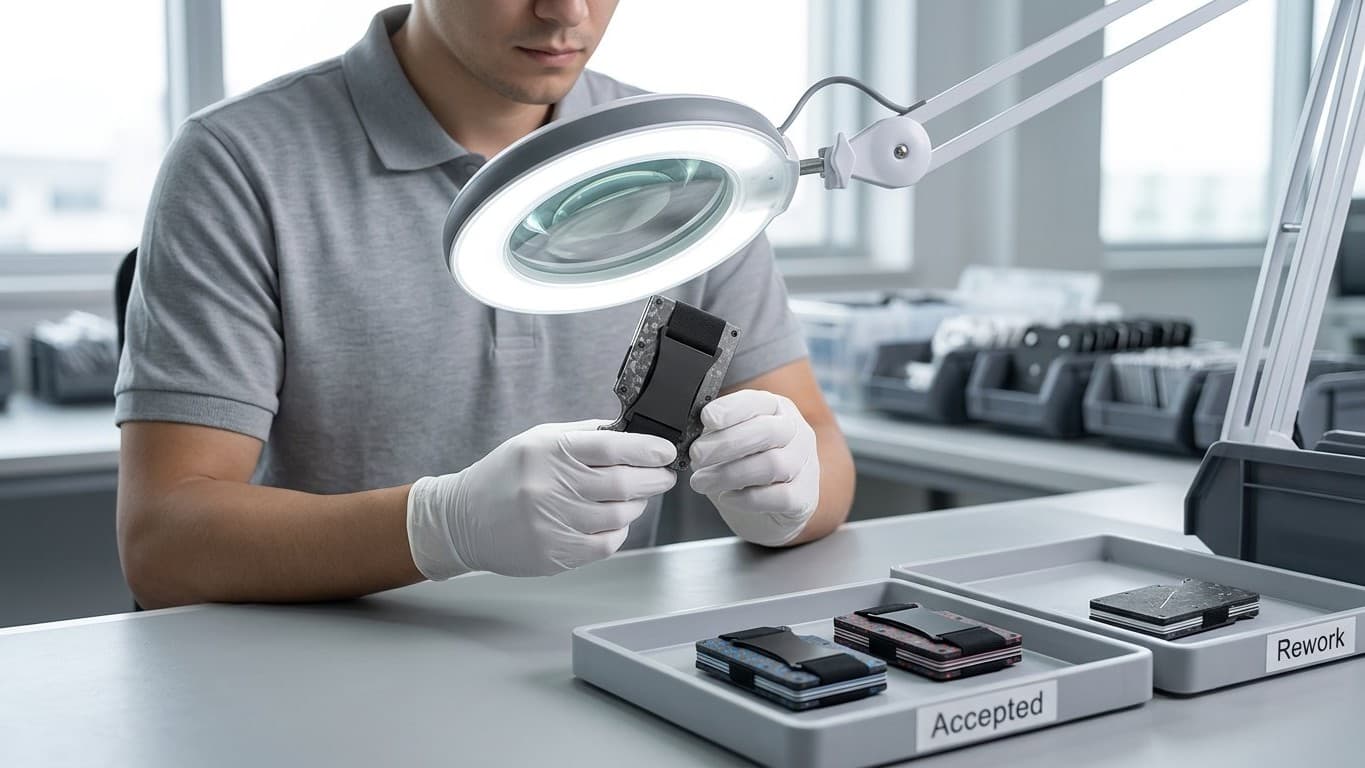
Final random sampling: Test 5–10 cards per batch for shielding effectiveness at target frequencies
Ask the supplier for their QC checklist. A manufacturer with documented processes will share it without hesitation. One without documented processes will hesitate.
Typical MOQs for custom RFID blocking cards range from 500–2,000 units for PVC cards and 300–1,000 units for metal cards. Lead times generally run 15–30 days for standard designs, with longer timelines for complex custom shapes or custom packaging.
Buyers testing a new market should ask about phased delivery options. Some manufacturers will produce a larger batch and store inventory for scheduled release, which helps manage cash flow without losing volume pricing.
Depending on your target market, the following certifications matter:
RoHS and REACH: Required for materials sold in the European Union
ISO 9001: Indicates a documented quality management system at the factory
CE marking: May apply depending on product categorization in the EU
Can you provide shielding effectiveness test data at 13.56 MHz and 125 kHz?
What is your batch-level QC procedure for shielding performance?
What is the MOQ for custom branding (laser engraving or full-color printing)?
What is your defect rate on similar projects?
What happens if a batch fails your final random sampling test?
Can you provide RoHS and REACH compliance documentation?
What is your production lead time including custom packaging?
Cannot or will not share test data
Use "military-grade" or similar terms without a verifiable standard behind them
Cannot explain what material sits inside their PVC cards
Have no documented QC process
Quote significantly below market rates without explanation
The sourcing framework above reflects what professional buyers expect from an RFID blocking card supplier. Here is how we align with those expectations at Gstar Technology.
We manufacture RFID blocking cards and RFID-blocking wallets in our Shenzhen facility, with in-house CNC machining for metal cards and precision lamination for PVC cards. This vertical integration means we control the processes that affect shielding performance: material selection, metal thickness, foil continuity, and finishing quality.
Our monthly production capacity exceeds 300,000 units across our product lines. For buyers evaluating suppliers, this matters because it indicates scale capability — the ability to deliver consistent volume without compromising QC.
We produce private-label RFID blocking cards for brands, wholesalers, and online sellers worldwide. Our OEM services cover custom shapes, materials, and packaging. For buyers with existing designs, we execute to specification. For buyers without designs, our ODM team develops products based on target price points and market positioning.
The 13+ years we have spent manufacturing RFID-blocking wallets and card accessories gives us practical knowledge of real-world shielding requirements. We know which materials hold up under daily use, which printing methods survive contact with keys and coins, and which packaging formats retailers prefer.
Buyers working with us typically move through a straightforward process: share a specification sheet or sample, receive a detailed quotation within 24 hours, and approve samples before mass production begins.
Our MOQ structure accommodates both startups testing a new market and established brands scaling existing product lines. Every production batch undergoes shielding spot checks before shipment, so the cards you receive match the samples you approved.
Choose a metal card if you are targeting the premium segment and need a product that lasts indefinitely. Choose PVC if full-color branding and lower unit cost matter more than longevity. If you are unsure which material fits your market, send us your target price point and quantity — we will recommend the most suitable approach.
Need help selecting the right card for your market? Contact Our Team with your specification, and we will respond with a detailed quotation within 24 hours.
Yes, when properly designed. A card containing a continuous metallic layer — or a solid metal card — attenuates the electromagnetic field from an RFID reader, preventing it from powering the chip inside your credit card or passport. Effectiveness depends on material, thickness, and coverage. Cards tested to at least –40 dB shielding effectiveness at 13.56 MHz are considered reliable.
No. RFID blocking cards are passive — they contain no magnets, batteries, or active electronics. They only interrupt radio waves. They will not demagnetize a magnetic stripe or damage an EMV chip. Physical rubbing against a metal card can scratch a credit card's surface over time, but this is cosmetic, not functional damage.
For resale, the best card is one that meets your target price point while delivering verified shielding performance. Metal cards justify higher retail prices and carry a premium feel. PVC cards work for volume sales at lower price points. The key is documented test data — without it, you cannot verify that what you are selling actually works.
A well-made PVC card with an internal metal foil layer typically lasts 2–3 years before the foil begins to crack from flexing. Solid metal cards last effectively indefinitely — there is no internal layer to degrade. For daily-use products intended to last, metal cards are the more durable investment.
The price difference reflects materials, manufacturing tolerance, and testing. A $2 card may use a thin aluminum layer that blocks only one frequency band and comes with no test data. A $20 card — typically metal — offers verified shielding across multiple bands, better durability, and a premium finish. For a brand, the higher-priced card also carries higher perceived value for retail positioning.
ASTM International. "D4935 – Standard Test Method for Measuring the Electromagnetic Shielding Effectiveness of Planar Materials." https://www.astm.org/d4935-18.html
European Chemicals Agency. "Understanding REACH." https://echa.europa.eu/regulations/reach/understanding-reach
ISO. "ISO 9001:2015 Quality management systems — Requirements." https://www.iso.org/standard/62085.html
EMVCo. "EMV® Contactless Specifications for Payment Systems." https://www.emvco.com/specifications/
<a href="<a href=" https:="" www.gstartec.com="" contactus.html"="" target="_blank" rel="noopener noreferrer">https://www.gstartec.com/contactus.html" style="display:inline-block;padding:12px 24px;background:#2563eb;color:#fff;text-decoration:none;border-radius:6px;font-weight:600">Get a Free Quote


