

Views: 463 Author: Professor Leon Publish Time: 09-01-2026 Origin: Site


Content Menu
● 1. Understanding Leather Wallets for Men: Types and Applications
● 2. Leather Wallets for Men: Quality and Performance Factors
● 3. How to Evaluate Leather Wallets for Men Suppliers
● 4. Key Quality Indicators for Leather Wallets Buyers
● 5. Relevant Industry Standards and Certifications
● 6. Understanding Wallets: Key Concepts for Buyers
● 7. Wallets Materials and Construction: What Affects Quality
● 8. How to Evaluate Wallets Quality: Key Specifications
● 9. Wallets Testing Standards and Certifications
● 10. What to Look for in a Wallets Manufacturer
● 11. Our Wallets Manufacturing Approach
9 min read
A buyer in Shenzhen once told me their biggest fear wasn't finding a factory. It was finding one that could explain why their wallets kept coming back with cracked edges after three months of use. The leather looked right. The stitching looked right. But the returns kept coming.
That is the gap between a wallet that photographs well and a wallet that survives daily use. For retailers and brand owners, the difference shows up in your return rate and your reputation.
This guide breaks down the technical specifications behind the best leather wallets for men — material grades, construction methods, RFID shielding efficacy, and the quality benchmarks you should demand from any supplier. No fluff. Just the manufacturing details that determine whether a product sells or sits in your warehouse.
The wallet market splits into three dominant categories, each serving a different customer profile and price point.
Slim wallets and card holders dominate the under-30 demographic. These typically hold 4–8 cards and fold cash once or not at all. Their appeal is pocket comfort — a loaded bifold creates a visible bulge and, over years, can contribute to back pain by putting uneven pressure on the sciatic nerve when sitting.
Classic bifolds and trifolds remain the standard for gift purchases and older demographics. They offer more capacity — 8–12 cards plus receipt and photo sleeves — but add 8–15 mm of thickness. The trade-off is capacity against bulk.
Hybrid wallets combine leather panels with metal frames or plates. These emerged in the last decade as a response to two demands: RFID security and true slimness. A metal frame of 0.8–1.5 mm thickness provides structural rigidity that lets the wallet stay thin without sagging.
What is the slimmest wallet for men? Card holders and hybrid designs typically measure under 10 mm even when fully loaded. A leather-only wallet rarely achieves this without sacrificing durability, because leather needs minimum thickness to hold its shape.
Not all leather is equal. The grade determines durability, patina development, and how the product ages.
Full-grain leather uses the outermost layer of the hide, retaining the natural fiber structure. It develops a patina over time and, with proper thickness, lasts decades. This is the premium tier.
Top-grain leather is sanded to remove surface imperfections, creating a more uniform appearance at lower cost. It is slightly less durable than full-grain but still a quality product for mid-tier retail price points.
Bonded leather is made from leather scraps fused with polyurethane. It peels and cracks within months. Avoid it entirely for B2B orders — the return rate will destroy your margins.
Buyer tip: Request a leather thickness specification of 1.0–1.2 mm for wallet panels. Thinner material fails at fold points; thicker material makes the wallet bulky.
The best leather wallets for men fail first at their seams. Two construction details determine longevity.
Saddle stitching uses two needles and a single thread that interlaces through each hole. If one stitch breaks, the rest hold. Machine stitching uses a single lockstitch — when it breaks, the entire seam unravels progressively. Saddle stitching is labor-intensive and more expensive, but it is the standard for premium wallets.
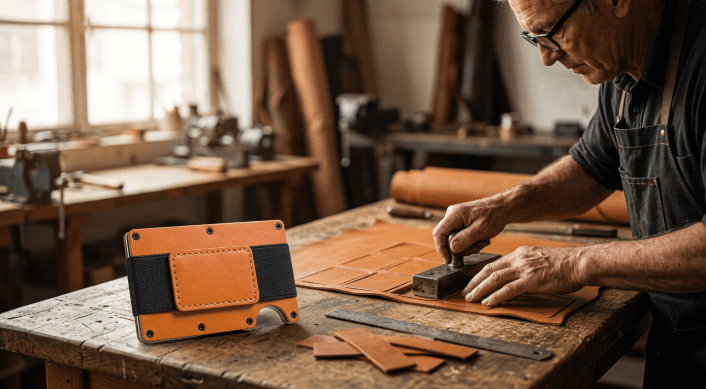
Edge finishing matters almost as much as the stitching. Painted edges that are applied thinly will chip. Folded edges — where the leather is wrapped around a liner — resist wear better. Heat-sealed edges, where the leather is fused under pressure, are a premium indicator.
Snap buttons should be solid brass or zinc alloy with a corrosion-resistant coating. Magnetic clasps need sufficient holding force — test that a fully loaded wallet stays closed when dropped from waist height. Zippers should run smoothly without catching; inspect the teeth material, as cheap zinc zippers deform under stress.
The procurement framework below applies whether you are ordering 200 units for a pilot or 20,000 for a retail chain.
Tensile strength tests: Verify the leather resists tearing under stress. Ask for the supplier's test data.
Colorfastness tests: Leather dyed poorly will transfer color to fabric or fade unevenly. Request rub-test results.
Abrasion tests: Simulates years of pocket friction. A wallet that fails here shows wear within weeks.
Pre-Shipment Inspection (PSI): A third-party or factory QC check on a random sample before shipment. This is non-negotiable.
Industry-standard MOQs for custom leather goods run 300–500 pieces. Some factories offer lower minimums for pilot runs — this is worth negotiating if you are testing a new design.
Lead times typically range 25–45 days for OEM production, depending on complexity. Factor in an additional 7–14 days for sea freight if you are importing.
OEM: You provide the design and specifications; the factory manufactures to your drawings.
ODM: The factory offers existing designs that you can brand with your logo.
Private label: Full branding applied to the factory's existing best-sellers.
Are slim wallets actually better? Yes, for the majority of men who carry fewer than eight cards. They reduce pocket bulk and sitting discomfort. But slim wallets demand better materials — thinner leather must be higher grade to maintain structural integrity.
When evaluating samples from multiple suppliers, use this checklist:
Stitch density: 6–8 stitches per inch is the industry standard for durability.
Edge consistency: Run your finger along the edge. Rough or uneven edges indicate poor finishing.
Fold flexibility: Bend the wallet 90 degrees at every fold line. Listen for cracking sounds — creaking leather is a warning sign.
RFID testing: If the product claims RFID blocking, request the attenuation test report. Effective shielding requires 60 dB or higher attenuation at 13.56 MHz.
Cannot provide material certifications or test reports.
Quote unusually low prices for full-grain leather. If the price is 30% below competitors, the leather grade is likely misrepresented.
Resist pre-shipment inspections.
Cannot explain their quality control process at each production stage.
RFID blocking performance is tested against ISO 14443 (proximity cards) and ISO 15693 (vicinity cards). These standards define the frequencies used by contactless payment systems — 13.56 MHz is the critical band.
For leather itself, no single global grading standard exists, but reputable tanneries follow the Leather Working Group (LWG) protocol for environmental and quality compliance. Ask suppliers which tannery they source from and whether that tannery holds LWG certification.
The wallet market has shifted dramatically since 2020. Contactless payment adoption means fewer men carry cash. The average man now carries 4–6 cards — a driver's license, two payment cards, a transit card, and possibly a work ID.
This behavioral change is why card holders and slim wallets now outsell traditional bifolds in most markets. The most popular leather wallets for men are no longer the largest — they are the most efficient.
Card cases hold 4–8 cards with no cash compartment or a minimal one. They measure 3–6 mm thick empty. For the urban professional who pays by phone and taps cards, this is the highest-function design available.
For the everyday-carry (EDC) segment, keychain wallets combine a card slot with a quick-release key ring. These serve men who want one item in their pocket, not two. Design considerations include snap closure strength and key ring durability — this is where hardware quality matters most.
Handwoven leather wallets, using intrecciato-style weaving, occupy a premium niche. They are labor-intensive — a single wallet can require 45 minutes of skilled handwork. This makes them a high-margin opportunity for private label brands targeting the luxury gift market. Production constraints mean lower volumes and longer lead times, but the perceived value justifies premium pricing.
The best leather wallets for men combine material selection with construction discipline. Three factors separate premium products from mid-tier:
Leather thickness consistency. Panels cut from different hide areas vary in thickness. Premium factories split leather to uniform thickness, ensuring consistent fold behavior.
Lining materials. A wallet lined with cheap fabric will wear through at card corners within months. Quality linings use the same leather or a durable microfiber.
Adhesive selection. The glue bonding leather panels must remain flexible. Brittle adhesives crack at fold lines, causing delamination. This is an invisible defect until failure — you cannot spot it in product photos.
When comparing supplier samples, measure these specifications directly:
| Specification | Premium Standard | Acceptable | Reject |
|---|---|---|---|
| Leather thickness | 1.0–1.2 mm | 0.8–1.0 mm | Below 0.8 mm |
| Stitch density | 7–8 per inch | 6 per inch | Below 6 per inch |
| RFID attenuation | 60 dB+ | 40–60 dB | Below 40 dB |
| Card slot count | 4–8 | 3–4 | — |
| Weight (slim wallet) | Under 60 g | 60–80 g | Over 80 g |
Beyond RFID testing, request these standard tests from any serious supplier:
Pocket abrasion test (Martindale method): Simulates years of friction against fabric.
Flex test: Repeated bending at fold points to identify premature cracking.
Color transfer test: Wet and dry rubbing to ensure dye stability.
Hardware corrosion test: Salt spray exposure per ASTM B117 standards.
A supplier cannot claim quality without showing you data. If they cannot produce test results, they are not performing the tests.
The manufacturing capability of a wallet factory determines whether your product works at scale. A factory that only assembles leather goods cannot produce hybrid metal-leather wallets without outsourcing the metal components — which adds lead time and quality risk.
Choose A if: You need a simple leather bifold with standard construction. A specialized leather goods factory is sufficient.
Choose B if: You need hybrid wallets with metal frames or RFID shielding plates. A factory with in-house metal machining — CNC cutting, stamping, and finishing — offers better quality control and shorter lead times because they control the entire process.
The industry standards described above — saddle stitching, full-grain sourcing, RFID attenuation testing, and uniform leather thickness — are not abstract concepts. They are specifications we build to daily.
As a manufacturer with 13+ years of experience producing RFID wallets, key organizers, and card holders, our approach is straightforward: control the entire manufacturing process. Our in-house CNC machining capability means the metal frames and RFID shielding layers in our hybrid leather wallets are produced under the same roof as the leather stitching. This integration matters because it eliminates the tolerance stacking that occurs when metal parts come from one factory and leather assembly from another.
We supply popular brands, wholesalers, and top online shop sellers globally. Our monthly production capacity of 300,000+ units means you can scale from a pilot run of 500 pieces to a mass production order without changing suppliers. Flexible MOQs lower the barrier to entry for new brands testing the market.
How do we meet the sourcing standards outlined in this guide? We align production with ISO 14443 shielding requirements, maintain the stitch densities and leather thickness specifications discussed above, and offer OEM and ODM services that let you bring your design — or choose from our existing patterns — to market under your brand.
If you are looking to source durable, RFID-ready leather wallets for your next product line, talk to our engineering team about your specifications. We can tell you what works, what costs more than it should, and what will fail in the field.
Can you customize a leather wallet with your brand logo? Yes. OEM processes include debossing, foil stamping, and custom metal plates for hybrid designs. What is the typical MOQ for custom leather wallets? Industry benchmarks run 300–500 pieces, but we offer flexible minimums for pilot runs — contact our team to discuss your volume.
ISO 14443 Identification cards — Contactless integrated circuit cards. International Organization for Standardization. https://www.iso.org/standard/73598.html
ISO 15693 Identification cards — Contactless vicinity cards. International Organization for Standardization. https://www.iso.org/standard/73599.html
Leather Working Group — Protocol for leather manufacturing sustainability and quality. https://www.leatherworkinggroup.com/
ASTM B117 Standard Practice for Operating Salt Spray (Fog) Apparatus. ASTM International. https://www.astm.org/b0117-19.html
Saddleback Leather — Full-grain leather glossary and construction standards. https://saddlebackleather.com/leather-grades


