

Views: 433 Author: Professor Leon Publish Time: 08-31-2026 Origin: Site


Content Menu
● 1. 1. Understanding Secrid Wallet Alternatives: Types and Applications
● 2. 2. Secrid Wallet Alternative Cheaper: Quality and Performance Factors
● 3. 3. How to Evaluate Secrid Wallet Alternative Cheaper Suppliers
● 4. 4. Key Quality Indicators for Secrid Wallet Alternative Cheaper Buyers
● 5. 5. Relevant Industry Standards and Certifications
● 6. 6. Materials and Construction: What Affects Quality and Cost
● 7. 7. How to Evaluate Cheaper Quality: Key Specifications
● 8. 8. Testing Standards and Certifications for RFID Wallets
● 9. 9. What to Look for in a Secrid Wallet Alternative Cheaper Manufacturer
● 10. 10. Our Approach to Manufacturing Secrid Wallet Alternatives
● 11. 11.
● 12. 12. Decision Guide: Choosing Your Sourcing Path
13 min read
A buyer in Rotterdam once told me they could not understand why Secrid wallets sold for €69 at retail when the bill of materials — aluminum, a leather flap, a spring mechanism — seemed so modest. They were right to question it. The gap between manufacturing cost and retail price is where B2B opportunities live.
This guide explains what makes Secrid expensive, where cheaper alternatives genuinely save money, and how to evaluate suppliers without sacrificing the features your customers expect.
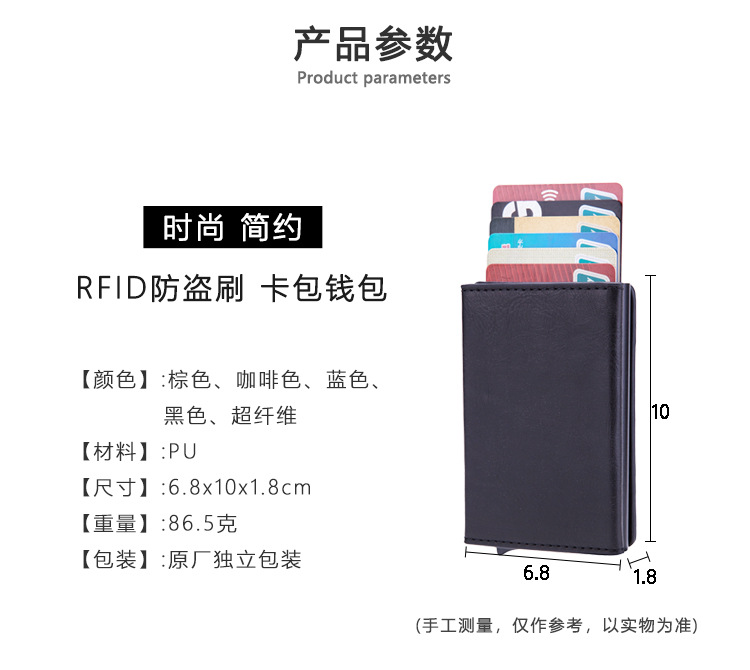
A Secrid wallet alternative cheaper than the original typically falls into one of three categories: aluminum cardholders, leather-aluminum hybrids, or polycarbonate spring-loaded wallets. Each serves a different price point and customer profile.
Aluminum cardholders replicate Secrid's core mechanism — a sliding aluminum sleeve that pops cards upward for access. They suit customers who prioritize slimness and durability. Hybrid wallets wrap the aluminum core in leather or microfiber, appealing to buyers who want a classic look with modern functionality. Polycarbonate wallets offer the lowest cost but feel less premium; they work for promotional items or bundle deals.
The application matters more than the material. A customer buying for themselves may accept a plastic mechanism. A retailer stocking shelves for a discerning demographic needs the aluminum core to justify the price tag.
Secrid's €60–€80 retail price includes brand marketing, the patented Cardprotector mechanism, and distribution margins across multiple tiers. The actual manufacturing cost of a comparable aluminum-and-leather wallet is often 60–70% less. That gap is the cost of building a brand consumers trust.
For B2B buyers, paying for brand equity you do not own makes little sense. Sourcing factory-direct eliminates the brand premium and distributor markups entirely. A wallet with the same materials and mechanism can be manufactured for a fraction of Secrid's retail price, leaving room for your own margin.
Secrid's signature is the aluminum Cardprotector sleeve — a sliding mechanism that ejects cards with a thumb press. Comparable mechanisms are available from Chinese manufacturers, provided they do not infringe on Secrid's patents. The European full-grain leather used in premium Secrid models is a cost driver; alternative leathers — PU, microfiber, or Asian full-grain — offer similar aesthetics at 40–60% lower cost.
The aluminum itself is not exotic. Grade 6061-T6, the same alloy Secrid uses, is widely available and costs roughly $4–$6 per kilogram. Anodizing adds $0.50–$1.50 per unit depending on color complexity. The mechanism, not the material, is where engineering matters.
Cheap alternatives often fail on three fronts: card spring tension, RFID shielding integrity, and edge finishing. A wallet that cannot hold cards securely or blocks only some frequencies is not a bargain — it is a refund waiting to happen.
Benchmark against Secrid's key specs: 6–8 card capacity, 0.5mm aluminum thickness, and 2–3 years of daily-use durability. A truly cheaper alternative hits 80–90% of that quality at 50–60% of the cost. Below that threshold, you risk damaging your brand reputation.
Quality in RFID wallets is not subjective. It is measurable through specific tests: card ejection cycles, RFID blocking frequency range, and material durability.
RFID blocking wallets must attenuate signals across 10 MHz to 3 GHz to cover credit cards, passports, and access cards. The critical frequency is 13.56 MHz, used by contactless payment cards. A simple test: place a payment card inside the wallet and attempt to read it with a standard card reader. If the reader cannot register the card, the shielding works.
Reputable suppliers provide test reports from third-party labs like SGS. If a supplier cannot produce one, treat that as a red flag. RFID shielding is a functional requirement for any wallet marketed as "blocking."
The spring-loaded ejection mechanism is the heart of a Secrid-style wallet. It must push cards upward smoothly and return them securely. The industry benchmark is 10,000+ ejection cycles without failure. Ask suppliers for test data. If they cannot provide it, request a sample and test it yourself — 100 cycles of rapid ejection will reveal most defects.
Aluminum wallets should have an anodized finish with a pencil hardness of 3H or above to resist scratching. Leather stitching should run 4–6 stitches per inch; denser stitching prevents tearing at stress points. Edge finishing determines how the wallet looks after six months of pocket use. Poor finishing shows as fraying or discoloration.
Evaluating a supplier requires more than comparing quotes. You need to assess manufacturing capability, quality control processes, and financial stability.
The single most important question: does the factory perform CNC machining in-house, or does it outsource? In-house machining means better quality control and lower unit costs. Outsourced machining adds a middleman margin and creates communication delays when specifications change.
Ask for a video tour of the production floor. A factory with in-house CNC machines, anodizing lines, and assembly stations is fundamentally different from one that assembles purchased components.
Acceptable Quality Limit (AQL) standards define how many defects are tolerable in a batch. For wallets, a typical AQL is 2.5 for visual defects and 1.5 for functional defects. This means, for example, that in a batch of 1,000 units, up to 1.5% may have functional issues before the batch is rejected.
Request the supplier's AQL protocol in writing. Also ask whether pre-shipment inspections are conducted by in-house QC or third-party firms. Third-party inspections (QIMA, AsiaInspection) provide independent verification but add cost. A factory confident in its quality will not object to them.
A supplier's production capacity indicates its ability to fulfill orders on time. For wallets, a monthly capacity of 300,000+ units suggests a serious operation. Ask about current order backlog and how the factory handles peak seasons. Financial stability matters because a factory that cannot manage cash flow may cut corners on materials or delay production. Request references from other buyers.
Buyers need a practical checklist to evaluate samples and bulk orders.
When you receive a sample, check:
Card fit: Cards should slide in smoothly and stay secure when the wallet is shaken.
Ejection smoothness: The mechanism should push cards out without sticking or requiring excessive force.
RFID blocking: Test with a contactless payment card and reader.
Stitching alignment: Stitches should be straight, evenly spaced, and free of loose threads.
Edge finishing: Run a finger along all edges; they should feel smooth, not rough or sharp.
Logo application: Laser engraving should be crisp; screen printing should not smudge.
What is the MOQ for standard designs? For custom designs?
What is the lead time for samples? For bulk production?
Can you provide a third-party RFID test report?
What is your AQL standard for visual and functional defects?
Do you perform pre-shipment inspections? Can I book a third-party inspection?
What are your payment terms? (Typical: 30% deposit, 70% before shipment.)
What is the warranty policy for defective units?
Cannot provide a physical sample before bulk production.
Quote prices dramatically below market average without explaining how.
Have no in-house manufacturing capability and cannot name their subcontractors.
Refuse third-party inspections.
Have no test reports for RFID blocking or material safety.
Pressure you to pay in full before production begins.
RFID wallets fall under general consumer goods regulations, but specific standards apply to materials and testing.
ISO 14443 defines the protocol for contactless payment cards operating at 13.56 MHz. REACH (EU) and CPSIA (US) regulate chemical safety for materials in consumer products. RoHS restricts hazardous substances in electronics, relevant if the wallet includes any electronic components.
Certifications to request: ISO 9001 for quality management systems, SGS or TÜV test reports for RFID blocking, and material safety data sheets (MSDS) for leather and plastics. A supplier with these documents has invested in compliance; one without them is taking shortcuts.
The material choices in a Secrid wallet alternative cheaper than the original determine both cost and perceived quality.
Grade 6061-T6 aluminum is the industry standard for wallet cardholders. It offers a good strength-to-weight ratio and accepts anodizing well. Anodizing creates a durable, scratch-resistant surface available in black, silver, gunmetal, and custom colors. The thickness matters: 0.5mm is the sweet spot for rigidity without bulk.
Full-grain leather is the premium choice — durable, develops a patina, and signals quality. It is also the most expensive. Microfiber leather (PU leather) replicates the look and feel at 40–60% lower cost. It is consistent in texture and color, making it ideal for branded products. Split leather sits between the two — real leather at a lower grade, but less durable.
Injection-molded polycarbonate wallets are the cheapest to produce at scale. A mold costs $3,000–$8,000, amortized over order volume. Unit costs drop significantly at 10,000+ pieces. The trade-off is perceived quality — polycarbonate feels less premium than aluminum. Use it for promotional items or entry-level price points.
Price tells you little about quality. Specifications do.
| Specification | Acceptable Range | Why It Matters |
|---|---|---|
| Card capacity | 6–8 cards | Matches Secrid's functionality |
| Aluminum thickness | 0.4–0.6mm | Balance of rigidity and slimness |
| RFID blocking range | 10 MHz – 3 GHz | Covers payment cards, passports, access cards |
| Ejection cycle life | 10,000+ cycles | Ensures mechanism longevity |
| Stitching density | 4–6 stitches per inch | Prevents tearing at stress points |
| Anodizing hardness | 3H+ pencil hardness | Scratch resistance |
| MOQ (OEM) | 300–500 pcs | Allows market testing before bulk orders |
| Lead time (bulk) | 15–25 days | Balances speed and production quality |
These specifications represent the minimum threshold for a wallet that customers will not return. A supplier quoting below these numbers should explain why — and you should verify their claims independently.
Testing is not optional for a product marketed as RFID-blocking. Without verification, you are making a claim you cannot support.
The standard test uses a card reader at 13.56 MHz (ISO 14443). Place a payment card inside the wallet, close it, and attempt to read the card. A successful block means the reader cannot register the card's data. Repeat the test at different positions within the wallet — the shielding should be uniform.
Third-party labs (SGS, TÜV, Intertek) provide certified test reports. These carry weight in retail channels and protect you from liability if a customer claims the wallet failed to block RFID signals.
Leather and plastic components must comply with REACH (EU) and CPSIA (US) for chemical safety. Request MSDS for all materials. If your target market includes children's products, additional testing may apply. Confirm which certifications your market requires before finalizing the order.
The ideal manufacturer combines in-house production, transparent pricing, and flexible MOQs.
A factory with in-house CNC machining, anodizing, and assembly lines controls its entire production process. This translates to better quality control, faster turnaround, and lower costs. A factory that outsources machining adds a middleman margin and loses control over tolerances and finish quality.
A competitive quote breaks down costs: materials, machining, finishing, packaging, and logistics. If a supplier cannot explain their pricing, they either do not understand their own costs or are hiding something. Ask for a detailed quotation that itemizes each component.
Flexible MOQs allow you to test the market before committing to large volumes. A supplier offering a 300-piece MOQ for standard designs is more accommodating than one requiring 5,000 pieces. Similarly, lead times of 15–25 days for bulk production indicate an efficient operation.
The standards outlined above are not theoretical — they are the benchmarks we use in our own factory.
Gstar Technology operates in Shenzhen with 13+ years of experience in RFID wallets, key organizers, and cardholders. Our in-house CNC machining eliminates outsourcing markups — you pay for machine time, not middlemen. With a monthly production capacity of 300,000+ units, we support both small test orders and large-scale retail programs.
We offer material alternatives — microfiber leather, polycarbonate, and aluminum grades — that reduce costs by 30–50% while maintaining the slim profile and card ejection mechanism your customers expect. For OEM projects, we provide free design templates and 3D renderings within 48 hours.
The process is straightforward: share your reference (for example, "a Secrid-style wallet in matte black with our logo"), receive a sample within 7–10 days for approval, confirm order details (MOQ, packaging, shipping terms), and production completes in 15–25 days. Video inspection is available before shipment if you cannot visit the factory.
Frequently Asked Questions
Secrid on Amazon may appear cheaper due to third-party sellers discounting bulk inventory, older model clearance, or gray-market imports. However, retail prices still include brand markup. For B2B buyers, direct factory sourcing is consistently cheaper than any retail channel.
Gen Z increasingly uses slim cardholders, phone case wallets (MagSafe-style), and key organizers. RFID blocking is a key feature they look for due to contactless payment adoption. This makes slim aluminum or hybrid wallets a strong category for e-commerce sellers targeting younger demographics.
Ridge is known for its minimalist, all-metal design and higher price point. Secrid offers a more classic leather-and-metal look with a pop-up card mechanism. For B2B buyers, neither brand is cost-effective for resale — a custom OEM wallet can match either style at a fraction of the cost.
Ekster offers similar pop-up mechanisms with a focus on quick card access and integrated tracking (optional). Secrid is more established in Europe. Both are premium-priced. For resellers, the key question is not which brand is "better," but how to offer a comparable product at a margin-friendly price.
For standard designs with logo printing, MOQs typically start at 300–500 pcs. For fully custom designs (ODM), MOQs may be higher (1,000+ pcs) due to tooling and sampling costs. A flexible supplier can help you start smaller to test the market.
Yes. Reputable manufacturers offer samples for a nominal fee, often refundable against your first order. Request both a standard sample and a customized sample with your logo to evaluate print quality.
Choose a standard aluminum cardholder if your target customers prioritize slimness and durability over luxury materials. This is the most direct Secrid alternative and offers the lowest cost at acceptable quality.
Choose a leather-aluminum hybrid if your customers expect a classic wallet look but want modern functionality. The higher perceived value justifies a higher retail price.
Choose a polycarbonate wallet if you are targeting price-sensitive customers or need promotional items in high volume. The lower cost per unit makes it viable for giveaways and bundle deals.
Choose a supplier with in-house CNC machining if you want the best combination of cost and quality control. Outsourced production adds margin and reduces oversight.
Finding a Secrid wallet alternative cheaper than the original is achievable by understanding material options, manufacturing cost drivers, and supplier capabilities. The cheapest option is not always the best value — look for suppliers who offer transparent pricing, flexible MOQs, and documented quality control.
If you are evaluating suppliers for your RFID wallet line, we would welcome the opportunity to quote your project. Our team responds within 24 hours with pricing and lead times.
ISO 14443 — Contactless payment card standard. https://www.iso.org/standard/73599.html
REACH Regulation (EU) — Chemical safety for consumer products. https://echa.europa.eu/regulations/reach/understanding-reach
CPSIA — Consumer Product Safety Improvement Act (US). https://www.cpsc.gov/Regulations-Laws--Standards/Statutes/Consumer-Product-Safety-Improvement-Act
AQL Standards — Acceptable Quality Limit for product inspection. https://www.qima.com/quality-control/aql
RFID Blocking Test Methods — Industry testing protocols. https://www.sgs.com/en/services/electrical-and-electronic-products


