

Views: 412 Author: Professor Leon Publish Time: 09-01-2026 Origin: Site


Content Menu
● 1. 1. Understanding the Ekster-Style Aluminum Card Holder: Types and Applications
● 2. 2. How to Evaluate Aluminum Card Holder Suppliers
● 3. 3. Key Quality Indicators and Industry Standards
● 4. 4. Cost Drivers and Price Benchmarks
● 5. 5. Production Process: From Raw Material to Finished Card Holder
● 6. 6. Customization and OEM/ODM Options
● 7. 7. Our Manufacturing Capabilities for Aluminum Card Holders
13 min read
When a brand owner sends a reference product photo and asks, "Can you make something like this?" the first thing a factory engineer checks is not the logo. It is the wall thickness. It is the slide mechanism tolerances. It is the anodizing depth. The market for premium aluminum card holders—popularized by brands like Ekster—has grown rapidly, and B2B buyers now recognize that "same as Ekster" means a specific set of engineering standards, not a vague aesthetic.
This guide breaks down what those standards are, how to evaluate suppliers who claim to meet them, and what the procurement process looks like from first inquiry to container load.
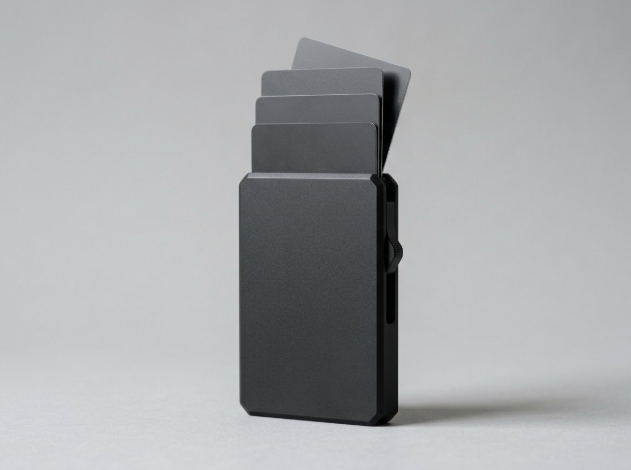
An "Ekster-style" aluminum card holder is a slim, rigid wallet typically machined from aluminum alloy, designed to hold 6–12 cards with a mechanical quick-access system. The category has expanded beyond card storage into everyday carry (EDC) accessories for professionals, travelers, and tech enthusiasts.
The core appeal is threefold: durability (aluminum resists bending and cracking), slimness (typically under 12mm thick), and RFID protection (blocking unauthorized scans of payment cards and IDs). Buyers sourcing these products need to distinguish between two main types: spring-assisted pop-up mechanisms and slide-out trays. The pop-up design uses a button or lever to fan cards outward; the slide design uses a thumb-operated metal plate.
For B2B buyers, the application matters. A card holder aimed at corporate gifts may prioritize laser engraving surfaces. One aimed at outdoor retailers needs salt-spray corrosion resistance. Understanding these end-use requirements before sourcing prevents costly specification mismatches later.
The aluminum alloy most commonly specified for premium card holders is 6061-T6, sometimes upgraded to 7075 for higher strength-to-weight ratios. The T6 temper indicates solution heat-treated and artificially aged—resulting in yield strength around 240 MPa for 6061, sufficient for daily pocket pressure without deformation.
The surface finish is where cheap products reveal themselves. Premium card holders use Type III hard anodizing (40–60 microns thickness) for scratch resistance, or Type II (8–12 microns) for standard color applications. Sandblasting before anodizing creates the matte texture associated with high-end EDC products. Tolerances matter critically: the card cavity must hold cards snugly without friction, typically requiring ±0.1mm precision on internal dimensions. Ask suppliers for their tolerance specifications in writing—vague answers signal imprecise manufacturing.
RFID blocking is not a single technology. It is a performance standard. The aluminum body itself blocks some RFID frequencies, but most premium card holders add a dedicated shielding layer—either a copper or aluminum foil liner, or a specialty RFID-blocking fabric—to ensure consistent attenuation.
Testing protocols matter: a legitimate supplier should provide test reports showing attenuation of at least 80 dB at 13.56 MHz (the frequency used by contactless payment cards) and ideally also at 125 kHz (low-frequency ID cards). Buyers should request these reports before committing to production. A card holder that blocks RFID signals inconsistently—working at one angle but failing at another—is worse than no protection because the user believes they are secure.
Standard aluminum card holder dimensions fall within a range: approximately 100–110mm in length, 65–70mm in width, and 8–12mm in thickness. Weight typically lands between 50–80 grams—heavy enough to feel substantial, light enough for front-pocket carry.
Capacity varies from 6 to 12 cards. The pop-up mechanism adds complexity: a spring-loaded lever or button that pushes cards upward for easy access. Mechanism durability is the key quality metric. A well-designed spring mechanism should survive 50,000+ activation cycles without losing tension. Buyers should ask suppliers how they test mechanism longevity—a factory that cannot articulate its test protocol likely does not have one.
The gap between a sample and mass production is where supplier quality becomes visible. A polished sample from a showroom tells you little about the factory's ability to replicate that finish across 10,000 units. This section provides a framework for evaluating suppliers before committing.
Start with production capacity. A supplier claiming to handle your 50,000-unit order should be able to state their monthly output in units—not in vague terms like "large capacity." For aluminum card holders, the critical question is whether CNC machining is in-house or outsourced. In-house machining gives the supplier control over tolerances and lead times; outsourcing introduces coordination risk.
Certifications provide a baseline: ISO 9001 for quality management, BSCI or SEDEX for social compliance. These do not guarantee product quality, but their absence is a red flag. Ask for certification numbers and verify them with the issuing bodies. A supplier that hesitates to share this information is likely hiding something.
When samples arrive, do not test them like a consumer. Test them like an engineer.
Dimensional verification: Measure length, width, thickness, and card slot depth against the spec sheet. Deviations beyond ±0.2mm indicate process instability.
Mechanism stress test: Operate the pop-up or slide mechanism 50–100 times in one sitting. Listen for grinding sounds—a sign of inadequate lubrication or poor surface finish on internal components.
Anodizing quality: Examine the surface under strong light. Color variation, pitting, or a "cloudy" appearance indicates poor anodizing bath control. Rub the surface with a coin; if it scratches easily, the anodizing is too thin.
RFID efficacy: Use an actual card reader at 13.56 MHz. Test at multiple angles and distances. Note any position where the card reads successfully through the holder—that is a shielding gap.
Drop test: Drop the holder (loaded with cards) from waist height onto concrete. Inspect for dents, cracks, or mechanism misalignment. Repeat three times.
"What is your tolerance specification for internal card cavity dimensions?"
"Can you provide the mill certificate for the aluminum alloy you use?"
"How do you test mechanism durability, and can you share the test data?"
"What is your rejection rate for finished units, and how do you handle defects?"
"Do you have in-house anodizing, or is that outsourced?"
Avoid suppliers who: cannot name their aluminum alloy grade, claim "unlimited capacity" without specifics, refuse to provide test reports, or quote prices dramatically below market rates without explaining the cost difference.
Quality in aluminum card holders is not subjective. It is measurable across several dimensions. Buyers who can specify these indicators in their RFQs will receive more accurate quotes and better production outcomes.
| Quality Indicator | Testing Method | Acceptable Standard |
|---|---|---|
| Dimensional accuracy | Caliper measurement | ±0.1–0.2mm on critical surfaces |
| Anodizing thickness | Coating thickness gauge | Type II: 8–12μm; Type III: 40–60μm |
| Anodizing hardness | Pencil hardness test | 9H minimum for Type III |
| Corrosion resistance | Salt-spray test (ASTM B117) | 24–72 hours without pitting |
| RFID attenuation | Field strength measurement | ≥80 dB at 13.56 MHz |
| Mechanism durability | Cycle testing | 50,000+ cycles without failure |
| Surface finish uniformity | Visual inspection under 500 lux | No color variation across surfaces |
Relevant industry standards include ASTM B117 for salt-spray corrosion testing and ISO 9227 for neutral salt spray. For RFID performance, reference ISO 14443 (the standard for proximity payment cards) to frame your attenuation requirements.
One honest caveat: not every standard applies to every product. A card holder destined for a gift shop shelf does not need military-grade corrosion resistance. Over-specifying drives up costs without adding market value. Match the standard to the product's intended use.
Understanding what drives cost helps buyers negotiate intelligently and avoid unrealistic expectations. Aluminum card holder pricing follows a predictable structure.
Material cost is the baseline: 6061-T6 aluminum at current market rates represents roughly 15–20% of total unit cost. Machining complexity is the largest variable—each CNC operation adds time, and tighter tolerances require slower spindle speeds and additional inspection. Surface finishing adds 10–25% depending on whether you choose standard anodizing or premium PVD coating. RFID liner material contributes a small but non-negligible amount. Order volume drives economies of scale in setup and tooling amortization.
For planning purposes only, current market ranges (FOB Shenzhen) look approximately like this:
Entry-level (basic anodized, no RFID liner, simple slide mechanism): $4–8 per unit at 500–1,000 pcs
Mid-range (CNC machining, RFID liner, Type II anodizing): $8–15 per unit
Premium (complex pop-up mechanism, Type III anodizing, custom packaging): $15–25+ per unit
These are indicative. Final pricing depends on your exact specifications. A buyer who understands these ranges can spot outliers—a quote at $3 per unit for a complex pop-up design should raise questions, not enthusiasm.
Most metal wallet factories set MOQs between 300 and 1,000 units for OEM/ODM projects. If your first order needs to be smaller, consider starting with a standard "blank" model—a design the factory already produces—and private labeling it. This reduces tooling costs and allows you to validate demand before committing to a custom design.
Negotiation levers that actually work: multi-SKU orders (combining several product variants into one production run), annual volume commitments, and prepayment terms. Suppliers discount for predictability, not for potential.
Understanding the manufacturing process helps buyers communicate with suppliers and identify where quality issues originate. The process for a CNC-machined aluminum card holder follows a consistent sequence.
Raw material: Aluminum bar stock or plate is sourced with mill certification confirming alloy composition.
CNC machining: The main body is machined from solid aluminum. This is the longest production step—a complex pop-up design may require 15–30 minutes of machine time per unit. Internal cavities for the mechanism are milled with precision tolerances.
Deburring and surface prep: Machined edges are deburred. The surface is sandblasted to create a uniform matte texture that improves anodizing adhesion.
Anodizing: Parts are racked and immersed in an electrolytic bath. The anodizing process creates a hard, corrosion-resistant aluminum oxide layer. Color can be added via dye before the sealing step.
Mechanism assembly: Springs, levers, and slider plates are assembled into the machined body. This step requires clean conditions—dust or metal particles can cause mechanism failure.
RFID liner installation: The shielding layer is cut to size and placed inside the card cavity.
Final inspection: Dimensional checks, mechanism function tests, and visual surface inspection. Rejected units are scrapped or reworked.
Packaging: Individual units are wrapped and boxed according to the buyer's specifications.
The quality of a card holder is determined at the machining and anodizing stages. A supplier with in-house control over these processes can maintain consistency; one that outsources them introduces variability at every handoff.
Customization goes far beyond putting your logo on a stock product. The level of customization you choose determines both your development timeline and your market differentiation.
OEM (Original Equipment Manufacturing): You provide the design—CAD files, material specs, finish requirements. The factory manufactures to your specification. This gives you full control over the final product but requires you to have design capability or work with a product designer.
ODM (Original Design Manufacturing): The factory provides a base design, and you customize branding, finish, and packaging. This is faster and lower-risk for first-time buyers. The trade-off is that your product will share its core design with other buyers' products.
Private label: You select an existing product from the factory's catalog and put your brand on it. The lowest-cost entry point, but with the least differentiation.
Customization points that matter beyond the logo: pantone-matched anodizing colors, custom card capacity, mechanism modifications (spring tension, thumb-slide placement), packaging design (retail-ready boxes, eco-friendly materials), and even custom engraving depth for a more tactile brand experience.
Choose OEM if: you have a proprietary design that differentiates your brand, and you are prepared for a longer development timeline.
Choose ODM if: you want to launch quickly with proven mechanics, and you are comfortable with a design that other brands may also use.
Choose private label if: you are testing a market or need a low-cost entry product.
This is where the industry standards we have discussed meet our production floor. Gstar Technology (Shenzhen) Co., Ltd. operates as a manufacturer of metal, leather, and plastic wallets, including aluminum card holders engineered to the same material and performance benchmarks that brands like Ekster have popularized.
Our approach to producing "Ekster-style" card holders is straightforward: we do not replicate trademarked designs or logos, but we manufacture to equivalent technical specifications. When a buyer sends us a reference product and says "same as Ekster aluminum card holder, but with our branding," we interpret that request through the lens of material grade, mechanism reliability, and finish quality.
We operate in-house CNC machining lines, which gives us direct control over the tolerances that determine mechanism smoothness—typically ±0.1mm on critical surfaces. Our finishing department handles anodizing (both Type II and Type III) and laser engraving internally. This vertical integration means your order does not pass through multiple subcontractors, each adding lead time and quality variance.
Every production batch undergoes multi-stage inspection: dimensional verification with calibrated instruments, mechanism cycle testing, visual surface inspection under controlled lighting, and RFID attenuation testing. We provide test documentation with each batch—RFID attenuation reports, salt-spray results, and drop test data—so your quality team can verify compliance without relying on our word alone.
With a monthly production capacity of 300,000+ units across our wallet lines, we can support both pilot orders starting at 300 units and mass production runs of 50,000+ units. Sample lead time is 7–10 days after specification confirmation; production lead time is 15–30 days depending on volume and finish complexity. Our typical quote turnaround is 24 hours.
We have supplied brands, wholesalers, and online retailers across North America, Europe, and Asia for over 13 years. Our clients range from startups launching their first product to established retailers expanding their EDC category. We treat the "same as Ekster" request as a specification challenge, not a shortcut—which means we will push back when your requirements are unclear, and we will tell you when a lower-cost approach achieves the same result.
Start Your Aluminum Card Holder Project Today
If you are looking for a manufacturing partner that produces premium aluminum card holders to the standards discussed in this guide—with OEM/ODM flexibility, documented quality control, and reliable production capacity—we are ready to discuss your project.
Or contact our team directly: Jerry Lee — sales@gstartec.com
**
Frequently Asked Questions**
What is the best aluminum wallet?
The "best" aluminum wallet depends on your priorities: slimness, card capacity, mechanism type, or RFI D protection. For B2B buyers, the best aluminum wallet is the one that matches your target market's needs at a price that sustains your margins. Compare material grade, mechanism durability, and finish quality—not brand names.
What is better, Ridge or Ekster?
These two premium brands use different mechanisms: Ridge uses a screw-tightened plate design that holds cards in a stack, while Ekster uses a pop-up slider for quick card access. For manufacturers, the question is which mechanism your customers prefer. Both styles are producible; the choice depends on your brand positioning and target demographic.
What is the best metal card holder?
The best metal card holder combines a durable construction material (aluminum or titanium), effective RFID blocking, and a mechanism that survives daily use. For B2B sourcing, "best" also means finding a supplier who can consistently replicate that quality at scale—a sample that performs well is meaningless if the factory cannot reproduce it.
What is the difference between the Ekster Cardholder and Cardholder Pro?
The Cardholder Pro typically offers higher card capacity and a more robust mechanism compared to the standard version. When sourcing an equivalent, specify the capacity and mechanism type you need. We manufacture both standard and "Pro"-style configurations, so the choice is a specification, not a mystery.
What is the minimum order quantity for custom aluminum card holders?
MOQ varies by supplier. Our standard MOQ for OEM/ODM aluminum card holders starts at 300 units. For first-time buyers, we recommend starting with a smaller order to validate product-market fit before scaling production. A 300-unit pilot order is a reasonable risk; a 50,000-unit commitment without market validation is not.
How long does it take to receive samples and mass production?
Samples typically take 7–10 days after specification confirmation. Mass production takes 15–30 days depending on order volume and finish complexity. Shipping adds 5–15 days for air freight or 20–40 days for sea freight, depending on destination.
ASTM International. "ASTM B117 - Standard Practice for Operating Salt Spray (Fog) Apparatus." https://www.astm.org/b0117-19.html
ISO. "ISO 9227:2022 Corrosion tests in artificial atmospheres — Salt spray tests." https://www.iso.org/standard/82942.html
ISO. "ISO 14443 Identification cards — Contactless integrated circuit cards." https://www.iso.org/standard/73598.html
The Aluminum Association. "6061-T6 Aluminum Properties." https://www.aluminum.org/
International Organization for Standardization. "ISO 9001:2015 Quality management systems." https://www.iso.org/standard/62085.html


