

Views: 0 Author: Professor Leon Publish Time: 07-27-2026 Origin: Site


9 min read
The rise of contactless payments and digital identity theft has made RFID blocking an essential feature for wallets, card holders, and key organizers. But for B2B buyers sourcing these products, the real question isn’t just whether a wallet blocks signals—it’s what material makes it work. The answer directly affects shielding performance, product cost, durability, and end-user satisfaction. Not all factories source or test these materials the same way.
At GSTAR, we have spent over 13 years manufacturing RFID wallets, key organizers, graded card holders, and bumper guards for popular brands, wholesalers, and top online sellers worldwide. We know that material quality determines whether a product truly protects against RFID skimming. In this factory guide, we explain exactly what RFID blocking materials are made of, how we source and test them at our Chinese facility, and how you can customize the material composition for your OEM or ODM project.

Most people ask: What is RFID blocking material made of? The short answer is that all effective materials create a conductive barrier—a Faraday cage—that disrupts radio frequency signals. But the specific materials vary widely in form, flexibility, and cost.
One of the oldest and most reliable methods is weaving fine metal fibers into fabric. Stainless steel, copper, and nickel fibers are commonly used because they offer high conductivity and durability. When these fibers are integrated into the lining of a wallet or card holder, they form a mesh that reflects or absorbs incoming RFID signals, preventing data from being read.
At our factory, we source high-grade metal fibers only from certified suppliers who can guarantee consistent conductivity. We then blend them with polyester or nylon to create a fabric that is both soft and effective. This is the material we often recommend for flexible products like our key organizers, where the lining needs to bend repeatedly without cracking.
For many RFID wallets, the simplest and most cost-effective solution is a thin layer of metal foil, typically aluminum or copper. Some constructions use a nickel-copper composite that balances signal blocking across a wider frequency range (125 kHz, 13.56 MHz, and higher). The foil is laminated between the outer material (leather, metal, or plastic) and the inner liner.
Company integration: For custom OEM projects, we offer foil layering options that let clients balance blocking performance with wallet thinness. Our engineering team works with you to decide how many layers are needed—sometimes a single 0.1mm foil layer is enough for basic protection; other cases require a multi-layer stack to block high-frequency scanners without adding bulk.
Modern RFID blocking material also includes conductive fabrics—polyester or nylon coated with a thin layer of copper, nickel, or silver. These fabrics are lightweight, sewable, and even washable, making them ideal for fabric-based wallets and pouches. Carbon-impregnated materials offer a similar effect at a lower cost, though they are less common in premium products.
Our R&D team evaluates new conductive fabrics every year to offer our clients the latest material options. For example, we recently introduced a nickel-coated nylon fabric that delivers >30 dB attenuation at 13.56 MHz while remaining thin enough to fit into a graded card holder without adding noticeable thickness.
Q: What is the most common RFID blocking material used in wallets?
A: The most common choices are aluminum foil for budget-friendly wallets and conductive nickel-copper fabric for premium flexible designs. At our factory, we use both depending on the product type. If you’re unsure which suits your OEM project, our team can advise based on your target price point and desired shielding level.
A factory guide wouldn’t be complete without explaining how we ensure every piece of material actually blocks signals. Sourcing and testing are where many manufacturers cut corners—but not us.
We select material suppliers based on three criteria: conductivity consistency, reliable lead times, and certifications (RoHS, REACH, etc.). It’s not enough for a fabric to claim it blocks RFID; we require documented test reports from the supplier. Our long-term relationships with global material producers give us access to consistent quality and preferential pricing.
Company integration: With our 300,000+ monthly production capacity, we maintain bulk purchasing agreements that secure material availability for large OEM orders. This means we can commit to your volume without unexpected raw material shortages.
Every roll of fabric and every sheet of foil that enters our warehouse is inspected. We use signal attenuation testing equipment to measure dB reduction at common RFID frequencies (125 kHz and 13.56 MHz). Our quality control team checks for pinholes in foils and uniform conductivity in woven fabrics. We aim for >90% blocking effectiveness—typically equivalent to at least 20–30 dB of attenuation.
Q: How do you test that the RFID blocking works before shipping?
A: We perform spot-check shielding tests on every production batch using spectrum analyzers and signal generators. This verifies that the finished product blocks the necessary frequencies. We can also provide test reports or arrange third-party testing per your requirements.
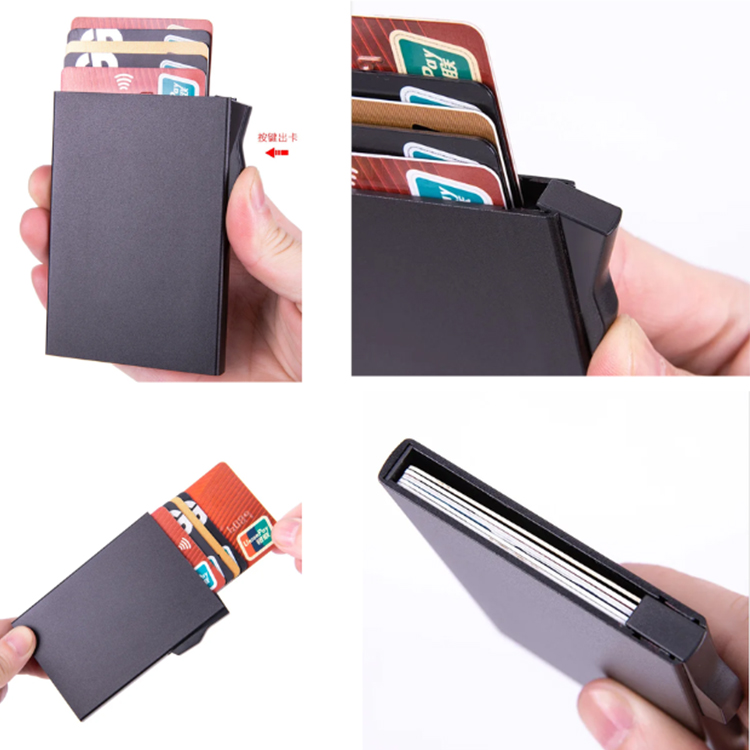
Knowing what is RFID blocking material made of is only half the story. The other half is how that material is incorporated into a real product without compromising its function or aesthetics.
We use automated die-cutting and our in-house CNC machining to cut foil and fabric layers to exact dimensions. The layering process is critical: the outer shell (leather, metal, or plastic) is first prepared, then the RFID blocking layer is bonded using heat or adhesive, and finally the inner lining is applied. Any gap in the shielding layer can create a “leak” in the Faraday cage.
Company integration: Our in-house CNC machining allows us to cut complex shapes—like the corners of a graded card holder or the slots of a bumper guard—with micron-level precision. This ensures the shielding layer covers every section that contacts credit cards.
Smaller products like key organizers and card holders present unique challenges. A rigid foil layer might crack when the product is flexed; a dense fiber layer could make the product too thick. Our solution is a hybrid approach: we use foil in the card slots (where rigidity is acceptable) and conductive fabric in the hinge areas (where flexibility is needed). This approach maintains both functionality and protection.
Q: How long does RFID blocking material last in a wallet?
A: With proper construction, the shielding layer lasts the lifetime of the product. We use durable bonding methods to prevent foil from cracking and conductive fabric from delaminating, even with daily use. Our testing has confirmed that properly integrated layers remain effective after years of bending.
During production, we perform inline checks: continuity testing on every piece, signal leak detection, and peel strength tests for laminated layers. Before packaging, each batch undergoes a final spot-check shielding test. This is part of the quality assurance we deliver to supermarkets, wholesalers, and top online sellers globally.
B2B buyers rarely need exactly the same material for every product. A luxury leather wallet requires a very different material mix than a budget-friendly card holder. That’s why we offer comprehensive customization.
Our engineering team considers your target price point, required shielding frequency, product weight, and thickness constraints. Options include:
Single-layer aluminum foil (budget)
Multi-layer nickel-copper hybrid (premium)
Conductive fabric (flexible, fabric-based products)
We produce samples with your chosen material stack-up so you can test performance before committing to mass production.
Q: Can I choose a different RFID blocking material for my private label product?
A: Absolutely. As an OEM/ODM manufacturer, we let you select from our approved material list. Based on your design, we recommend the best option and produce a prototype for your approval.
For private label clients, appearance matters. We hide blocking layers inside leather or metal exteriors—embossing logos on the surface, for example—without compromising the shielding. This capability comes from 13+ years of manufacturing experience and our close collaboration with designers.
Typical sample lead time is 7–10 days after you submit design specifications. We validate the material choice using our in-house testing. Send your material requirements to our team via our contact page.
We don’t just trust the material—we verify it at every stage.
Pre-production: We review raw material certifications from suppliers.
In-production: Random samples are pulled from each production run and tested with spectrum analyzers.
Post-production: Every finished product is visually inspected and a statistical sample undergoes final signal attenuation testing.
Our QC lab is dedicated to RFID products, with calibrated equipment to measure dB reduction across the key frequency bands.
All materials we use are RoHS and REACH compliant. For clients shipping to the EU or US, we can provide compliance documentation and arrange independent lab testing. This is especially important for supermarket chains and top online sellers who require certified products.
We have refined our material sourcing and production processes specifically for RFID wallets, key organizers, graded card holders, and bumper guards. Our team understands the nuances of each material—how it behaves under heat, pressure, and daily use.
Our large capacity means we can handle bulk orders with consistent quality. Bulk purchasing power also lets us negotiate better material prices, which we pass on to our clients. Even at high volume, we maintain a low defect rate through rigorous inline QC.
Whether you need 500 units for a test launch or 50,000 for a national campaign, we can accommodate. Typical production lead time is 15–25 days. Get a quote within 24 hours and start your project.
Q: Is RFID blocking material safe to carry against the body?
A: Yes. The materials we use—metal foils, conductive fibers, and carbon-based fabrics—are non-toxic and RoHS compliant. We source only certified materials for all our products to ensure end-user safety.
RFID blocking material is not one-size-fits-all. Metal fibers, foils, conductive fabrics, and carbon blends each have trade-offs in cost, flexibility, and performance. The factory’s sourcing, testing, and customization capabilities directly impact the final product’s quality.
At GSTAR, we combine 13+ years of experience, in-house CNC machining, 300,000+ monthly capacity, and full OEM/ODM support to bring your vision to life—whether it’s a sleek RFID wallet, a rugged key organizer, or a precision graded card holder.
Ready to source RFID blocking products for your brand? Let’s discuss your material requirements.
[1] Federal Communications Commission. “RFID User’s Guide.” Accessed 2025. https://www.fcc.gov/consumers/guides/rfid-users-guide
[2] European Committee for Electrotechnical Standardization (CENELEC). “RoHS Directive 2011/65/EU.” https://www.cenelec.eu/standards/topics/RoHS/
[3] ISO/IEC 14443-1:2018 “Identification cards — Contactless integrated circuit cards — Proximity cards.” https://www.iso.org/standard/73598.html
[4] Material Safety Data Sheet for Nickel-Copper Conductive Fabric – GSTAR internal QC documentation (available on request).
[5] “RFID Blocking: How Materials Work,” Journal of Electromagnetic Waves and Applications, vol. 34, no. 7, 2020. https://doi.org/10.1080/09205071.2020.1757480


