

Views: 314 Author: Professor Leon Publish Time: 08-18-2026 Origin: Site


Content Menu
● 1. What Is a Mens Long Wallet Leather Product, Really?
● 2. What Leather Types Should You Specify for a Long Wallet?
● 3. What Makes a Leather Zippered Wallet Different to Manufacture?
● 4. How Is a Long Wallet Constructed? The Manufacturing Process
● 5. What Quality Tests Should a Leather Wallet Pass?
● 6. How to Evaluate a Mens Long Wallet Leather Supplier
● 7. What Industry Standards Apply to Leather Wallets?
● 8. Our Leather Manufacturing Capabilities
● 9. Quality Control: Our Multi-Stage Inspection Process
● 10. How Customization Works: OEM and ODM Options
● 11. Ordering Process: MOQ, Lead Time, and Shipping
● 12. Certifications and Industry Standards
10 min read
When a European brand owner opens their first sample shipment from a new supplier, the first thing they check is rarely the stitching. It's the smell. Real leather has a distinct, slightly sweet odor from the tanning process. If it smells like plastic, the material spec was swapped somewhere between the quotation and the production line. That single moment — the olfactory test — tells you more about a supplier's integrity than any certificate they emailed you.
Sourcing a men's long leather wallet is not a product search. It's a supply chain audit. Here's what you need to know before you commit to a factory.
A men's long wallet leather product is a bi-fold or tri-fold wallet measuring approximately 190–200mm in length (versus 110–120mm for a standard bifold), designed to carry unfolded banknotes, multiple cards, and sometimes a coin compartment. The "long" format originated in cash-heavy economies and has seen a resurgence among consumers who carry travel documents, receipts, or simply prefer not to fold their currency.
For B2B buyers, the long wallet presents a specific manufacturing challenge: more surface area means more material inconsistency risk, more stitching length, and more structural flex points that can fail.
The leather choice determines everything downstream: price point, durability, brand positioning, and even the stitching technique required.
Full-grain leather uses the outermost layer of the hide, retaining the natural grain. It develops a patina with use, is highly tear-resistant, and is the standard for premium "buy it for life" positioning. Expect to pay 20–40% more per square foot compared to top-grain.
Top-grain leather is sanded to remove imperfections and create a uniform surface. It's more stain-resistant and easier to finish consistently across large production runs — a practical choice for mainstream retail where color consistency across 5,000 units matters more than natural variation.
PU (polyurethane) leather — often marketed as "vegan leather" — is a coated fabric. It costs a fraction of genuine hide, but it peels and cracks within 12–24 months of regular use. For a product category where consumers expect 5–10 years of service, PU is a warranty risk.
A practical caveat: full-grain is not always the right answer. If you're targeting a price point under $30 retail, full-grain will crush your margins. Top-grain is often the smarter commercial choice.
Wallet exteriors typically use 1.0mm to 1.4mm leather. Below 1.0mm, the material lacks structural rigidity and the wallet will flop. Above 1.4mm, folding becomes difficult and the wallet adds unnecessary bulk.
The tanning process matters for manufacturing yield. Chrome-tanned leather is more flexible and easier to cut consistently, making it the industry standard for wallets. Vegetable-tanned leather is stiffer, more environmentally friendly, and preferred for embossing (logos, monograms) but requires more skill to stitch cleanly.
The leather zippered wallet variant adds a coin compartment or full perimeter closure. It's a high-demand subcategory for men who want security for loose change or travel documents.
The critical specification is the zipper itself — not a generic metal zipper, but a YKK-branded or equivalent zipper rated for at least 10,000 open-close cycles. The zipper tape must be sewn into the leather with a density that prevents the fabric from pulling away from the hide.
A common failure point is the zipper head weight. If the zipper head is too light (under 8 grams), it will slip under tension. If it's too heavy (over 15 grams), it drags and the leather around the zipper flap stretches over time.
There is a reason many factories charge a $1.50–2.50 premium for zippered constructions: the alignment tolerance is ±1mm. If the zipper track is off by 2mm, the wallet will pucker visibly at the corners.
Step 1: Cutting. The leather is die-cut (for high volume, 1,000+ units) or CNC-cut (for complex shapes, rigid materials, or metal-leather hybrids). Die-cutting is faster and cheaper per unit; CNC offers precision for intricate curves.
Step 2: Skiving. The edges are thinned to reduce bulk at fold points. Skiving is where many budget factories cut corners — they skip it entirely, resulting in a stiff, bulky fold that cracks within months.
Step 3: Stitching. The industry benchmark for long wallets is 8–10 stitches per inch (SPI). Below 8 SPI, the seam is structurally weak. Above 10 SPI, the leather is perforated too densely and can tear along the stitch line. Bonded nylon thread is the standard for high-stress seams; polyester is acceptable for decorative stitching.
Step 4: Edge finishing. Hand-painted edges are the luxury standard — they seal the raw leather edges with a colored pigment. Machine-burnished edges are more durable but less refined. For B2B buyers, the distinction matters because hand-painted edges add 15–20 minutes of labor per unit.
Step 5: RFID lining insertion. An RFID-blocking layer (typically a non-woven fabric lined with metal fibers) is inserted between the leather and the interior lining. It attenuates signals at 13.56 MHz — the frequency used by contactless payment cards.
A reputable factory will run the following tests on every production batch:
Bally Flexometer test: The leather sample is flexed repeatedly (typically 20,000–50,000 cycles) to measure resistance to cracking. [1]
Hardware pull test: Measures the force required to detach a zipper pull or snap button. Industry standard is 5–7 kgf (kilogram-force).
Stitch tension test: The seam is pulled perpendicular to its direction to check for thread breakage or needle-hole tearing.
Color fastness test: The leather is rubbed with a dry and wet cloth (Crockmeter test) to check for dye transfer. [2]
If a supplier cannot show you their test reports from the last 90 days, that's a red flag.
You need a framework that goes beyond "they sent me a nice sample." Here is the evaluation structure used by procurement professionals:
Ask which tannery supplies their leather. A factory that buys from a single, named tannery (e.g., in Italy, Spain, or a certified Chinese tannery) will have consistent color and texture across batches. A factory that buys leftover hides from multiple sources will produce wallets with visible lot variation.
For custom colors — say, a pink leather wallet for a secondary brand line — the factory must do Pantone matching on the actual hide. Leather dye absorbs differently than ink on paper. A good factory will provide a physical sample swatch in the exact dye lot before production. Insist on this. Accepting a digital color proof is how you end up with a product that is "close but not quite."
Ask for a sample and count the stitches per inch. If it's below 8 SPI on a long wallet, the product will not survive a season of daily use.
Typical MOQs for a men's long wallet leather order:
| Order Type | MOQ | Lead Time |
|---|---|---|
| Stock design + private label logo | 100–300 units | 15–20 days |
| Custom color on existing design | 300–500 units | 25–35 days |
| Full custom design (new pattern) | 500–1,000 units | 45–60 days |
The lead time is not arbitrary. A custom order requires material confirmation (3–5 days), sample approval (7–10 days), production (20–30 days), and shipping (5–15 days by air, 30–40 days by sea). A supplier who promises 15-day delivery on a full custom design is either lying or using inferior materials.
"Which tannery supplies the leather for this design?"
"What is the SPI (stitches per inch) on this sample?"
"Can you provide a Pantone-matched swatch in the exact dye lot before bulk production?"
"What is your AQL (Acceptable Quality Limit) for major defects?"
"Will you handle pre-shipment inspection, or do I need a third-party inspector?"
"What is your replacement policy for defective units?"
Cannot name their tannery or material source
Quote a lead time that is 50% shorter than industry standard for custom work
Refuse to send physical samples before bulk production (saying "our photos are accurate" is a warning sign)
Cannot show you a flex test or color fastness report
Offer RFID blocking at no cost — the material costs money, and free RFID usually means a thin, ineffective layer
There is no single global standard for wallets, but buyers should be aware of these reference points:
ISO 11640 (color fastness): Specifies the method for determining the resistance of leather to rubbing. [3]
ISO 5402 (flex resistance): Defines the flexing test for leather, measuring resistance to cracking. [4]
REACH compliance (EU): Restricts hazardous chemicals in consumer products, including leather goods. If you sell in the EU, your supplier must certify REACH compliance for the tanning and dyeing process. [5]
Prop 65 (California): Requires warnings for products containing certain chemicals, including some leather tanning agents. [6]
A factory with these certifications has already invested in compliance infrastructure — a signal of a more mature operation.
The technical requirements above are the baseline. The question is whether a factory can execute them at scale, on schedule, and at a cost that preserves your margin.
At Gstar Technology (Shenzhen) Co., Ltd., our approach to manufacturing men's long leather wallets is built on 13+ years of production experience in RFID wallets and leather goods. We operate in-house CNC machining, which gives us precision control over cutting — especially for the complex layering required in RFID-blocking constructions. We don't outsource the critical steps and lose visibility.
Our monthly production capacity exceeds 300,000 units across wallets, key organizers, and card holders. That capacity is structured for flexibility: a startup's first 500-unit test run gets the same production line attention as a supermarket chain's 10,000-unit restock.
We offer OEM and ODM services. In an OEM arrangement, you provide the specification and we build to it. In an ODM arrangement, we present our existing designs — including popular long wallet formats — and you brand them as your own. Private label options are available on stock designs for faster market entry.
If you need a specific aesthetic — a pink leather wallet for a niche fashion line, or a rugged full-grain design with RFID protection — our material library allows rapid sampling. We manage the dye lot matching, stitching density, and flex test standards discussed above on every production line.
| Capability | Specification |
|---|---|
| Monthly capacity | 300,000+ units |
| MOQ (custom color) | 500 units |
| MOQ (private label on stock) | 100–300 units |
| Lead time (stock + logo) | 15–20 days |
| Lead time (full custom) | 45–60 days |
| RFID blocking | Standard option, 13.56 MHz |
| Quality control | AQL 1.5 major defects |
We run a three-stage inspection on every order:
Incoming material inspection: Leather hides are checked for thickness consistency, surface defects, and color uniformity against the approved dye lot reference.
In-process inspection: During stitching and assembly, line inspectors check SPI consistency, edge alignment, and hardware attachment at 2-hour intervals.
Pre-shipment inspection: A final AQL 1.5 inspection is performed on finished goods. If a defective unit is found, we offer a replacement or a credit note on the next order.
Full custom (OEM): You provide the pattern, material spec, and hardware requirements. We produce samples for approval before bulk production.
Design adaptation (ODM): We replicate the functionality of popular designs — the number of card slots, zipper layout, thickness — without infringing on trademarks. We often improve durability or reduce production costs for our clients.
Logo application: Blind embossing (debossing) is the premium choice for a subtle, elegant finish. Foil stamping is more visible. Screen printing is the budget option but wears faster.
Inquiry and specification: Send your design or select from our ODM catalogue.
Sampling: We produce a physical sample (3–5 days for stock designs, 7–10 days for custom).
Approval: You approve the sample, including Pantone color matching.
Production: Bulk manufacturing begins (20–30 days, depending on order size).
Inspection: Pre-shipment inspection with AQL 1.5 standards.
Shipping: By air (5–15 days) or sea (30–40 days). We handle export documentation.
Our production facility complies with REACH requirements for EU-bound goods and follows ISO testing methods for flex resistance and color fastness. We can provide compliance documentation upon request for your target market.
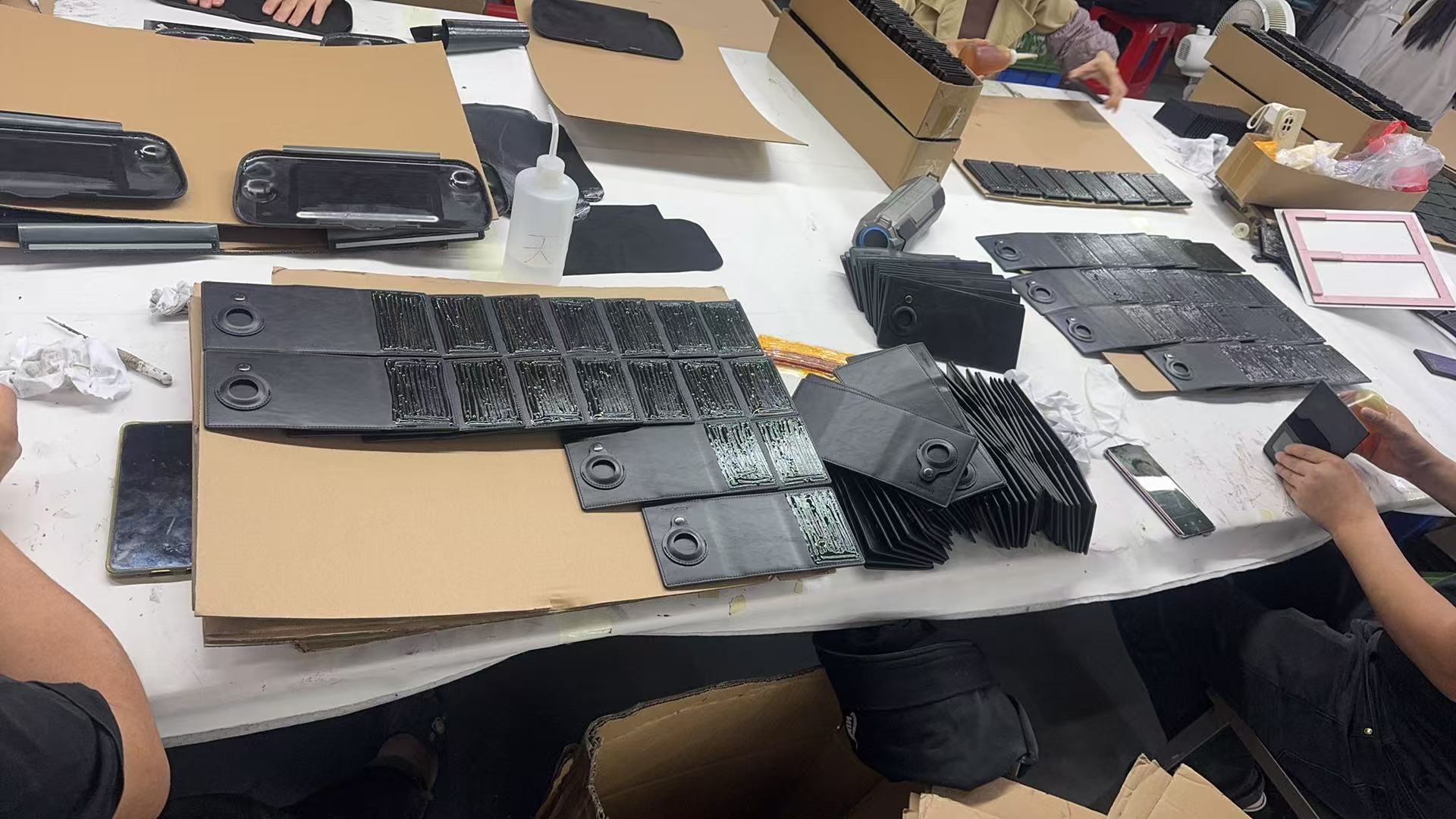
Choose a full-service factory if... you need a partner who handles everything from material sourcing to shipping documentation, manages quality control internally, and can scale from 500 to 300,000 units without changing processes.
Choose a trading company if... you are buying a one-off batch of an existing product and price is the only consideration. You will sacrifice quality oversight, customization speed, and accountability.
The decision framework is simple: your brand's reputation is tied to the product's durability. The factory that engineers the flex test and stitch density into their production line is the one that protects your margin over the long term — because the alternative is returns, chargebacks, and a damaged retail relationship.
For a detailed discussion on your specific men's long wallet leather requirements, please Contact Our Team to discuss your OEM project.
[1] Bally Flexometer test method for leather flex resistance — SATRA Technology. https://www.satra.com/spotlight/article.php?id=241
[2] ISO 11640:2018 Leather — Tests for colour fastness — Colour fastness to cycles of rubbing. https://www.iso.org/standard/73166.html
[3] ISO 5402-1:2017 Leather — Determination of flex resistance. https://www.iso.org/standard/66235.html
[4] REACH Regulation (EC) No 1907/2006 — European Chemicals Agency. https://echa.europa.eu/regulations/reach/understanding-reach
[5] California Proposition 65 — Office of Environmental Health Hazard Assessment. https://oehha.ca.gov/proposition-65


