

Views: 223 Author: Professor Leon Publish Time: 08-10-2026 Origin: Site


Content Menu
● 1. Why the "Travel Wallet Male" Market Demands a Specialized Manufacturer
● 2. Our Manufacturing Arsenal: Precision Machining and High-Volume Production
● 3. Customization and OEM/ODM Services for Travel Wallets
● 4. Price Competitiveness and Flexible MOQ: A Supplier Strategy for Growth
● 5. Quality Control: Ensuring Every Travel Wallet Meets Global Standards
● 6. Our Global Network: Serving Top Sellers and Supermarkets Worldwide
● 7. Frequently Asked Questions
● 8. How to Choose the Right Manufacturing Partner
14 min read
The last time a buyer from Hamburg sent us a sketch of a travel wallet, the file had 14 layers and a hinge mechanism we had not seen before. He asked if we could make it work. We could, but only because our CNC machines run in-house, not through a third party that adds two weeks and a layer of miscommunication to every revision.
That is the reality of sourcing men's travel wallets in 2025. The product looks simple from the outside — a slim case for passports, cards, and boarding passes. But the manufacturing demands are specific. This guide covers what we have learned over 13+ years of building these products for brands, wholesalers, and online sellers across North America and Europe. We will walk through material selection, production capacity, customization routes, and the quality checks that prevent a 10,000-unit order from becoming a return nightmare.
---
A standard bifold wallet and a travel wallet are different products. We make both, and the production lines do not overlap much.
The travel wallet male demographic expects specific features: a passport slot that does not stretch after three uses, a boarding pass pocket that fits an A4-folded document, a coin compartment for countries that still use cash, and RFID protection that actually works. Generic wallet production lines — the ones making fashion bifolds with card slots and a bill fold — fail on most of these counts. The stitching tension is wrong for heavier fabrics. The card slots are not spaced for multiple passports. The RFID lining is a token addition that covers one slot instead of the whole body.
Our 13+ years in this category means we have already solved these problems once. When a client sends us a reference image of a travel wallet male design, we can flag potential structural issues before cutting material. That saves two to three weeks of prototyping time on every project.
The core difference is thickness management. A travel wallet carries more items but must remain slim enough to slide into a jacket pocket or a hotel safe. This requires either rigid materials like aluminum or CNC-machined metal, or carefully layered leather with minimal stitching bulk.
We see buyers make one consistent mistake: they source travel wallets from suppliers who only make fashion wallets. The result is a product that bulges, falls apart at the seams under passport weight, or has RFID protection that only covers the card slots closest to the outer shell. We avoid this by treating travel wallets as a distinct product category with its own material specifications and quality checks.
Metal travel wallets are no longer a niche. Aluminum and titanium builds have moved from premium to mainstream because travelers want durability that leather cannot match. This is where our in-house CNC machining capability matters. We do not outsource metal cutting. Our machines hold tolerances that produce seamless edges and card slots that do not scratch cards on insertion. For a metal travel wallet, that fit-and-finish is the difference between a premium product and a return.
RFID protection is the other non-negotiable. We use a metallic lining that covers the entire wallet body, not just the two slots closest to the closure. The testing process is simple: we place a powered RFID card inside a closed wallet and attempt to read it with a standard reader from 10 centimeters. If the read succeeds, the batch fails. We run this test on a sample from every production lot, not just at the prototype stage.
The "travel wallet male" keyword drives most search volume, but the product itself is not gender-locked. We produce the same RFID-blocking construction in slimmer profiles and expanded colorways — blush leather, rose gold metal, smaller card capacity — for the travel wallet women segment. The manufacturing process is identical. The design adaptation is straightforward: narrower width, lighter materials, reduced capacity. Buyers who ignore this segment leave money on the table, especially for gift-oriented retail channels.
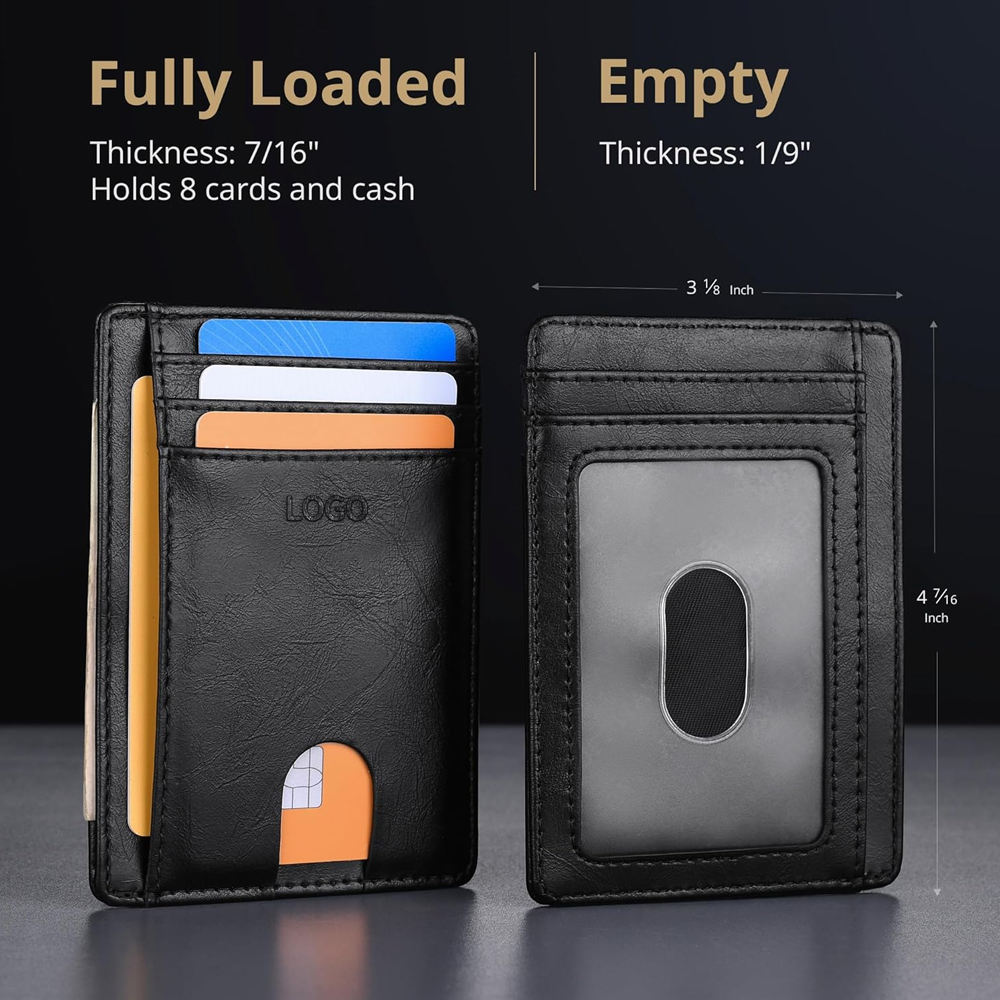
Our factory in Shenzhen runs a mixed production floor. One section handles leather cutting and stitching. Another runs CNC machining for metal wallets. A third handles injection molding for ABS and plastic builds. This is not a point of pride — it is a practical necessity. Travel wallets require material flexibility because the market demands it. A single buyer might order a leather travel wallet for their EU retail line and a metal version for their US online store. We produce both without splitting the order across two factories.
CNC machining for wallets is different from CNC machining for mechanical parts. The tolerances are looser — 0.1 mm is sufficient for a card slot — but the surface finish requirements are higher. Scratches that would be invisible on a gear housing are unacceptable on a wallet that sits against a phone in a pocket.
Our CNC department runs 5-axis machines that handle complex geometries: curved edges, recessed card slots, integrated hinges. We control the anodizing process in-house as well, which is where most quality issues arise. Anodizing inconsistencies — color variation, thin coating, chipping — account for more metal wallet returns than structural failure. Keeping that process internal lets us catch defects before packaging, not after shipping.
Stock-outs during peak travel seasons are the fastest way to lose retail shelf space. A supermarket chain or a large online seller cannot afford a six-week gap in supply when summer travel demand spikes.
Our monthly production capacity of 300,000+ units covers that risk. Whether you order 1,000 units for a test launch or 50,000 units for a national retail rollout, we maintain the same production line discipline. We do not switch to faster, lower-quality processes for large orders. The QC checkpoints remain identical at every volume.
Material selection is a cost-performance trade-off, and we help buyers navigate it based on their target price point.
Full-grain leather: Premium positioning, $25+ retail. Requires careful cutting to avoid surface defects. Best for business travelers.
Vegan leather / PU: Mid-range, $15–25 retail. Consistent texture, easier to work with, but less durable long-term.
Ballistic nylon: Rugged, $10–20 retail. We use this for adventure-oriented travel wallet male designs. Resists abrasion well.
ABS plastic: Budget, $5–10 retail. Injection molded, lightweight. We recommend this for promotional or entry-level products.
Aluminum / Titanium: Premium metal, $30+ retail. CNC machined. Best for the modern traveler who wants durability without bulk.
Our factory's versatility means we can suggest the right material for your audience rather than pushing whatever material we have in stock. A rugged canvas travel wallet and a sleek leather business model are both within our production range.
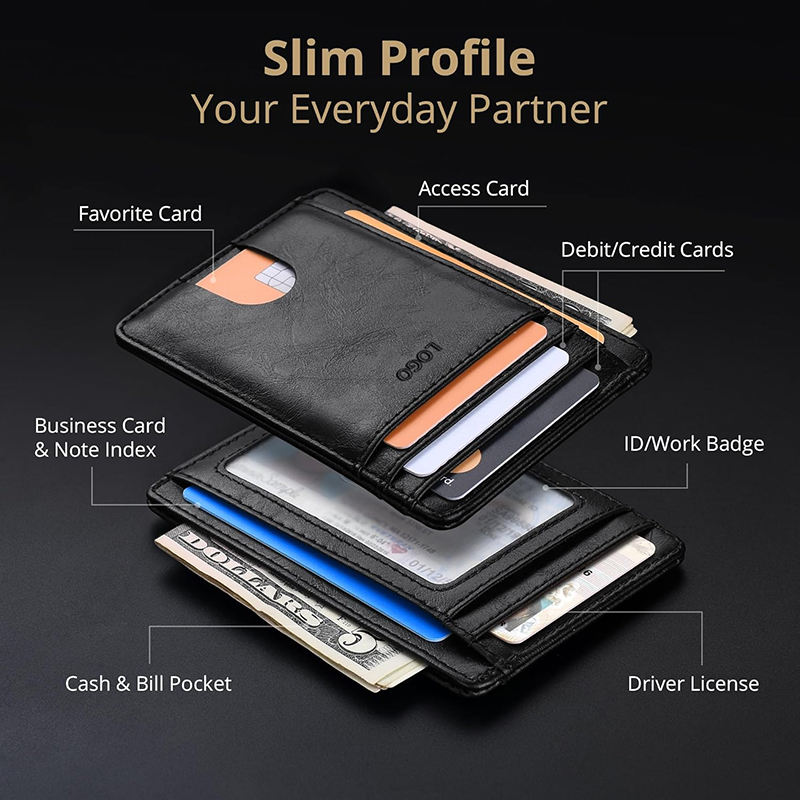
The most common question we receive is: "Can you make exactly what I have in mind?" The answer depends on whether you want our existing design (ODM) or a fully custom product (OEM). Both routes work, but they serve different timelines and budgets.
Our catalog includes 20+ travel wallet designs that are production-ready. These have been tested for durability, RFID effectiveness, and manufacturing consistency. You select a design, choose your materials and colors, add your logo, and we produce.
The advantage is speed. ODM lead times run 15–25 days because the tooling and production process already exist. For a brand entering the travel wallet market without a design team, this is the most efficient route. You get a proven product with your branding, without the risk of a custom design that fails in production.
For buyers with a specific design — a unique hinge mechanism, a particular card layout, a proprietary RFID configuration — we run a full OEM process:
Initial consultation: You share sketches, reference images, or a competitor product you want to improve.
Engineering review: Our technical team assesses manufacturability and flags issues like wall thickness that is too thin for CNC machining or stitching that will not hold under passport weight.
3D rendering and prototype: We produce a 3D model for approval, then create a physical prototype.
Sample approval: You test the prototype for functionality, fit, and finish.
Mass production: Once the sample is approved, we move to production with the QC checkpoints locked in.
The engineering support team works directly with your designers. This reduces the risk of production errors because we catch problems in the design phase, not after you have committed to 10,000 units.
We never recommend skipping the sample stage. A 2D sketch or even a 3D render does not convey how a wallet feels in hand, how smoothly the card slots release, or how the RFID lining performs when the wallet is fully packed.
Our sample turnaround is typically 5–7 business days for standard designs and 10–14 days for custom metal wallets that require CNC programming. We can usually provide a quote within 24 hours of your initial inquiry, and we encourage you to physically test the sample before approving mass production.

Pricing in the wallet industry is opaque by design. Many suppliers quote a flat per-unit price without breaking down where costs come from. We structure pricing transparently based on three factors: material selection, design complexity, and order volume.
A standard leather travel wallet with RFID lining costs less than a CNC-machined aluminum model with a magnetic closure. The difference is the machining time and the anodizing process, not the "premium" label. We show you this breakdown so you understand what you are paying for and can make informed trade-offs.
As a direct manufacturer in Shenzhen, we eliminate the trading company markup. Our pricing reflects the actual production cost plus a reasonable margin, which allows aggressive wholesale pricing without cutting quality. For a travel wallet male product retailing at $24.99, we can typically hit a landed cost that leaves 50%+ gross margin after freight and duties.
High MOQs are the biggest barrier for new brands entering the travel wallet category. We address this with flexible minimum order quantities:
ODM designs: MOQ from 300 units per colorway.
OEM custom designs: MOQ from 1,000 units for leather or plastic builds, 2,000 units for CNC-machined metal wallets.
Repeat orders: MOQ drops to 200 units once the tooling and production process are established.
This allows a small online seller to test a "travel wallet male" design without committing to a container. It also lets established retailers place frequent, smaller orders instead of tying up capital in a single large shipment.
Standard lead times are 15–25 days for ODM orders and 30–40 days for custom OEM projects, including sample approval. Production itself typically takes 10–15 days; the rest is tooling, material procurement, and QC.
We manage export documentation, customs clearance, and shipping logistics. Most of our clients use sea freight for bulk orders and air freight for urgent restocks. We pack products in retail-ready packaging — custom boxes, polybags, hang tags — so they move from our warehouse to your distribution center without repacking.
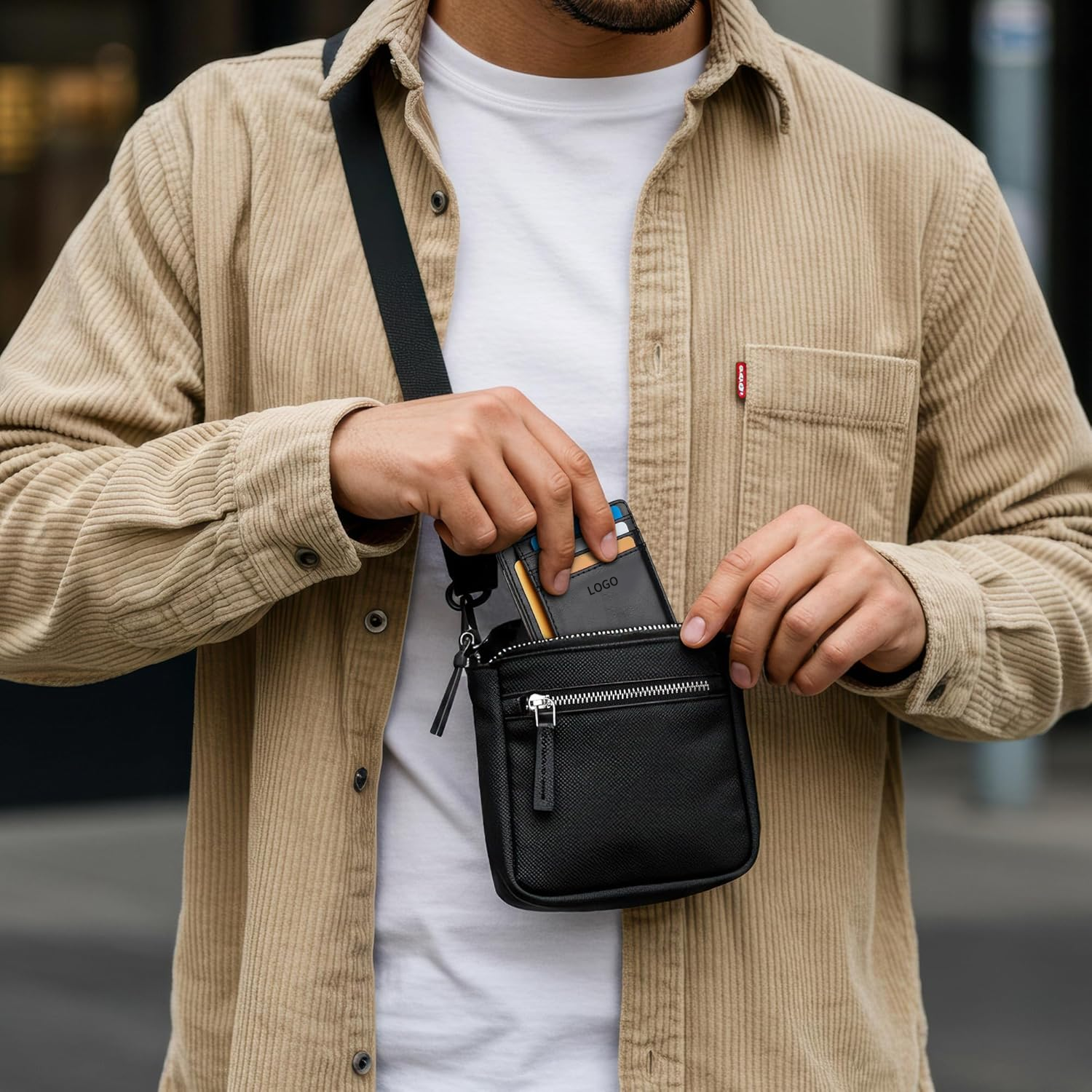
Quality control is not a single inspection at the end of the line. It is a multi-point process that starts with incoming materials and continues through every production stage.
Our QC team operates independently of the production line. This is a deliberate choice — inspectors who report to the production manager face pressure to pass borderline batches. Our inspectors report to the quality director, which removes that conflict of interest.
The inspection checkpoints are:
Incoming material inspection: Leather hides are checked for surface defects. Metal sheets are measured for thickness consistency. RFID lining is tested for signal blocking before cutting.
In-process checks: During stitching, we verify thread tension and stitch density. During CNC machining, we measure card slot dimensions and edge smoothness.
Final random inspection: Before packing, we pull a random sample from each batch and test zippers (if applicable), stitching integrity, RFID blocking effectiveness, and overall finish.
For RFID effectiveness, we use a standard ISO 14443 reader. The test criteria are straightforward: a contactless card inside the wallet must not be readable from 10 centimeters. We document the test results for every batch and share them with the buyer.
International brands selling in the EU or US must meet chemical safety standards. Our materials comply with REACH and RoHS regulations. We maintain documentation for each material batch, including test reports from third-party laboratories.
This matters more than most buyers realize. A shipment that fails customs due to non-compliant materials costs weeks of delay and significant financial loss. We handle the compliance paperwork as part of our service, ensuring your travel wallet products clear customs without issues.
One honest caveat: our standard materials are compliant, but if you request a custom material — a specific leather finish or a unique metal alloy — we need to test it for compliance before mass production. This adds 5–7 days to the timeline but prevents a much longer delay later.
---
Our client base spans popular brands, wholesalers, top online shop sellers, and supermarket chains across North America, Europe, and the Middle East. This geographic diversity gives us insight into regional market trends — European buyers prioritize RFID protection and minimalist design, while North American buyers favor durability and multi-functional layouts.
We are not a transactional factory. We work as a partner in your growth. Our global agency networks help us understand regional preferences and adjust our production accordingly. When a European brand needs a slim leather travel wallet for business travelers, we know the design language. When a US online seller needs a rugged metal wallet for outdoor enthusiasts, we know the material requirements.
This market knowledge is built into our design recommendations. We do not just manufacture what you ask for — we flag when a design will not resonate with your target audience.
Consider a scenario: a supermarket chain needs 20,000 RFID travel wallets — including models for the travel wallet women segment — delivered in 30 days for a seasonal promotion.
Our response: we allocate two production lines to the order, one for the leather models and one for the metal models. The QC team works overtime after capacity planning. We deliver 20,000 units in 28 days, with the full batch passing RFID testing and final inspection.
This is not a hypothetical — we execute this type of order regularly. The key is our 300,000+ monthly capacity, which leaves room for urgent orders without disrupting existing production schedules.
Every client gets a dedicated account manager who provides production updates throughout the cycle. You do not wonder where your order is — you receive photo and video updates at each stage, from material cutting to final packaging.
We bridge the time-zone gap between Shenzhen and your headquarters. Our account managers work flexible hours to ensure you can reach them during your business day. This communication structure prevents misunderstandings and keeps projects moving forward.
---
What is the minimum order quantity for a custom men's travel wallet?
Our MOQs are flexible and depend on design complexity and materials. Standard leather or plastic wallets have a lower MOQ (from 300 units for ODM designs), while custom metal CNC-machined wallets may require 2,000 units. Contact our team for a specific quote tailored to your project.
Can you produce travel wallets for women as well?
Yes. While the focus is often on the "travel wallet male," our manufacturing capabilities are fully versatile. We offer various colors, sizes, and interior layouts to appeal to a female demographic, ensuring you can cover the travel wallet women segment with the same quality and RFID protection.
How do you ensure the RFID blocking feature is effective?
We use specialized RFID-blocking materials — typically a metallic lining or carbon fiber composite — that cover the entire wallet body, not just individual card slots. Every production batch is tested with a standard ISO 14443 reader. A card inside the wallet must not be readable from 10 centimeters. If it is, the batch fails and is reworked.
What is the typical lead time for an OEM project?
For standard ODM designs, lead time is typically 15–25 days. For custom OEM designs involving new tooling or complex CNC machining, lead time is generally 30–40 days, including sample approval. Urgent orders can be expedited with air freight, but production time itself is rarely compressed.
Can you help with packaging design?
Yes. We offer custom packaging solutions, including retail boxes, polybags, and hang tags. We can print your branding to ensure your product is shelf-ready. Packaging design is included in the OEM process, and we provide digital proofs before production.
What are your payment terms?
Typically, we require a 30% deposit to begin production and 70% balance before shipment. For long-term partners with a proven order history, we can discuss more flexible terms.
---
The decision comes down to three factors:
Choose a factory with in-house CNC machining if you are launching a metal travel wallet. Outsourced CNC adds lead time, increases cost, and reduces quality control. A factory that machines in-house will deliver better tolerances and faster iterations.
Choose a factory with flexible MOQs if you are a startup or mid-size brand. High MOQs force you to over-commit capital to inventory. Flexible MOQs let you test designs, gather market feedback, and scale incrementally.
Choose a factory with multi-point QC if you are selling through retail or supermarket channels. Returns from defective wallets destroy margins and damage your brand reputation. Independent QC inspection — separate from the production line — is the only way to ensure consistent quality at volume.
We fit all three criteria. Our 13+ years of experience, in-house CNC machining, 300,000+ monthly capacity, and independent QC team make us a reliable partner for brands at any scale.
---
The travel wallet category rewards suppliers who understand the specific demands of the product: RFID protection that works, materials that survive constant handling, and manufacturing processes that scale without quality loss. That is what we have built at Gstar Technology over the past decade-plus.
If you have a men's travel wallet design ready for production — or need help developing one from scratch — our team is ready to review your specifications and provide a quote within 24 hours.
---
RFID Journal. "RFID Blocking: What It Does and Doesn't Do." https://www.rfidjournal.com/
REACH Compliance. European Chemicals Agency. https://echa.europa.eu/
RoHS Directive. European Commission. https://environment.ec.europa.eu/
Grand View Research. "Global RFID Market Report." https://www.grandviewresearch.com/
Statista. "Travel Accessories Market Overview." https://www.statista.com/


