

Views: 475 Author: Professor Leon Publish Time: 08-21-2026 Origin: Site


Content Menu
● 1. What Does "Preparing Custom Wallets for Amazon FBA" Actually Involve?
● 2. Understanding Amazon FBA Requirements for Wallet Products
● 3. Step-by-Step Process of Preparing Custom Wallets
● 4. Material Selection for Custom Wallets
● 5. Prototyping, Sampling, and Pre-Production Validation
● 6. Cost Structure and MOQ Considerations
● 7. Packaging, Labeling, and FBA Preparation Checklist
● 8. How to Evaluate Wallet Manufacturers for FBA Production
● 9. How We Meet These Standards at Gstar Technology (Shenzhen) Co., Ltd.
● 10. How to Start Your Custom Wallet Project
● 11. Common Questions About Custom Wallets for Amazon FBA
12 min read
When an overseas buyer places their first custom wallet order for Amazon FBA, the question they ask is rarely about price. It is about whether the factory can replicate the sample quality at scale. The gap between a single handmade prototype and a 2,000-unit production run is where most FBA wallet projects fail.
This guide walks through every step of preparing custom wallets for Amazon FBA — from design blueprint to FBA warehouse delivery. The focus is on procurement-level knowledge: what to specify, what to test, and what to ask before signing a purchase order.
Preparing custom wallets for Amazon FBA means taking a wallet concept from design through manufacturing, packaging, and labeling to meet Amazon's fulfillment center requirements. It covers material selection, pattern engineering, prototype validation, mass production quality control, and FBA-specific compliance.
The process has eight distinct production stages: pattern drawing, transferring the pattern onto material, rough cutting, skiving and lining attachment, precise cutting, gluing, stitching, and final finishing. Each stage affects your unit cost, defect rate, and customer reviews.
Wallets are not a restricted category on Amazon, but specific features trigger additional documentation. Metal RFID-blocking wallets may require material safety data sheets for certain alloys. Wallets with embedded magnets must meet child safety guidelines under the Consumer Product Safety Improvement Act (CPSIA) if selling in the US. RFID-blocking wallets that claim electronic protection are subject to FCC compliance if they contain active components.
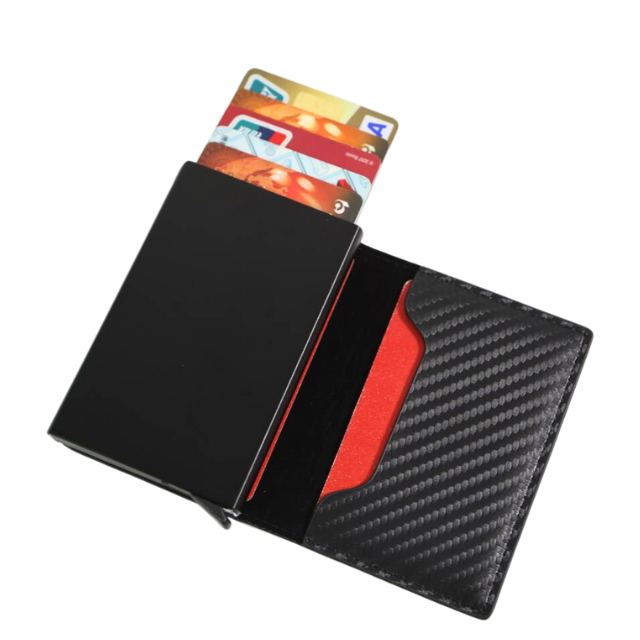
The most common compliance mistake is making unverified RFID-blocking claims. Amazon can remove listings for false performance claims. If you market a wallet as RFID-blocking, the material must be tested with a standard 13.56 MHz RFID reader, and you should retain the test report.
Amazon's FBA program has specific packaging requirements. Each unit must be poly-bagged with a suffocation warning if the bag opening exceeds 5 inches. FNSKU labels must be applied to each unit — these are different from UPC barcodes. FNSKU labels are Amazon-specific and track inventory within their system; UPC codes identify the product globally.
Master carton requirements include weight limits (50 lbs for most fulfillment centers), dimension restrictions, and FBA box ID labels. In 2024–2025, Amazon has enforced stricter labeling compliance — non-compliant units are returned to the seller at the seller's cost.
The pattern defines stitch lines, panel shapes, and material grain direction. Digital formats — AI, DXF, or PDF at 1:1 scale — are the industry standard for manufacturer communication.
Standard wallet dimensions range from 4.25" x 3.5" (closed) for slim bifolds to 4.5" x 3.75" for full bifolds with coin pockets. The pattern must account for material thickness: a 1.2mm leather panel folds differently than a 0.8mm panel, affecting the final closed thickness.
Request a spec sheet from your manufacturer confirming your pattern matches production tolerances. This document should list every panel dimension, stitch allowance, and material specification.
Pattern transfer methods vary by material. For leather, hand tracing with an awl or laser engraving marks the cutting lines. For metal wallets — aluminum, titanium, or stainless steel — the pattern transfers through CNC programming rather than physical tracing.
Grain direction matters for leather. Cutting along the spine versus across it affects durability and appearance. A wallet cut against the grain will show premature wear at fold lines. Experienced manufacturers automatically align patterns with grain direction, but you should confirm this on your spec sheet.
Rough cutting is the first physical cut, intentionally larger than the final shape to allow for skiving — the thinning of edges so folds lay flat. Leather manufacturers use sharp knives or die-cutting machines. Metal wallet manufacturers use CNC laser or water jet cutting.
Request nested cutting layouts from your manufacturer. Nesting arranges patterns to minimize material waste. For leather, this can lower per-unit cost by 3–7%. For metal, the savings are even higher because sheet metal is priced by weight.
Skiving thins leather edges so folds lay flat and stitching is cleaner. A poorly skived wallet shows bulky, uneven edges — a common source of negative Amazon reviews.
Lining materials include microfiber, PU, and cotton. The lining determines the "premium feel" customers perceive when opening the wallet. For RFID-blocking wallets, the lining may include a metal or conductive thread layer. This is a spec you can highlight in your Amazon listing — but only if the material is genuinely tested.
Tolerance standards differ by material. Leather wallets typically allow ±0.5mm. Metal wallets require ±0.1mm, especially for RFID-blocking models where panel alignment affects shielding performance.
Misaligned panels are the #1 cause of wallet returns. For metal wallets, this stage includes CNC finishing, chamfering, and surface sanding. For leather, it involves trimming each panel to its exact final dimension.
Adhesive selection depends on material. Water-based PU glue works for leather — it is eco-friendly and remains flexible after curing. Cyanoacrylate bonds metal-to-metal. Hot-melt adhesives suit fabric wallets.
Curing time is critical. Rushing this step causes delamination — layers separating after weeks of use. Delamination appears in Amazon reviews as "wallet falling apart after a month." For multi-layer wallets with 6 card slots plus a cash compartment, the gluing order determines structural integrity. Each layer must bond to the previous one before the next is applied.
Two stitching methods dominate: machine stitching and saddle stitching. Saddle stitching uses two needles and is more durable — if one stitch breaks, the rest hold. Machine stitching is faster and cost-effective for high volume but fails entirely if a thread breaks.
Edge painting creates a polished finish that reads as "premium" in product photos. This is a visual differentiator for Amazon listings. Final inspection checks for loose threads, glue residue, and panel alignment.
Full-grain leather is the premium option. It develops a patina over time, which some customers love. It costs more and has natural markings that vary between units.
Top-grain leather is more uniform and slightly less durable. It sits in the mid-range and works well for consistent colorways.
PU leather — also called vegan leather — costs less and offers consistent color. Durability is lower, making it suitable for entry-level FBA products where price drives the purchase decision.
Aluminum is lightweight, affordable, and takes laser engraving well. It is the most common metal wallet material on Amazon.
Titanium is premium and extremely durable. It costs significantly more — justify this with a higher selling price and clear listing copy about the material advantage.
Stainless steel is heavy but strong. Consider FBA shipping weight implications: a stainless steel wallet weighs 3–4 times more than an aluminum one, increasing per-unit fulfillment fees.
Nylon and Cordura offer durability and lightweight construction for minimalist wallets. Hybrid designs — leather exterior with a metal RFID shield inside — are a growing Amazon trend. This combination lets you charge a premium for the leather look while delivering genuine RFID protection.
Single samples confirm design and material choices. Pre-production samples come from the actual production line and validate manufacturing processes.
When evaluating a sample, check stitching density (measured in SPI — stitches per inch), edge finishing quality, and snap or button force. A bifold wallet should have 6–8 SPI for durability. Test the wallet with standard card dimensions — 85.6mm x 53.98mm — to ensure slots fit without being too tight or loose.
Ask the manufacturer to ship the sample in packaging that mimics your final FBA packaging. This validates your packaging design before you commit to mass production.
Run a drop test to simulate shipping damage — this matters for hard-shell metal wallets. Perform a wear test by opening and closing the wallet 500+ times to check hinge or snap durability. For RFID-blocking claims, verify with a standard RFID reader and request the test report in writing.
Pricing breaks down into material cost, labor, tooling (molds and dies), packaging, and logistics. Metal wallets have higher tooling costs but lower per-unit labor — CNC machines run consistently once programmed. Leather wallets have lower tooling costs but higher per-unit labor because stitching is more manual.
Ask for a break-even cost per unit at your target MOQ. This lets you compare quotes fairly across manufacturers with different pricing structures.
Typical MOQs for custom wallets: 500–1000 units for leather, 300–500 for metal due to CNC setup efficiencies. To negotiate a lower MOQ, offer a longer lead time or accept standard colors to reduce setup cost.
Plan your first FBA shipment at 2–3 months of projected sales. This buffer protects against stockouts — Amazon's Inventory Performance Index penalizes sellers who run out of stock, reducing search visibility.
Retail-ready packaging — a rigid box with branding — improves perceived value and can justify a higher price point. It increases cost and FBA storage fees because boxes take more warehouse space.
Poly bags with hang holes are cost-effective. Ensure the bag is labeled with the suffocation warning if the opening exceeds 5 inches. For metal wallets, add foam or bubble wrap to prevent scratches during transit.
FNSKU label placement: on the back of the product or the packaging — never cover the product's own branding. Master cartons need the FBA box ID label and a "Made in China" sticker. Amazon has been enforcing stricter labeling compliance recently — non-compliant units are returned to the seller at their cost.
The evaluation framework has five dimensions: design support capability, sample turnaround time, production capacity, quality control processes, and communication standards.
Design support means the factory can review your pattern, flag tolerance issues, and suggest material alternatives. Sample turnaround should be under 7 days for standard wallets. Production capacity must match your projected sales volume — a factory producing 5,000 units monthly cannot support a product that sells 10,000 units per month. Quality control processes should include the inspection steps described earlier: drop testing, wear testing, and RFID verification.
Communication standards matter more than most buyers realize. Response time within 24 hours, willingness to share production photos and videos, and itemized quotations indicate a factory that manages projects professionally.
Quote immediately without asking about your target price point or order quantity
Cannot provide a spec sheet with tolerances
Refuse to share production photos or videos
Promise delivery times under 2 weeks for custom production — this is unrealistic for tooling and sampling
Offer MOQs under 100 units for custom wallets — this usually means they are reselling generic stock, not manufacturing your design
What is your tooling cost for this design, and is it amortized into the unit price?
What tolerances do you hold for leather and metal wallets?
Can you provide a pre-production sample from the actual production line?
What is your defect rate on similar wallet projects?
How do you handle defective units in a shipment — replacement or credit?
Do you have ISO 9001 certification?
What is your current production capacity for metal wallets?
Choose a leather wallet manufacturer if your target price point is under $15 and you need classic aesthetics with lower tooling costs. Choose a metal wallet manufacturer if you are positioning an RFID-blocking product at $25+ and need precise CNC tolerances.
Choose a factory with 500+ unit MOQs if you have established sales data and need consistent inventory. Choose a factory with flexible low MOQs if you are testing a new product category and want to validate demand before scaling.
The wallet production process described above is our daily workflow. With 13+ years of manufacturing experience, we have refined each stage — from pattern drawing to final inspection — into a repeatable system for Amazon FBA sellers.
Our in-house CNC machining allows us to hold ±0.1mm tolerances on metal wallets, which is a key requirement for RFID-blocking products where panel alignment affects shielding performance. Our 300,000+ monthly production capacity means we can handle the volume that FBA sellers need for consistent inventory without supply gaps.
We offer OEM and ODM flexibility. Whether you need a pattern drawn from scratch or a pre-production sample validated, our engineering team works directly with your spec sheet — no middlemen, which shortens turnaround times. Our quality control follows the inspection steps in Section 4.2 on every batch before shipping, so your Amazon reviews do not suffer from preventable defects.
We offer flexible MOQs for custom wallets and fast sample delivery — typically within 5–7 days — so you can validate your product before committing to large-scale FBA inventory.
Prepare your concept: reference images, target price point, and estimated order quantity. Send an inquiry with these requirements — most reputable manufacturers respond within 24 hours with a preliminary quote. Ask for a sample before mass production; never skip this step, even if you are on a tight launch timeline.
A typical timeline from design approval to FBA warehouse delivery: 1–2 weeks for design and sampling, 2–4 weeks for mass production, and 25–35 days for sea freight to the US. Plan a 6–8 week total lead time.
Start with a hand sketch or digital drawing, then convert it into a technical pattern in DXF or AI format. Specify materials, dimensions, and stitch type. Work with a manufacturer that offers pattern support — many provide free pattern review for OEM orders, which catches tolerance issues before production begins.
Bifold wallets have two folds and a classic profile. Trifold wallets have three folds and more card capacity but are bulkier. Minimalist wallets — money clip styles or single-panel RFID metal cases — are a growing category. Each type has different preparation steps: bifolds require more stitching, metal wallets require CNC machining.
From a design perspective, balanced card slot placement and a separate cash compartment create the best organization. For FBA sellers, "organization" also means the wallet should photograph well — bulky designs look messy in product images and convert poorly.
Your wallet must hold an ID card, 2–4 credit cards, and folded cash. If it cannot hold these comfortably, it will generate negative reviews. Always test with standard card dimensions — 85.6mm x 53.98mm.
Not required, but it is a strong selling point. RFID-blocking wallets are a high-demand Amazon category. If you choose this feature, ensure the material is tested and the claim is accurate — false claims can lead to listing removal.
Amazon Seller Central — FBA Packaging and Labeling Requirements. https://sellercentral.amazon.com/help/hub/reference/external/G20014140
Consumer Product Safety Commission — CPSIA Requirements. https://www.cpsc.gov/Regulations-Laws--Standards/Statutes/The-Consumer-Product-Safety-Improvement-Act
International Organization for Standardization — ISO 9001 Quality Management. https://www.iso.org/iso-9001-quality-management.html
Federal Communications Commission — Equipment Authorization for RF Devices. https://www.fcc.gov/oet/ea/
<a href="<a href=" https:="" www.gstartec.com="" contactus.html"="" target="_blank" rel="noopener noreferrer">https://www.gstartec.com/contactus.html" style="display:inline-block;padding:12px 24px;background:#2563eb;color:#fff;text-decoration:none;border-radius:6px;font-weight:600">Get a Free Quote


