

Views: 363 Author: Professor Leon Publish Time: 08-21-2026 Origin: Site


Content Menu
● 1. What Are the Different Types of Graded Card Protectors?
● 2. What Are the Exact Dimensions of PSA, CGC, BGS, and SGC Slabs?
● 3. What Materials Are Used for Custom Graded Card Protectors?
● 4. How Does the Customization Process Work Step by Step?
● 5. What Should You Look for When Evaluating a Graded Card Protector Manufacturer?
● 6. Which Graded Card Protector Is the Best?
● 7. How to Get GradedGuard Off a Slab?
● 8. What Industry Standards Apply to Graded Card Protection?
● 9. Questions to Ask Before Ordering Custom Graded Card Protectors
● 11. How to Customize Graded Card Protectors: Decision Guide
11 min read
A buyer from a trading card accessories brand called last quarter with a straightforward request: "I want a metal case for PSA slabs with my logo on it." The conversation stalled at the second question. Which PSA holder version? What interior tolerance? Hinged or two-piece? The buyer had not realized that "customizing graded card protectors" involves more than picking a color and sending a logo file.
This guide covers the technical decisions behind custom graded card protection—slab dimensions, material properties, printing methods, and supplier evaluation—so you can prepare a specification sheet that a factory can actually build from.
Graded card protectors fall into three distinct product categories, each serving a different protection level and price point. The term "customization" applies differently to each type.
Card sleeves are soft, flexible polypropylene or mylar pouches that fit over a graded slab. They protect against dust and light scratching but offer zero impact resistance. Customization is limited to print on the sleeve surface or the header strip.
One-touch cases are rigid plastic holders with a magnetic or snap closure. They provide moderate impact protection and are popular for display. These offer more customization surface area—sides, backs, and sometimes the closure mechanism itself.
Slab cases (cases-for-cases) are hard shells—often aluminum, steel, or polycarbonate—designed to hold a PSA, CGC, or BGS slab securely. This is the premium category. Surface area is maximized for branding, and material choice significantly impacts both protection level and manufacturing complexity.
For B2B buyers, the slab case category offers the most differentiation potential. A branded aluminum case with laser-engraved logos sells at a premium that a printed poly sleeve cannot match.
Graded card cases are not one-size-fits-all. Each grading company uses a different holder, and the differences in thickness and dimensions are significant enough that a case designed for one will not fit another.
| Grading Company | Approx. External Dimensions (H × W × D) | Notes |
|---|---|---|
| PSA | 88.9 mm × 63.5 mm × 3.6 mm | Thinnest of the major graders |
| CGC | 90.2 mm × 64.0 mm × 4.2 mm | Slightly thicker than PSA |
| BGS | 92.1 mm × 64.0 mm × 4.0 mm | Taller than PSA |
| SGC | 88.9 mm × 63.5 mm × 4.0 mm | Similar footprint to PSA, thicker |
Do PSA card guards fit CGC? No. PSA slabs are thinner and slightly smaller. A guard designed for PSA will be too tight on a CGC slab—it may not close properly, or worse, it could put pressure on the holder. The thickness difference of 0.6 mm might sound negligible, but for a rigid case with tight tolerances, it is the difference between a secure fit and a cracked shell.
When preparing a specification sheet, state the grading company explicitly. Do not write "fits all slabs." A reputable manufacturer will ask which grader the case is for before quoting.
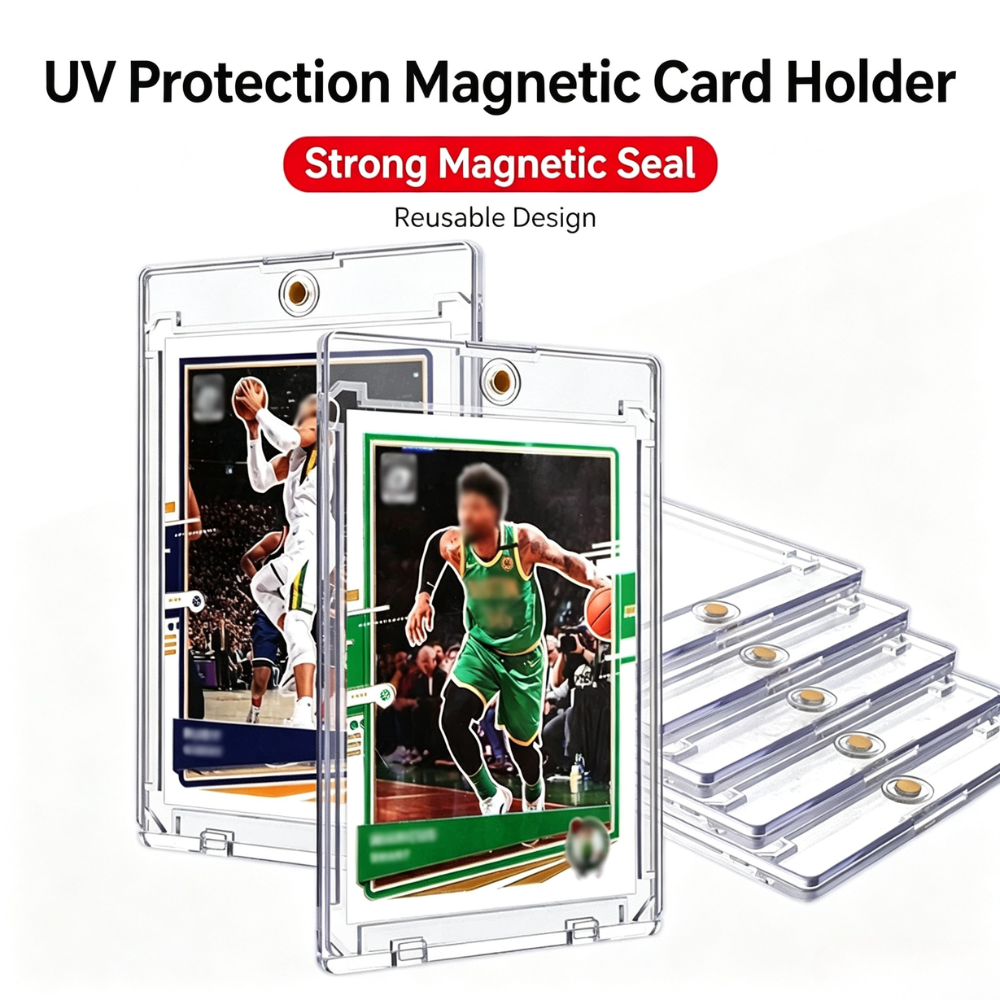
Material selection determines protection level, manufacturing cost, and perceived quality. Each option has trade-offs.
PVC (Polyvinyl chloride) is the budget option. It is rigid and clear, but it requires plasticizers that can off-gas over time. For graded card protection, archival safety matters—collectors pay premiums for cards in pristine condition, and a case that degrades the slab label is a liability.
PET (Polyethylene terephthalate) is the preferred clear plastic for graded card cases. It offers excellent clarity, better impact resistance than PVC, and does not require the same plasticizer content. UV-resistant PET variants are available, which matters for display cases exposed to light.
Acrylic provides the premium clear-case experience. It has the highest optical clarity and feels substantial in hand. The trade-off: acrylic scratches more easily than PET. A scratched case defeats the purpose of a display-oriented product.
Aluminum is the top choice for slab cases and "armor" style protectors. It offers superior crush and impact resistance—a dropped aluminum case protects the slab inside, while a plastic case might crack. Aluminum also provides the best surface for branding: laser engraving on aluminum is permanent and scratch-resistant.
Stainless steel offers even higher durability but adds significant weight and cost. It is rarely used except for ultra-premium products.
Imperfect insight: Aluminum is not always the right answer. For a lightweight, low-cost product aimed at casual collectors, a PET one-touch case makes more sense. Aluminum cases are heavier and more expensive to ship—freight costs can eat into margins on low-value orders. The material choice should follow the target price point, not the maximum protection level.
The path from concept to finished graded card case follows a standard sequence. Understanding each step helps you ask the right questions and avoid costly revisions.
Step 1: Define the product brief. Specify the grading company (PSA, CGC, BGS), the case type (one-touch, slab case, storage box), the target retail price, and the protection level required. A case for a $5,000 card needs different engineering than one for a $50 card.
Step 2: Choose the material and finish. Decide between plastic and metal, clear and opaque, matte and glossy. This decision drives the manufacturing process—injection molding for plastic, CNC machining for metal.
Step 3: Request engineering drawings. A manufacturer should provide a dimensional drawing showing internal tolerances. The drawing must indicate how much clearance exists between the slab and the case wall. Too tight, and the slab jams. Too loose, and it rattles.
Step 4: Approve prototypes. The manufacturer produces samples for fit testing. Check three things: does the slab slide in smoothly, does the case close securely, and does the labeling sit correctly?
Step 5: Run a pilot batch. Before committing to a full production run, request a pilot batch of 50–100 units. Test them with actual slabs from the grading company you are targeting. Verify print adhesion and any moving parts.
Step 6: Scale to full production. Once the pilot passes, the manufacturer ramps to full production. Agree on quality checkpoints and packaging standards before the run starts.
Supplier evaluation for graded card cases requires attention to manufacturing capability, not just price quotes. The following framework applies across product categories.
Check for in-house machining capability. A manufacturer with in-house CNC machining can control tolerances directly. If they outsource machining, lead times extend and quality control becomes indirect. Ask whether the factory owns its CNC equipment or subcontracts it.
Verify tolerance measurement practices. A case with a 0.2 mm tolerance requires caliper or gauge measurement during production. Ask how the factory inspects dimensions—random sampling or 100% inspection—and what tools they use.
Ask about material sourcing. Where does the aluminum come from? What grade of PET do they use? A manufacturer that sources certified materials can provide documentation. One that cannot trace materials may be using recycled or off-spec stock.
Review their defect classification. What counts as a reject? A small scratch on the inside of a clear case might be invisible to the buyer but could be flagged by a strict inspector. Understand the factory's standards before production starts, not after.
Evaluate prototype turnaround. A responsive manufacturer provides samples within 7–14 days. Longer lead times suggest either a crowded production schedule or a lack of in-house prototyping capability.
The "best" protector depends on the protection level required and the target customer's willingness to pay.
For display and everyday handling, rigid one-touch cases with UV-resistant PET offer the best balance of clarity, protection, and cost. These suit collectors who want to show their cards without hiding them in a box.
For maximum physical protection, aluminum slab cases are the clear winner. They protect against bending, crushing, and impact—the failure modes that plastic cases cannot resist. A dropped aluminum case might dent, but the slab inside survives.
For bulk storage, comprehensive graded card storage boxes—holding 5 to 20 slabs—are gaining popularity. These are typically aluminum or wood with foam or felt lining. They offer a higher perceived value and are well-suited for branded premium products.
For B2B buyers, the "best" choice is the one that fits the target price point and brand positioning. A budget brand should not launch with aluminum cases; a premium brand should not launch with thin poly sleeves.
GradedGuard and similar adhesive products leave residue when removed. The standard removal method uses isopropyl alcohol (90% or higher). Apply a small amount to a microfiber cloth and gently rub the residue in a circular motion.
Warning: Avoid getting solvent on the slab label itself. The ink on PSA and CGC labels is not solvent-proof. Isopropyl alcohol can smear or remove the label ink, which devalues the card significantly.
For buyers customizing cases: this is a reminder to use materials that do not require adhesives in contact with the slab. A case with a secure mechanical closure—magnetic or snap—eliminates the residue problem entirely.
No universal certification exists specifically for graded card cases. However, several standards apply to the materials and manufacturing processes.
Archival safety: Materials should be acid-free and PVC-free to prevent chemical degradation of the slab and card over time. PSA does not officially endorse third-party cases, but the company recommends acid-free, PVC-free holders for card storage.
RoHS compliance: For products sold in the EU, materials must comply with the Restriction of Hazardous Substances directive. This restricts lead, mercury, cadmium, and other substances in electrical and electronic products. Cases that include magnetic closures may fall under this scope.
REACH compliance: The EU's Registration, Evaluation, Authorisation and Restriction of Chemicals regulation applies to materials used in consumer products. Aluminum and plastic cases must meet REACH substance restrictions.
ISO 9001: This quality management standard applies to the manufacturing process, not the product itself. A manufacturer with ISO 9001 certification has documented quality control procedures. Ask for their certificate and check the scope.
ASTM D256 (Izod Impact Test): While not specifically for card cases, this standard measures plastic impact resistance. A manufacturer claiming high impact protection should be able to reference test data.
Use this checklist when contacting manufacturers. The answers reveal their technical competence and whether they understand graded card specifications.
What is your tolerance range for internal dimensions?
Do you have in-house CNC machining or do you outsource?
What material grade do you use for aluminum cases?
Can you provide a sample drawing before prototyping?
What is your MOQ for custom dimensions versus standard dimensions?
How do you handle defective units in production?
What packaging do you use to prevent scratching during shipping?
Can you laser-engrave logos, or do you only offer screen printing?
What is your typical prototype lead time?
Do you test fit with actual PSA/CGC slabs?
Some red flags indicate a manufacturer that does not understand graded card protection.
Avoid suppliers who claim "universal fit" without asking the grading company. A one-size-fits-all case is a red flag. Different slabs have different dimensions, and a truly universal case would fit none of them well.
Avoid suppliers who cannot provide dimensional drawings. A custom case without engineering drawings is guesswork. If they cannot show tolerances, they cannot control them.
Avoid suppliers who quote injection molding MOQs for a CNC-machined product. Injection molding requires expensive tooling—often $5,000 to $20,000 per mold. CNC machining has no tooling cost but higher per-unit cost. A supplier who confuses these processes either lacks experience or is padding the quote.
Avoid suppliers who do not ask about the target price point. Material choice and manufacturing method should follow the retail price. A supplier who quotes without asking about pricing is either quoting for the wrong product or lacks strategic thinking.
Choose aluminum slab cases if your target customer collects high-value cards and prioritizes protection over portability. The premium price point supports the higher manufacturing and shipping costs.
Choose PET one-touch cases if your target customer wants display-friendly protection at a mid-range price. PET offers the best balance of clarity, durability, and cost.
Choose comprehensive storage boxes if you are targeting serious collectors with large collections. A branded storage box for 10–20 slabs offers higher perceived value and a larger branding surface.
Choose a manufacturer with in-house CNC machining if you need tight tolerances and fast prototype turnaround. In-house capability reduces lead times and improves quality control on dimensional accuracy.
Choose a manufacturer with flexible MOQs if you are launching a new product line and want to test the market before committing to large volumes. A pilot run of 100–300 units allows you to validate the product and gather feedback.
---
As a manufacturer specializing in custom accessories, our approach to graded card protectors starts with the same technical questions outlined above. Our in-house CNC machining capability means we control tolerances directly—every slot and groove is cut to the exact specifications of the slab it will hold. We do not outsource machining, which shortens lead times and keeps quality control in one facility.
With 13+ years of manufacturing experience across metal, leather, and plastic products, we understand the balance between material cost and retail positioning. Whether you need a simple branded PET case or a complex multi-slab aluminum storage box, we handle OEM and ODM projects with flexible MOQs for pilot runs. Our 300,000+ monthly production capacity supports scale-up when your product gains traction.
If you have a design and need engineering support to finalize dimensions, or if you need a complete solution from concept to production, contact our team with your specifications. We typically respond within 24 hours with a quotation and feasibility assessment.
PSA Card Grading Standards and Holder Dimensions. Professional Sports Authenticator. https://www.psacard.com
CGC Trading Cards Grading Standards. Certified Guaranty Company. https://www.cgccards.com
BGS Grading Standards and Holder Specifications. Beckett Grading Services. https://www.beckett.com
Restriction of Hazardous Substances (RoHS) Directive. European Commission. https://environment.ec.europa.eu
REACH Regulation. European Chemicals Agency. https://echa.europa.eu
ISO 9001 Quality Management Systems. International Organization for Standardization. https://www.iso.org
ASTM D256 Standard Test Method for Determining the Izod Pendulum Impact Resistance of Plastics. ASTM International. https://www.astm.org


