

Views: 369 Author: Professor Leon Publish Time: 08-22-2026 Origin: Site


Content Menu
● 1. What Are the Main Types of Key Organizers?
● 2. How Do Materials Affect Key Organizer Quality?
● 3. What Mechanisms Should Buyers Understand Before Ordering?
● 4. How Should Buyers Evaluate Key Organizer Suppliers?
● 5. What Are the Key Quality Indicators for Key Organizer Buyers?
● 6. What Industry Standards Apply to Key Organizers?
● 7. How to Choose a Key Organizer for Your Brand: The Selection Framework
● 8. What Should Buyers Ask Before Placing a Key Organizer Order?
● 9. What Red Flags Should Buyers Avoid When Vetting Suppliers?
● 10. How We Meet These Standards
● 11. Common Questions About Sourcing Key Organizers
● 12. Decision Guide: Which Sourcing Approach Fits Your Brand?
9 min read
A procurement manager once told me their worst batch of key organizers arrived with two recurring defects: the hex screws stripped after a month of use, and the anodized coating flaked off around the keyhole. The supplier had passed the initial sample check. The problem only appeared at the 5,000-unit scale. That story summarizes why choosing a key organizer for resale is not a product decision. It is a supplier decision.
The key organizer market has grown beyond simple EDC accessories. It is now a high-margin, customizable category that overlaps with wallets, phone accessories, and multi-tools. But the crowded supplier landscape creates a real problem for B2B buyers: inconsistent material quality, hidden tooling costs, and manufacturers who cannot replicate sample quality at scale.
This guide covers the technical and commercial criteria for selecting a key organizer — from mechanism types and material families to supplier vetting frameworks. By the end, you will know exactly what to ask a supplier before placing a bulk order.
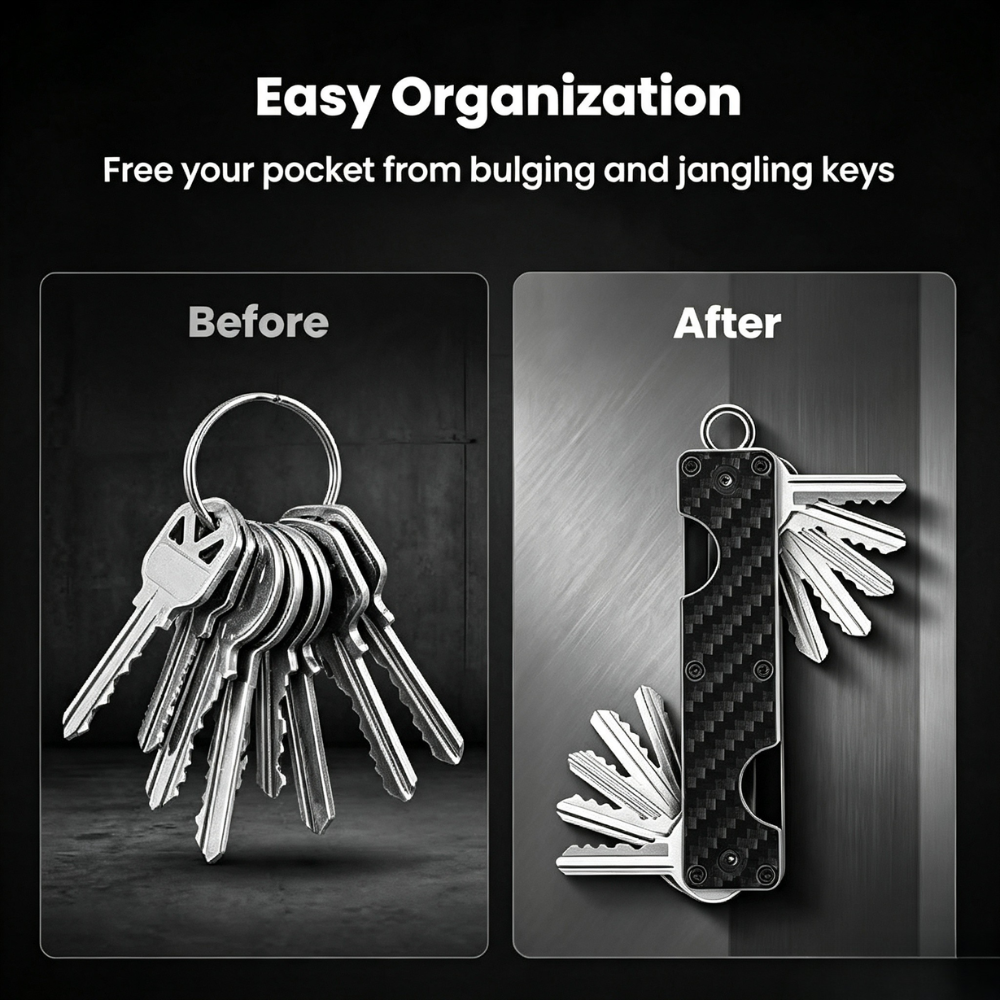
Bar-style organizers are the most common. They use a central pivot or hex screws to clamp keys between two flat plates. Folding or case-style organizers wrap keys in a leather or metal sleeve, offering a cleaner silhouette for formal settings. Modular organizers add mounting points for multi-tools, bottle openers, or Bluetooth trackers.
Each type serves a different end-user. Bar-style organizers appeal to users who want quick access and minimal bulk. Folding styles attract buyers looking for a leather-goods aesthetic. Modular systems command higher price points because they replace multiple EDC items. When sourcing, the first question is not "which is best" but "which fits your target customer's carry habits."
Material selection drives both cost and perceived value. The table below summarizes the trade-offs.
| Material | Weight | Corrosion Resistance | Machinability | Typical Retail Tier |
|---|---|---|---|---|
| 6061-T6 Aluminum | Light | Good (with anodizing) | Excellent | $15–$40 |
| 7075 Aluminum | Light | Good (with anodizing) | Moderate | $30–$50 |
| Titanium (Grade 5) | Very Light | Excellent | Difficult | $50–$100+ |
| Stainless Steel (304) | Heavy | Excellent | Good | $20–$45 |
| Zinc Alloy | Moderate | Poor (needs coating) | Excellent (cast) | $8–$20 |
| Full-Grain Leather | N/A | N/A | N/A (stitching) | $25–$60 |
6061-T6 aluminum is the workhorse of the industry. It balances cost, weight, and CNC machinability. Titanium offers the best strength-to-weight ratio but increases material cost and machining time significantly. Zinc alloy keeps entry-level pricing low but feels less premium and requires careful coating to prevent corrosion. Leather hybrids complicate the supply chain because they require cutting, stitching, and edge painting — processes that most metal-focused factories outsource.
The retention system determines how the organizer holds keys and how easily users can swap them. Hex screw designs are the most popular because they provide a solid clamp. However, the screw grade matters. Standard zinc-plated screws strip easily. Buyers should specify stainless steel screws or ask about thread-locking compounds.
Friction pivots allow keys to fan out without fully loosening the organizer. The pivot relies on precise tolerances and a lubrication layer. If the tolerance exceeds ±0.05mm, the mechanism either binds or wobbles. Spring-loaded mechanisms are less common because they add assembly complexity and failure points. For a first order, simpler is safer.
Evaluating a supplier requires checking four areas: raw material sourcing, process ownership, quality control, and production capacity. Buyers should ask for mill certificates for aluminum or titanium to verify the alloy grade. They should also ask which processes are in-house. A factory that outsources anodizing or laser engraving adds lead time and quality variance.
Quality control protocols matter more than certifications. Ask about inspection checkpoints. A reliable supplier conducts incoming material checks, in-process dimensional checks, and final visual inspection before packing. Request the AQL (Acceptable Quality Limit) standard used for shipment sampling. Industry standard is AQL 2.5, but tighter limits are available for premium lines.
Five indicators separate a well-made organizer from a cheap one. First, edge chamfering. Rough edges scratch keys and pocket linings. Second, anodizing thickness. Type II anodizing (5–10 microns) is decorative; Type III hard-coat (25–50 microns) resists wear. Third, screw torque consistency. Screws should tighten smoothly without cross-threading. Fourth, surface finish uniformity. Anodizing color should match across batches. Fifth, key slot alignment. Misaligned slots cause keys to sit at awkward angles.
Salt-spray testing is the benchmark for corrosion resistance. ASTM B117 is the common standard; 48 hours without visible corrosion is acceptable for aluminum. For leather components, ask about the tanning process and whether the supplier tests for colorfastness.
Key organizers are not heavily regulated, but several standards apply to materials and finishes. REACH and RoHS compliance are mandatory for selling in the European Union. They restrict hazardous substances in metals and coatings. ISO 9001 certification indicates a factory has documented quality management processes. For leather components, buyers should check for compliance with Proposition 65 in California, which covers lead and phthalates.
There is no universal standard for key organizer dimensions, but common specifications exist: key hole diameters range from 4mm to 6mm, and split-ring gauges typically range from 1.2mm to 1.6mm. A reputable supplier will provide a technical drawing with tolerances before production.
The selection process breaks down into three steps: define the end-user profile, match specs to price tiers, and verify compatibility with your existing product line.
EDC enthusiasts prioritize titanium, tool compatibility, and minimalist designs. They are willing to pay for weight reduction and are the most likely to leave negative reviews for small defects. Corporate gift buyers want leather or branded metal options with engraving compatibility. Mass-market retail buyers are cost-sensitive and require durable options that survive rough handling.
Entry-tier products retail between $10 and $20. They typically use zinc alloy with basic coating and a standard bar design. Mid-tier products retail between $20 and $40. They use 6061-T6 aluminum with Type II anodizing and modular add-on options. Premium-tier products retail above $40. They use titanium or 7075 aluminum, CNC precision machining, and custom hardware.
Check whether the organizer integrates with your existing accessories. Does it attach to a multi-tool with a standard 1/4-inch hex mount? Can it work alongside a magnetic phone wallet without interference? If your brand sells RFID-blocking wallets, confirm that the key organizer's metal construction does not disrupt the RFID layer in a combined carry system.
Use this checklist when contacting shortlisted suppliers.
What aluminum grade do you use, and can you provide a mill certificate?
Which processes are in-house: CNC machining, anodizing, laser engraving, assembly?
What is your MOQ per SKU, and does it apply to mixed orders?
What is the lead time for standard ODM designs and custom OEM designs?
What AQL standard do you use for final inspection?
Can you provide a pre-production sample within 7 days?
Do you offer retail-ready packaging, or is packaging quoted separately?
What are your shipping terms: FOB, EXW, or DDP?
Can you combine key organizers with other products in one shipment?
Who owns the molds or tooling after production ends?
Avoid suppliers who quote significantly below market rates without explaining the cost difference. Low-cost quotes often hide thin-walled aluminum, poor anodizing adhesion, or loose tolerances. Avoid suppliers who cannot provide a technical drawing. Avoid suppliers who resist signing NDAs if you share proprietary designs. And avoid suppliers who do not offer pre-production samples. A "sample is great, mass production isn't" problem usually traces back to a supplier who hand-polishes samples but runs automated lines for production. Ask for a random sample from the production line, not just a polished pre-production unit.
The sourcing framework above is not theoretical. We apply it to our own production lines at Gstar Technology in Shenzhen. With 13+ years of manufacturing experience, we operate in-house CNC machining, which gives us control over tolerances down to ±0.05mm and consistent surface finishing — directly addressing the quality control concerns discussed earlier.
Our monthly output of 300,000+ units allows us to scale from pilot runs to peak-season volumes without stretching lead times. We offer both OEM (your technical drawings) and ODM (our existing key organizer designs) models. Custom branding options include laser engraving, Pantone-matched anodizing, and custom packaging. Our material range covers aluminum, titanium, stainless steel, and leather hybrids, so you can hit your target retail price point.
For B2B buyers, we provide pre-production samples within 7 days for standard designs, flexible MOQs for new brands and established distributors, and FOB Shenzhen, EXW, or DDP shipping options to streamline your supply chain.
For OEM (your design), MOQs typically start at 500–1,000 units. For ODM (existing designs with your logo), some suppliers offer MOQs as low as 100–200 units. Always clarify whether the MOQ applies to a single SKU or a mixed order.
Yes. Many manufacturers produce complementary accessories like RFID wallets, card holders, and phone stands. Combining products in one order reduces shipping costs and simplifies supplier management. This is a practical consideration for brands expanding their EDC lineup.
Quality organizers use smooth, chamfered edges and proper anodizing to minimize abrasion. Check the internal surfaces of the organizer, not just the exterior finish. A poorly finished interior will scratch keys regardless of how good the outside looks.
Standard ODM production takes 15–25 days. Custom OEM production, including tooling and sampling, typically takes 30–45 days. Add 2–5 days for express shipping or 15–30 days for sea freight. Factor these timelines into your inventory planning.
There is no universal answer. Titanium offers the best strength-to-weight ratio but at a higher cost. 6061-T6 aluminum offers the best balance of cost and durability. Zinc alloy is budget-friendly but less premium. The right choice depends on your target retail price and end-user expectations.
Choose ODM if you need fast market entry, have limited design resources, or want to test the category with minimal risk. Choose OEM if you have a proprietary design, need specific dimensions or features, or want exclusive rights to a product. Choose a hybrid approach — modifying an existing design with custom finishes, hardware, or packaging — if you want differentiation without the cost of full tooling development.
Ready to source key organizers that meet your brand's quality and budget requirements? Talk to our team today.
ASTM International. "ASTM B117 - Standard Practice for Operating Salt Spray (Fog) Apparatus." https://www.astm.org/b0117-19.html
European Chemicals Agency. "REACH Regulation." https://echa.europa.eu/regulations/reach/understanding-reach
International Organization for Standardization. "ISO 9001:2015 Quality Management Systems." https://www.iso.org/standard/62085.html
California Office of Environmental Health Hazard Assessment. "Proposition 65." https://oehha.ca.gov/proposition-65
International Organization for Standardization. "ISO 2859-1: Sampling Procedures for Inspection by Attributes." https://www.iso.org/standard/1141.html


