

Views: 205 Author: Princee Lee Publish Time: 02-06-2026 Origin: Princee Lee


Content Menu
● Understanding the Invisible Threat: What is RFID Skimming?
>> The Frequency Factor: 13.56 MHz vs. 125 kHz
● How to Tell If Wallet Is RFID Protected: Visual and Physical Cues
>> 1. The Manufacturer's Marking
● The Practical Lab: How to Check RFID Wallet at Home
>> The "Tap-to-Pay" Supermarket Test
● The Science of Shielding: How We Build at Gstar Technology
>> Aerospace-Grade Aluminum Chambers
● Why Choose Gstar Technology (Shenzhen) Co., Ltd.?
>> 1. Mastery of Material Science
>> 2. State-of-the-Art Factory
● OEM and ODM: Customizing Security for Your Brand
>> Custom Branding and Shielding
● Why Ready Stock is a Game Changer for Retailers
>> Benefits of Our Ready-to-Ship (RTS)
● Market Trends for 2026: What Consumers Want
>> 2. Sustainability and Ethics
>> 3. Tactical and Industrial Aesthetics
● Why Choose Gstar Technology? (Our Unique Selling Propositions)
● Maximizing Your ROI: A Guide for Wholesalers
>> High-Quality Digital Assets
● Deep Dive: The Anatomy of a Gstar Pop-Up Wallet
● Case Study: Success in the Minimalist Niche
● The Future of Wallets: What's Next?
● Manufacturing Excellence: A Deep Dive into the Gstar Process
● Marketing Your Secure Wallet
● Frequently Asked Questions (FAQ)
>> 1. Can RFID protection damage my credit cards?
>> 2. Does an RFID wallet protect against magnetic strip demagnetization?
>> 3. Will my transit card work through the wallet?
>> 4. What is the difference between "passive" and "active" RFID blocking?
>> 5. How long does the RFID blocking material last?
In the modern landscape of 2026, security is no longer just about heavy deadbolts and physical safes. As our financial lives have migrated into the digital realm, our vulnerabilities have shifted as well. The convenience of "tap-to-pay" technology and contactless credit cards has brought a hidden risk: RFID skimming. For consumers and retailers alike, the question of the hour is: how to tell if wallet is RFID protected?
At Gstar Technology (Shenzhen) Co., Ltd., we have spent years at the forefront of the secure accessory industry. Based in the technological heart of China, we specialize in merging high-end aesthetics with cutting-edge security. Whether you are a solo traveler looking for peace of mind or a business owner looking to source a high-quality product line, understanding how to verify the integrity of your wallet's shielding is paramount. This guide serves as the ultimate manual for identifying, testing, and sourcing the best RFID-protected wallets in the market today.

Before we dive into the RFID wallet protection test methods, we must understand what we are protecting against. RFID (Radio Frequency Identification) uses electromagnetic fields to automatically identify and track tags attached to objects. Your credit cards, debit cards, and passports contain these tags, which hold your sensitive data.
Electronic pickpockets use handheld scanners to "ping" these tags from a distance. If your wallet lacks a shield, your card will respond by transmitting its data—your name, card number, and expiration date—directly to the thief's device. This is why many people are asking, "is my wallet RFID blocking?" and seeking ways to verify their gear.
Most modern credit cards operate on a high-frequency (13.56 MHz) band. This is the frequency that standard RFID-blocking wallets are designed to stop. Older access cards for office buildings often use a low-frequency (125 kHz) signal. When you perform an RFID protected wallet check, it is important to know that most consumer-grade blocking wallets are optimized for the 13.56 MHz frequency used by banks.
If you have just purchased a wallet and are wondering how to identify RFID wallet features without technical equipment, there are a few tell-tale signs to look for.
The most obvious way is to look for a logo or a stamp. High-quality manufacturers like Gstar Technology (Shenzhen) Co., Ltd. often emboss an RFID-protected icon or the letters "RFID" directly into the leather or onto the internal lining. This serves as a primary indicator for the consumer.
If you can feel the interior layers of the wallet, check for a metallic or "crinkly" sound between the outer leather and the inner fabric. Most effective shielding uses a thin layer of metallic-infused fabric or aluminum foil. If the wallet feels like it has a slightly stiff, paper-like layer inside the card slots, you are likely looking at a shielded product.
In many of our flagship products at Gstar Technology, such as our pop-up models, we use a solid aluminum chamber. This is the easiest way regarding how to identify RFID wallet security. If your cards sit inside a metal box, they are naturally shielded by the "Faraday Cage" effect, where the metal shell redirects the radio waves around the exterior rather than letting them penetrate the cards inside.
If you aren't satisfied with visual cues and want to know for sure, you need a test RFID blocking wallet method that provides concrete results. Here are the most effective DIY strategies.
This is perhaps the most reliable real-world RFID blocking wallet test method.
1. Go to a store with a contactless payment terminal.
2. Place your credit card inside the wallet.
3. When the terminal asks for payment, hold your *closed* wallet against the reader.
4. If the transaction does not go through and the machine cannot read the card, your wallet is working.
5. To be thorough, try holding the wallet at different angles. If the machine stays silent, you can stop asking "does my wallet block RFID?"—you have your answer.
Most modern smartphones are equipped with NFC (Near Field Communication) technology, which is compatible with RFID signals. This makes it incredibly easy to test RFID blocking wallet effectiveness at home.
1. Download an "NFC Reader" app from your app store.
2. Ensure NFC is turned on in your phone's settings.
3. Place your credit card on the back of your phone to see if the app can read it. You should hear a beep or see card data appear.
4. Now, place that same card inside your wallet and close it.
5. Tap your phone against the wallet.
6. If the phone fails to detect the card, your protection is solid. This is a definitive way to know RFID wallet works.
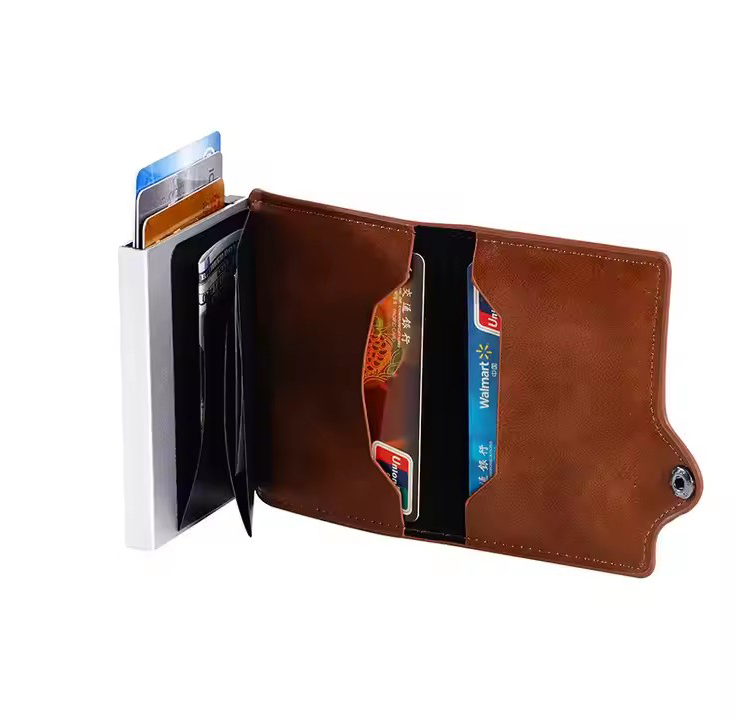
At Gstar Technology (Shenzhen) Co., Ltd., we don't just "add" a layer; we engineer a barrier. Understanding how to know RFID wallet works requires a look at the materials used in the manufacturing process.
We utilize a blend of nickel, copper, and polyester. The copper provides the electrical conductivity needed to deflect the waves, while the nickel adds durability and prevents corrosion. This fabric is sewn between the leather and the lining, ensuring a slim leather pop up wallet remains thin while offering maximum security.
For some of our more traditional bifold designs, we use industrial-grade aluminum foil laminates. These are bonded to the leather, creating a continuous barrier. This is the core of an effective RFID protected wallet check. If there are gaps in the shielding, the radio waves can "leak" in, a phenomenon known as "diffraction." Our manufacturing process ensures 360-degree coverage for the card slots.
In our pop-up models, the metal case itself is the shield. By using 6063 aluminum alloy, we provide a rigid structure that is physically impossible for a 13.56 MHz signal to penetrate. If you are looking for how to check RFID wallet reliability, the metal case is the gold standard.
As a premier manufacturer in Shenzhen, we are more than just a factory. We are a partner in your brand's security journey.
We don't just buy off-the-shelf shielding. We source the highest grade of EMI (Electromagnetic Interference) blocking fabrics. When our clients ask, "is my wallet RFID blocking?", we can provide lab reports and material safety data sheets (MSDS) to prove it.
Our Shenzhen facility is equipped with specialized testing equipment. Every batch of wallets undergoes a random RFID blocking wallet test method using signal generators and spectrum analyzers to ensure the blocking dB (decibel) level meets international standards (usually >60dB).
The world of digital theft is evolving. Our R&D team is constantly monitoring new skimming frequencies and techniques. We are currently developing "Active" RFID blockers—small cards that emit a jamming signal to interfere with scanners even more aggressively.

Gstar Technology is a leader in OEM (Original Equipment Manufacturer) and ODM (Original Design Manufacturer) services. If you want to launch your own line of secure wallets, we are the engine that can drive your production.
Do you want a specific type of leather? Or perhaps a specific color of aluminum for your metal pop up card holder leather? We can customize every aspect. More importantly, we can integrate specific levels of shielding. If your market requires protection for 125 kHz signals as well as 13.56 MHz, we can adjust the thickness and material of the lining to suit your needs.
When you work with us on an OEM project, we provide prototypes that have already passed our internal RFID wallet protection test. This means you can go to market with the confidence that your customers are truly protected. We can even help you design the "RFID Protected" branding to help your customers how to identify RFID wallet features quickly.
In the world of e-commerce, speed is everything. Gstar Technology maintains a significant inventory of our most popular slim leather pop up wallet models in our Shenzhen warehouse.
- Rapid Fulfillment: Orders from our stock can be processed and shipped within 48 hours.
- Low Minimums: If you are a startup and want to test the waters with an RFID protected wallet check for your local market, you can order as few as 50 units.
- Guaranteed Quality: Our stock items are our "Best Sellers"—designs that have been refined over years of feedback and rigorous testing.
When you buy leather pop up card holder inventory from Gstar, you are getting a product that has been vetted by thousands of users worldwide.
Staying ahead of the curve is vital. Our market research department has identified several key trends for the upcoming year that should guide your product selection.
While biometric wallets are emerging, the most popular "smart" feature remains the AirTag compatibility. We have designed a specific front pocket pop up wallet with a built-in AirTag holder, allowing users to track their wallet via their smartphone.
Consumers are increasingly asking about the origin of their leather. Gstar Technology is committed to ethical sourcing, offering LWG (Leather Working Group) certified leathers and sustainable packaging options to help our clients appeal to eco-conscious demographics.
There is a growing demand for "tactical" minimalism. This involves combining a metal pop up card holder leather core with high-performance fabrics like Cordura or carbon fiber textures, creating a rugged look that appeals to the EDC (Everyday Carry) community.
With thousands of manufacturers in China, why should Gstar Technology be your first choice?
- 13+ Years of Specialization: We didn't just start making wallets; we pioneered the integration of metal and leather in the Shenzhen region.
- Global Compliance: Our products meet CE, RoHS, and REACH standards, ensuring they are safe for sale in the US, EU, and beyond.
- Innovative R&D: We release new designs every quarter, ensuring our clients always have access to the latest one touch pop up card wallet technology.
- US-Based Support: While our manufacturing is in China, we maintain a presence in the US (Wilmington, DE) to facilitate smoother communication and after-sales service for our Western partners.
When you decide to buy leather pop up card holder stock from us, we don't just send the product and say goodbye. We provide the tools for your success.
We provide our B2B partners with professional photography and 4K product videos. This is essential for platforms like Amazon, Shopify, and TikTok Shop, where visual storytelling drives conversions.
The unboxing experience is a massive part of the perceived value. We offer custom gift boxes, velvet pouches, and branded inserts. A minimalist leather card holder presented in a premium matte black box can command a 30% higher retail price than one in a polybag.
Located in Shenzhen, we are minutes away from one of the world's largest ports and airports. We offer DDP (Delivered Duty Paid) shipping, meaning we handle the customs, duties, and taxes, delivering the goods directly to your warehouse door.
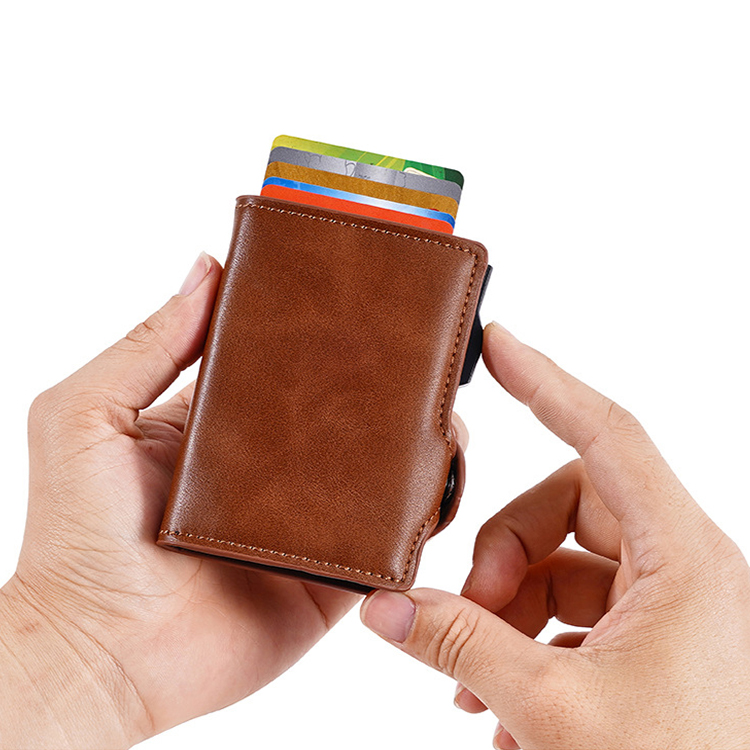
To truly understand the value, let's look at the "Exploded View" of our leather wallet with metal case.
1. The Outer Shell: Sourced from premium tanneries, the leather is skived (thinned) to a precise 0.8mm. This ensures the wallet remains a slim leather pop up wallet even when fully loaded.
2. The Internal Aluminum Box: Crafted from 6063 aluminum alloy. It's lightweight yet strong enough to withstand being stepped on.
3. The Trigger Mechanism: A patented lever system that requires exactly the right amount of pressure—not so light that it triggers in your pocket, and not so firm that it's difficult to use.
4. RFID Blocking Fabric: A secondary layer of metallic mesh sewn into the leather folds to protect any cards kept in the exterior pockets.
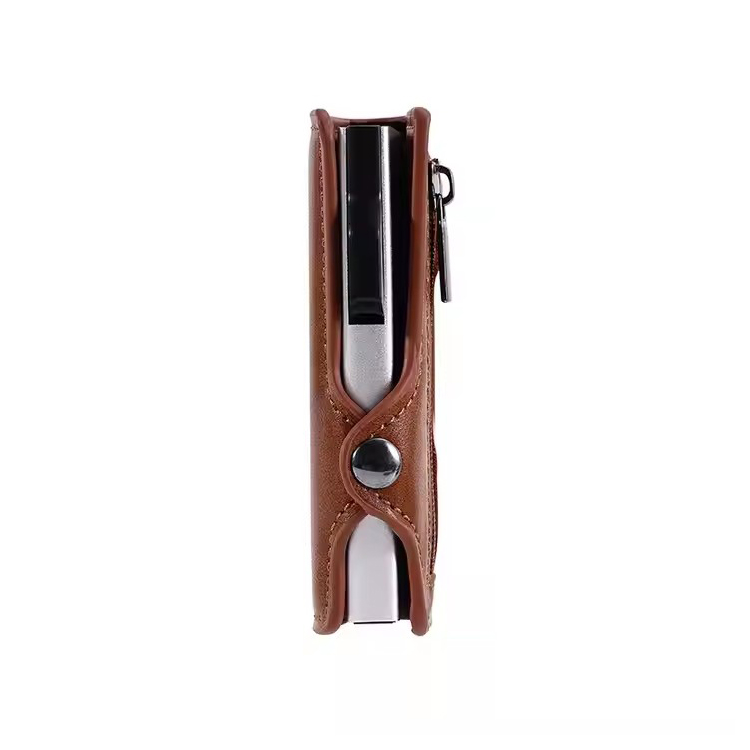
5. The Magnetic or Button Closure: We use high-grade N52 neodymium magnets or heavy-duty snap buttons for the leather pop up wallet with button models, ensuring the wallet stays closed under pressure.
One of our European clients approached us in 2024 wanting to launch a minimalist leather card holder brand. They had no design experience but a strong marketing plan.
Using our ODM service, they selected a pop up leather card holder wallet from our stock. We customized it with a unique "Emerald Green" Crazy Horse leather and their logo embossed on the trigger. Within six months, they moved 50,000 units on Instagram and TikTok. Because we had the RFID pop up leather wallet core ready in stock, we were able to scale their production from 500 units to 10,000 units in just three weeks.
As we look toward the late 2020s, the "wallet" is becoming a piece of tech hardware. We are seeing a merger of traditional leather crafts and advanced electronics. Gstar Technology is currently exploring:
* Biometric Access: Fingerprint scanners to release the cards from the one touch pop up card wallet.
* Bluetooth Tracking: Ensuring you never lose your wallet again.
* Solar-Powered Active Jamming: Using thin-film solar cells to power active RFID blockers.
The question will no longer be "is my wallet RFID blocking?", but rather "how many layers of security does my wallet have?"
To truly appreciate a Gstar product, one must look at the assembly line. Every pop up leather card holder wallet starts as a selection of premium hides.
1. Selection: We choose leathers that are thin enough to remain minimalist but tough enough to house a metal core.
2. Lamination: This is where the RFID wallet protection test begins. We bond the blocking fabric to the leather using heat-sensitive adhesives that don't add bulk.
3. Precision Cutting: Using laser cutters, we ensure that the blocking material perfectly matches the leather pieces, leaving no gaps for signal leakage.
4. Hardware Integration: The leather wallet with metal case is fitted with its spring-loaded mechanism. This is tested manually by our QC team.
5. Final Stitching: We use nylon threads that are abrasion-resistant, ensuring the wallet doesn't fall apart at the seams.
If you are a business owner, how do you sell the "Security" aspect?
* Educational Content: Use this guide as a template. Teach your customers how to know RFID wallet works.
* Video Demonstrations: Show the "Smartphone NFC Test" in your social media ads. Visual proof is the most effective sales tool.
* Certifications: Display your Gstar Technology testing reports. It proves that you have done the RFID protected wallet check on their behalf.

Determining how to tell if wallet is RFID protected doesn't require a PhD in physics, but it does require attention to detail. Whether through visual inspection, the supermarket terminal test, or the smartphone NFC method, verifying your protection is essential for modern living.
Gstar Technology (Shenzhen) Co., Ltd. remains committed to being the world's premier provider of these secure solutions. We invite you to explore our range of minimalist leather card holder products and our robust OEM/ODM services. Don't leave your data to chance—partner with the experts who treat security as an art form.
No, it is a common myth. The shielding in an RFID protected wallet check is passive. It simply reflects or absorbs radio waves. It does not emit any magnetic field or radiation that could demagnetize your cards or damage the chips.
Generally, no. RFID blocking is designed to stop radio waves (electronic skimming). It does not provide a shield against powerful magnets. However, because our leather wallet with metal case provides a physical barrier, it can help prevent minor scratches to the magnetic strip.
If the wallet is high-quality and offers 360-degree protection, your transit card (like an Oyster or Metro card) will *not* work while inside. You will need to slide the card out slightly or use an external, non-shielded pocket. This is actually a sign that the RFID blocking wallet test method has been successful.
Passive blocking (what we use in our slim leather pop up wallet) uses materials like aluminum or copper to block signals. Active blocking uses a small battery and a circuit to emit a "noise" signal that jams scanners. Passive is usually preferred because it is thinner, lighter, and never runs out of power.
The metallized fabrics used in a Gstar leather pop up wallet with button are incredibly durable. As long as the fabric is not physically torn or dissolved by harsh chemicals, it will provide protection for the entire lifespan of the wallet. We design our wallets to last for years of daily use.


