

Views: 515 Author: Professor Leon Publish Time: 09-01-2026 Origin: Site


Content Menu
● 1. What Defines the Best Minimal Wallets from a Technical Standpoint?
● 2. How Does Design Engineering Prevent Wallet Loss?
● 3. How to Evaluate Minimal Wallet Suppliers
● 4. What Testing Standards Apply to Minimal Wallets?
● 5. What Are the Realistic Cost Drivers and Logistics Considerations?
● 6. How We Meet These Standards
● 7. Common Questions Buyers Ask
● 8. Making the Sourcing Decision
11 min read
The last time a European brand owner visited our factory, he spent twenty minutes flipping the same aluminum cardholder over in his hands. Not because he was indecisive — he was checking the edge radius with his thumb, holding it up to the light to inspect the anodizing uniformity, and sliding a card in and out roughly fifty times. When he finally looked up, his question was not about price. It was: "Can your production line hold this same tolerance across 10,000 units?"
That is the real question behind every "best minimal wallets" search made by a buyer, not a consumer. Aesthetics matter, but for brands, the definition of "best" is tied to whether a factory can replicate a prototype's precision at scale. This guide breaks down the technical benchmarks, material standards, and procurement frameworks that separate a marketable slim wallet from a returns disaster.
The best minimal wallets share a core set of engineering parameters: materials with verified durability ratings, RFID shielding that meets blocking standards, and mechanical components tested for cycle life. A consumer sees a thin profile; a buyer should see a specification sheet.
Aluminum: The dominant metal in premium minimal wallets is 6061-T6 aerospace-grade aluminum. The T6 temper designation indicates solution heat-treated and artificially aged — yielding a tensile strength around 310 MPa. What matters more for buyers is the surface finish. A proper hard-anodized coating (per MIL-A-8625, Type II or III) creates a surface layer of 5–25 microns. Type III hard anodizing reaches 25–50 microns and significantly improves scratch resistance.
The machining tolerances matter too. A wallet machined from solid bar stock with a CNC tolerance of ±0.05 mm produces precise card tracks and flush-fitting plates. Cheaper cast versions often have visible parting lines and weaker structural integrity. If a seller describes their product as "aircraft-grade aluminum" without specifying the alloy and temper, treat that as a red flag.
Leather: Full-grain leather retains the natural fiber structure, making it the most durable choice for cardholders. Top-grain leather has the top layer sanded off to remove blemishes — slightly thinner but more uniform in appearance. Bonded leather is a composite of leather fibers and polyurethane; it will peel within months and should be avoided for any product claiming longevity. Vegetable-tanned leather develops a patina over time, which many consumers value as a personalization feature. Chrome-tanned leather is more water-resistant but does not age the same way.
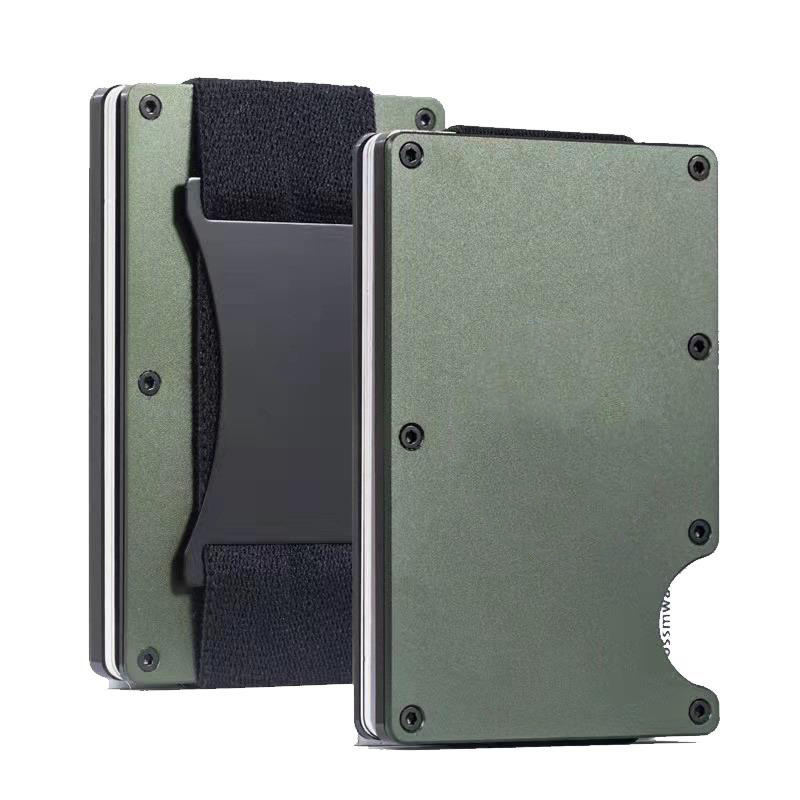
Hardware: Screws and fasteners should be 304 stainless steel or titanium. For RFID-blocking metal wallets, the screws also secure the shielding layer. A 304-grade fastener resists corrosion from sweat and daily handling, preventing the stripped-thread failures common with zinc-alloy alternatives.
RFID Blocking: The practical standard for blocking is 10 MHz to 3 GHz, covering RFID frequencies used in credit cards (13.56 MHz), passports, and some access cards. Shielding is achieved through a continuous conductive layer — either a metal housing or an internal RFID-blocking plate. The shielding material's thickness and coverage area determine effectiveness. A wallet with a cutout for quick card access may compromise shielding in that section, so buyers should verify the test report covers the product's actual configuration.
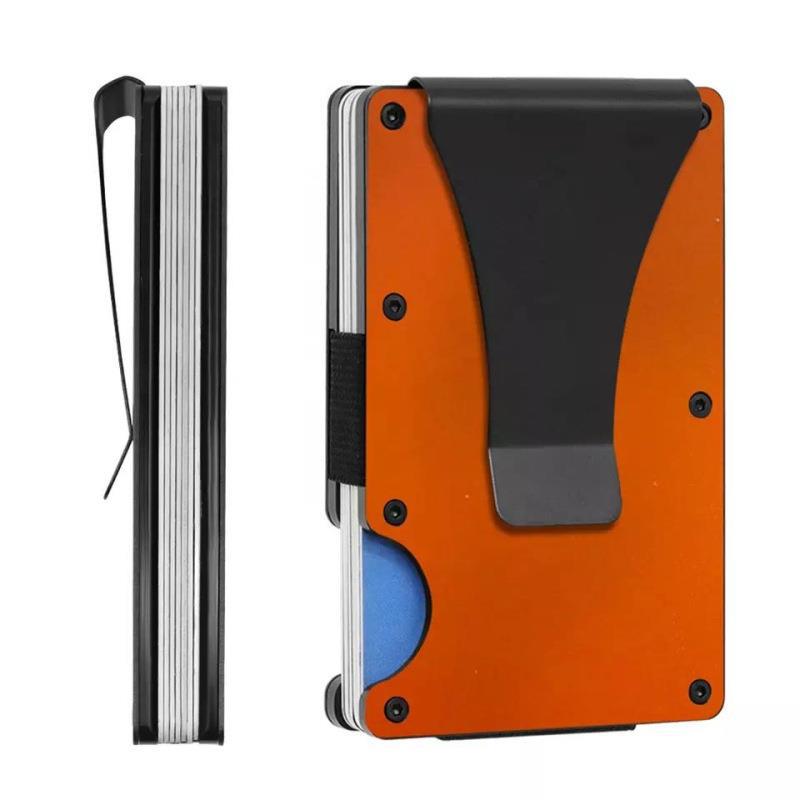
Thickness and Capacity: The "slim" threshold is generally under 10 mm when loaded with 4–6 cards. Beyond that, the wallet loses its minimal positioning. Card retention mechanisms fall into two camps:
| Feature | Elastic Band Design | Mechanical Locking (Pop-Up) |
|---|---|---|
| Thickness when empty | 6–8 mm | 8–10 mm |
| Card access speed | Moderate (pull from side) | Fast (button/slide release) |
| Moving parts | Minimal | 5–10 components |
| Failure risk | Band stretching over time | Spring fatigue, track wear |
| Manufacturing complexity | Low | High |
| Typical price point | Lower | Higher |
Quick Card Access: Mechanical pop-up mechanisms require precise spring tension — typically 0.5–1.5 N of force for reliable ejection without accidental deployment. The track tolerance must be tight enough to prevent wobble but loose enough for smooth sliding. Over time, aluminum-on-aluminum contact can generate wear debris; quality manufacturers apply a dry-film lubricant to the track during assembly.
The best minimal wallets are not just slim — they are engineered to stay with their owner. This involves weight distribution, surface texture, and modular features that make the wallet locatable.
A wallet under 50 grams creates less "pocket amnesia" — the phenomenon where a heavier object shifts position and is forgotten. Weight distribution matters: a wallet with a thick money clip on one side and thin card storage on the other will torque in a pocket. Balanced designs keep the center of gravity near the geometric center.
Surface texture is a functional feature, not just an aesthetic one. A bead-blasted or fine-brushed finish increases friction against pocket fabric, reducing slippage. Sharp corners snag on seams and cause the wallet to work its way out during movement. A radius of at least 0.5 mm on all corners significantly reduces this risk, though it complicates CNC machining slightly.
The integration of key organizers or modular attachments changes the product category. A wallet with an integrated key ring or an AirTag slot addresses the "never lose it" concern directly. However, modularity increases manufacturing complexity. Press-fit components require tight tolerance control to avoid loosening over time; screw-fit assembly adds labor cost but improves serviceability. For a brand deciding between a simple cardholder and a modular system, the modular option demands a supplier with more mature assembly and QC processes.
The supplier evaluation process should start with technical capability audits, not price negotiations. A supplier's ability to meet specification targets across a production run is the single most reliable predictor of product success.
What is your material certification process? A reliable supplier provides mill certificates for aluminum or leather sourcing documentation. Verify these are current and traceable to the batch used in your production run.
How do you control anodizing color consistency across batches? Anodizing is a batch process; slight variations occur naturally. A supplier with in-house anodizing lines can control this better than one that outsources finishing. Ask for their acceptable Delta E color tolerance.
What is your RFID blocking test protocol? The supplier should test finished units, not just the raw shielding material. Ask for test reports from a third-party lab (e.g., SGS, TÜV) rather than in-house testing alone.
What is your defect rate target and how is it measured? A realistic target for precision-machined metal wallets is under 2% final inspection failure. Ask about their incoming material inspection and in-process QC checkpoints.
Can you provide production samples from the actual line, not just pre-production samples? This distinguishes a pilot run from mass production, where tooling wear and operator fatigue affect quality.
Cannot specify their aluminum alloy and temper. If they say "aluminum" without details, they likely use the cheapest available stock.
Quote suspiciously low prices for CNC-machined products. CNC machining time is the dominant cost driver. A quote far below market rates indicates either cast construction (passed off as machined) or substandard finishing.
Resist third-party inspections. A supplier confident in their QC welcomes pre-shipment inspection by an independent agency.
Have no written quality manual. ISO 9001 certification is a baseline, not a differentiator. The absence of any formal quality system is disqualifying.
Choose an ODM model if you are entering the market quickly with limited design resources. You select from existing proven designs, apply your branding, and launch with lower MOQs and faster timelines.
Choose an OEM model if you have proprietary design IP or a specific product vision that requires custom tooling, unique materials, or novel mechanisms. This path requires a supplier with R&D engineering capability and a willingness to iterate on prototypes.
Testing standards for minimal wallets are not as codified as those for electronics, but several relevant benchmarks apply:
RFID Blocking: Tested per ISO 10373-1 (test methods for contactless integrated circuit cards). Shielding effectiveness is measured in decibels (dB) across the target frequency range. A reduction of 30 dB or more is generally considered effective blocking.
Surface Finish: Anodizing quality per ASTM B244 (measuring coating thickness) and ASTM B117 (salt spray testing for corrosion resistance).
Leather Durability: Flex resistance per ISO 5402 (flexing test) and tear strength per ISO 3377-1.
Drop Testing: While not standardized to a single protocol, most reputable manufacturers perform internal drop tests from 1.5 meters onto hard surfaces, verifying that card retention mechanisms do not fail and that the wallet does not separate into components.
Fastener Torque: Screws should withstand specified torque without stripping. For M2 stainless steel screws, a typical spec is 0.3–0.5 N·m.
The total cost of ownership for minimal wallets extends beyond the unit price. Understanding the cost structure helps buyers negotiate intelligently.
The unit price of a CNC-machined aluminum wallet comprises roughly: 25–35% raw material, 30–40% machining time, 15–20% surface finishing, and 10–15% assembly and packaging. Labor costs are comparatively low in automated CNC processes, but tooling costs for custom designs — typically $3,000–$10,000 for molds or custom fixtures — amortize across the production run.
Cheapest is not always most profitable. A wallet sourced at $2.00 less per unit loses that advantage if the defect rate runs 5% higher, resulting in customer returns and chargebacks. Factor the cost of quality into the unit price comparison.
Aluminum wallets are lightweight — a typical unit weighs 30–50 grams. Air freight for 1,000 units adds roughly $0.50–$1.00 per unit depending on route and fuel prices. Leather wallets are slightly heavier but still far below the volumetric weight thresholds that make sea freight necessary.
Understanding Incoterms affects cash flow:
EXW (Ex Works): The buyer arranges all transportation. Lowest quoted price but maximum logistical responsibility.
FOB (Free on Board): The supplier delivers to the named port. The buyer assumes cost and risk once the goods are on the vessel.
DDP (Delivered Duty Paid): The supplier handles all logistics and import duties. Highest quoted price but minimal buyer involvement.
For first-time importers, FOB is a standard middle ground. For established brands with logistics partners, EXW may offer more control. DDP suits smaller orders where the buyer lacks import experience.
The criteria above are not theoretical. As a manufacturer of RFID-blocking cardholders and minimal wallets, we have built our production system around meeting these benchmarks consistently.
Our Shenzhen facility operates in-house CNC machining lines, which gives us direct control over the tolerances discussed in Section 2. We do not outsource critical machining steps, so the ±0.05 mm track precision that makes a pop-up mechanism reliable is held across the entire production run — not just on prototype samples. The anodizing color consistency question we recommend buyers ask? We handle finishing in-house as well, maintaining Delta E tolerances within commercially acceptable ranges.
For RFID blocking, we test finished units across the 10 MHz to 3 GHz spectrum, not just the raw shielding material. This catches assembly-level issues — a misaligned shielding plate or a fastener that breaks the conductive continuity — before the product ships.
Our 13 years in this industry and monthly capacity of 300,000+ units mean that when a brand's sales forecast jumps from 2,000 to 20,000 units, the supply chain does not buckle. We have lived through the scenario where a design performs well in testing but fails in mass production due to tooling wear. Our QC system includes in-process checkpoints and pre-shipment inspection protocols that catch these issues before they become your returns problem.
For brands at different stages, we offer flexible MOQ structures. Testing a new SKU with 500 units on a stock/ODM model is feasible. Scaling to a fully custom OEM design with your proprietary mechanism is equally supported — our engineering team reviews designs for manufacturability before tooling begins, which saves both time and money compared to discovering issues mid-production.
Are minimalist wallets worth it for consumers?
For the target demographic that prioritizes pocket comfort and quick access, yes. For B2B buyers, they represent a high-margin category — lower material usage than traditional wallets, but high perceived value that supports premium pricing.
What are the best budget wallet brands?
Rather than brand names, look at the supply chain. Many "budget" brands source from ODM factories where unbranded models compete with premium brands at a fraction of the cost. The difference is often branding and packaging — not the underlying product quality.
Can I customize the RFID blocking feature?
Yes. Shielding material layering can be adjusted to meet specific retail requirements. For example, if your target market requires blocking at 13.56 MHz (the frequency used by contactless payment cards), the shielding can be tuned accordingly and verified through third-party testing.
What is the typical MOQ for a custom metal wallet?
It depends on complexity. Stock and ODM models can start from a few hundred units. Fully custom OEM designs requiring new tooling typically require higher MOQs to amortize the upfront investment.
How do I ensure custom engraving doesn't fade?
Laser engraving on anodized aluminum is permanent — the laser removes the anodized layer to reveal the base metal, creating a contrast that cannot wear off. This is the recommended method for long-lasting branding on metal surfaces.
The best minimal wallets for your brand are not the ones with the most five-star reviews on consumer sites. They are the ones whose manufacturing process you have verified — where the alloy is certified, the RFID blocking is tested on finished units, the QC checkpoints are defined, and the supplier can prove they hold tolerances at scale.
The trade-off to accept: a supplier with in-house machining and finishing capabilities will rarely quote the absolute lowest price in the market. They will quote a price that reflects controlled quality. For brands that have experienced the cost of returns, chargebacks, and damaged reputation from a failed product launch, that difference is worth the premium.
If you are evaluating suppliers for a line of minimal wallets, the conversation should start with specifications, not price. Contact Our Team with your target materials, capacity range, and branding requirements — we will respond with a technical assessment and a quotation within 24 hours.
ASTM International. (2023). B244-09(2021) Standard Test Method for Measurement of Thickness of Anodic Coatings on Aluminum. https://www.astm.org/b0244-09r21.html
ASTM International. (2019). B117-19 Standard Practice for Operating Salt Spray (Fog) Apparatus. https://www.astm.org/b0117-19.html
ISO. (2016). ISO 10373-1:2020 Cards and security devices for personal identification — Test methods — Part 1: General characteristics. https://www.iso.org/standard/73696.html
ISO. (2019). ISO 5402-1:2017 Leather — Determination of flex resistance — Part 1: Flexometer method. https://www.iso.org/standard/66279.html
ISO. (2022). ISO 3377-1:2011 Leather — Physical and mechanical tests — Determination of tear load — Part 1: Single edge tear. https://www.iso.org/standard/51273.html
MIL-DTL-8625F. (2017). Anodic Coatings for Aluminum and Aluminum Alloys. United States Department of Defense. http://everyspec.com/MIL-SPECS/MIL-SPECS-MIL-DTL/MIL-DTL-8625F_39500/


