

Views: 402 Author: Professor Leon Publish Time: 08-31-2026 Origin: Site


Content Menu
● 1. What Is a Secrid Card Protector OEM Manufacturer?
● 2. The Mechanism: Why Precision Tolerances Matter
● 3. Materials and Manufacturing: What Buyers Should Specify
● 4. The Manufacturing Process: CNC Machining vs. Die-Casting
● 5. How to Evaluate a Card Protector Factory: The Procurement Framework
● 6. OEM vs. ODM vs. Private Label: Which Model Fits Your Business?
● 7. Pricing Structure: What You Are Actually Paying For
● 8. How We Meet These Standards at GSTAR
● 9. Frequently Asked Questions
● 10. Decision Guide: Which Manufacturing Partner Should You Choose?
11 min read
The first container order is where most card protector projects go to die. A buyer approves a perfect sample, the factory promises a 20-day lead time, and then the shipment arrives with anodizing that scratches off in a week and springs that lose tension after 200 pushes. The sample was great. The mass production was not.
This guide covers what procurement teams need to know before signing a contract with a Secrid card protector OEM manufacturer — the mechanism itself, material specifications, factory evaluation criteria, and the costs that actually matter.
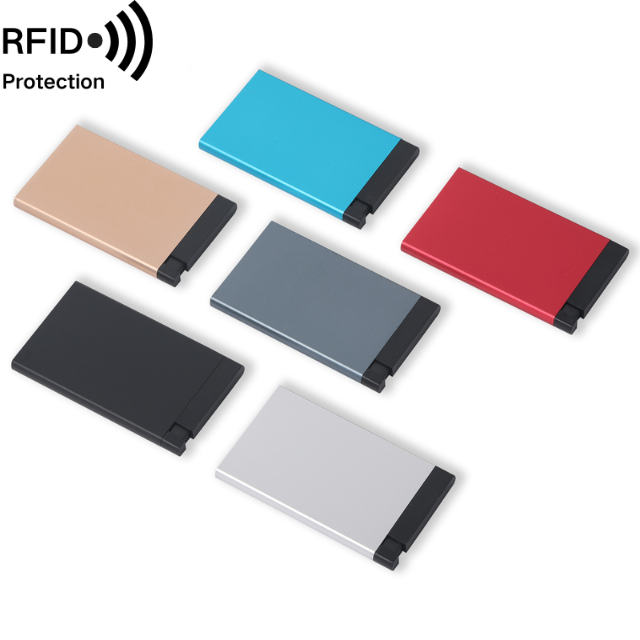
A Secrid card protector OEM manufacturer is a factory that produces aluminum card holders with a spring-loaded slider mechanism — the same product category popularized by the Dutch Secrid brand — under another company's brand name. These factories handle CNC machining, surface finishing, assembly, and packaging according to buyer specifications.
The term "Secrid" is a registered trademark. No legitimate factory will produce units with the Secrid logo without a licensing agreement. What OEM manufacturers actually produce are Secrid-style or Secrid-compatible card protectors: generically designed units that replicate the form factor and function without infringing on patented elements.
The card protector mechanism is deceptively simple. A metal housing holds 4–6 cards. A push-down lever compresses a spring, which forces an inner plastic slider forward, fanning the cards outward. Release the lever, and the cards retract.
The critical component is the slider track. The aluminum housing must guide the plastic slider with tolerances of ±0.05mm. Too loose, and the slider wobbles — cards catch on the edges and jam. Too tight, and the friction increases, wearing down the spring faster and making the action feel stiff.
Most buyers focus on the housing finish. The spring is what fails first in cheap units. A standard card protector uses a stainless steel compression spring rated for 50,000–100,000 cycles. Cheaper factories use zinc-plated carbon steel, which corrodes and loses temper within months.
Ask your supplier for the spring's cycle rating. A factory that cannot answer this question has not tested their product properly.
The RFID blocking function comes from the aluminum housing itself. Aluminum attenuates electromagnetic signals across both common frequency ranges:
125kHz — Low frequency (access cards, animal tags)
13.56MHz — High frequency (contactless payment, NFC)
The housing blocks these signals through the Faraday cage effect. However, the card opening slot is a vulnerability. Cards exposed through the opening can still be read. For complete blocking, some manufacturers add an RFID-shielding film or use a fully enclosed design.
Testing standard: A properly shielded card protector should show at least 20–30 dB of attenuation at 13.56MHz. Request test data before committing to production.
Most card protectors use 6061 or 7075 aluminum alloy.
6061 aluminum: Good corrosion resistance, easier to anodize, more affordable. Suitable for most applications.
7075 aluminum: Higher strength, better scratch resistance, but harder to machine and more expensive. Used for premium products.
The surface treatment matters more than the alloy grade. Anodizing creates a hard, corrosion-resistant oxide layer that accepts dye. Type II anodizing is standard for colored finishes. Type III (hard anodizing) is thicker and more wear-resistant but limits color options.
Powder coating is cheaper but adds thickness, which can interfere with the slider tolerance. Most reputable manufacturers recommend anodizing for the housing and powder coating only for the outer sleeve or wrap.
The inner slider uses either ABS or polycarbonate.
ABS: Cheaper, easier to mold, but less impact-resistant.
Polycarbonate: Stronger, better UV resistance, but requires higher molding temperatures and costs more.
The slider's role in the mechanism means dimensional stability matters. Polycarbonate is the safer choice for products sold in hot climates — ABS can warp at temperatures above 80°C (176°F), which is achievable in a parked car on a summer day.
Many card protectors ship with a leather or PU leather sleeve. Full-grain leather costs 3–5x more than PU leather but justifies a premium price point. The stitching pattern and edge finishing are what differentiate a $5 product from a $30 product.
One honest caveat: PU leather is not always the wrong choice. If your target price point is under $15 retail, PU leather is the only option that keeps margins viable. The key is matching material to market positioning.
CNC machining cuts the aluminum housing from solid bar stock. This process offers:
Flexibility: Easy to modify designs between batches
Tighter tolerances: ±0.02mm achievable
Higher unit cost: More material waste, longer cycle time
CNC is the right choice for orders under 5,000 units or products with complex geometries.
Die-casting injects molten aluminum into a steel mold. This process offers:
Lower unit cost at scale: Economical above 5,000 units
Faster cycle times: Minutes per part vs. hours
Higher tooling cost: $5,000–$15,000 for a new mold
Looser tolerances: ±0.1mm typical, requiring secondary machining
Most card protector production above 10,000 units uses die-casting for the housing shell, followed by CNC machining for the slider track — a hybrid approach that balances cost and precision.
After machining, the housing goes through:
Deburring — removing sharp edges
Polishing or sandblasting — achieving the desired texture
Anodizing — coloring and hardening the surface
Laser engraving — applying logos and branding
Laser engraving is the preferred method for aluminum branding because it is permanent and does not peel. Pad printing wears off within months of pocket use.
A factory's stated capacity means little without context. Ask for:
Current machine count — how many CNC machines are operational
Current utilization rate — how much of that capacity is committed
Historical lead times — not promised, but actual average lead times for similar products
A realistic lead time for a 5,000-unit card protector order is 25–40 days after sample approval. Factories quoting 7-day production for 10,000 units are either lying or cutting QC steps.
Minimum certifications for a card protector manufacturer:
ISO 9001 — Quality management system
REACH compliance — EU chemical safety (mandatory for European exports)
RoHS compliance — Restriction of hazardous substances
Social compliance audits (BSCI, Sedex) are not mandatory but indicate a factory that takes its obligations seriously. If you are selling to European retail chains, BSCI certification is often a prerequisite for being listed as a supplier.
Design for Manufacturing (DFM) feedback is the single best indicator of a factory's engineering competence. A factory that provides DFM feedback on your CAD files before quoting is worth more than one that simply says "yes, we can make it."
DFM feedback identifies:
Features that are difficult to machine (sharp internal corners, thin walls)
Tolerance requirements that are unnecessarily tight (adding cost without benefit)
Material suggestions that reduce cost without affecting quality
Guarantee everything — no factory can guarantee zero defects. A realistic factory quotes 95–98% yield on first pass.
Refuse sampling before mass production — this is non-negotiable.
Cannot name their material suppliers — if they do not know where their aluminum comes from, neither do you.
Quote tooling costs that seem too low — quality molds are expensive. A $1,000 mold for an aluminum housing will produce poor parts.
OEM is appropriate when you have a patent, a unique design, or specific technical requirements that differentiate your product. You supply the CAD files, and the factory produces to your specifications.
Requires: NDA signed before sharing files, tooling investment, longer development time
Best for: Brands with proprietary designs and established distribution
ODM means the factory uses their existing card protector design and applies your logo, colors, and packaging. This is the fastest route to market.
Requires: Logo artwork, packaging design, minimum order quantity
Best for: New brands entering the market, Amazon sellers, testing a product category
Private label is a subset of ODM where the product is essentially generic. You select from the factory's catalog, add your branding, and sell.
Requires: A brand name and a sales channel
Best for: Wholesalers, supermarket chains, promotional product distributors
Choose ODM if you need to launch within 60 days. Choose OEM if you have a design that genuinely differentiates your product.
| Component | Cost Range (USD) | % of Unit Price |
|---|---|---|
| Aluminum housing (CNC + anodizing) | $0.80–$1.50 | 30–40% |
| Plastic slider (injection molding) | $0.20–$0.40 | 8–12% |
| Spring and rivets | $0.10–$0.20 | 3–5% |
| Assembly labor | $0.15–$0.30 | 5–8% |
| Packaging | $0.20–$0.50 | 8–15% |
| Factory overhead + margin | $0.50–$1.00 | 20–30% |
Total unit cost typically ranges $2.50–$5.00 FOB for CNC-machined units at 5,000+ quantities. Die-cast units at 20,000+ quantities can reach $1.80–$2.50 per unit.
Non-Recurring Engineering costs cover molds, fixtures, and program setup. Expect:
Injection mold for plastic slider: $2,000–$5,000
Die-cast mold for aluminum housing: $5,000–$15,000
CNC fixture setup: $500–$2,000
Tooling is usually amortized over the first production run. Negotiate whether the tooling belongs to you after payment — most factories will agree to this, but it must be in the contract.
EXW (Ex Works): You handle all logistics. Cheapest unit price, most work.
FOB (Free on Board): Factory delivers to the port. Most common for sea freight.
DDP (Delivered Duty Paid): Factory handles everything including customs. Easier for Amazon FBA.
Sea freight from China to the US West Coast takes 18–25 days. To Europe, 25–35 days. Air freight takes 5–7 days but costs 5–10x more per unit.
Now that you understand what the industry requires, here is how our factory, Gstar Technology (Shenzhen) Co., Ltd., approaches these challenges.
Our core capability is in-house CNC machining. We do not outsource the slider track cutting — we control it directly. That matters because the ±0.05mm tolerance on the slider mechanism is where most quality failures originate. With 13+ years of RFID wallet manufacturing experience, we have refined our processes to maintain consistent spring tension and slider alignment across production runs.
Our monthly production capacity of 300,000+ units means we handle bulk orders for wholesalers, supermarket chains, and top online sellers without stretching lead times. We offer both OEM and ODM services: you can bring your own CAD files, or we can show you our existing card protector designs and customize colors, logos, and packaging.
Quality control is multi-stage — incoming material inspection, in-process dimensional checks, spring tension testing on assembled units, and final visual inspection before packing. We provide pre-production samples for approval before mass production, and we hold the gold sample for comparison during final QC.
For buyers entering the market, our ODM route offers flexible MOQs starting around 500–1,000 units, allowing you to test demand without overcommitting inventory. For established brands, our OEM capability supports full customization including material selection, surface treatment, and custom packaging design.
We provide quotes within 24 hours and work to strict deadlines. If you have a project in mind, Contact Our Team with your specifications, and we will give you a clear picture of what is achievable.
Amazon sellers offering low prices on "Secrid-style" card protectors are typically buying generic units from OEM/ODM manufacturers in China — not the original Dutch Secrid product. The original Secrid carries a premium for Dutch design and European manufacturing. Generic units, produced without the brand licensing cost, sell at a fraction of the price. This is a legitimate market segment, provided the product does not infringe on Secrid's patents or use its trademark.
The Secrid brand offers a 2-year warranty on their products, not lifetime. When you work with an OEM manufacturer, warranty terms are contractual. A reasonable expectation is a 6–12 month warranty against manufacturing defects, with terms negotiated based on the product and order volume. Ask your supplier what their defect rate is — a factory with a 1% defect rate can afford a longer warranty than one with 5%.
Yes, the original Secrid uses aluminum housing to block RFID signals. In OEM production, you must specify which frequency ranges you need to block — 125kHz, 13.56MHz, or both. The material and design determine effectiveness. Request attenuation test data from your manufacturer to verify the shielding actually works.
Cards fall out only if the spring tension is inadequate or the slider tolerance is off. In well-manufactured units, the mechanism holds cards firmly until the lever is pressed. If you receive units where cards slide out, it indicates a QC failure in spring tension testing. A reputable manufacturer tests each unit's spring action before packing.
MOQs vary significantly by factory and production method. For ODM orders (existing design, custom logo), expect 500–1,000 units. For OEM orders (new design requiring tooling), MOQs typically start at 3,000–5,000 units to justify tooling amortization. CNC-machined orders can sometimes accept lower MOQs because no mold investment is required.
Production typically takes 15–30 days after sample approval, depending on order volume. Sea freight adds 18–35 days to the US or EU. Air freight takes 5–7 days but costs significantly more. Total timeline from order confirmation to delivery is usually 45–70 days for sea freight — plan your inventory accordingly.
Choose a CNC-focused factory if:
Your order is under 5,000 units
You need tight tolerances on a custom design
You want the flexibility to iterate on design between batches
Your product is positioned as premium
Choose a die-casting factory if:
Your order exceeds 10,000 units
You have a proven design that will not change
Unit cost is your primary driver
You are selling at a competitive price point
Choose an ODM relationship if:
You are entering the market for the first time
You need to launch within 60 days
You want to test demand before investing in custom tooling
Choose an OEM relationship if:
You have a patented or novel design
You need specific material or performance characteristics
You are building a defensible brand position
Secrid — Dutch wallet makers since 1995. https://www.secrid.com/
ISO 9001:2015 Quality Management Systems. https://www.iso.org/standard/62085.html
REACH Regulation (EC) No 1907/2006. https://echa.europa.eu/regulations/reach/understanding-reach
RoHS Directive 2011/65/EU. https://environment.ec.europa.eu/topics/waste-and-recycling/rohs-directive_en
RFID Blocking Materials and Testing Standards. https://www.rfidjournal.com/
Ready to source card protectors for your brand? <a href="<a href=" https:="" www.gstartec.com="" contactus.html"="" target="_blank" rel="noopener noreferrer">https://www.gstartec.com/contactus.html" style="display:inline-block;padding:12px 24px;background:#2563eb;color:#fff;text-decoration:none;border-radius:6px;font-weight:600">Get a Free Quote


